


Dynamic Pricing with Uncertain Capacities
Abstract
In markets, such as those for airline tickets and hotel accommodations, firms sell time-dated products and have private information about unsold capacities. We show that competition under private information may explain observed phenomena, such as increased price dispersion and higher expected prices toward the deadline. We also show that private information severely limits the market power of firms and that information exchange about capacity increases firms’ profits. Finally, we inquire into the incentives to unilaterally disclose information or to engage in espionage about rival’s capacity and show that they increase firms’ profits compared with the private information setting.
This paper was accepted by Omar Besbes, revenue management and market analytics.
Funding: This work was partially funded by the Austrian Science Foundation FWF under [Project FG 6].
Supplemental Material: The online appendix is available at https://doi.org/10.1287/mnsc.2022.4613.
1. Introduction
In markets such as those for hotel accommodations, airline flights, shipping, generated electricity, or any other time-dated product, firms sell a fixed capacity with a deadline. A large amount of literature in management and economics has devoted attention to this issue, focusing mostly on a monopolistic seller who sets prices to serve consumers who arrive gradually over time.1 Starting with Dudey (1992), there is also a smaller amount of literature dealing with competition (see Martínez-de Albéniz and Talluri (2011)). Although it is often the case that firms are uncertain about their competitors’ unsold capacity, this literature assumes that capacity is commonly known. We close this gap by providing the first equilibrium analysis of dynamic competitive pricing of time-dated products where information about unsold capacity is private.2
To focus the analysis on the strategic implications of private information about capacities, we start with a stylized model where two firms compete in two periods and demand is known and constant in both periods. A firm can be either constrained or unconstrained. A constrained firm’s capacity is just enough to serve the demand in one period, whereas an unconstrained firm can serve consumers in both periods. The model is simplified version of the model proposed by Dudey (1992) with the main difference that the firms have private information about their capacity at the beginning of the game. Firms set prices in both periods, and consumers buy from the lowest-priced firm in the period in which they arrive.3 We show that the market equilibrium in the second period critically depends on the belief that the firm that did not sell in the first period has about the capacity of its rival. This belief depends on the structure of the market equilibrium in the first period. If the equilibrium would display price signaling, firms charge different first-period prices depending on their capacity, allowing their rivals to infer their private information from the prices they charge. On the other hand, if firms would set their price independent of whether they are constrained or unconstrained, then the equilibrium is pooling, and no inference can be made.
The contribution of our paper is twofold. From a positive perspective, we provide a new supply-side explanation that can reconcile several empirical observations. First, prices tend to increase and become more dispersed as the deadline approaches (McAfee and Te Velde 2006, Clark and Vincent 2012).4 Second, there is no clear, monotonic relation between price dispersion and whether demand is peak or off-peak (Puller et al. 2009). This second observation is hard to reconcile with other supply-side explanations (Dana 1999 and related literature). Our simple model of a market in which firms are uncertain about their rivals’ capacity suffices to explain these patterns without introducing heterogeneous behavior on the demand side.5 Our explanation emphasizes that firms want to limit information revelation in periods long before the deadline to generate more profits in periods closer to the deadline.
From a normative perspective, we show that firms’ profit margins are significantly lower (and consumer surplus significantly higher) if they are uncertain about their rivals’ capacities. Conversely, we show that if firms manage to exchange information, they can increase their profits—at the expense of consumers. This finding may help explain the recent adoption of information sharing protocols, such as the online publication of real-time seat maps.
We now explain these results in more detail. Given some market outcome in the first period, both firms know which firm sold one unit and at which price. This information enables the nonselling firm to form a posterior belief about the residual capacity of the selling firm and therefore estimate the probability that it will face competition in the second period. Following the analysis in Janssen and Rasmusen (2002), price dispersion is an essential feature in the second period as the nonselling firm is uncertain about whether the competitor can actively compete. The expected equilibrium prices and profits are determined by this uncertainty, as it is the only source of market power.
Turning to the first period, we characterize the unique pooling equilibrium where both firms charge the same price. This price equals the opportunity cost of selling in the first period for a constrained firm, given its prior belief about its rival type. In addition, there exists a continuum of semiseparating equilibria where constrained and unconstrained firms randomize their pricing decisions in both periods. In all these semiseparating equilibria, first-period prices reveal some information about the rival’s capacity but are not fully informative. Firms make more profits in the first period than in the unique pooling equilibrium, but their second-period profits are lower, driven by a lower average posterior belief. It turns out that the effect on second-period profits dominates so that the pooling equilibrium Pareto-dominates these semiseparating equilibria; that is, firms suffer from revealing information through first-period pricing. In some of these semiseparating equilibria, the effect of information revelation is so strong that the expected prices in the second period are lower than first-period prices.6 Still, in all equilibria, there is less price dispersion in periods further away from the deadline as firms try to hide their private information. Similarly, price dispersion is highest in markets with most uncertainty and lowest when firms are relatively certain that capacity is either too high (off-peak demand) or too low (peak demand). Most importantly, the pooling equilibrium yields considerably lower profits than what Dudey (1992) predicts in his model where firms’ capacities are public information.
We extend this basic framework to accommodate several features of real-world markets. First, we show that all our results are unchanged if consumers are patient and strategically choose to wait for prices to fall. Second, our results also survive with minor modifications if consumers’ valuation increases as we approach the deadline or if their arrival process is stochastic. Third, we show that the pooling equilibrium we identify in the baseline model survives if we extend the number of periods in which trade occurs. Finally, we consider an extension of the model whereby some consumers have a (strong) preference for each of the firms and show that the mixed (semiseparating) equilibria we identified in the baseline model extend nicely to this setting. These results make clear that the basic mechanisms identified in the baseline model are robust to several natural extensions.
In real-world markets, firms may voluntarily disclose information regarding their unsold capacities or, alternatively, gather information about rival’s capacities and one may wonder whether private information regarding capacities will remain if firms can engage in such activities. Airlines frequently announce (disclose) how many seats they have left at the current price they offer. Alternatively, firms may learn the unsold capacity of their rivals through industrial espionage, for example, by scraping online data sources.7 Industrial espionage is in many ways the reverse of voluntary disclosure as the firm that takes the initiative and bears the cost gets informed about the rival’s capacity. An important difference is that unlike the public nature of disclosure, espionage cannot be observed so that it is the expectation of industrial espionage that drives competitors’ behavior rather than the act itself. We show that for any positive disclosure or spying cost, no matter how small, private information remains an important element in understanding markets with time-dated products. Not surprisingly, if the cost of disclosing or engaging in espionage is sufficiently large, no firm wants to engage in voluntary disclosure or in industrial espionage. More interestingly, if this cost is smaller, only one firm decides to disclose or acquire information, and it is the firm whose information is not revealed that benefits most. Moreover, ex ante market power of firms is higher than when firms have to act not knowing the private information of their rivals and even higher than when both firms exchange information!8 One interesting aspect of the results on espionage is that even if both firms know their rival still has unsold capacity in the last period, they do not engage in marginal cost pricing as firms may (second-order) believe that their competitor believes that they are sold out.9
1.1. Related Literature
As indicated at the start of the paper, to the best of our knowledge, there does not exist a paper providing an equilibrium analysis of dynamic pricing of time-dated products where capacities are private information. Of course, there is a large literature in revenue management studying different aspects of dynamic pricing problems. Restricting ourselves to the literature introducing competition between firms, the seminal paper by Dudey (1992) has been extended in various directions. Dasci and Karakul (2009) consider two customer segments with different reservation values. Uncertainty about the size of demand has been addressed by Martínez-de Albéniz and Talluri (2011). Gallego and Hu (2014) analyze firms producing a mix of substitutable and complementary goods, whereas Xu and Hopp (2006) study inventory choices prior to competition. Strategic consumers are considered in Levin et al. (2009) and Anton et al. (2014), whereas some of these papers also introduce more than two firms competing with each other. To focus on the implications of private information about capacities, our baseline model abstracts away from all these factors, without implying that these factors are unimportant in real-world markets. In Section 4.3, we show how our results are robust to reintroducing quite a few of these factors.
Two recent papers (Montez and Schutz 2021, Somogyi et al. 2022) study the implications of private information about capacities in a static pricing environment. Somogyi et al. (2022) find that capacity-constrained firms price less aggressively than unconstrained firms as they prefer to focus on any leftover demand in case their rival is also capacity constrained. Although we find that a similar consideration is relevant in some of our equilibria, the dynamic game allows for much richer equilibrium patterns, allowing us to explain the stylized facts and to derive welfare conclusion about information sharing. Montez and Schutz (2021) consider a model of price competition where the precommitted capacities are unobserved. They show that the fact that capacity choices are typically not known to competitors drastically affects the prediction that Cournot type of behavior should be expected in markets where firms produce in advance. Our model does not allow for endogenous capacity choice, yet has dynamic pricing instead, and shares the message that not knowing capacity choices of rivals negatively affects firms’ market power.10
The paper is also clearly related to the extensive literature on disclosure (Dranove and Jin (2010) for an overview of the quality literature) and the much smaller literature on industrial espionage (Solan and Yariv 2004, Barrachina et al. 2014). These topics, of course, only cover part of our paper, and none of these papers investigate the incentives to disclose or spy on capacities.
The paper is also related to the literature on information exchange (see Gal-Or (1985) and Shapiro (1986) for early contributions) and the competition policy issues related to information exchange (see the horizontal guidelines by the European Union (EU) Commission (2011) or the OECD (2010) report). It is common wisdom that information exchange can have both a positive or negative impact on the competitiveness of the market, depending on the type of information exchanged. We show that in markets for time-dated products information exchange about unsold capacity is unambiguously anticompetitive and that, in particular, with information exchange firms can achieve collusive outcomes even if they choose prices unilaterally.
Finally, there is an interesting relation between our paper and the literature on sequential auctions with budget constraints (Pitchik 2009, Balseiro et al. 2015). An alternative way to interpret our model is that two players compete in two sequential auctions for two objects with a common value and that they have a privately known budget which is either equal to the value of one object or the value of two objects. The sequential auction literature differs in that it is important how much budget a bidder has left to compete in a later auction and not only whether a bidder can compete. This difference allows us to fully characterize the set of equilibria and derive their properties.
The rest of the paper is organized as follows. The next section presents the baseline model with private information, whereas Section 4 presents the results of the baseline model and the extensions. In between, Section 3 briefly analyzes the complete information model as a benchmark. Section 5 develops the arguments pertaining to disclosure, whereas Section 6 deals with espionage. Section 7 concludes. Proofs that are essential for a proper understanding of the results are given in the main body of the paper; other proofs are relegated to Appendix A. Detailed discussions on equilibria under espionage are in Appendix B, whereas some additional material can be found in an online appendix.
2. Basic Model and Solution Concept
The baseline model builds on the work of Dudey (1992). We consider a homogeneous goods market where two firms compete in prices over time. The demand side is composed of myopic consumers with unit demand, and we normalize their willingness to pay to one. Consumers enter the market in the first or the second period, observe the prices charged in the market at that time, and buy at the lowest price if that is below their willingness to pay. Otherwise, the consumer leaves the market and does not come back. In case the observed prices are the same, all consumers buy from one of the firms (with each selling with equal probability).11 For ease of notation, we normalize the market size in each period to one.
Each firm has an initial capacity which is private information. To make things interesting, a firm is either constrained if it can only sell to one consumer or unconstrained if it can cover the demand in both periods. Firms’ production cost is normalized to zero. The prior probability a firm is constrained is denoted by α and is independent across firms.12
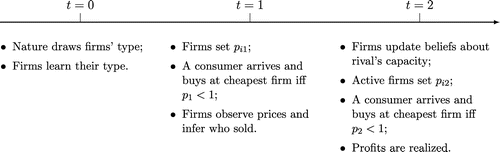
The game unfolds as follows. In period 1, depending on their capacity, each firm i chooses a price , i = 1, 2. The consumer that entered the market in period 1 observes both prices and buys at the lowest price, provided that price is not larger than one. Firms observe both first-period prices13 and know from whom the consumer bought in the first period (if at all). At the beginning of the second period, they update their beliefs about whether the rival firm has unsold capacity left based on the price of the rival firm. All firms with unsold capacity set a price , i = 1, 2 in the second period. The period 2 consumer observes both prices and also buys at the lowest price if that is not larger than 1. Firms choose their prices to maximize the sum of profits in both periods. This timeline is depicted in Figure 1.
We solve the model using perfect Bayesian equilibrium as solution concept (Fudenberg and Tirole 1991).
A perfect Bayesian equilibrium (PBE) of this game is a combination of (possibly mixed) strategies , where and are the first-period prices of firm i in case it is constrained, respectively, unconstrained, and a set of beliefs that the nonselling firm i has about the rival firm being constrained based on the first-period price such that
At the beginning of period 2, the nonselling firm i updates its belief using Bayes’ rule when possible
For every pair of prices , each firm i that still has unsold capacity left in the second period chooses price to maximize second-period profit given the competitor’s second-period strategy and the updated belief
Each firm i chooses a pair of first-period prices () to maximize the sum of expected profits in both periods giving the first-period prices () chosen by the rival and the equilibrium price reactions .14
When appropriate, we also show that the PBE we analyze also satisfies the intuitive criterion.
As discussed in Section 1, we acknowledge that this model abstracts from many features that are important in real-world markets, but we first want to study the strategic implications of private information about capacities in its simplest possible form. Section 4.3 analyzes several extensions of this baseline model.
3. Revisiting the Complete Information Results
Before analyzing the private information game, in this section, we briefly revisit the results for the complete information game. This is essentially the Dudey (1992) model but simplified to two periods and firms either having one or two units to sell. When there is common knowledge that both firms are constrained, they will set monopoly prices when they have unsold capacity left. When there is common knowledge that both firms are unconstrained, they will set prices equal to marginal cost in both periods. Finally, if it is commonly known that one firm is constrained, while the other is unconstrained, we have the following result.
If it is common knowledge that one firm is constrained while the other is not, then there exists a unique subgame perfect equilibrium in undominated strategies where the constrained firm sells at in the first period, and the unconstrained firm sells for in the second period. In addition, there exists a continuum of subgame perfect equilibria in weakly dominated strategies, indexed by , where the constrained firm sells at x in the first period and the unconstrained firm sells at one in the second period.
To understand why there are multiple equilibria, it is best to provide the subgame perfect equilibrium strategies and to recall the result of Blume (2003), who shows that in the Bertrand model of competition with homogeneous goods, there exists an equilibrium where one firm sets the price equal to marginal cost, whereas the other firm randomizes uniformly over a very small interval above this price. With this result in mind, suppose that the constrained firm sets for some , whereas the unconstrained firm uniformly randomizes its first-period price in the interval for some small . The constrained firm makes an equilibrium profit of x, whereas the unconstrained firm makes a profit of one as it can sell at the monopoly price in the second period. If the constrained firm does not sell in the first period, firms engage in marginal cost pricing in the second period.
It is straightforward to verify that there are no profitable deviations. If the constrained firm sets a higher price, there is a large probability that it will not sell in the first period and will face Bertrand competition in the second period. Thus, this deviation results in a profit close to zero. Selling at a lower price in the first period is also not profitable. If the unconstrained firm undercuts the constrained firm in the first period, it will also face Bertrand competition in the second period, making the deviation unprofitable.
The unconstrained firm does not have a strict incentive to set first-period prices smaller than one, however. Moreover, if the constrained firm deviates and set , the unconstrained firm would be better off setting a price larger than p1. Thus, setting a price is a weakly dominated strategy for the unconstrained firm. Therefore, for the benchmark model of complete information, we continue focusing on the Dudey (1992) monopoly outcome as that is the unique equilibrium in undominated strategies. In Section 6, we will refer, however, to the weakly dominated equilibria to explain that equilibria of the espionage game do not converge to the Dudey (1992) monopoly outcome if the cost of espionage approaches zero. For future reference, the ex ante expected profits to the firms under public information is equal to : Firms make a profit of one in all cases except when both are unconstrained.
4. Implications of Information Asymmetry
To understand the importance of private information, it is instructive to understand in more detail how private information about capacity undermines Dudey’s monopoly result. If the Dudey outcome was supported by an equilibrium in the game with uncertainty about capacity, it must be that constrained firms set a price of one in the first period and unconstrained firms set a higher price. Given these first-period prices, in the second period the firms would set prices of one if at least one firm set a price of one in the first period and a price equal to marginal cost if both firms set a larger price. In such a case, the unconstrained firm has incentives to deviate and imitate the constrained firm in the first period. There are two benefits of doing so. First, the unconstrained firm has the chance of being able to sell in the first period at the maximum possible price, increasing its expected first-period profits. Second, this deviation leads the rival to set the monopoly price of one in the second period because it expects to be a monopolist. As a result, the second-period profit of the deviating firm is approximately equal to the monopoly profit. Hence, the unconstrained firm accrues extraordinary rents by imitating the constrained firm. It follows that the Dudey equilibrium requires a level of coordination between constrained and unconstrained firms that is impossible to achieve under private information.
The previous argument extends more generally. In particular, no separating equilibrium with constrained and unconstrained firms setting different prices in the first period exists. Using the fact that if first-period prices reveal the information of the selling firm, then second-period prices are either equal to zero or one; the main argument shows that incentive compatibility cannot hold: Either the unconstrained or the constrained firm wants to imitate the first-period price of the other type. Thus, our first result follows.
A separating equilibrium does not exist.
The proof is given in Appendix A.
We will next construct a pooling equilibrium where both types choose the same first-period price. As a generalization of this equilibrium plays an important role also in the next sections, we discuss its construction in some detail for the more general case where the posterior probability that the rival is constrained given the rival’s first-period price is denoted by .15 We first focus on the second period following such a pooling outcome in the first period and let the cumulative price distributions in the second period be denoted by FS and FN for firm S (who sold in period 1) and firm N (who did not sell in period 1), respectively. In the second period, it is common knowledge that firm N still has a unit to sell, whereas firm S is sold out with probability θ. Thus, as in Janssen and Rasmusen (2002), with probability θ firm N is a monopolist in period 2, whereas it faces a competitor with probability . It is clear from their analysis that a Nash equilibrium in pure strategies does not exist, and the same argument applies to our setting. By setting a price in the second period, firm N has an expected profit of : With probability θ, it is a monopolist and always sells, whereas with the remaining probability the firm only sells if the competitor sets a larger price. As firm N gets an expected profit of θ when setting , it is easy to see that, to make firm N indifferent, the unconstrained firm S must randomize according to
To finalize the construction of a candidate pooling equilibrium, we now argue that it must be that the first-period equilibrium price equals α. It is clear that cannot be smaller than as a constrained firm would want to deviate: By setting a higher price, it does not learn anything and expects a profit of α in the second period. On the other hand, by having , the constrained firm would get an expected payoff of (as it would sell with probability in period 1 and gets an expected profit of α in period 2 if it did not sell in period 1), and would like to undercut . Thus, it must be that .
We now argue that no type of firm wants to deviate from this candidate pooling equilibrium. It is clear that neither type wants to deviate upward as they then forego the possibility to sell in the first period and the previous argument on second-period pricing implies their expected profit in that period equals α as the firm that sells is constrained with probability α.17 In addition, it is clear that the constrained firm does not want to deviate downward. Whether an unconstrained firm wants to deviate downward depends on how one specifies the out-of-equilibrium beliefs. If it sticks to the pooling price, it expects an overall equilibrium profit of . If it undercuts the first-period price by setting and induces an out-of-equilibrium belief , it expects a payoff of . Thus, it is not profitable to deviate if . Such a belief is actually very reasonable. For example, the intuitive criterion implies that as only the unconstrained type can possibly benefit from undercutting.
Thus, we have proved the following.
There exists a unique symmetric18 pooling equilibrium, where both types of firms charge . In the second period firms’ prices satisfy , and for and a mass point of α at one.
The ex ante expected profit in this pooling equilibrium is equal to This expression can be easily understood by looking at a firm who charges in both periods. The ex ante probability of selling is then given by one if the firm is constrained (which happens with probability α), whereas if the firm is unconstrained, it sells with probability 0.5 in period 1 and sells for sure in period 2 (which happens with probability ). This profit is strictly smaller than , which, as we have seen in the previous section, is the profit under complete information. This is an important step in our overall claim that under private information, firms have less market power than under full information.
4.1. Semiseparating Equilibria
We will now argue that, in addition to the pooling equilibrium, there exists a continuum of semiseparating equilibria. In a semiseparating equilibrium, both types of firms charge prices in the same support, albeit they may do so with different probabilities. As a result, firms imperfectly learn from first-period prices as different first-period prices are associated with different posterior beliefs and, consequently, different outcomes in the second period.
Letting Q(p) denote the probability that a firm charging p sells in the first period and noticing that is determined on the equilibrium path by the probability distributions that different types use, the expected profit of a constrained firm is equal to
The expected profit of an unconstrained firm is equal to
This expression can be understood by realizing that the unconstrained firm’s profit includes an additional term reflecting the value of holding an extra unit. If the unconstrained firm does not sell in the first period, its continuation profit is equal to that of a constrained firm that did not sell. If, however, an unconstrained firm sells in the first period, it can still sell in the second period. From the discussion preceding Proposition 3, it follows that the second-period profit in this case equals the posterior belief .
In a semiseparating equilibrium, for all prices in the support, the profit of the constrained, and the unconstrained firm must be constant. This implies that must be equal to a constant, and therefore the posterior belief must be an increasing function of the price (because the probability of selling Q(p) decreases in p). Because the profit of this additional unit must be positive, the unconstrained firm will only charge prices that sell with positive probability in the first period. As a result, the upper bound of the price distribution must have an atom.
Using these insights and the randomization conditions, we are able to characterize the equilibrium strategies. The results are summarized in the following proposition.
For every , there exists a semiseparating equilibrium such that both types of firms randomize their first-period prices in the interval with a mass point at , whereas the second-period prices are in the interval , with , where is the negative branch of the Lambert-W function.19
The constrained type’s equilibrium profit equals α, whereas the unconstrained type’s profit equals . As is decreasing in is also decreasing in , and these equilibria are Pareto-ranked and inferior, from the firms’ perspective, to the pooling equilibrium.
The formal proof for this result can be found in Appendix A.
The result follows from three basic observations. First, no equilibrium exists in which both types of firms choose prices on distinct supports, as (similar to a separating equilibrium) the unconstrained firm would have an incentive to deviate and mimic the constrained type. Second, as discussed in the beginning of this section, lower prices must induce lower posteriors to keep firms indifferent across different first-period prices in the interval . Third, the mass point at the upper bound of the distribution must induce a posterior belief exactly equal to the price. This is because the firm must be indifferent between selling at price and losing the tiebreak to another firm selling at the same price.
Depending on , the semiseparating equilibria can reveal more or less information. The smaller , the less information is revealed, with the pooling equilibrium (which can be regarded as the limit of the semiseparating equilibria for converging to α) revealing no information. Equilibria with higher have a wider range of first-period prices and a more dispersed distribution of second-period beliefs. This higher dispersion is associated with a higher likelihood that the unconstrained firm sells in the first period and therefore a lower average second-period price. That is, information revelation through market outcomes is detrimental for firms’ profits because it necessarily involves a sort of miscoordination: Unconstrained firms are more likely to sell early. In the proof in Appendix A, we show that a greater induces lower ex ante profits, as the impact of a lower expected posterior in the second-period profit outweighs the (stochastic) increase in first-period prices brought about by a higher upper-bound.
We now establish some results that allow us to make comparisons across equilibria. For this reason, let us refer to E1 as the semiseparating equilibrium associated with the upper bound and E2 as the equilibrium associated with the upper bound , with . The following comparisons can be made.
Compared with E1, E2 displays
(1) A more informative first-period price distribution,
(2) A higher probability that the unconstrained firm sells in the first period, and
(3) A lower expected second-period price.
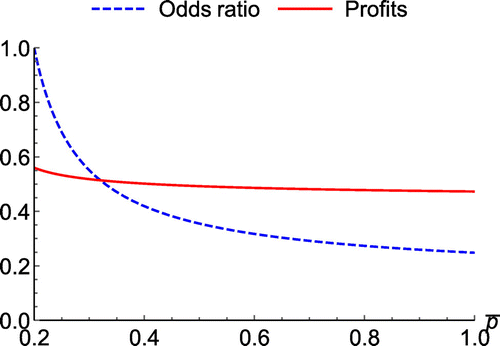
These results are illustrated in Figure 2, where we depict the ex ante expected profit and the odds ratio measuring the likelihood that the constrained firm sells relative to the prior in each equilibrium for . The figure shows that the odds ratio is quickly decreasing in . If , the odds ratio is one as both types are equally likely to sell, but if , it is approximately equal to only 0.33 so that the unconstrained firm is disproportionately much more likely to sell. This results in firms assessing it is much more likely that there is competition in the second period, resulting in lower expected second-period prices and profits. The Figure also shows that as a result, the ex ante expected profit over both periods is decreasing from 0.56 to 0.47 when ranges from to one, amounting to a 16% decrease.
4.2. Empirical and Welfare Implications
Now that we have characterized all equilibria of the game with private information, we discuss the implications. First, from the preceding information, it is clear that Dudey (1992) overstates the market power of firms engaging in dynamic competitive pricing: The pooling equilibrium under private information yields already lower profits, and the semiseparating equilibria result in even lower profits. Thus, the ratio of ex ante equilibrium profits under private information and complete information equals at most . For small values of α, this ratio approaches 75%, shedding light on the incentives for information exchange regarding firms’ capacities: Firms can increase their margins significantly if they exchange information about capacities so that rivals’ capacities are common knowledge. Because total sales are constant across equilibria, the ex ante expected prices are lower, whereas consumer surplus is higher under private information. Second, if we measure equilibrium price dispersion by the range of prices that may be charged along the equilibrium path, price dispersion increases over time. This holds in the pooling equilibrium (since there is no price dispersion in the first period) and in every semiseparating equilibrium. In a semiseparating equilibrium, the range of equilibrium prices in the first period is equal to , and equal to in the second period, where is the posterior belief that the firm that sold in the first period is constrained given that it sold at p1. Because in any semiseparating equilibrium , the result on price dispersion follows if for any . However, as the expected payoff of a constrained firm must be equal to α in any semiseparating equilibrium, and is also the expected second-period profit, it must be that as otherwise a constrained firm will prefer setting as it could guarantee itself a profit larger than α in the second period. The same results hold for other measures of dispersion, such as variance, both in the pooling and semiseparating equilibria.
To illustrate the result for a semiseparating equilibrium, Figure 3 presents the first- and second-period price distributions for the case where and where we focus on an equilibrium with .20 The figure clearly shows not only that the interval of prices that can be charged along the equilibrium path is larger in the second period than in the first, but also that first-period prices are more concentrated if other measures of price dispersion are used. In fact, one can also show that a property the figure displays, namely that the first- and second-period price distributions intersect only once, is always true so that the second-period price distributions have more mass both to the left and to the right of this intersection point. Thus, based on our model, an explanation for the observed increase in price dispersion toward the deadline is that in the first period(s) of competition firms try not to signal their capacity levels by choosing similar prices independent of their types. The pressure to sell (just) before the deadline, together with the remaining uncertainty regarding firms’ types results in more price dispersion in later periods as suggested by the empirical evidence discussed in the Introduction.

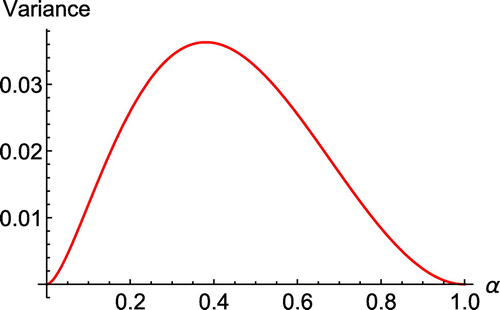
Third, our model explains that flights that are expected to be peak do not have more dispersion than those that are expected to be off-peak (Puller et al. (2009)) as follows. Whether a flight is expected to be peak is captured by the prior probability α a firm is constrained: the higher α, the more likely it is the flight is peak. If α is large, then there is no reason for firms to strongly compete and prices in both periods are close to the monopoly price with little price dispersion. Conversely, if α is small, then firms compete severely in both periods and all prices are close to marginal cost: even if the second-period distribution ranges from α to 1 almost all probability mass is close to α. Instead, when α is intermediate, the second-period price distribution displays high variance, and the first-period price lies at the lower bound of this distribution. Thus, our model predicts that there is no clear monotonic relationship between price dispersion and peak and off-peak flights. Figure 4 depicts the overall price dispersion across periods as a function of α in the pooling equilibrium.
Fourth, empirical evidence also suggests that transaction prices, that is, the prices at which consumers buy the good, often (but not always (cf. Endnote 4)) tend to be higher toward the deadline. This is obviously true in the pooling equilibrium as the first-period price equals α, whereas second-period prices are distributed over the interval . For semiseparating equilibria with higher profits, where is close to α, the same holds true. However, other semiseparating equilibria with lower profits exhibit the opposite feature. Thus, our model can account for both increasing and decreasing prices toward the deadline. However, as firms’ profits are inversely related to , one may argue that first-period prices are lower as firms are likely able to coordinate on the equilibria that are most profitable for them. Interestingly, there is an intimate connection between firms’ profits and the evolution of transaction prices over time. A simple statistic summarizing the evolution of transaction prices is , that is, the expected second-period price given the first-period price. It turns out that the expected second-period price is ,21 which depends on the posterior belief. In the pooling equilibrium, this posterior is equal to α and so the expected price is . That is, prices follow a submartingale, and we know that the pooling equilibrium is the best possible equilibrium from the firms’ perspective. Instead, in the worst semiseparating equilibrium, where , each price in is associated with a posterior and so . In addition, because , we have that . As a result, for all so that prices follow a supermartingale in the worst possible equilibrium from the firms’ perspective.22 This is illustrated in Figure 5, depicting expected first- and second-period transaction prices as a function of for . The figure shows that in the pooling equilibrium the expected second-period price is close to two times the expected first-period price but that this ratio changes quickly when increases and that when is close to one expected second-period transaction prices can be in the order of four times smaller than first-period prices! Thus, semiseparating equilibria where is close to one may explain some of the observations of last-minute discounts on Airbnb in Huang (2021).

Finally, there is a novel empirical implication of our model that, to the best of our knowledge, has not been tested yet, namely, that prices are positively correlated over time, even conditional on type, that is, higher first-period prices induce higher beliefs and, as a result, higher second-period prices. This implication follows from the fact that, for a given is increasing in p1: Higher prices are more likely to be set by constrained firms as relative to an unconstrained firm they do not benefit as much from selling in the first period as when they do, they cannot sell again in the second period. As is the lower-bound of the distribution of second-period prices, a higher means a first-order stochastic dominance shift of second-period prices.
4.3. Extensions
The model we have analyzed thus far is stylized and abstracts from many features that are present in real-world markets and that have been studied before in the revenue management literature. The simplicity of the baseline model allows to explain the main mechanism in detail and to argue that important real-world observations can already be explained by focusing on a new feature of markets with time-dated products, namely asymmetric information about capacities. A legitimate concern, of course, is whether the explanation is robust to alternative, more realistic modeling assumptions. To this end, we now discuss several extensions to the baseline model. Depending on the extension, we show that the qualitative properties of the pooling and/or the semiseparating equilibria continue to hold in more complicated models that take important features of real-world markets into account. In addition, if the Dudey (1992) analysis extends without major complications, we compare the equilibrium profits under complete and private information to conclude that firms’ profits are higher under complete information.
4.3.1. Random Arrival of Consumers.
In the baseline model, it is common knowledge that a consumer arrives in every period. Whenever a firm fails to sell, it correctly infers that its rival sold, which allows them to keep track of the number of units sold. In this section, we relax this assumption so that, in every period, a consumer is present only with probability . We analyze both the model with complete information about capacities and our model with information asymmetry. We show that uncertainty about whether the competitor sold to a consumer further strengthens the importance of our analysis and our conclusion that private information reduces market power. In particular, firms’ mixing strategies in the second period now also extend to the analysis where there is perfect information about capacities affecting Proposition 1. In addition, it remains true that the profits in the pooling equilibrium with private information about capacities are lower. In this section, we focus on the pooling equilibrium, whereas the analysis of semiseparating equilibria is in an online appendix.
Consider first the (Dudey) model with complete information about capacities whereby in every period a consumer arrives with probability and let us focus on the interesting case in which only one firm is constrained. If, as in Dudey’s equilibrium, the constrained firm charges the lowest price in the first period, then there is a probability that it does not sell and therefore still competes in the second period. This uncertainty creates an incentive to undercut in the second period that translates into an equilibrium price distribution with support in . Given that the expected second-period profits equal the constrained firm is pushed to sell at in the first period. Interestingly, the same equilibrium applies if both firms know that they are constrained since a firm that did not sell in the first period does not know whether the rival sold. Only when both firms know that they are unconstrained, will the equilibrium remain the same as before with firms pricing at marginal cost. Overall, demand uncertainty drives the prices down, but the Dudey equilibrium structure is preserved, a result consistent with the findings of Martínez-de Albéniz and Talluri (2011). We can compute the expected ex ante profit by considering a firm that prices at in both periods, and it is given by .
Suppose then that firms are also uncertain about the capacity of the rival. Given that a firm did not sell in the first period, it updates the probability that it is a monopolist in the second period. Using Bayes’ rule, this probability is Thus, the pooling equilibrium we constructed before for the case where λ = 1 can be easily extended by having both constrained and unconstrained firms choose and randomize over prices larger than in the second period. Because all prices in the support yield the same profit, we can compute the expected ex ante profit by assuming that the firm charges in every period. If it is constrained, the probability it sells its one unit is given by whereas if it is unconstrained the expected number of units it sells is given by Thus, the overall profit is given by
Ex ante expected profits under information asymmetry about capacities are still smaller than those under complete information becuse As the right-hand side (RHS) is increasing in λ one could even argue that the effect of asymmetric information about capacities is even stronger if consumer arrivals are stochastic.
4.3.2. Multiple Periods.
Another dimension to extend our model is to consider multiple periods. The two-period model we have considered thus far is rather particular in that in the first period it is common knowledge that both firms are present while, being the last period, further dynamic considerations are irrelevant in the second period. With longer time horizons, the strategic considerations of firms include (i) uncertainty regarding the presence of their rival and (ii) the willingness to forgo current profits to improve future outcomes. To make progress toward a multiperiod analysis, we need to separate these two strategic considerations. We do so by informing each firm whether their rival is still active at the beginning of each period. This is necessary to support an asymmetric pooling equilibrium, whereby firms alternate as the lowest-pricing firm.
Consider a T-period version of the model with a constant consumer arrival rate probability of and allow firms to observe whether their rival is still active before setting the price. Constrained firms have a single unit, while unconstrained firms have at least T units. An asymmetric pooling equilibrium exists whereby, in every period in which both firms are active, the firm with the highest current posterior charges a price pt (independent of its capacity), and its rival charges prices . Given this rule and some prior belief , the posterior belief conditional on the event that the firm who charged the lowest price remains active follows from Bayes’ rule and is given by
In such a pooling equilibrium, the constrained type of both firms must be indifferent in every period between selling at pt or deferring to its rival. In the last period, the continuation profit is, by definition, zero. In any previous period, let Πt denote the continuation profit conditional on the rival firm remaining active and denote by Vt the continuation profit for a constrained type who becomes the only active firm in period t (i.e., ). In a pooling equilibrium, the constrained firm must be indifferent between being the lowest-pricing seller or not. If not, then the firm enjoys monopoly rents if its rival leaves and competitive rents if the rival stays. If the firm is the lowest-pricing seller and a customer arrives it sells at price pt, whereas if no consumer arrives both firms remain active in the next period. Thus, the indifference condition reads . Iterating forward, we know that the same firm will be indifferent between selling or not next period. Hence,
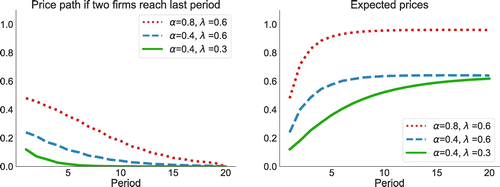
As pointed out by Martínez-de Albéniz and Talluri (2011) and Gallego and Hu (2014), prices tend to decrease as long as firms fail to sell a unit. This is visible from the left plot of Figure 6, which depicts the resulting price sequence in case two firms reach the last time period. However, the expected per-period price increases with time, as depicted by the right plot of Figure 6 for different values of λ and the initial belief α.
4.3.3. Multiple Firms.
We now revert back to a two-period analysis but extend our model to include firms and have k consumers entering the market in each period. To keep the analysis close to the baseline case, we assume that firms can serve at most one consumer per period. Let denote the number of active firms in period 2 and q(k) the probability the number of active firms is smaller than or equal to k. We focus on the existence of pooling equilibria for the case where .23
Given some outcome in the first period, the set of firms in period 2 can be partitioned into two groups: selling and nonselling firms. Nonselling firms are commonly known to be active in the second period, whereas there is uncertainty about nonselling firms’ participation. Let θi denote the (posterior) probability that firm i is active from the perspective of firm . In the terminology of Armstrong and Vickers (2022), θi is the reach of firm i and, because types are drawn independently, this market corresponds to the independent reach case (see also McAfee 1994). Given the model features, in a pooling equilibrium, k firms are (believed to be) inactive in the second period with probability α, whereas the remaining n – k firms are active with probability 1. Denote this profile of posteriors by .
Similar to the analysis at the beginning of Section 4.1, firms with , must be willing to charge the monopoly price (), at which firms sell, if and only if, . This pins down the profit level of nonselling firms to be equal to q(k), which conditional on being active is the same expected second-period profit all firms get.
Moving to the first period, we ask whether a pooling equilibrium exist. If it exists, it must be at the price , where we make the dependence of q on explicit. As before, the only reason why pooling may not be an equilibrium is that unconstrained firms prefer to undercut and ensure they sell in the first period. Their equilibrium profit is
Their deviation profit is instead equal to , as unconstrained firms are the only types that possibly could have an incentive to undercut and thus will reveal themselves to be unconstrained if they deviate. Hence, the pooling equilibrium exists, if and only if,
It is straightforward to verify that if k is the largest integer smaller than or equal to , this condition is trivially satisfied (e.g., if k = 1 and n = 2 as in the baseline model). Instead, if , this condition is only met for α sufficiently low. In general, for every , there exists some such that the condition is met for , and for these parameter values the pooling equilibrium is robust.
4.3.4. Demand and Consumer Heterogeneity.
Next, we consider three extensions related to the modeling of demand. Thus far, we have studied a simple demand structure where demand is constant and certain over time, whereas consumers are myopic and demand the good in the period they arrive in the market. The revenue management literature has considered more sophisticated demand structures. For example, Gallego and Hu (2014) study heterogeneous consumer preferences and time-varying demand. Levin et al. (2009) consider forward-looking consumers, who can decide to wait and delay purchase. Martínez-de Albéniz and Talluri (2011) and Anderson and Schneider (2007) study dynamic pricing with stochastic demand. More recently, Dana and Williams (2022) study dynamic capacity-then-price competition, when demand elasticity decreases over time. In this section, we incorporate some of these features in our model to show that the qualitative results remain robust.
4.3.4.1. Increasing Willingness to Pay.
First, in our baseline model, we assume that consumers’ valuation for the product does not change over time. The vast empirical literature on dynamic pricing in airline industries (McAfee and Te Velde 2006, Lazarev 2013, Williams 2022) explains increasing prices toward the deadline with increasing willingness to pay of consumers. Although demand becomes less price sensitive closer to the end of the selling period in the hotel industry as well (Garcia et al. 2022), for the cruise industry, Joo et al. (2020) show that consumers are more price-elastic closer to the end of the selling period, but prices increase due to the large amount of demand.
To accommodate the possibility for increasing willingness to pay, we now assume the second period consumer has a higher valuation v > 1, whereas we also comment on how our analysis below is robust to consumer heterogeneity.
It is not difficult to see that for a given posterior probability θ the second-period mixed pricing strategies are now given by
Moving to the first period, it can be verified that for that the pooling equilibrium can be sustained with the pooling price being equal to . If v is larger and , it is not surprising that a pooling equilibrium cannot be sustained anymore as firms have an incentive to concentrate almost exclusively on consumers that arrive late.
To construct the equilibrium for this case, consider that in the first period the constrained firm chooses a price of one with probability q and higher prices with the remaining probability. The unconstrained firm sets a price of one in the first period as it has no incentive to set a price above one. Thus, the posterior belief is given by . Hence, the expected profits of the constrained firm from charging the monopoly price and any higher price are given by
Solving for the mass point on the monopoly price gives , which for yields q < 1 and . The latter inequality also guarantees that the constrained firm does not want to deviate and undercut in the first period, whereas, like in our baseline model, the unconstrained firm does not want to undercut because it triggers Bertrand competition in the second period.24
Figure 7 represents the expected (selling) prices in the first and second period as a function of v. Not surprisingly, the difference in prices is increasing in v, whereas the figure confirms that even for the expected price is larger in the second period.
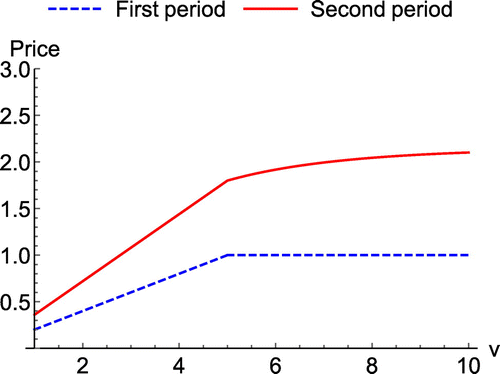
Note. Calibrated for .
It is clear that if , the equilibrium profits equal , whereas under complete information about capacities, the ex ante expected profits equal .25 Thus, for any α, if v is not too large, the profits under complete information remain larger than under private information.
4.3.4.2. Loyal Consumers.
In our baseline model, all consumers consider the products offered by the firms as identical. One way to depart from this homogeneous goods market assumption is to consider that a fraction of consumers is loyal (captive) to each of the firms and do not consider purchasing from the rival. A fraction of consumers considers both firms and purchases from the cheapest. We further assume that there is a single consumer in each period.
As is common in models with loyal consumers, only equilibria with mixed first-period prices exist, even if capacities are known. In this case, provided that , the equilibrium is qualitatively similar to the case of no loyal customers studied in Section 3. The unconstrained firm charges (stochastically) higher prices, and therefore firms coordinate on a high margin equilibrium.
We focus instead on the model with unknown capacities. To see why a pooling equilibrium does not exist, in such an equilibrium, the constrained firm must be indifferent between selling in the first period and selling in the second period. However, with a fraction of loyal consumers, there cannot exist a mass point at any price below one, as constrained firms would immediately deviate to one as they can sell to their loyal consumers and still get the same payoff in the second period in case they did not sell. Semiseparating equilibria exist, however, and although more complex, the equilibrium characterization shares many features with the semiseparating equilibria described in Section 4.1. The reason for the additional complexity is that if σ is low enough, unconstrained firms are not willing to charge prices too close to one because these prices sell with low probability and therefore provide relatively low profits. Hence, in equilibrium, constrained firms are the only ones who charge prices close enough to one. We refer the reader to an online appendix where we provide a detailed characterization.
4.3.4.3. Patient Consumers.
Finally, we have thus far assumed that consumers are myopic and only consider buying when they enter the market. There has been considerable interest in the revenue management literature in the presence of forward-looking consumers (Levin et al. 2009, Besbes and Lobel 2015): If prices are decreasing over time, consumers would rather wait before buying. As long as equilibrium prices are (stochastically) increasing over time, which is the case in the pooling equilibrium and in a range of semiseparating equilibria, price-taking consumers do not have an incentive to wait and buy later.
A more subtle point is raised in markets where there are a few large consumers that may internalize their impact on future prices when deciding to wait. In our setting, a consumer who waits induces a static game in the second period in which both firms compete for two consumers. Even in this case, competition between firms will not result in Bertrand competition as the constrained firms cannot serve the whole demand and uncertainty about whether the competitor is constrained remains. What is an equilibrium of this second period is that a constrained firm charges a price of one, whereas an unconstrained firm randomizes over the interval . The expected price in the second period is then larger than , implying that a large strategic consumer, facing a price of in the first period of the pooling equilibrium does not want to postpone buying until the second period so that the assumption of myopic consumers is innocuous.26
Thus, where consumers are price takers or have an impact on future prices if they postpone their purchase decision, the pooling equilibrium is robust to this extension of patient strategic buyers.
5. Disclosure
Having explored in detail the implications of private information, in this section and the next, we explore to what extent private information continues to play an important role when firms can affect the information structure by either voluntarily disclosing information or by engaging in industrial espionage. Thus, in this section, we allow firms to voluntarily disclose their private information about capacity and investigate whether such disclosure increases their profits.27 As disclosure requires investing in technology to be able to do so,28 disclosure is a long-term decision that is taken before firms learn their type. If a firm discloses the rival knows the capacity of the disclosing firm precisely.
It is clear that when the disclosure cost is too high, neither firm wants to disclose, and the equilibrium analysis of the previous section remains valid. Therefore, in this section, we mainly focus on disclosure costs being small enough so that at least one firm will want to deviate from the equilibrium of the previous section and disclose. To this end, we start the analysis by assuming that one firm discloses its private information, whereas the other does not, and consider the impact disclosure has on the pricing strategies of firms. We then evaluate the overall profit the disclosing and nondisclosing firm make. We conclude that when the disclosing cost is small enough there only exist asymmetric equilibria where one firm discloses. Thus, despite the existence of voluntary disclosure, private information remains an important ingredient to understand markets with time-dated products.
Consider first the situation where the disclosing firm is constrained. The continuation game is essentially identical to the complete information game in which one firm is constrained and the other is unconstrained. As we described earlier, equilibrium requires the disclosing firm to sell in the first period at a price and its rival to sell in the second period at a price p = 1. Unlike the complete information game, equilibria where the first-period price is smaller than α do not exist as due to its ignorance about the rival’s capacity, the disclosing firm has an expected profit of at least α. Similar to the complete information game, there is a continuum of equilibria in weakly dominated strategies and the only equilibrium in undominated strategies is the Dudey equilibrium with . It is on this equilibrium that we will focus.
The more interesting situation is where the disclosing firm is unconstrained. If it sells in the first period, it is common knowledge that both firms have capacity left in the second period and Bertrand competition results in marginal cost pricing. However, this would leave the nondisclosing firm without profit in any period, which cannot be an equilibrium outcome. It follows that in equilibrium both types of the nondisclosing firm sell in the first period and set the same price. Using the second-period results of the pooling equilibrium discussed in the previous section reveals that both firms make an expected profit of α in the second period and the unconstrained nondisclosing firm can expect an overall profit of . This outcome can be sustained with the following strategies. Following Blume (2003), the disclosing firm uniformly randomizes over the interval in the first period, whereas both types of the nondisclosing firm charge . In the second period, the disclosing firm has a posterior belief of α that its rival is constrained and both firms choose prices according to (1) and (2) as in the second period of the private information game.29
Combining the two cases, it is easy to see that the disclosing firm makes an expected ex ante profits of , where is the disclosure cost30: with probability α it is constrained and makes a profit of in the first period, whereas with the remaining probability, it is unconstrained and makes an expected profit of in the second period. On the other hand, the nondisclosing competitor makes an expected ex ante profits of : If the disclosing firm is constrained it makes a profit of one in the second period, whereas if the disclosing firm is unconstrained its overall profits are either α or , depending on whether it is itself constrained.
Interestingly, the nondisclosing firm’s profit exceeds the maximal payoff, it can get in the complete information game, and hence, it would never want to deviate. The reason is that it makes more profit if the rival is unconstrained. In that case, the disclosing firm lets the rival sell in the first period and creates the opportunity for the nondisclosing firm to sell in the second period as the disclosing firm is uninformed about the rival’s capacity. In addition, the nondisclosing firm earns more profits than the disclosing firm, regardless of the equilibrium that is being played. Therefore, equilibria exist in which only one firm discloses if the disclosure cost is sufficiently small () so that the disclosing firm makes more profit than in the game under private information.
We summarize the previous discussion here.
If , then the disclosure game has a unique equilibrium in undominated strategies in which one firm discloses and obtains , wheras its rival obtains . If , where 31 all equilibria involve no disclosure and are outcome equivalent to the incomplete information game. For intermediate values, asymmetric disclosure and no disclosure equilibria coexist.
The operating profits of disclosing, given by , are strictly larger than the maximal payoff in the private information game analyzed in the previous section. Thus, for small enough disclosure cost, it is optimal for one firm to disclose. The multiplicity of equilibria arises for intermediate disclosure cost and stems from the multiplicity of equilibria studied in the previous section. As the private information game has multiple semiseparating equilibria with different payoffs, the decision whether to disclose depends on a firm’s expectations regarding which equilibrium they will play if it does not disclose.
All these equilibria are less competitive than the incomplete information benchmark. More importantly, the disclosure equilibrium induces higher prices than in the complete information outcome! Therefore, allowing voluntary information disclosure in this market is anticompetitive, and even more so than mutual information exchange, and accordingly severely harms consumers. From a competition policy perspective, our analysis indicates that there may be good reasons to forbid firms to reveal their capacities in a dynamic pricing setting where capacity constraints are important. The disclosing firm mainly gains in all cases where it is capacity constrained, whereas the additional loss of not having private information when it is unconstrained is insufficient to dominate this gain. The nondisclosing firm is mainly free-riding on the disclosure decision of its rival and benefits especially if it is unconstrained.
6. Industrial Espionage
We now consider the incentives of firms to spy on the rival and to secretly learn its capacity. Industrial espionage is, in a sense, the reverse of voluntary disclosure as the one who incurs the spying cost c is the one who learns the capacity of the rival. If there exists equilibria with industrial espionage, then the firm expecting to be spied on also expects the rival to know its capacity. As in the previous section, we model espionage as a long-term endeavor that is decided on before pricing decisions are made, and it delivers certainty about whether the rival is constrained. Importantly, and unlike the previous section, the act of spying cannot be observed so that it is the expectation of being spied on rather than the act itself that affects a firm’s behavior.
It is not difficult to see that for any c > 0, there cannot be an equilibrium where both firms spy for sure. If they would do so, the equilibrium outcome of the complete information game would result with the firms setting price equal to marginal cost if and only if both turn out to be unconstrained. However, then one of the firms can obtain the same operating profits without incurring the spying cost, by setting a first-period price of one if constrained and a larger price if unconstrained. If the rival is constrained, a firm can then anyway obtain a profit of one (possibly in the second period), whereas if the rival is unconstrained, it also obtains a profit of one if constrained. This result should not come as a surprise: There is something secretive about spying, and one may think that a firm may not want to act in such a way that the rival expects it to engage in industrial espionage for sure. As an implication, some form of private information will prevail also when allowing for industrial espionage.
Similar to the previous section, when the spying cost is large an equilibrium without industrial espionage exists, whereas if the spying cost is smaller, but not too small, an asymmetric equilibrium exists where one firm spies, and the other does not. We provide the details of the threshold values where these equilibria exist in Appendix B. Equilibrium play in this equilibrium mimics that of the asymmetric equilibrium in the disclosure game: One firm is informed about her rival’s type and the other firm expects this to be the case. It follows from Section 5 that the ex ante expected candidate equilibrium profits are equal to and for the spying (informed) and nonspying (uninformed) firm, respectively. Because the nonspying firm has a lower equilibrium payoff, it may be tempted to secretly spy on its rival and use this information in the second period to increase its profit. This puts a lower bound on the spying cost for this pure strategy asymmetric equilibrium to exist.32
Important new considerations apply when the spying cost is small, and we now turn our attention to constructing an equilibrium in this range where one firm spies for sure, whereas the other firm spies with some probability . We refer to the latter firm as the mixing firm. If this mixing firm is constrained, this event is common knowledge, and this firm will sell at a price not lower than the prior.
When the mixing firm is unconstrained, instead, equilibrium play dictates that the rival (spying) firm sells in the first period. Continuation play will then depend on the capacity of the rival and the information gathered by the mixing firm. What is of special interest in the second period is that if the mixing firm spied, it charges the monopoly price if its rival is constrained and charges lower, but still strictly positive, prices otherwise. If both firms spy and are unconstrained, both firms know that there is enough unsold capacity in the market to result in severe competition, that is, marginal cost pricing in both periods. However, the firm that is supposed to always spy does not know that the mixing firm (spied and) knows that it is unconstrained. As both the constrained and unconstrained spying firm sell at the same first-period price (and learn nothing about the rival), an unconstrained spying firm believes with probability that the mixing rival still has its posterior of it being constrained equal to the prior α, and thus is setting positive prices; therefore, the spying unconstrained firm reacts correspondingly by charging positive prices as well. Thus, even if both firms are unconstrained and know that the rival is unconstrained, they may escape marginal cost pricing as it is not common knowledge that both are unconstrained.
In Appendix A, we show the following proposition holds, which essentially says that the candidate equilibrium we outlined earlier is indeed an equilibrium.
If , then there exists an asymmetric equilibrium where one firm engages in industrial espionage for sure, whereas the other randomizes between spying and not spying. The randomizing firm has the same ex ante expected profit as under complete information, whereas the spying firm’s profits is smaller. As the cost of spying approaches one, the spying probability of the mixing firm approaches one, but the ex ante expected equilibrium profit of the firm that always engages in industrial espionage converges to α, which is smaller than that under the Dudey outcome.
A reader familiar with Dudey (1992) may have expected that if the cost of espionage approaches zero and both firms spy almost surely, equilibria converge to the Dudey monopoly result. The proposition shows this is not necessarily the case. However, the asymmetric equilibrium we constructed here does converge to one of the equilibria of the complete information game (see Section 3). In this equilibrium, the firm that always engages in industrial espionage has an expected profit of , which is increasing in the cost of spying. The reason is that the rival firm’s probability of spying decreases and that because of this the spying firm makes a higher expected profit in the second period, which also translates into a higher first-period price in case the rival is unconstrained.
In this equilibrium, if c approaches zero, the ex ante expected payoff of the spying firm converges to α, which is considerably below the payoff of of the mixing firm, which is also the ex ante expected payoff of the complete information game. Calculating the average payoff of a firm in this equilibrium as , it is clear that this is exactly equal to the firms’ ex ante expected profit in the pooling equilibrium under private information, . As for small c equilibrium profits are increasing in c, firms prefer the spying equilibrium to the one under pure private information, whereas consumers are worse off.
An open question remains as to whether other equilibria supporting different outcomes exist. In particular, a symmetric equilibrium may exist whereby both firms choose to spy with some positive probability. In such an equilibrium, firms will mix in overlapping intervals depending on both their type and their information. As the cost of spying converges to zero, it may well be that these price distributions collapse to the prices in the Dudey outcome.
7. Conclusion
This is the first paper that performs an equilibrium analysis of dynamic competitive pricing in markets for time-dated products (such as hotel rooms, airline flights, shipping, generated electricity), where firms have private information about their unsold capacities. We focus mostly on a simple framework with two firms, two periods and one consumer arriving in each period, but we consider several extensions such as a multiple periods, consumers arriving randomly, and having higher valuations closer to the deadline. Despite its simplicity, the equilibrium analysis is intricate, and the results yield interesting insight into existing empirical observations. We show that the existence of private information considerably restricts the market power that firms have in such situations and that information exchange of private information regarding unsold capacity is anticompetitive and detrimental to consumer welfare. We also show that the model can explain observed pricing patterns. In particular, our model provides an explanation for increasing prices and price dispersion as the deadline approaches. We extend the analysis by considering the private incentives to voluntary disclose private information or to engage in industrial espionage. Surprisingly, from a consumer welfare perspective, one-sided voluntary disclosure is even worse than mutual information exchange as the disclosing firm is able to get the full information payoffs, but it is especially the nondisclosing firm that benefits from the additional information regarding the rival’s capacity while maintaining uncertainty regarding its own capacity. This raises the question whether voluntary disclosure of unsold capacity should be forbidden from a competition policy perspective. Industrial espionage is in some sense similar to “reverse voluntary disclosure,” with similar results; however, the difference being that it is a secretive act that creates private rather than public information. We summarize the profit and consumer welfare comparisons across the different information scenarios we have analyzed in the following Table 1.
|

Table 1. Ranking of Industry Profits and Consumer Surplus Across the Main Four Equilibria with 4 Denoting the Best and 1 the Worst Outcome
| Equilibrium type | Public information (Dudey) | Private information (pooling) | Disclosure (small cost) | Espionage (small cost) |
|---|---|---|---|---|
| Industry profits | 3 | 1 | 4 | 2 |
| Consumer surplus | 2 | 4 | 1 | 3 |
From a policy perspective, our work is also related to the recent literature studying potential channels in which (pricing) algorithms may impact competition (Harrington 2018, Calvano et al. 2020). As indicated previously, one part of our analysis shows that it is not only essential for firms coordinating their pricing that they are informed about their rivals’ capacity but that it is known by their rivals that they know. When it is commonly known that competitors use similar algorithmic tools, one possible implication of our research is that the use of these tools may lead to a substantial increase in prices and a reduction in consumer surplus.
Our analysis points at many angles for future research. One possibility is to cover different extensions in one model. Another is to investigate our conjecture at the end of Section 6 and to inquire into the existence of a symmetric equilibrium where both firms randomize their decision to engage in industrial espionage and to study whether the equilibrium converges to the Dudey equilibrium outcome as the cost of industrial espionage becomes negligible. Further direction would be to allow for the possibility that the product is sold out. With consumers being strategic and firms potentially selling out, it is interesting to see whether disclosure policies of unsold capacities may also influence consumer decisions. Third, in our basic model and in the different extensions, we assumed that consumers know that they will be able to buy the product if they accept the price; that is, capacity is not a limiting factor. When consumers are myopic and do not consider waiting for future periods to buy this is not an issue as they either face firms selling their product or they do not. However, when consumers are strategic, as in one of the extensions analyzed, consumers may decide to buy now as they are afraid the product will be sold out later. Finally, we have assumed that demand is known, and it would be interesting to introduce elements of uncertainty regarding demand and demand learning into our analysis (Bertsimas and Perakis 2006, Liu and Zhang 2013, Gallego and Hu 2014, Cheung et al. 2017).
The authors thank Omar Besbes, an associate editor, three anonymous reviewers, Marc Dudey, Robert Somogyi, and participants at the Vienna Graduate School of Economics seminar, the Theory Committee Meeting of the VfS, the Oligo Workshop 2021, the 21st Centre for Policy Research/Journal of Industrial Economics Conference on Applied Industrial Organization, and the EEA-ESEM Conference 2021 for useful comments.
Appendix A. Proofs of Propositions
Consider a separating equilibrium, possibly in mixed strategies, where pu is a price in the support of the first-period prices set by an unconstrained firm, whereas is in the support of the first-period prices set by a constrained firm. To be an equilibrium, no type should have an incentive to imitate the price of the other type. Both deviations we consider are on-the-equilibrium path, such that out-of-equilibrium beliefs do not play a role. The two deviations give the following two incentive compatibility constraints:
These two constraints can be rewritten as
We show this by construction. Consider any semiseparating equilibrium with a support of first-period prices on an interval . Clearly, as prices below α are weakly dominated for constrained firms. Similarly, , as otherwise the constrained firm will never price at , which yields an expected profit of α. Hence, . Naturally .
For every price , the (posterior) belief can be derived from the equilibrium strategies of each firm. For prices , simply let , whereas for prices , we let . We now use the randomization conditions for both types of firms. Given that is the probability that the rival’s price exceeds p, for every price , we have
In words, a constrained firm charging p sells with probability Q(p). If it fails to sell (because the competitor’s price is smaller than ), it obtains a continuation profit equal to the posterior type of the selling firm, which depends on the price the competitor charges (). Taking derivatives, we obtain the following:
The constrained firm optimally trades off selling its unit in the first period, which brings p, but results in a loss of continuation profit of , with obtaining more revenue on the infra-marginal units.
The unconstrained firm’s profit reads
That is, the unconstrained firm’s profit reflects the fact that if it sells in the first period it can still sell in the second and obtain a continuation profit that depends on the price it charges (as it becomes the selling firm). Because is constant by construction,
Replacing this condition in the randomization condition of the constrained firm yields
A crucial observation is that the unconstrained firm must have a mass point at the upper-bound of the support, for otherwise and , which is a contradiction with the fact that the unconstrained firm is indeed willing to charge such a price. The indifference conditions for the mass point now read
The expected profits can then be simply obtained by noticing that . Hence,
This expression is decreasing in with .
To verify that this constitutes an equilibrium, we need to impose that the expected posterior equals the prior. Namely,
That this condition holds can be seen as follows:
The first step uses the randomization condition of the unconstrained firms, the second condition follows from integration, and the third step uses the fact that . As the boundary conditions of the ODE yield , it follows that
Recall that . A useful property of the Lambert-function is that .33 Hence,
Using this, we can further simplify
We first establish (i). By definition, the expected posterior about the type of each firm is the prior in both E1 and E2. The distribution of posteriors in equilibrium i is
We now show (ii) and (iii). The expected second-period profit is , which is increasing and concave in θ. Let θ1 and θ2 the random variables associated with a given firm’s posterior in both equilibria. By Rothschild and Stiglitz (1976), for some ε with zero mean. Let denote the distribution of the minimum of two draws from . Then,
The first step follows from the fact that the minimum of θ2 is not higher than the minimum of θ1 plus a random draw of ε, establishing (ii), whereas the last step follows from Jensen’s inequality, proving (iii).
We start the analysis in the second period of the price competition and consider the case where the spying firm has successfully sold a unit in the first period and believes that the rival is informed with probability and uninformed with probability .34 Applying the insights gained in Section 4, the spying firm expects that the mixing firm, when it does not spy and is uninformed, randomizes over some interval with some cumulative distribution function , which has a mass point at the upper bound. Let us denote the mass by ω. As a best response, the spying firm must also randomize on the interval . However, an informed mixing firm (that has spied and knows the rival’s type) chooses different prices, depending on the rival’s type. If the rival is constrained, then the mixing firm naturally chooses the monopoly price as the spying firm has sold in the first period. If, however, the spying firm is unconstrained, then the mixing firm knows that and will undercut this interval to maximize profits. As there cannot be an equilibrium with the informed mixing firm choosing a second-period price for sure (as the spying firm will have an incentive to undercut), the spying firm should not only mix over but also over a lower interval. Thus, the mixing strategy of spying firm will be represented by some cumulative distribution function over the interval , for some . In addition, when informed the mixing firm will randomize over the interval with .
In what follows, we derive the unknowns , and some properties of the functions and . First, by undercutting the mass point of ω at one, the spying firm has an expected profit of . Thus, and are characterized such that any price in the interval yields the spying firm the same profit. Second, as by pricing at pL firms know for sure they will sell, it must be that . Third, as by setting the spying firm makes a second-period profit of it should be that Fourth, by not spying and setting a price equal to one, an unconstrained mixing firm expects to get a second-period profit of α. As the nonspying firm expects to get the same profit over the whole domain , it should be that . Fifth, as by spying and setting a price equal to pL in case the rival is unconstrained and choosing a price of one if the rival is constrained, the mixing firm gets an ex ante expected payoff of when it actually spies, whereas the ex ante expected payoff of not spying equals ; it should be that . Sixth, as when spying, the mixing firm should be indifferent between setting any price in the interval , it should be that so that .
Combining the last three points yields expressions for β and in terms of exogenous parameters. It follows that for any and from the fifth point that β converges to one and converges to one if c approaches zero. This implies that in this asymmetric equilibrium the expected second-period profit of the spying firm converges to zero. In terms of first-period pricing strategies, as the mixing firm should not be willing to deviate from its strategy of pushing the rival to sell when it spies, the first-period price set by the spying firm if the rival is unconstrained should be equal to and the interval of prices where the mixing firm uniformly randomizes over is . It follows that these prices also converge to zero if c approaches zero and that in the limit, the spying firm will only make profit if the mixing firm is constrained. Thus, if c approaches zero, the ex ante expected payoff of the spying firm equals α, which is considerably below the payoff of , which is the payoff of the mixing firm and also the ex ante expected payoff of the complete information game. Interestingly, it is also lower than the profit under private information.
Appendix B. Equilibria When the Cost of Espionage Is Not Small
In this appendix, we provide more details of two equilibria of the game with industrial espionage discussed in Section 6. In particular, we establish two propositions dealing with large and intermediate spying costs, where the next two sections first investigate for which values of c one can sustain the equilibrium outcomes of the previous two sections when firms have the possibility to spy on each other.
B.1. Equilibria Without Spying
It is clear that for a large enough spying cost, firms will not engage in industrial espionage. To determine boundary costs where spying is not profitable, we compare the candidate equilibria under spying with the pooling equilibria under private information. This keeps the analysis focused without qualitatively affecting the results. To establish the cutoff value of c such that no spying constitutes an equilibrium, we need to derive the optimal strategy of a firm that decides to spy on its rival when it is not expected to do so. If the deviating firm discovers that its rival is unconstrained, it has no profitable deviation and will charge in both periods (if it has available capacity in the second period), obtaining if unconstrained and α if constrained. If, on the other hand, it discovers the rival is constrained, the optimal pricing depends on the value of α. Clearly, it could guarantee itself monopoly profits in the second period by letting the rival sell for sure in the first period (by deviating to a higher price). If the firm itself is, however, unconstrained, it may stick to the equilibrium (pooling) pricing strategy, selling with probability 0.5 in the first period, yielding an overall expected profit of , or, if it does not sell, which also happens with probability 0.5, make monopoly profits in the second period. Clearly, the overall profit of is larger than one if . The associated profit of spying is therefore
Thus, it is not optimal to deviate if
If , there exists an equilibrium where firms choose not to spy and price as in the pooling equilibrium of Proposition 3.
In case that the continuation equilibrium is semiseparating, the value of would be modified slightly because (i) the equilibrium profit of a nonspying unconstrained firm falls, and (ii) the equilibrium profit of an unconstrained firm who learns that its rival is unconstrained also falls. It can be shown that the net benefit from spying increases as increases. In the limit case in which , the corresponding cutoff value is .
B.2. Asymmetric Equilibria for Intermediate Spying Cost
Next, we consider whether, and if so under what conditions, an asymmetric equilibrium exists where one firm spies and the other does not. The equilibrium play in such an equilibrium mimics the one under disclosure with the roles reversed. It follows from Section 5 that the ex ante expected candidate equilibrium profits are equal to and for the spying and nonspying firm, respectively.
To see for which values of c these strategies constitute an equilibrium, we should verify whether the spying and nonspying firms have incentives to deviate. If a firm is supposed to spy and it does not, it will optimally choose a first-period price of α, yielding α if constrained and (for out-of-equilibrium beliefs satisfying the intuitive criterion) if unconstrained. It follows that the firm that is expected to spy will do so if . Similarly, if the firm that is supposed not to spy deviates and spies, it may tailor its price to the information. Given equilibrium play, this ability is useless if it has only one unit, as it would have obtained monopoly profits regardless. If, instead, the deviating firm is unconstrained it will allow her rival to sell in the first period and reap the monopoly rents in the second period, increasing its expected payoff by .
If , an asymmetric equilibrium exists where one firm spies for sure and the other does not. The operating profit of the spying firm is larger than that of the nonspying firm, but the difference is smaller than the spying cost.
Interestingly, as , there exists a range of c values such that the asymmetric equilibrium characterized in this section coexist with the equilibrium where no firm spies. It is clear that industrial espionage by one firm increases the market power of both firms and that it is therefore anticompetitive and bad for consumer welfare. Also of interest is that the nonspying firm always makes a profit of , which is the ex ante equilibrium profit if the uncertainty is revealed before prices are chosen. A firm does not need to know its rival’s capacity: It is enough that the rival knows its capacity! Finally, as the equilibrium only exists for , it is clear that in this equilibrium the profit of the spying firm is smaller than the profit of the nonspying firm.
In this proof, we provide more detail why deviating from the equilibrium strategies is not optimal. First, if the spying firm, that is, the firm that according to the asymmetric equilibrium is supposed to spy, deviates and decides not to spy, the nonspying firm does not observe this deviation and sticks to its first-period pricing, so that the spying firm only knows that with probability α the rival is constrained and charges one and with probability randomizes uniformly above . The deviation profits clearly depend on the continuation pricing strategy and on the beliefs of the rival. To give the candidate equilibrium maximal chance, we look for every possible pricing strategy at reasonable beliefs of the rival that create the lowest deviation payoff. The candidate equilibrium can be sustained as an equilibrium if all the possible pricing strategies yield a lower payoff than the equilibrium payoff for some reasonable belief of the rival.
If, after deviating and not spying, the firm sets a first-period price of independent of whether it itself is constrained, its deviation profit is (at least) equal to . To see this, with this pricing strategy, the firm sells and the first-period profit equals α. A firm can only make profit in the second period if it is unconstrained. As α is the equilibrium first-period price if the nonspying firm is unconstrained, the unconstrained, nonspying firm has to believe that the rival plays according to the candidate equilibrium so the expected second-period profit equals . However, for the constrained nonspying firm, α is an out-of-equilibrium price, and it may well believe that its rival is unconstrained, and in that case, the expected second-period profit equals zero. Thus, the deviating firm IS only makes a second-period profit of if both firms are unconstrained, yielding an overall deviation profit of .
All other first-period prices can generate lower payoffs for reasonable beliefs of the nonspying firm. After a first-period price by the spying firm larger than one, the nonspying firm may believe that its rival is unconstrained, and in that case, the spying firm will only make an expected profit of α (in the second period). On the other hand, after a first-period price by the spying firm that is larger than and smaller than one, the nonspying firm may again believe its rival is unconstrained, and in that case, the spying firm will only make an expected profit of α (in the first period).
Thus, the spying firm does not want to deviate if or .
Next, consider that the nonspying firm deviates and decides to spy, which is not observed by its rival. As the spying firm knows the rival’s type and lets a nonspying constrained rival sell at a price of one anyway, the nonspying firm does not gain anything from spying. If, however, the nonspying firm is unconstrained, learning the capacity of its rival can increase its expected profit. If it learns that its rival is constrained, the nonspying firm can still push its rival to sell in the first period (as the spying rival believes a nonspying firm would do), but then set the monopoly price in the second period. In case the spying firm is unconstrained as well, the deviating nonspying firm cannot do better than choosing the equilibrium prices. Hence, the ex ante expected deviation profit of the nonspying firm equals . This is smaller than the equilibrium profit of if
1 See Talluri and Van Ryzin (2006) for an overview of early literature and Hörner and Samuelson (2011) and Board and Skrzypacz (2016) for important recent contributions, where optimal contracts are determined depending on whether a firm can commit and where buyers are forward-looking.
2 A paper by Lin and Sibdari (2009) proposes a heuristic pricing policy based on the Nash equilibrium prices derived from the game with complete information, but they do not consider the strategic equilibrium pricing decisions under private information.
3 We also consider several extensions to this framework, including multiple periods, strategic consumers, random arrival, and captive consumers.
4 It is not always true that transaction prices are higher closer to the deadline. For example, an Airbnb host may provide a last-minute discount if her listing has not been booked closer to the available date (Huang 2021). As we explain later, this feature is consistent with some of the equilibria of our model.
5 In the context of their model, McAfee and Te Velde (2006) conclude that “changing demand is a salient feature of the data, and models that assume that the shape of demand is constant over time are empirically invalid.” We show that uncertain capacities naturally result in market outcomes that resemble those in markets with changing demand. Furthermore, we show that our results still apply if valuations increase toward the deadline.
6 This multiplicity allows the model to reconcile a wide range of findings, including those discussed in Endnote 3.
7 In Canada, WestJet seems to have engaged in industrial espionage when it acquired “access to a special reservation website for the employees and retirees of Air Canada” as The Globe and Mail reported in July 2004. The article reports on a lawsuit initiated by Air Canada and continues that the “website contains confidential information about the number of passengers booked on all flights at Air Canada and its subsidiary Zip for up to 352 days in the future.” In May 2006, CBC News reports that a settlement was reached in which “WestJet apologized to Air Canada” and that “the lawsuit centered on allegations that WestJet management used the password of a former Air Canada employee to access a website maintained by Air Canada to download “detailed and commercially sensitive” information.
8 There is some evidence that firms engage in communication about capacities, albeit on a more long-term basis. See, in particular, Aryal et al. (2022).
9 In other words, Bertrand competition requires that firms have common knowledge about unsold capacity levels of all firms.
10 Similarly, Fabra and Llobet (2021) study a uniform price auction where firms are privately informed about their (random) capacities. Interestingly, they also find that uncertainty about rivals’ capacities leads to less excise of market power and higher consumer surplus.
11 Under an alternative tie-breaking rule whereby both firms sell half of their capacity in the first period if they set identical prices, the continuation game is outcome-equivalent to the one we study here but more complicated to analyze. Details are given in the online appendix.
12 For the case of asymmetric priors, see Endnote 29.
13 In many markets where firms and consumers make online transactions, it is easy for firms to observe competitors’ prices: If consumers can observe both prices, it is typically also possible for firms to observe them. If we dispose of this assumption, the analysis becomes more involved as firms must form conjectures about the prices charged by competitors. In the online appendix, we show, however, that the pooling equilibrium characterized in Section 4 remains an equilibrium when first-period prices are hidden from competitors.
14 The second-period prices do not depend on whether a firm is constrained or not as the firm can only sell one unit in the last period. The only thing that is still relevant at that stage is whether a firm still has a unit of capacity left to sell.
15 In the special case of the pooling equilibrium we analyze in this section, the first-period price does not reveal any new information to the firms so that Bayes’ rule yields . In later sections where we analyze other equilibria, θ will generally not be equal to To stress that this posterior probability may depend on the price that is charged, in later sections we also write
16 Note that is different from the distribution function found in Janssen and Rasmusen (2002) as they only deal with symmetric information, whereas in our setting, it is important to realize that the selling firm knows that there is competition in period 2 (whereas the firm that does not sell does not know).
17 The second-period profit is determined by the belief of the deviating nonselling player regarding the probability that the nondeviating selling player is constrained. Clearly, given the selling player chose its equilibrium price in the first period, Bayes’ rule implies this belief should be equal to α.
18 There also exist two asymmetric pooling equilibria, in which independent of their type one of the firms charges α and the other mixes in the interval (α, α + ε). This equilibrium is outcome equivalent to the pooling equilibrium.
19 Recall that the Lambert-W function is such that .
20 More precisely, for every , there is a different price distribution that is characterized by . When we talk in this paragraph about the second-period price distribution, we mean the average second-period price distribution, where the average is taken over all possible s.
21 This can be seen as follows. First, with probability , only one firm has unsold capacity left in the second period, and in that case, the expected transaction price is simply the expected price given that the CDF of prices is given by (2), that is, , where the natural logarithm comes from integrating the term that arises in the distribution function term. With the remaining probability , there are two firms with unsold capacity in the second period. Using (1) and (2), the CDF of the minimum price in that case is given by . The second-period transaction price follows by adding these different expressions.
22 Across semiseparating equilibria, if the first-period price is competitive (below the mass point), the continuation price is expected to fall further. Instead, if the market price is not competitive (at the mass point), the continuation price is expected to raise even further.
23 If instead k > n, then with a probability of one, and all active firms would sell at , whereas if , then with a probability of one, and firms would engage in Bertrand competition in the second period.
24 We can now consider a modification of this model by supposing that only a fraction q of consumers have a valuation v > 1 in period 2, whereas the rest have a valuation of one. If qv < 1, the monopoly price is one, so the results from the baseline model are unaffected. If , there exists a pooling equilibrium with and the only difference is that the second period distribution has a hole in . Finally, if , a semiseparating equilibrium exists where the constrained firm randomizes with prices above one, and the price distribution in the second period may also have a hole in its support.
25 When capacities are known, if one firm is known to be constrained and the other is unconstrained, the profits are one and v, respectively, whereas if both firms are constrained, the equilibrium involves the firms to choose a first-period price of one with probability and a higher price with the remaining probability and to choose a second-period price equal to . Interestingly, two constrained firms cannot benefit from the higher second-period valuation as they have to be indifferent between selling in the first and second period.
26 This means that the dynamic market is more competitive than its static counterpart.
27 In separate literature, Cui et al. (2019) and Calvo et al. (2020) study empirically the effect of disclosing to consumers that capacity is running out. As discussed in the beginning of Section 4.3 we study markets where consumers do not have to be afraid that capacity is running out so that disclosing capacity is mostly directed toward competitors.
28 For example, in the airline industry, it only makes sense to disclose information about unsold capacity if an airline does so for all its flights. This requires developing the software to track unsold capacity across several sales channels and display this information on the website.
29 This environment is strategically equivalent to a market with asymmetric priors. In such a case, the firm with a lower prior sells in the first period at a price equal to its prior.
30 The disclosure cost is potentially multifaceted. For instance, as disclosure is intimately related to transparency, it may impact consumer values.
31 In the proof of Proposition 4 in Appendix A, we show that the lowest possible equilibrium payoff of a semiseparating equilibrium under private information is given by , where and is the negative branch of the Lambert function. As the highest possible equilibrium payoff of a disclosing firm equals , there cannot exist a disclosure equilibrium if , which gives the condition stated in the proposition.
32 The nondisclosing (informed) firm in the previous section would never want to deviate as it makes the most profit, and by disclosing, it does not get more information itself. As the roles are reversed, this does not hold for the nonspying (uninformed) firm.
33 To see this, notice that for that so that and so that We then have that Taking logs on both sides, we get or As , we have that
34 The latter implicitly assumes that the first-period pricing strategy of the mixing firm is such that no information regarding the mixing firm’s type is revealed. However, as the mixing firm is not supposed to sell in the first period anyway, the pricing strategy in this period is payoff irrelevant, and we may assume that both types choose the same first-period pricing strategy.
References
- (2007) Price competition with revenue management and costly consumer search. Technical report, Department of Economics, University of Virginia, Charlottesville, VA.Google Scholar
- (2014) Dynamic price competition with capacity constraints and a strategic buyer. Internat. Econom. Rev. 55(3):943–958.Crossref, Google Scholar
- (2022) Patterns of competitive interaction. Econometrica. 90(1):153–191.Crossref, Google Scholar
- (2022) Coordinated capacity reductions and public communication in the airline industry. Rev. Econom. Stud. 89(6):3055–3084.Google Scholar
- (2015) Repeated auctions with budgets in ad exchanges: Approximations and design. Management Sci. 61(4):864–884.Link, Google Scholar
- (2014) Entry and espionage with noisy signals. Games Econom. Behav. 83:127–146.Crossref, Google Scholar
- (2006)
Dynamic pricing: A learning approach . Mathematical and Computational Models for Congestion Charging (Springer, Berlin), 45–79.Crossref, Google Scholar - (2015) Intertemporal price discrimination: Structure and computation of optimal policies. Management Sci. 61(1):92–110.Link, Google Scholar
- (2003) Bertrand without fudge. Econom. Lett. 78(2):167–168.Crossref, Google Scholar
- (2016) Revenue management with forward-looking buyers. J. Political Econom. 124(4):1046–1087.Crossref, Google Scholar
- (2020) Artificial intelligence, algorithmic pricing and collusion. Amer. Econom. Rev. 110(10):3267–3297.Google Scholar
- (2020) Disclosing product availability in online retail. Manufacturing Service Oper. Management., ePub ahead of print October 1, https://doi.org/10.1287/msom.2020.0882.Link, Google Scholar
- (2017) Dynamic pricing and demand learning with limited price experimentation. Oper. Res. 65(6):1722–1731.Link, Google Scholar
- (2012) Capacity-contingent pricing and competition in the airline industry. J. Air Transportation Management 24:7–11.Crossref, Google Scholar
- (2019) Learning from inventory availability information: Evidence from field experiments on Amazon. Management Sci. 65(3):1216–1235.Link, Google Scholar
- (1999) Equilibrium price dispersion under demand uncertainty: The roles of costly capacity and market structure. RAND J. Econom. 30(4):632–660.Crossref, Google Scholar
- (2022) Intertemporal price discrimination in sequential quantity-price games. Marketing Sci. 41(5):966–981.Link, Google Scholar
- (2009) Two-period dynamic versus fixed-ratio pricing in a capacity constrained duopoly. Eur. J. Oper. Res. 197(3):945–968.Crossref, Google Scholar
- (2010) Quality disclosure and certification: Theory and practice. J. Econom. Literature 48(4):935–963.Crossref, Google Scholar
- (1992) Dynamic Edgeworth-Bertrand competition. Quart. J. Econom. 107(4):1461–1477.Crossref, Google Scholar
EU Commission (2011) Guidelines on the applicability of Article 101 of the Treaty on the Functioning of the European Union to horizontal co-operation agreements. Official J. Eur. Union 54:1–72.Google Scholar- (2021) Auctions with privately known capacities: Understanding competition among renewables. CEPR Discussion Papers 14060.Google Scholar
- (1991). Game Theory, vol. 393 (MIT Press, Cambridge, MA), 80.Google Scholar
- (1985) Information sharing in oligopoly. Econometrica 53(2):329–343.Crossref, Google Scholar
- (2014) Dynamic pricing of perishable assets under competition. Management Sci. 60(5):1241–1259.Link, Google Scholar
- (2022) Demand estimation using managerial responses to automated price recommendations. Management Sci. 68(11):7918–7939.Google Scholar
- (2018) Developing competition law for collusion by autonomous artificial agents. J. Competing Law Econom. 14(3):331–363.Crossref, Google Scholar
- (2011) Managing strategic buyers. J. Political Econom. 119(3):379–425.Crossref, Google Scholar
- (2021) Seller-pricing frictions and platform remedies. Working paper, Simon Business School, University of Rochester, Rochester, NY.Google Scholar
- (2002) Bertrand competition under uncertainty. J. Industrial Econom. 50(1):11–21.Crossref, Google Scholar
- (2020) Temporal distance and price responsiveness: Empirical investigation of the cruise industry. Management Sci. 66(11):5362–5388.Link, Google Scholar
- (2013) The Welfare Effects of Intertemporal Price Discrimination: An Empirical Analysis of Airline Pricing in US Monopoly Markets (New York University, New York).Google Scholar
- (2009) Dynamic pricing in the presence of strategic consumers and oligopolistic competition. Management Sci. 55(1):32–46.Link, Google Scholar
- (2009) Dynamic price competition with discrete customer choices. Eur. J. Oper. Res. 197(3):969–980.Crossref, Google Scholar
- (2013) Dynamic pricing competition with strategic customers under vertical product differentiation. Management Sci. 59(1):84–101.Link, Google Scholar
- (2011) Dynamic price competition with fixed capacities. Management Sci. 57(6):1078–1093.Link, Google Scholar
- (1994) Endogenous availability, cartels, and merger in an equilibrium price dispersion. J. Econom. Theory 62(1):24–47.Crossref, Google Scholar
- (2006) Dynamic pricing in the airline industry. Handbook on Economics and Information Systems, vol. 1, 527–567.Google Scholar
- (2021) All-pay oligopolies: Price competition with unobservable inventory choices. Rev. Econom. Stud. 88(5):2407–2438.Google Scholar
OECD (2010) Information Exchanges Between Competitors under Competition Law (Policy Roundtables).Google Scholar- (2009) Budget-constrained sequential auctions with incomplete information. Games Econom. Behav. 66(2):928–949.Crossref, Google Scholar
- (2009) Testing theories of scarcity pricing in the airline industry. Technical report, National Bureau of Economic Research, Cambridge, MA.Google Scholar
- (1976) Equilibrium in competitive insurance markets: An essay on the economics of imperfect information. Quart. J. Econom. 90(4):629–649.Crossref, Google Scholar
- (1986) Exchange of cost information in oligopoly. Rev. Econom. Stud. 53(3):433–446.Crossref, Google Scholar
- (2004) Games with espionage. Games Econom. Behav. 47(1):172–199.Crossref, Google Scholar
- (2022) Price competition with capacity uncertainty: Feasting on leftovers. Working paper, Budapest University of Technology and Economics, Budapest.Google Scholar
- (2006) The Theory and Practice of Revenue Management, vol. 68 (Springer Science & Business Media, Boston).Google Scholar
- (2022) The welfare effects of dynamic pricing: Evidence from airline markets. Econometrica 90(2):831–858.Crossref, Google Scholar
- (2006) A monopolistic and oligopolistic stochastic flow revenue management model. Oper. Res. 54(6):1098–1109.Link, Google Scholar

