

June 11, 2021 in Healthcare Analytics
COVID-19: We are not yet out of the woods
How and when do we get there? The million-dollar question in public health and world politics.
SHARE: PRINT ARTICLE: https://doi.org/10.1287/LYTX.2021.04.09

Summer of 2021 is here but the world is currently in a strange situation. On one hand, COVID-19 vaccines are proving their effectiveness in many rich Western and Middle Eastern countries, reducing the case positivity rate and hospitalizations to all-time lows. On the other hand, there are alarming surges happening in Asian and Latin American countries, making the spring of 2021 the most horrific spring ever. Hundreds of thousands of people lost their lives in India, Nepal, Pakistan, the Philippines, Brazil and in various parts of Latin America.
COVID-19 positive surges in many countries such as Taiwan and Japan, which fared really well last year and earned accolades from public health professionals, are now once again on the defense against the virus. Taipei, the capital city of Taiwan, went under unofficial lockdown. In Osaka, Japan’s hospitals are filling up so fast that a bed shortage is threatening the city. Citizens of Japan are now demanding cancellations of the 2021 Tokyo Olympics for fear of a super-spreader event, albeit with almost zero chance of such a cancellation happening.
The virus is mutating as it is spreading, and a growing number of healthcare professionals fear that the effectiveness of the vaccines against the mutants is becoming increasingly uncertain. A scenario where an earlier vaccinated population may become vulnerable to a new variant no longer looks far-fetched. To that end, Pfizer and Moderna, two mRNA-based vaccine manufacturers, predicted that a booster shot would become necessary to provide protection against the possible mutants within six to 12 months of initial vaccination. Overall, it has become clear that no one is safe until everyone or nearly everyone is safe and protected. But how and when do we get there with the current pace of vaccination? That has become the million-dollar question in public health and world politics.
Progress in Vaccination
The United States, United Kingdom and Israel have done a really good job in ramping up vaccination this year. Those countries not only prudently invested heavy sums of money last year to preorder vaccine doses, but their respective governments developed efficient distribution and administration strategies to get the doses into people’s arms. The latter was no trivial accomplishment. Getting a vast number of the adult population vaccinated is not something any country specializes in. Countries have done children vaccination at mass scale in the past to eradicate diseases like polio, chicken pox or measles. But because of misinformation, disinformation and misunderstanding about vaccines such as microchips being injected in the body through the vaccine, there are a nontrivial number of people in many countries that do not want to get vaccinated. We are seeing this in the United States where state-by-state and county-by-county distribution shows a fairly uneven distribution of vaccination rates for populations of 12 and older. In some parts of the country no vaccination data is available, which is worrisome.
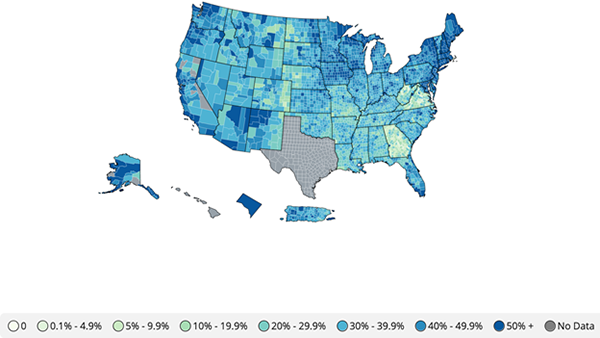
Source: CDC (https://covid.cdc.gov/covid-data-tracker/#county-view) as of June 6, 2021.
Other places such as India, where the country’s government did not put a major emphasis on rapid vaccination despite being the “pharmacy of the world,” suffered heartbreaking tragedies during the second wave of infections caused by a more transmissible variant. I have lost some extended family members in India due to COVID-19 and hence the tragedy has hit close to home for me.
India put a ban on all vaccine exports; but because India is a major vaccine manufacturer, supplies of vaccines were delayed for low- and middle-income countries in Africa and South and Southeast Asia. While those countries could not vaccinate their people owing to supply shortages, the mutant virus spread as travel and commerce continued in the connected world. Suddenly, half the world became highly vulnerable. The United Kingdom (U.K.), United States, United Arab Emirates, Canada and Australia later banned travel from India and South Asia but not before the mutant virus landed on their respective shores and spread again among the unvaccinated. In the U.K. the case counts recently rose by 99% over a month from about 2,000 to 4,000 per day. It is still a small increase compared to what happened during the winter months this year but is a concern.
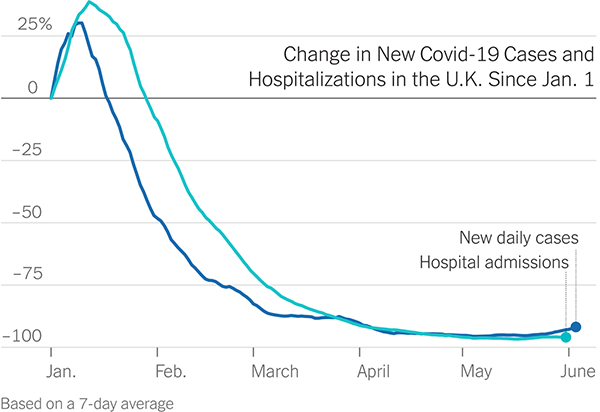
Source: The New York Times and Government and health agencies of the United Kingdom
What is the Next Step?
So, what should the world do now? It was well known from the very beginning that vaccinating the entire world population of 7.9 billion was not going to be easy. I dedicated a whole column to describing the challenges earlier in the year, so will not do that again. But production capacity and distribution are key bottlenecks. There are several vaccines available in the marketplace manufactured by different countries, but there are only a limited number of suppliers of ingredients. Just like in any global supply chain, COVID-19 vaccines, especially the most effective mRNA vaccines, require certain essential lipids that are not produced at scale.
Another thing to keep in mind is that this vaccine is new, not even a year old in the marketplace. The mRNA technology platform is also new for manufacturing vaccines at scale. Just like with any other new products, there are hiccups in ramping up production across a global supply chain. The problem becomes much more acute when the demand outstrips supply in an order of magnitude level like now. It will be one to two years before this supply chain can become adequately robust and stable to meet the global demand. Vaccinating all citizens of a country outside of the rich, Western nations by the end of 2021 is a pipe dream. In some cases, it might be the end of 2022, 2023 or even 2024.
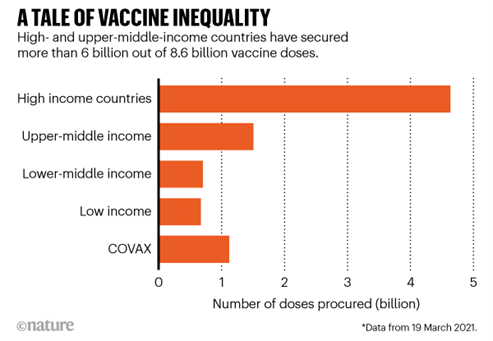
Source: Nature magazine
The supply chain problem was compounded by the fact that last year the United States invoked the Defense Production Act to secure ingredients for producing vaccines for its citizens, leaving very little opportunity for other country-based manufacturers to produce vaccines. This became a foreign policy issue for the Biden Administration when the CEO of the world’s largest manufacturer based in India tweeted to the POTUS to lift restrictions on the export of vaccine ingredients. Since then the Biden Administration has moved to release ingredients as well as send excess vaccine doses overseas. But clearly the West needs to do more.
China and Russia, meanwhile, have jumped on the “vaccine diplomacy” bandwagon and have sent vaccines to many countries such as the United Arab Emirates and Brazil. Those quantities are, however, miniscule compared to the demand. mRNA vaccines, especially the one from Pfizer, require extremely cold temperatures for storage and distribution. This is very difficult to accomplish in many tropical, low- and medium-income countries, especially in their rural areas. Adenoid vaccines such as the one from Johnson & Johnson would be a better alternative since it can be stored in standard fridge temperatures that are easier to maintain in warmer and rural countries. But J&J vaccines are in short supply even in the U.S. owing to manufacturing debacles.
In addition, there are regulatory hurdles to clear different vaccines in many countries. Some countries have now proclaimed that any vaccine that is either FDA or World Health Organization (WHO) approved would be approved to be used in their countries. That is a sensible approach, and all countries need to adopt that. But a lot is resting on the U.S. because very soon it will have more vaccines than needed. The rate of export needs to be accelerated.
The other thing that needs to be considered is a temporary “technology transfer” from the inventor of vaccines to contract manufacturers. Increasing the manufacturing capacity would lead to higher throughput in a short period of time, provided ingredients supply could be ramped up as well. The key challenge would be an adequate level of training, equipment and facility development. The WHO is already talking about a global collaboration like this where universities might provide help to set up regional vaccine production factories around the globe.
In terms of COVID-19 vaccines, humankind is trying to move at a pace that was unheard of in the past. Competitors are becoming collaborators in this effort, which is quite unprecedented. But the world can’t wait very long. The virus is mutating; it is trying its best to break through the vaccine protections. Pundits have warned that this is not the last pandemic that we are witnessing; the next one would not take 100 years to arrive. All our scientific achievements would become ineffective if humankind does not come together in a more cohesive way and build rapid vaccine discovery, manufacturing and distribution capacity in a decentralized manner across the globe.
We need to come to terms with the fact that the size of a country’s GDP should not control whether it will have access to communicable disease protection in a timely fashion. We no longer live in isolation, regardless of what certain politicians might say. Pandemic protection would be our biggest test of coming together as one species.
Rajib Ghosh is the founder and CEO of Health Roads, LLC, a consulting company for enabling digital transformation in healthcare organizations. He has 25 years of technology experience in various industry verticals where he had management roles in software engineering, data analytics, program management, product management, business operations and strategy development. Ghosh spent a decade and half in the U.S. healthcare industry as part of a global ecosystem of medical device manufacturers, medical software vendors, telemedicine and telehealth solution providers. He’s held senior positions at Hill-Rom, Solta Medical and Bosch Healthcare. His recent work includes leading data-driven digital transformation in the public health space, including county-level healthcare agencies and organizations focused on underserved populations.
([email protected])