


October 9, 2018 in In Memoriam
Martin Shubik (1926-2018)
SHARE: PRINT ARTICLE: https://doi.org/10.1287/orms.2018.05.16
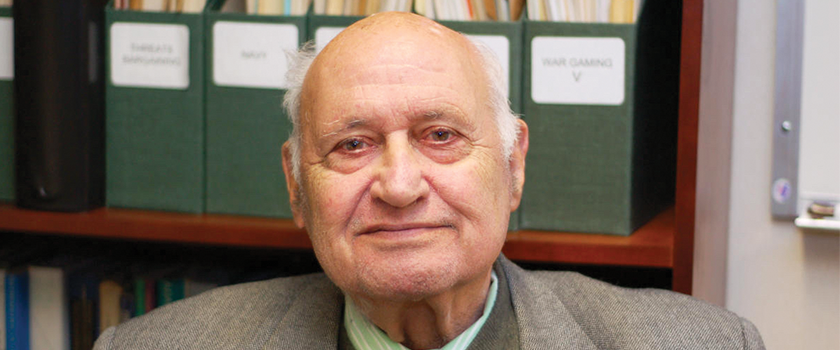
Martin Shubik, a renowned economist, a pioneer of game theory, a “giant” in the OR/MS field and a member of the faculty at Yale University for 55 years, passed away on Aug. 22. He was 92. The Seymour H. Knox Professor Emeritus of Mathematical Institutional Economics at the Yale School of Management, Shubik was perhaps best known for using the tools of game theory to better understand numerous phenomena of economic and political life.
“Martin Shubik made outstanding and fundamental research contributions to game theory (including cooperative and experimental games), defense analysis and the theory of money and financial institutions,” said Edward Kaplan, a professor at Yale SOM and a past president of INFORMS. “With Martin, we are talking about Nobel Prize quality research that travels far beyond ‘outstanding’ to as many superlatives as you can think of.”
Shortly before his death, Professor Shubik was informed that he had been named an INFORMS Fellow, which made him “very, very happy” according to Kaplan, who nominated Shubik for the honor.
Social Scientist at Heart
An economist by title and reputation who studied mathematics and physics and spent many years in the Yale School of Management, Professor Shubik considered himself a social scientist – a reflection of his diverse interests and passions. In their founding days, the fields of operations research and management science attracted scientists from such diverse fields and so it was with Professor Shubik.
An abstract of Professor Shubik’s paper, “Game Theory and Operations Research,” was presented at the 1953 Annual Meeting of the Operations Research Society of America (ORSA, a forerunner of INFORMS) and appeared in the first issue of the society’s journal Operations Research. Shubik revisited the topic in “Game Theory and Operations Research: Some Musings 50 Years Later” in the 50th anniversary issue of the journal. He won the Lanchester Prize from ORSA in 1983 for his book, “Game Theory in the Social Sciences,” and the Koopman Prize from INFORMS in 1995 with Jerome Bracken for the application of game theory to nuclear coalitions and crisis stability.
“Scholars in many fields count Shubik as an inspiration and a collaborator,” Christopher S. Tang wrote in a letter supporting Shubik’s nomination to be an INFORMS Fellow. A professor at the UCLA Anderson School of Management and a prominent member of INFORMS who received his Ph.D. in management science at Yale, Tang added that “[Shubik’s] research contributions to game theory are superb and easily merit the Fellow designation, but the same could be said separately for his work on defense analysis and on military gaming. His overall body of work is so innovative, penetrating and voluminous that it has had enduring effects on research, education and practice.”
The Early Years
Martin Shubik was born in Manhattan, New York, on March 24, 1926 to Joseph and Sara Shubik, Jewish immigrants from Russia and France, respectively. Weeks after Martin’s birth, the Shubiks moved to England, where they lived until 1940 when, in the wake of increased German bombing, Joseph sent his wife, son and then 10-year-old daughter Irene to Canada to stay with relatives.
Martin Shubik finished high school at Pickering College in Newmarket, Ontario, a suburb of Toronto. He once described himself as having been an “erratic scholar” in high school, doing well in history, English, algebra and other subjects but poorly in geometry. (“I see well in many dimensions as long as the dimensions are around two,” he once said.) Shubik received a scholarship to the University of Toronto, majoring in mathematics reportedly with the objective of being a “consumer” of mathematics on a hunch that the social sciences were going to become highly mathematized.
After a stint in the Royal Canadian Navy where he earned the rank of lieutenant, Shubik completed his bachelor’s degree as well as a master’s degree in political economy at the University of Toronto.
In a 2016 lecture reported on by the Yale School of Management News, Shubik said his study of physics taught him to think about using mathematical models to describe complex phenomena. His mind sought to examine and formalize the world around him in order to better understand it. While serving in the Royal Canadian Navy, he watched daily routines, such as the boat drill, and wondered whether they were optimal procedures. “I more and more started to see questions that were operations research-like,” Shubik said.
While at the University of Toronto, Shubik wrote his master’s thesis on quipos, the knotted strings used as a form of communication and for accounting in the Incan empire., but it was an assignment – a book review –in an economic theory course that ultimately changed his career projection. Shubik happened to choose “The Theory of Games and Economic Behavior” by John von Neumann and Oskar Morgenstern to review. The book obviously made an impression on Shubik, who went on to get a Ph.D. in game theory at Princeton University.
At Princeton starting in 1950, Shubik found himself in the midst of a “rich intellectual brew,” studying with Oskar Morgenstern and Albert Tucker and sharing a suite with Lloyd Shapley and John Nash, who became co-authors and lifelong friends of Shubik’s. The intellectual brew included such luminaries as Thomas Whitin, Otto Eckstein and Gary Becker on the economics side and Marvin Minsky, John McCarthy, Herbert Scarf, Ralph Gomory, Richard Karlin, Alan Hoffman and Harlan Mills in mathematics.
“A Method for Evaluating the Distribution of Power in a Committee System,” a seminal paper co-authored by Shubik and Shapley, came out of this period. “Martin’s work in game theory is legendary,” said Kaplan, pointing to that early paper as a substantial part of Shubik’s legacy. “It introduced the well-known Shapley-Shubik index that became a staple in the study of elections and assembly voting (such as in the United Nations).”
Post Doc Days
After completing his doctorate, Shubik spent four years working for General Electric, a position that gave him an opportunity to look into nearly every facet of the economy. In 1961, Shubik joined IBM Labs and began his search for a viable theory of money in microeconomics. Shubik eventually settled in back at Yale, his academic home for the past 55 years, where he taught courses in economics, game theory and investment theory and practice. Professor Shubik also served as the director of the Cowles Foundation for Research in Economics from 1973 until 1976, and he was one of the founding faculty members of the Yale School of Management (then the School of Organization and Management).
In the 1970s, Professor Shubik also returned to the elusive theory of money and microeconomics that had eluded him a decade earlier, only this time he built a model that, in collaboration with Shapley, treats money as a commodity traded for other commodities in a multiplayer game. He continued to build on the model well into the 21st century, publishing three lectures in 2016 on the theory of money and financial institutions. Shubik coined the term “mathematical institutional economics” to describe his approach to understanding the economy.
Professor Shubik’s longtime Yale colleague Shyam Sunder described what may have been Shubik’s greatest intellectual preoccupation: “Until the end, Martin Shubik explored money and the institutions societies create to make it serve human ends. Money – the most concrete yet the most ephemeral of objects of value – occupied his theorizing, gaming, teaching and investing.”
Among family and friends, Shubik was known as an excellent cook and a lover of food, art and humor, and he remained closely connected to friends from every period of his life and continued to add friends till the end.
Professor Shubik is survived by his wife of 50 years, Julie Shubik; his daughter Claire Shubik-Richards; his son-in-law, economist Seth Richards; grandsons Elliott and Leopold Shubik-Richards; his niece Anna Shubik Sweeney and her family; and his sister, the pioneering television producer Irene Shubik.
Acknowledgment
This article is based on multiple sources, most notably the INFORMS History of O.R. Excellence and the Yale School of Management News, from which several passages were drawn.
SHARE: