
February 3, 2020 in Machine Learning
Fighting fake news during disasters
Machine learning, game theory shown to be effective tools to monitor, debunk misinformation.
SHARE: PRINT ARTICLE: https://doi.org/10.1287/orms.2020.01.06
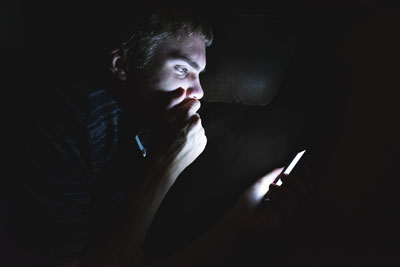
With billions of daily users, social media platforms prove to play an important role in the dissemination of news, opinions, comments and even personal updates. On sites such as Twitter and Facebook, users can find up-to-date information on just about any topic of interest. Given the extreme speeds at which information can travel across these platforms, they play a vital role in the dissemination of timely news, such as political updates and risk communications.
Although there are significant benefits of using social media to release timely news and updates, the unmoderated nature of sites such as Twitter can create a rumor mill among users. When false information is maliciously or mistakenly spread on social media sites it can result in millions of misinformed users. Over the last decade, there has been an overwhelming amount of cases where false news spreads during crisis events, such as natural disasters and terrorist attacks. This misinformation proves to be very dangerous during these menacing situations, as the integrity and accuracy of emergency communications is of the utmost importance. Given that emergency communications are often needed for affected populations to make informed decisions regarding planning and evacuation, it is vital that misinformation is controlled in an effective and efficient manner.
Spread of Fake News on Twitter During Crises
To understand the magnitude of fake news dissemination during crisis events, we turn to real cases that occurred within the last decade.
In October 2012, Hurricane Sandy caused destruction across the Caribbean before impacting the entire East Coast of the United States. The storm caused significant devastation throughout New Jersey and New York. As a result of the storm’s surge, New York City was victim to flooded streets, subway lines and tunnels. On Oct. 28, 2012, a meteorologist incorrectly informed CNN that the floor of the New York Stock Exchange (NYSE) was flooded. An invalid tweet was posted, which read: “BREAKING: Confirmed flooding on NYSE. The trading floor is flooded under more than 3 feet of water.” After this false information was disseminated throughout the news and social media, a NYSE official denied that there was any flooding, and CNN issued a correction. This misinformation caused a significant panic among the public in New York City and around the world, as damage to the floor of the NYSE could have resulted in an economic hit, as well as the loss of a landmark building.
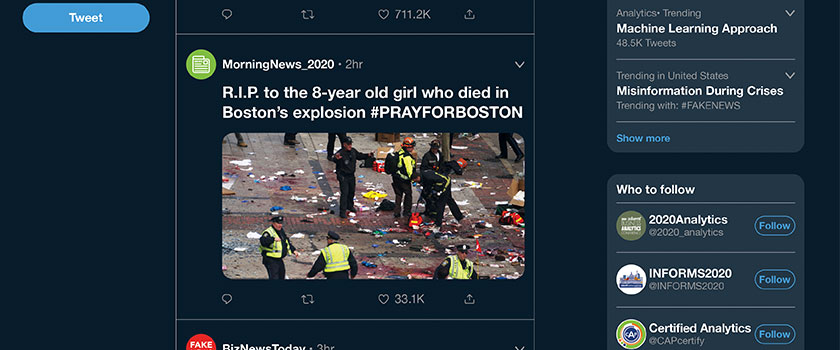
 Every year, the Boston Marathon attracts around 30,000 contestants and even more fans supporting the event. During the 2013 race, a bombing near the finish line killed three people and injured many more. This act of terrorism led to a panic throughout Boston, and law enforcement evacuated the area and halted flights leaving Boston. During the online dismay that followed, many false rumors were spread. One of the most widespread rumors stated that a young girl, who was running in remembrance of the Sandy Hook victims, was killed in the bombing. A tweet, which read “R.I.P. to the 8-year old girl who died in Boston’s explosions, while running for the Sandy Hook kids. #prayforboston,” received more than 33,000 retweets, reaching millions of users across Twitter’s network. This false information diverted attention away from other critical news following this extreme act of terrorism.
During Hurricane Harvey in August 2017, many homes and buildings in Houston were destroyed as a result of high winds and overwhelming flooding. When residents were evacuating their homes in an effort to find safety, a malicious false rumor was spread across Twitter, which stated that undocumented immigrants could not seek safety in Texas shelters. The claim was that shelters were checking IDs at their doors, and therefore undocumented immigrants would not be able to enter. This proved to be extremely dangerous to the lives of more than 500,000 undocumented immigrants in the Houston area, as their opportunities for reaching safety were unfavorable.
On Oct. 1, 2017, the United States was struck by an act of terrorism as a shooter opened fire at an outdoor concert in Las Vegas. The shooting resulted in 58 deaths and more than 400 injuries from gun shots. Many concert attendees rushed to find safety and evacuate the area, while many emergency responders and volunteers showed their heroism as they remained in the high-risk area to tend to the wounded people. In the chaos that ensued, false information was spread both online and offline, leading to skewed beliefs and unneeded misguidance. One of the most prominent pieces of misinformation, which was spread by an emergency dispatcher, claimed that the University Medical Center was completely out of beds and no more patients could be serviced. This information quickly contaminated Twitter’s network and led to the falsehood being extensively spread. False news such as this can cause significant harm, as the injured people needed prompt medical attention.
Although there are many cases where misinformation has been spread during disaster situations, these selected cases show the panic and distress that false news can cause during threatening situations. To resolve misinformation that is spread during disasters, major accounts such as government organizations, news agencies, public figures and emergency managers often post to social media to dispel the falsehoods and offer corrected information.
Correcting Fake News
The threat of misinformation propagating throughout social media brings the need for timely and valid debunking posts from trustworthy accounts. Without such posts, Twitter users may remain misinformed, resulting in a wider reach of the incorrect news. In many of the cases where false information spreads during disaster events, government accounts and other major accounts turn to social media to supply the public with updated information. Sometimes this false news is even posted on web pages to expose the risks.
Following the Boston Marathon bombing and the Las Vegas shooting, false news was addressed on websites such as The New York Times, The Washington Post, USA Today and The Wall Street Journal. Additionally, many accounts posted to Twitter in order to disprove the inaccuracies.
When rumors were spread during Hurricane Sandy, the Federal Emergency Management Agency (FEMA) released a Hurricane Sandy “Rumor Control” page, where the false rumors were debunked. Many other accounts took to social media to correct the falsehoods. In the case of the NYSE flooding rumor, the account that originally spread the misinformation ended up posting a new tweet to admit to the wrongdoing, and the account also released a public apology.
When false news was spread during Hurricane Harvey, a huge debunking effort was exhibited by many different agencies. Similar to Hurricane Sandy, FEMA released a Rumor Control page that listed all of the false rumors. Aside from this, many governmental and news agencies, including Immigration and Customs Enforcement (@ICEgov), Customs and Border Protection (@CBP), the City of Houston (@HoustonTX), CNN (@CNN) and The Hill (@thehill) posted to Twitter to clarify the misinformation. A tweet from @HoustonTX, which read “WE WILL NOT ASK FOR IMMIGRATION STATUS OR PAPERS AT ANY SHELTER. No vamos a pedir documentos ni estatus migratorio en ningun albergue,” received more than 100,000 retweets, proving to be an extremely effective debunking effort.
From our conversations with emergency managers, and the historical evidence showing the many rumor debunking strategies, the process of identifying and monitoring misinformation can require a significant amount of time. In order to correct false news, agencies must first identify the case, and subsequently track the online and/or offline activity to understand the coverage of the topic. If the story has reached a large number of people, and no other major accounts have clarified the misinformation, then the agency will likely choose to expend their human resources to debunk. If the case is not widespread, or if other accounts have made significant debunking efforts, then agencies will likely choose to remain out of the conversation.
Tracking tweets to monitor the impact and depth of the information spreading takes significant efforts and human resources, and through our research, we have shown how machine learning can be used to limit the need for human intervention in monitoring misinformation.
A Machine Learning Approach to Monitor Misinformation
Machine learning proves to be an effective tool to automatically monitor misinformation during disasters. By training algorithms on a small portion of incoming data related to a misinformation case, the models can be deployed to predict the veracity of newly emerging tweets. After tweets are collected from Twitter’s API and labeled based on the veracity of their content (as either true, false or neutral), our framework is put to work to learn the labeled tweets, and subsequently predict the veracity of new tweets. To learn Twitter data, our methods vectorize the text of tweets using term frequency-inverse document frequency (tf-idf), and also take into account numerical features such as the number of retweets and likes. The extracted features are used to train the models using k-fold cross-validation, and then the models are tested on new data. The results of this study show that out of eight different algorithms, Support Vector Machine performed the best in monitoring misinformed tweets, achieving a predictive performance of over 87%. This research was driven by the need for efficient methods to monitor misinformation during crisis events.
So, how can this work, and how does it prove to be more effective than traditional methods?
When misinformation is identified on social media, agencies can easily collect some of the tweets using the Twitter API. After collection, the agencies then label the tweets as either true, false or neutral. The tweets are then fed into our framework to train the models and then deploy them on newly emerging tweets. From the results of the framework, analysts can easily and automatically monitor the misinformation to see if users are continuing to post false news related to the misinformation or are beginning to share the truth.
The analysts can also see who the accounts are that are spreading or debunking the misinformation. Depending on the number and nature of the accounts posting about the misinformation, the analysts can make informed decisions on whether to debunk. Traditionally, misinformation is manually monitored, requiring human resources to read and track the cases. With this automated approach, agencies can quickly quantify the misinformation’s spread.
Using Game Theory to Support Debunking Decisions
When multiple rumors propagate, official agencies must choose the specific rumor case(s) to debunk in order to effectively use their resources. Using their available information, they can quickly react to minimize the spread of these rumors. If this information is imprecise, it can cause widespread confusion, and people may continue to trust misinformation and spread it unknowingly. If agencies choose to invest time to completely learn and verify the details of a possible misinformation case, this can allow false news to spread with full force, making the process of strategic decision-making very challenging.
We apply game theory to develop mathematical frameworks that can model the strategic interactions between official agencies and social media users during false rumor propagation. In game theory, each player considers the strategies of the other player(s) in formulating her own strategy to maximize her expected payoff. In a misinformation debunking-spreading game, the official agencies have a set of objectives, that is, to minimize the costs of debunking and the impact of false news transmission. On the other hand, social media users have a different set of objectives, such as maximizing their influence and credibility rating in the social networks.
Based on these objectives, game-theoretic models serve as decision support tools for the emergency agencies to make critical decisions regarding the rumor cases that need to be debunked, and subsequently releasing correct information to the public by effectively utilizing available resources. These models can also be utilized to determine the optimal debunking strategies for the government agencies so that they can minimize the spread of misinformation during crisis events by addressing the trade-offs between reacting fast with partial/incomplete information and reacting at a later stage with complete information.
Acknowledgment
The research described in this article was partially supported by the National Science Foundation under Award No. 1762807. Any opinions, findings and conclusions or recommendations expressed in this material are those of the authors and do not necessarily reflect the views of the NSF.
Kyle Hunt is a Ph.D. student in Industrial and Systems Engineering at the University at Buffalo, with a concentration in operations research. His research has been funded multiple times by both National Science Foundation REU awards and by the University at Buffalo’s Experiential Learning Network. His research interests are in emergency management, national defense and sports analytics. He has received the School of Engineering and Applied Sciences (SEAS) Dean’s Excellence Scholarship, the SEAS Dean’s Achievement Award and the University at Buffalo’s Research and Scholarship Award of Distinction. Puneet Agarwal is a Ph.D. student in the Department of Industrial and Systems Engineering at the University at Buffalo. His research interest lies in the field of disaster risk management and strategic decision-making. In 2019, he received the Geohazards Research Award from the University at Buffalo’s Center for Geohazards Studies to support his research on misinformation diffusion during disasters. Like Hunt, his team’s research has been widely covered in publications and by media agencies. Ridwan Al Aziz is a Ph.D. student in the Department of Industrial and Systems Engineering at the University at Buffalo. A Presidential Fellow, Al Aziz received his B.Sc. degree and M.Sc. degree in industrial and production engineering (IPE) from Bangladesh University of Engineering and Technology, where he also served as a faculty member in the IPE department for three years. His research interests include leveraging data analysis, machine learning and game theory for analyzing information diffusion, debunking rumors in social media and securing the U.S. border. Jun Zhuang is a professor in the Department of Industrial and Systems Engineering at the University at Buffalo. His long-term research goal is to integrate operations research, big data analytics, game theory and decision analysis to improve mitigation, preparedness, response and recovery for natural and man-made disasters. Other areas of interest include applications to healthcare, sports, transportation, supply chain management, sustainability and architecture. His research has been supported by the NSF, U.S. Department of Homeland Security, U.S. Department of Energy and other federal organizations. Zhuang has published more than 100 peer-reviewed journal articles in Operations Research, IISE Transactions, Risk Analysis, Decision Analysis and European Journal of Operational Research, among others.