


July 30, 2020 in International Analytics Education
PARIS21 project receives warm welcome in Caribbean
Buoyed by success in Grenada, teaching team makes plans to take statistics literacy workshops to rest of region and beyond.
SHARE: PRINT ARTICLE: https://doi.org/10.1287/orms.2020.04.07

On May 5, 2019, Yu Tian and Millicent Gay Tejada, two representatives of the Partnership in Statistics for Development in the 21st Century (PARIS21), reached out to me with an interesting proposition. PARIS21 was established in 1999 by the United Nations, European Commission, Organisation for Economic Co-operation and Development (OECD), International Monetary Fund and World Bank to promote better use and production of statistics throughout the developing world. Since its establishment, PARIS21 has successfully developed a worldwide network of statisticians, policy makers, analysts and development practitioners committed to evidence-based decision-making. This network supports PARIS21’s objectives of achieving national and international development goals, reducing poverty in low- and middle-income countries, and creating a culture of management for development results.
Tian is a policy analyst who monitors the global support of statistics and global statistical literacy. He also engages in reporting of sustainable development goal (SDG) indicators, measuring the use of statistics in policy making and other analytical tasks. Tejada is the project officer for Asia and the Pacific. She is responsible for the development of statistical strategy for the region. When they reached out to me, Tian and Tejada had been following the development of the “Handbook on Statistical Methodology” by the National Statistical Office of Mongolia (NSO) and a team of U.S. colleagues, of which I was a member [1, 2]. Tian and Tejada believed that a similar approach could be taken to improving statistical literacy and growing statistical capacity in Caribbean countries, and they hoped I would work with them on this initiative.
I had worked with colleagues on statistics/operations research/analytics literacy and capacity building projects in several other nations (Uruguay, South Africa, Colombia, India, Kenya, Argentina, Nepal, Cameroon, Tanzania, Fiji, Cuba, Tunisia and Mongolia [3, 4]), so I was eager to work with PARIS21 colleagues. Through further engagement and discussion, we determined the topics to be covered and that our first efforts would focus on high school education in Grenada, a Caribbean island nation north of Trinidad and Tobago. Tian and Tejada proposed a three-day workshop on “effectively teaching introductory statistics for high school teachers” to Grenadian government officials. The NSO and Ministry of Education Grenada quickly indicated their enthusiasm for the project and their willingness to host the workshop.
Contingent on the success of the Grenadian workshop, we also made plans to roll out similar workshops across the Caribbean and Central America over the following few years, organize the participants of these workshops into workgroups that would develop chapters for a “Handbook on Statistical Methodology” oriented to the region, and establish a recurring Caribbean and Central American conference on effectively teaching statistics. We planned to eventually extend this program to developing regions outside the Caribbean and Central America, and ultimately consider replicating the program for operations research.
I recruited a team of innovative and respected statistics instructors to create material and teach at the workshops. The team included: Anna Bargagliotti (Loyola Marymount University), Beth Chance (Cal Poly San Luis Obispo), Christine Franklin (University of Georgia), Kaycie Maddox (Northeast Georgia Regional Educational Service Agency), Roxy Peck (Cal Poly San Luis Obispo), Lynne Steuerle Schofield (Swarthmore College) and Nathan Tintle (Dordt University).
The team developed material at the high school level on:
- “Motivation: Why teach/study the material in this module?”
- “Organization and Flow: How can/should coverage of the key concepts be organized?”
- “Key Concepts: How can each of the key concepts and terms in this module be effectively covered?”
- “Examples: How can this material be applied to real problems?”
- “Helpful Hints: What else can we suggest for this module?”
for modules on:
- data visualization and descriptive statistics,
- probability for statistics,
- basic statistical inference,
- regression analysis, and
- experimental design and sampling.
The team decided that Chance, Tintle and I would travel to St. George’s in early December to deliver the inaugural workshop for this project. The 1st Caribbean & Central American Workshop on Statistical Literacy for High School Students was opened on Dec. 3, 2019, with a welcome from Halim Brizan, director of statistics with Grenada’s Ministry of Finance. Throughout the three-day workshop, 25 colleagues (primarily high school teachers along with a few college instructors and officials from the National Statistics Office and Ministry of Education Grenada) participated. The participants were highly engaged and extremely enthusiastic, and they gave outstanding reviews of the workshop. The Grenada Broadcasting Network provided national coverage of the workshop [5].
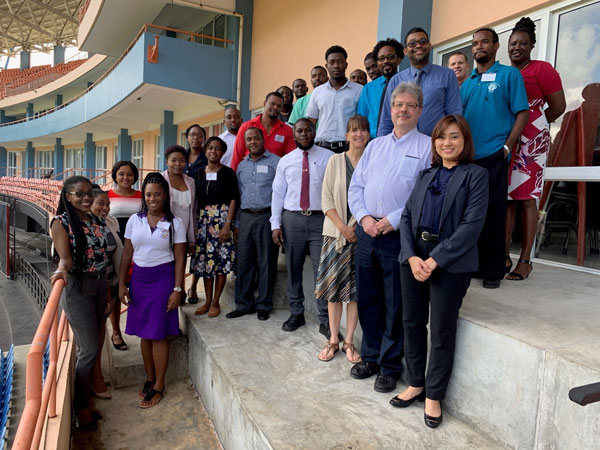
Attendees of the 1st Caribbean & Central American Workshop on Statistical Literacy for High School Students.
Efforts to roll out similar workshops across the Caribbean and Central America over the following few years are proceeding, albeit more slowly than originally hoped due to the global coronavirus pandemic. As these efforts progress, organization of the participants into workgroups that will develop chapters for the “Handbook on Statistical Methodology” oriented to the region can commence, and eventually the recurring Caribbean and Central American conference on effectively teaching statistics can be organized. As these efforts proceed, the program can be extended to developing regions outside the Caribbean and Central America and can be replicated for operations research. This was a terrific first step in what we hope will be a very productive and rewarding endeavor.
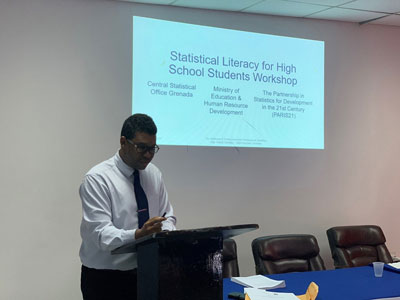
Halim Brizan, director of statistics with Grenada’s Ministry of Finance, welcomes workshop participants.
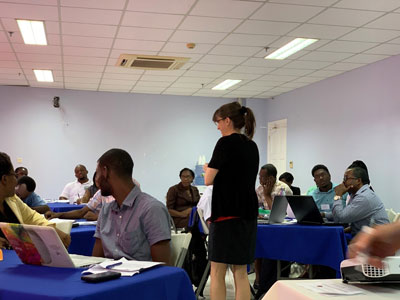
Beth Chance discusses statistical inference.
References
- Sonomtseren, Mendsaikhan; Sodnomtseren, Altantsetseg; and Zorigt, Khuslen, 2016, “O.R. without borders: Introducing O.R. in Mongolian schools,” OR/MS Today, Vol. 43, No. 4.
- Cochran, James J., 2018, “Ambassadors and O.R. education,” OR/MS Today, Vol. 45, No. 4.
- Cochran, James J., 2013, “How do you find and prepare for opportunities to work in developing nations? AMSTAT News, June.
- Cochran, James J., 2015, “An O.R. perspective on U.S./Cuba relations,” OR/MS Today, Vol. 42, No. 2.
- https://www.facebook.com/watch/?v=2736786999675140
James J. Cochran is associate dean for research and professor of applied statistics at the Culverhouse College of Business, University of Alabama. He is chair of the INFORMS Magazine Editorial Advisory Board.
([email protected])