December 9, 2020 in Food Supply Shortage
Has COVID-19 ‘broken’ our food supply chain?
Pandemic highlights challenges that need help from data science, analytics and operations research skills.
SHARE: PRINT ARTICLE: https://doi.org/10.1287/orms.2020.06.02
The headline blared, “A tenth of the world could go hungry while crops rot in the field.” An aerial image of an endless queue of cars at a food bank was juxtaposed with a shot of a dairy farmer dumping milk down a barn floor drain. The gap between the food demand and supply and its human toll on both ends is gut wrenching.
My colleague on the Board on Agriculture and Natural Resources (BANR) of the National Academies of Sciences, Engineering, and Medicine sent me the Bloomberg article [1]. It is a sobering account. But as someone who developed algorithms to manage complex supply chains for a multinational corporation, it piqued more questions than answers. What’s really going on? Exactly how has the COVID-19 pandemic “broken” our food supply chain? And more to the point, what are the challenges for the operations research (O.R.) community?
The food and agriculture industry is diverse, complex and mind-bogglingly massive. At the recent “Perspectives on COVID-19 and the Food and Agriculture System” webinar hosted by BANR, former U.S. Secretary of Agriculture Tom Vilsack said the food and agriculture industry represents roughly 28% of the U.S. workforce and is connected to 20% of the U.S. economy.
Pre-COVID-19, the food system was largely underappreciated by most U.S. consumers who have access to a full-scale grocery store. It is an incredibly efficient system. With the exception of food deserts, it provides affordable food and abundant choices to consumers. But has the pandemic demonstrated that the food supply chain is not as resilient as it needs to be?
COVID-19 Shocks Food Supply Chain
Shocks to the food supply chain are not unusual. As the old adage goes, “farming is legalized gambling.” In fact, farming is so risky that crop insurance is subsidized by the U.S. government to ensure an adequate food supply [2]. Risks from weather events, such as hurricanes, droughts and hailstorms, are expected. Foodborne disease outbreaks happen [3].
These events, however, are localized to a geographic region, a business or a food [4]. COVID-19 caused shocks on a global scale not seen since World War II. In March 2020, after impacting 144 countries in three months, the virus was declared a pandemic by the World Health Organization. All segments of the food supply chain (farm production, processing, transportation and consumer demand) were simultaneously disrupted.
Many of these disruptions were the results of measures aimed at trying to contain the spread of the virus. Borders closed. Workers were restricted. Businesses shutdown. Enhanced safety protocols, new operating procedures and increased oversight were instituted. However, not all sectors and products were equally affected. Different products experienced disruptions at different stages of the supply chain.
‘Food Away From Home’ Demand
The U.S. food supply chain is divided into two roughly equal and disjoint sectors: the retail (“at home”) food sector and the food service (“away from home”) sector [5, 6]. When schools, restaurants and businesses closed as part of the economic shut down, demand from the food service sector vanished – abruptly.
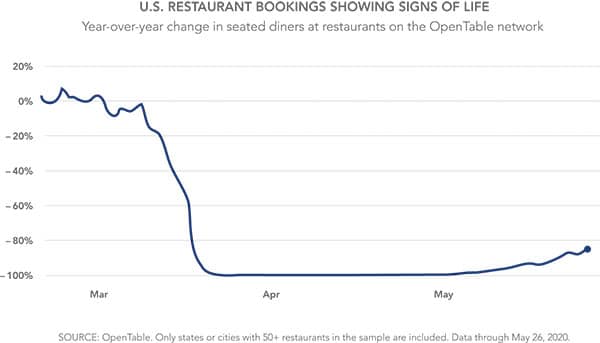
Figure 1. The state of the U.S. restaurant industry.
Source: https://www.opentable.com/state-of-industry
The food service sector supply chain connects a different set of actors than the retail sector supply chain. We eat different food at home than we do in restaurants. For example, most oysters are eaten away from home. A study conducted at Virginia Tech in spring 2020 found that only 3% of mollusk farmers were not impacted by the pandemic [7].
It is nontrivial to pivot food supplies from the service to the retail sector. Consumption patterns, quantities, packaging, label requirements and quality expectations differ. The oyster industry faces serious impediments because many Americans don’t know how to shuck or cook oysters at home, consider oysters a luxury item, and prefer a petite size, which is exceeded if harvests are delayed [8]. Potato varieties that make the perfect frozen French fries, such as Ranger Russet, aren’t well-suited for the fresh market or other types of processing [9, 10].
Restaurants closed at a time when food banks were experiencing an increasing need for their donations, while adding furloughed workers to the ranks of those in need of food assistance – a shutdown double whammy. If food service sector producers can’t find alternate buyers, they are left with three options: stockpile, donate or dump.
Stockpiling requires storage capacity and amenable product shelf lives. Some products, like soy beans, can be stored for long periods. Others, like fresh fruits and vegetables, are highly perishable. Even with proper temperature and humidity storage, the average shelf life from harvest to table for a long-distance market strawberry is just seven days, a narrow window for supply chain adjustments [11].
Donations require a distribution network. Who provides the harvesting, packing and transportation? Cranney Farms in Oakley, Idaho, offered its crop of 2 million potatoes to anyone who wanted to come and get them. Even if farmers opt to make the donation at a time when their operations are facing rising losses and uncertainty, food donation centers (that have historically handled more dry goods) need the capacity to receive and safely store high-volume fresh food deliveries. Feeding America, the nation’s largest domestic hunger relief organization, reported a nearly 60% decrease in volunteers in April.
Dumping is the option of last resort. It doesn’t make sense to spend additional money to pick, package and store products that no one is going to buy. The cost-effective option in this case is plowing under the crop. At least $5 billion of fresh fruits and vegetables have already been wasted, according to estimates from the Produce Marketing Association [12]. Even when major segments of the milk market dried up virtually overnight [13], cows still have to be milked daily and unlike some agriculture products, milk is produced year-round. If there’s no buyer, or ability to store or redirect it to products with longer shelf lives (e.g., cheese, butter, powdered milk), farmers are forced to dump their excess milk. According to the USDA, 43 million gallons have been dumped in 2020.
‘Food at Home’ Demand
Abrupt increases in demand and panic buying caused some initial shortages in grocery stores. (The water supply was not at risk, but people are conditioned to buying water during an emergency, so shelves of bottled water emptied.) Some stores limited purchases of at-risk items per consumer, but stockouts were generally short lived and substitute products were available. Safety stocks along the food supply chain were drawn down to meet the demand [14].
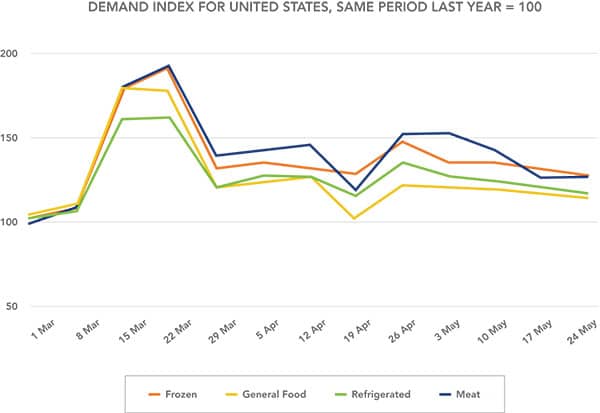
Figure 2. Retail food demand is up and has remained high. The IRI CPG Demand Index measures weekly changes in consumer purchases (in dollar terms) relative to the same period in the previous year.
Source: https://advantage.iriworldwide.com/Engineering/covid19/
Processing
Processing has been disrupted by labor shortages and shutdowns. In the confined space of processing plants, workers are often stationed close together to optimize production [15]. COVID-19 has shone a spotlight on the poor working conditions in meat processing plants as the virus spread and plants closed. The meat processing industry is very consolidated. Almost 60% of the pork processing capacity comes from just 15 plants [16]. When one of these plants is closed, the effects ripple.
For example, hog processing uses standardization to simplify production and increase throughput. Only hogs of a certain size fit into the equipment. If a hog grows too big (typically past six months or 300 pounds), it can’t be processed. As processing plants shut down, hogs continue to grow, leaving farmers in the lurch [17]. In May, the National Pork Producers Council estimated up to 10 million hogs would be euthanized to avoid overcrowding on farms in the coming months.
Transportation
Agriculture and food products use three basic modes of transportation: 1) bulk (ships, barges), 2) containers (boat, rail, truck) and other road transport, and 3) air freight. The most disrupted mode is air freight. The disruption is caused by the steep decline in passenger air travel, which normally accounts for the majority of air cargo capacity. This affected high-value-to-weight perishables that are air shipped. In the week of May 10-16, the global air cargo capacity was 26% lower than during the same period in 2019, with the largest declines (more than 80%) on routes between Europe and Latin America [18].
Quarantine measures and delays in border inspections, including fewer inspectors, also impacted transportation. Commercial road transport in April was about 20% lower than usual in Canada and the United States, impacting dairy and meat traveling by refrigerated containers [19]. Bulk shipments, which are used by grains, had the least disruption.
Farm Production
The most disrupted input to farm production is labor. Some agriculture sectors are more dependent on seasonal labor than others. For example, cereal grains typically require less labor while fruits and vegetables require more. Seasonal workers help plant and harvest fruits and vegetables. Many migrant farm workers use employer-provided camp-style housing and van transportation, making them vulnerable to COVID-19 transmission. In May, Yakima County, Washington, one of the largest suppliers of sweet cherries, apples and pears, had the highest case rate on the West Coast [20].
Remarkable Food Supply Chain Response
The pandemic is still unfolding. Bottlenecks remain and require attention. But all things considered, the food supply chain has demonstrated remarkable resilience in the face of the pandemic to date.
Regulations and procedures for food trade were relaxed and streamlined, e.g., the creation of expedited “green lanes” for food at intra-EU border crossings. Private air freight expanded to help fill the gap following the collapse in passenger air transportation, adding 20,000 metric tons of daily capacity in February and March [21].
Food processors and retailers increased operating hours, hired additional employees, and incentivized labor with COVID-19 bonus pay. The variety of some products was curtailed to the most popular items to reduce manufacturing complexity and simplify inventory management [22]. Alternative sources were found when faced with supply disruptions.
Labeling regulations were changed, and producers leveraged social media to make it easier to sell directly to consumers [23]. Restaurants switched to take-out and delivery, with some offering services such as meal kits rather than prepared food.
Innovative-collaborative responses created new linkages from food service suppliers to food banks, such as the USDA “Farmers to Families Food Box” program, which will purchase up to $4.5 billion in fresh produce, dairy and meats, and has already delivered 117.8 million boxes since May [24].
The ‘Crisis After the Crisis’
There is, however, a looming “crisis after the crisis” that is not a food supply problem, but a food access problem [25]. New levels of food insecurity are forecasted even for countries that had relative stability due to the devastating impacts of the pandemic on jobs and livelihoods. The World Bank predicts that the U.S. economy will contract 6.1% this year and the global economy will shrink by 5.2%. If this is correct, it would represent the deepest recession since World War II. The fraction of economies experiencing declines in per capita output is the largest since 1870 [26].
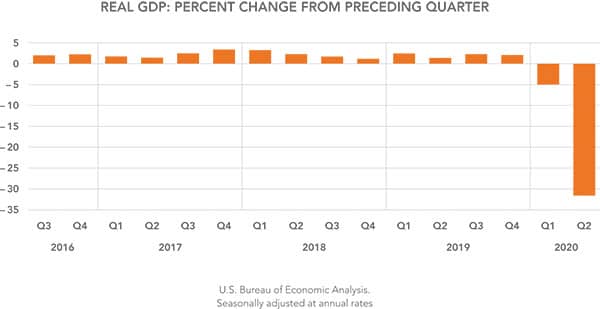
Figure 3. Real gross domestic product (GDP) decreased at an annual rate of 31.4% in the second quarter of 2020.
Source: https://www.bea.gov/news/2020/gross-domestic-product-third-estimate-corporate-profits-revised-and-gdp-industry-annual
Oxfam warns that by the end of 2020 as many as 12,000 people could die per day as a result of hunger linked to COVID-19, potentially more than from the virus itself [27]. Malnutrition and obesity increase the risk of morbidity from COVID-19. Even the mildest forms of food insecurity can have lifelong consequences and contribute to the life cycle of poverty. Safety nets are essential to avoid increases in hunger and food insecurity. Clearly, there are formidable challenges, but are they better characterized as a “broken food supply chain” or a “broken food system?”
More Resilient, Sustainable Food System
In 2019, before COVID-19 when climate change was the preeminent global threat, the “Science Breakthroughs 2030: A Strategy for Food and Agriculture Research by 2030” consensus study sponsored by the National Academies called on the nation to “Establish initiatives to nurture the emerging area of agri-food informatics and to facilitate the adoption and development of information technology, data science and artificial intelligence in food and agricultural research” as one of its five recommendations. This was prescient.
The direct impacts of COVID-19 and the indirect impacts of the efforts to contain the virus have highlighted challenges that need data science, analytics and operations research skills, such as:
- More data and better models to predict and mitigate food supply chain risks.
- Building more resilient, sustainable regional and local food supply chains.
- Forging more agility between food retail and food service sector supply chains.
- Increasing automation to address the food and agriculture labor challenges.
- Scaling e-commerce capabilities for fresh products and groceries.
- Creating multiscale modeling of the food system with sufficient accuracy for useful stress testing (as was done for the monetary system following the financial crisis).
Food and agriculture research has been recently highlighted in the O.R. field, taking top honors in the 2020 Innovative Applications in Analytics Award given by the INFORMS Analytics Society (winning project titled “Integrated Analytics for Sustainable Agriculture in Latin America”) and the 2020 Wagner Prize administered by the INFORMS Practice Section (prize-winning paper titled “Distribution Estimation and Efficient Optimization for Portfolio Management in Agribusiness: Analytical Developments and Benefits”). An impressive body of work has recently been selected for the 2nd edition of the INFORMS Editor’s Cut on agriculture, titled “Feeding the World through Analytics” (pubsonline.informs.org/editorscut).
Since 2015, exposure to real-world challenges and proprietary data sets are made possible by the Syngenta Crop Challenge in Analytics hosted by the INFORMS Analytics Society. Data for food and agriculture is increasingly available, thanks to efforts such as the Platform for Big Data in Agriculture run by the world’s largest consortium of agriculture research centers, CGIAR.
The unanticipated shock of COVID-19 has unleashed the worst global crisis in our lifetime. Although the food supply chain has responded remarkably well thanks to unprecedented action, the crisis is far from over. The food supply and demand are still under stress, which affects not just the supply chain but the government policies, financial markets and social organizations of the broader food system. While effectively responding to the food supply chain challenges, there is an opportunity to learn from the food system weaknesses the pandemic has highlighted. The knowledge and skills of the INFORMS community can help address supply chain challenges, but moreover they can help accelerate the transformation to a stronger, more resilient and sustainable food system.
References & Notes
- https://www.bloomberg.com/news/features/2020-08-31/hunger-is-threatening-to-kill-more-people-than-covid-this-year?
- In 2019, 83% of the crop acreage was insured by the Federal Crop Insurance Program, according to the USDA.
- In 2017, nearly 200 outbreak clusters were investigated by the Centers for Disease Control and Prevention leading to recalls of soy nut butter, soft raw milk cheeses, imported papayas, among others.
- https://www.foodsafetynews.com/2020/04/chipotle-agrees-to-pay-25-million-federal-fine-for-role-in-some-outbreaks/
- In 2018, Americans spent more money on food from full-service and fast-food restaurants ($678 billion) than at grocery stores and warehouse clubs ($627 billion), according to the USDA.
- https://www.ncbi.nlm.nih.gov/books/NBK305173/
- https://www.pubs.ext.vt.edu/content/dam/pubs_ext_vt_edu/AAEC/aaec-218/AAEC-218.pdf
- https://www.nbcnews.com/news/us-news/want-help-save-oyster-industry-eat-bigger-ones-some-farmers-n1212436
- More than 100 different varieties of potatoes are grown in Maine alone to support the highly specialized nature of the potato market, https://www.usnews.com/news/best-states/articles/2020-05-21/covid-19-poses-an-unprecedented-crisis-for-potato-farmers
- https://www.chicagotribune.com/coronavirus/ct-nw-coronavirus-french-fry-potato-surplus-20200505-qjeg7tm6dffixmer5vuy6d5yyi-story.html
- https://rvpadmin.cce.cornell.edu/uploads/doc_98.pdf
- https://www.cnbc.com/2020/05/02/coronavirus-devastates-agriculture-dumped-milk-euthanized-livestock.html
- The biggest buyer of fluid milk in the United States is the National School Lunch Program.
- https://www.bbc.com/worklife/article/20200401-covid-19-why-we-wont-run-out-of-food-during-coronavirus
- https://www.cdc.gov/mmwr/volumes/69/wr/mm6918e3.htm
- http://jaysonlusk.com/blog/2020/4/9/these-15-plants-slaughter-59-of-all-hogs-in-the-us
- https://kpcw.org/post/millions-pigs-will-be-euthanized-pandemic-cripples-meatpacking-plants#stream/
- https://www.accenture.com/us-en/insights/travel/coronavirus-air-cargo-capacity
- https://www.geotab.com/blog/impact-of-covid-19/
- https://www.washingtonpost.com/business/2020/09/24/seasonal-farm-workers-coronavirus/
- http://www.oecd.org/coronavirus/policy-responses/food-supply-chains-and-covid-19-impacts-and-policy-lessons-71b57aea/
- https://www.bbc.com/news/business-51961624
- https://www.fda.gov/media/136469/download
- https://www.ams.usda.gov/selling-food-to-usda/farmers-to-families-food-box
- https://www.nationalacademies.org/event/06-19-2020/covid-19-and-the-food-and-agricultural-system
- https://www.worldbank.org/en/publication/global-economic-prospects
- https://www.oxfam.org/en/press-releases/12000-people-day-could-die-covid-19-linked-hunger-end-year-potentially-more-disease
U.S. Food System Fun Facts
The U.S. food system has evolved to provide (1) choices, (2) convenience and (3) affordability.
- There are more than 200 flavors of Lay’s potato chips (https://www.taquitos.net/snack_guide/Lays_Potato_Chips).
- The average American spends 445% more time watching TV per week day (2.58 hours) than on food preparation and clean up (0.56 hours) (https://www.bls.gov/news.release/atus.t02.htm).
- Household food expenditures as a share of disposable income have steadily dropped over time from 17% in the 1960s to less than 10% in 2019 (https://www.ers.usda.gov/data-products/food-expenditure-series/interactive-charts-food-expenditures/).
Robin Lougee, Ph.D., is an O.R. ambassador, member of National Academies of Sciences, Engineering and Medicine’s Board on Agriculture and Natural Resources, and INFORMS Impact Prize recipient. Connect with her on LinkedIn at https://www.linkedin.com/in/robinlougee/.