
March 4, 2021 in In Memoriam
Alan J. Hoffman (1924-2021)
Founding father of mathematical programming remembered for his work in simplex method, decades-long career at IBM
SHARE: PRINT ARTICLE: https://doi.org/10.1287/orms.2021.02.02n
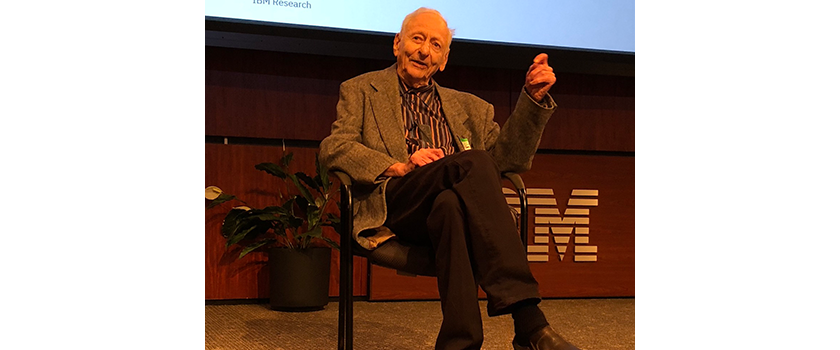
Alan Hoffman, one of the founding fathers of mathematical programming, passed away on Jan. 18, 2021. Over the course of his career, he published upwards of 200 academic papers, more than a third of them with coauthors. His mathematical range spanned numerous areas in both algebra and operations research.
Hoffman, 96, was born in New York City in 1924. He began his undergraduate studies at Columbia University at the age of 16. His education was interrupted when the United States entered into World War II. He served in the U.S. Army from 1943 through 1946 in both Europe and the Pacific. During this period, he developed the beginnings of his ideas in inversion geometry, which became the subject of his doctoral dissertation, completed in 1950 at Columbia.
After a year at the Institute for Advance Study in Princeton, he joined Project SCOOP (Scientific Computation of Optimal Programs) in the Applied Mathematics Division of the National Bureau of Standards (NBS; now the National Institute of Standards and Technology), where he learned about linear programming and the simplex method from George Dantzig. While at NBS, Hoffman developed the first example of cycling in the simplex method, an example that appears in numerous textbooks on the subject, and collaborated with Joe Kruskal on the concept of total unimodularity, providing an explanation of why some linear programs with integer data have integer solutions, and some do not.
Following a year as scientific liaison officer (mathematics) at the London branch of the Office of Naval Research and a brief period in the Operations Research group at General Electric in Manhattan, Hoffman joined IBM Research’s fledgling Mathematical Sciences group at the Thomas J. Watson Research Center in Yorktown Heights, N.Y., in 1961. Hoffman flourished at IBM, collaborating with colleagues there and in academia on a range of topics for more than four decades. During his long career, Hoffman produced important results in geometry, combinatorics, matrix inequalities and graph spectra. Although he never wrote software at IBM, his work in linear inequalities, linear programming, duality, greedy algorithms and combinatorial optimization laid the foundations for much of modern mathematical optimization. He was appointed an IBM Fellow in 1977, retired in 2002, and continued to visit the research center and collaborate with department members for another decade.
Hoffman was elected to the National Academy of Sciences in 1982, the American Academy of Arts and Sciences in 1987, and the inaugural class of INFORMS Fellows in 2002. Over his long career, Hoffman served on the editorial board of 11 journals and as the founding editor of Linear Algebra and its Applications. In 1992, together with Phil Wolfe, he was awarded the John von Neumann Theory Prize by ORSA and TIMS, predecessors of INFORMS. In presenting the award, George Nemhauser recognized Hoffman and Wolfe as the intellectual leaders of the mathematical programming group at IBM. He cited Hoffman for his work in combinatorics and linear programming and for his early work on the computational efficiency of the simplex method during his time at NBS. In August 2000, Hoffman was honored by the Mathematical Programming Society as one of 10 recipients (three from IBM) of the Founders Award.
Hoffman served as a visiting professor at several universities, including Stanford, Georgia Tech and Technion, advising 15 Ph.D. students. Hoffman’s humor, enthusiasm for math, music and puns, kindness and generosity were appreciated by all who encountered him.
Hoffman is survived by his daughters, Eleanor and Elizabeth, as well as grandchildren and great-grandchildren.
Brenda Dietrich is the Geoffrion Family Professor of Practice in the School of Operations Research and Information Engineering at Cornell University. She holds a Ph.D. from that department and had a long career at IBM practicing and innovating in operations research, culminating in the role of IBM Fellow and VP. She is an INFORMS Fellow, former president of INFORMS and a member of the National Academy of Engineering. Irv Lustig, CAP-X, is the optimization principal at Princeton Consultants, an INFORMS Fellow and a Certified Analytics Professional-Expert (CAP-X). He is chair of the 2025-2026 INFORMS Edelman Award Competition.