
October 3, 2022 in Student Perspectives
How INFORMS Student Chapters Managed the COVID-19 Pandemic
Featuring North Carolina State University and Pennsylvania State University
SHARE: PRINT ARTICLE: https://doi.org/10.1287/orms.2022.05.04
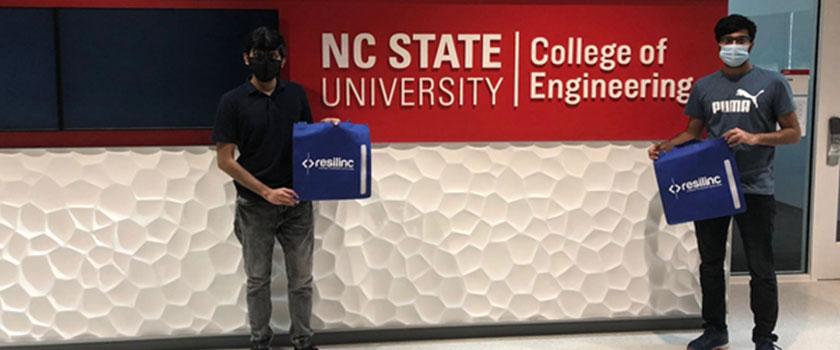
Over the past two years, the coronavirus pandemic has had a tremendous impact on our lives; universities and schools converted to virtual teaching, and almost every aspect of our social life has changed. During these challenging times, student organizations, such as INFORMS student chapters, had a heavy responsibility to bring students together. As the pandemic restrictions eased, many students started to go back to their campuses; however, many others chose to remain virtual or in hybrid mode. Undoubtedly, the return to “normal” has not been without its challenges. In this article, we feature two INFORMS student chapters – Pennsylvania State University (PSU) and North Carolina State University (NCSU) – and their current and previous teams to learn about the challenges they’ve faced since the onset of COVID-19 and how they overcame them.
Describe your student chapter. What programs and events are typically held for students, before and after COVID-19?
PSU: Before the pandemic, the PSU INFORMS Chapter held in-person seminars and panel discussions that provided resources to our members pertaining to job searches, developing professional skills and networking.
NCSU: Before the new volunteer team took over in fall 2020, we had not seen or participated in INFORMS NCSU Chapter events. Generally, the officers organized some tutorial sessions for the welfare of graduate students to fast-track their transferable skills. When the current team took over, we recreated the vision and mission statement. We developed five broader themes to achieve world-class excellence in revamping the INFORMS NCSU Student Chapter. We aim to inspire and nurture students to enrich, enhance and educate themselves through engagement in a professional organization (INFORMS). We emphasize developing academic, professional and interpersonal skills among the student members and provide networking opportunities with working professionals and industry leaders. We divide the events into five major categories to benefit student researchers and graduate students in technical and professional activities.
- Academic workshops aim to share state-of-the-art research at the university level. People from academia present their ongoing research with case studies.
- Industry workshops discuss the latest technology and practical implementation of advanced industrial engineering (IE) and operations research (O.R.) topics.
- Professional training workshops address the need for transformation from student to working professional, in which industry speakers share their best practices and O.R. techniques.
- Career development programs aim to prepare students for internships and full-time opportunities.
- Student tutorial initiatives by current Ph.D. students aim to help new graduate students get ready for research and applications in management science.
These ideas and actions helped us successfully organize our events and garnered us a Magna Cum Laude award at the 2021 INFORMS Annual Meeting.
How did you transition these workshops and events from in-person to virtual? What were the biggest challenges and how did you overcome them?
PSU: When meeting in person was no longer a viable option, our chapter meetings went virtual. The difficulties in going virtual were recruiting individuals to speak to our members and having our members attend virtually. In many ways, potential speakers were overwhelmed by the technology transition (many of us had little experience with Zoom-esque software at the time), and our members had reservations about the impact a virtual meeting might provide them (is it really worth it?). In addition, everyone had to bootstrap their online etiquette and learn to speak up the same way one would in person.
NCSU: The transition from our predecessors was not adequate, so we started our events from scratch. After observing the pandemic for six months (March-August 2020), we realized that instead of halting a student chapter and its deliverables, we could begin Zoom workshops and take the opportunity to interact with students by engaging in online meetings with our vision and mission. We firmly believe that inviting great industry speakers and top-class researchers from academia would bring the student community together, regardless of their background. We decided to launch our session by inviting speakers from a business school, a C-suite executive from one of the largest banks, and a CEO from a European-based organization. This was successful, and we followed a similar suit for the spring 2021 semester with 12 more events, including student tutorials, professional development workshops and career guidance programs. We received sponsorship from corporate companies for financial support and utilized those funds for giveaways and souvenirs. We created a robust database of participants across all social media, including a LinkedIn page and YouTube channel showcasing video recordings and updates of ongoing events. Due to the virtual setting of these events, many participants were in different time zones, so finding a time that would be appropriate for most participants was the biggest challenge. To tackle this, we gave preference to speakers who were in the same or similar time zones as the students. These new approaches helped us successfully organize the events without any hassles.
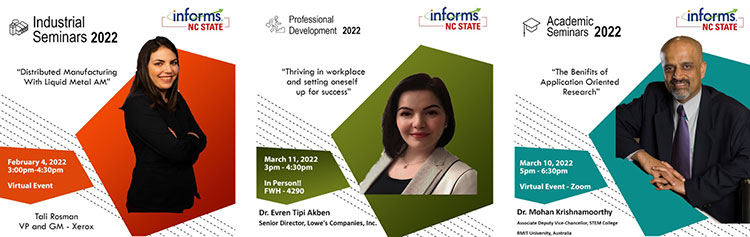
Showcase of INFORMS NCSU Chapter hybrid events during the spring semester.
During the COVID-19 pandemic, how did your university help and support the student chapter?
PSU: Penn State provided many resources to the various clubs on campus, the most important being the individual Zoom accounts that could schedule and facilitate these virtual meetings. Without these accounts, it is likely that the meetings would not have taken place, and it would have been much more difficult to engage with our chapter members.
NCSU: When events were all strictly virtual, there were fewer arrangements required (such as classrooms/conference rooms, refreshments, etc.). But when the events became hybrid – that is, virtual and in person – we often got help from the Department of Industrial and Systems Engineering (ISE) at NC State for arranging room space. Also, funding was made available for event expenses by the department and the university’s student involvement center.
What would you say has been a positive outcome of the pandemic for your organization?
PSU: One benefit of the pandemic was that the travel constraint often placed on in-person speakers was removed. As such, we were able to reach out to former graduate students that had moved on to either academic or industry jobs that could speak about their experiences transitioning into a full-time career.
NCSU: During the pandemic, we converted an option into an opportunity. We invited speakers from across the globe, and Zoom calls became an active participation medium. We attracted students by offering gift cards, engaging them online and sharing goodies offline to convey our appreciation for their voluntary participation. We organized tutorial sessions and developed a “grad4grad” program in collaboration with the ISE Graduate Student Association. We had participation from universities across Asia, Europe and the Americas in some of our tutorial sessions. We believe that the pandemic has opened many avenues for the effective and efficient conduct of meetings and sessions.
Now that COVID-19 pandemic restrictions have eased, what changes are you planning to make to the programs?
PSU: Penn State has lifted many of the restrictions on in-person meetings and masking. As a result, we are able to meet in person again. This is a high priority for the current chapter board because meeting in person is an important concept in building a sense of community and peers within the student chapter. Ultimately, the goal of the current officers is to continue with in-person events because we find that they are more beneficial in engaging with members and building a supportive and cohesive community.
NCSU: Now, arranging in-person events is going to be a bit challenging because students are somewhat used to virtual events. New members may not have much experience in organizing in-person events. We are considering holding workshop(s) on how to organize in-person events and encourage students to participate.
Thank you to the NCSU and PSU student chapters for sharing their experiences. Based on what we’ve learned, here are some tips for other INFORMS student chapters as they “restart”:
- Don’t jump into offering only in-person events.
- Reach out to alumni and ask for potential sponsorships from their companies/institutions.
- Ask your department for support in reserving space for hybrid networking events.
- Make sure your list of alumni is updated with the COVID-era graduates – they may be more eager to participate in networking activities.
Kimia Vahdat is a Ph.D. candidate in the Edward P. Fitts Department of Industrial and Systems Engineering at North Carolina State University. She is an editorial staff writer for OR/MS Tomorrow, the student magazine of INFORMS.