
December 1, 2025 in Sports Analytics
Moving the Chains with Math: The Tush Push Unpacked
SHARE: PRINT ARTICLE: https://doi.org/10.1287/orms.2025.04.06
The Analytics Revolution on the Football Field
Analytics has fundamentally transformed the way football is played, bringing a new level of precision and strategy to on-field decisions. Coaches now rely on real-time data to make tactical adjustments during games, such as optimizing substitutions based on player fatigue, tweaking formations to exploit opponent weaknesses and responding dynamically to in-game developments. Advanced tracking technologies and wearable sensors provide detailed insights into player movements, positioning and workload, allowing for personalized training regimens and more effective game preparation.
Teams use data-informed analysis to refine their playing styles, moving beyond traditional strategies to adopt approaches tailored to their unique strengths and the tendencies of their opponents. Metrics including passing networks, heat maps and spatial control zones help coaches identify and address tactical inefficiencies, while predictive models inform decisions on play calling, fourth-down attempts and defensive alignments. This evidence-based approach has led to more efficient, adaptable and competitive teams, reshaping the very fabric of on-field football strategy.
Analytics in football has changed many ideas in football that were previously considered normal. The notion that teams should punt unless it’s late in the fourth quarter is outdated in today’s football. Teams are – with the backing of analytics – now going for fourth downs early in the game, even in their own territory. However, these choices have not been met without pushback. Many traditional minds in football, and coaches who want to avoid the pushback when failing while taking an unordinary risk, have chosen to do what is considered “normal” in football instead of making the analytically correct decision. This fear leads to analytical processes in football often being hindered because these long-time coaches have so much power.
We focus here on a particular play that has generated some controversy in recent years. A newer analytical controversy in football revolves around the 2-point conversion. The main debate is whether to always attempt a 2-point conversion after scoring a touchdown when trailing by 8 points in the fourth quarter. The modern age of analytics clearly supports going for the 2-point conversion; however, many old-school coaches, who are considered responsible if the 2-point conversion fails, often just take the extra point. What this study will dive into will be even more radical than that. We will discuss whether some teams should always go for 2, but also whether they should run a certain play when they do it.
Overview: What Exactly Is the Tush Push?
There have been very few plays that have sparked as much debate and fascination as the “tush push.” The tush push is a quarterback sneak in which the teammates actively push their quarterbacks from behind to secure a first down or touchdown. Most of the time, it happens when only 1 yard is needed and often happens at the 1-yard line to score a touchdown. The play was first popularized during the 2021 season by the Philadelphia Eagles with quarterback Jalen Hurts providing size in the backfield, and center Jason Kelce, who was considered one of the best in the league, could easily push Hurts forward. Hurts is known as a mobile quarterback with massive leg power to push forward while also having the ability to maneuver around traffic in front of him when needed. With the combination of strength from the offensive line, power from the quarterback and drive from a player pushing the quarterback from behind, the tush push has changed the short-yardage game in the NFL.
Despite controversy and many questions relating to its sportsmanship, the tush push remains a staple in the NFL and has expanded to many teams, particularly the Buffalo Bills and their massive quarterback Josh Allen. As the league continues to evolve, it’s important to consider whether there are additional strategic advantages to this play – such as its potential use in 2-point conversions – that haven’t yet been explored.
Analyzing the Tush Push: A Statistical Dive into Hurts vs. Allen
To effectively look into the reliability of the tush push, let’s begin by taking a look at how it’s used by Hurts and Allen, two quarterbacks known for their physicality and effectiveness in short-yardage situations. Looking at the 2024-2025 NFL season for each of the quarterbacks, we see the following achievements with the play in Figure 1a.
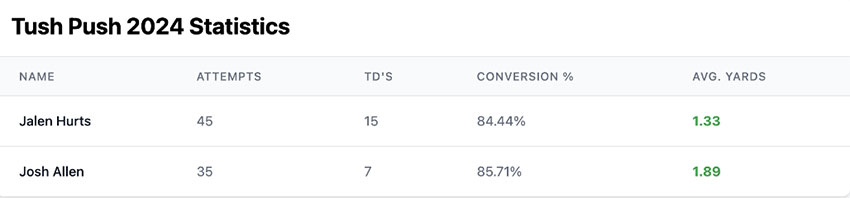
Both quarterbacks have a more than 80% conversion rate for these short-yard situations (all under 1 yard), showing why their teams rely on the tush push for plays within 1 yard of the line to gain. However, the one category that shines the most is the average yards per attempt, with Hurts having 1.33 yards while Allen has just under 2 yards at 1.89 yards per attempt. With Allen’s yards per attempt so high, it begs the question: Why not go for 2 after every touchdown?
Adjusting for Goal-Line Bias and Its Implications
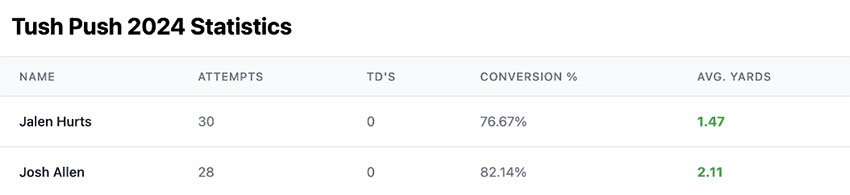
To assess whether the tush push could revolutionize the 2-point conversion strategies, we must start by isolating plays outside of the goal-line context, otherwise known as plays within 1 yard in which a touchdown was scored. This is because when it is a play on the 1-yard line, the maximum possible yards the quarterback can gain is 1, which can skew the average yards results. When we removed those plays, the following statistics were created in Figure 1b.
Figure 2 displays a Poisson fit of the yards gained on all of Allen’s tush push attempts (not counting those starting at the 1-yard line) in the 2024-2025 NFL season. By modeling the data with a Poisson distribution (after considering other discrete distributions like the negative binomial and geometric), we were able to visualize how often each yardage outcome occurs (shown in blue) and how it aligns with expected probabilities (shown by the red line).
Using this model, we were able to estimate that the probability of Allen gaining 2 or more yards (i.e., the distance required to achieve a 2-point conversion) on a single tush push is 62.2%. This translates to an expected point value of 1.244 per 2-point conversion attempt, which is significantly higher than the expected points of a standard (kicked) extra point for placekicker Tyler Bass, which is 0.964. From this analysis, one might conclude that the Bills should start opting for the 2-point attempt every time because it is a smarter long-term strategy.
[exec_tush_push_unpacked]
Room for Improvement
To further improve their 2-point conversion success rate, the Bills need to take a page from the Eagles’ playbook by expanding the versatility of their tush push package. Right now, Allen’s ability to perform the tush push in short-yard situations is phenomenal, but when 2 full yards are needed, the play becomes a bit more vulnerable. That being said, Buffalo can easily increase efficiency by introducing layered wrinkles to their current formation, such as motion, misdirection or tight end sneak opportunities. These variations will constantly keep the opponents’ defense guessing and prevent them from always crashing the middle of the formation trying to stop Allen. Additionally, with a mobile quarterback like Allen, the Bills could implement fake tush pushes that turn into jump throws (à la 2007 Heisman Trophy winner Tim Tebow) over the line or a 1v1 fade to Keon Coleman, who is their most physically demanding wide receiver. Once the Bills are able to diversify their tush push, as well as adapt to how the defense is set up, their 2-point conversion rate could reach an even higher success rate.
Potential Drawbacks
As previously mentioned, we filtered out all tush push attempts that were within 1 yard of the end zone because those would skew the yards per attempt for tush pushes. However, the rest of the tush push plays may not accurately represent the defense that would be played during a 2-point conversion. First, the vast majority of tush push plays happen during third-and-1 and fourth-and-1. Second, the defensive line may not fully sell out to stop the tush push as they might on a 2-point conversion, because allowing a first down isn’t as critical as forcing the defense to fully commit on a 2-point conversion. However,, this concern is rather minor because defenses often stack the box when facing a tush push, showing that they are selling out, similar to a 2-point conversion.
Another potential concern with defensive schemes is whether they play differently because it’s a traditional 1-yard attempt versus the 1-yard attempt on tush push plays. For example, in Super Bowl 59, Kansas City Chiefs defensive end Chris Jones had a unique strategy in which he lined up sideways to try to prevent the offensive line push. These all-out strategies may be less essential when stopping a 2-yard tush push compared with a 1-yard tush push. That is why it will be critical to measure short-term success if the Bills, Eagles and other teams try this strategy and specifically to focus on whether defensive strategies shift.
Conclusion
As the NFL continues to evolve, evaluating the tush push play is yet another example of how analytics and innovation can reshape the game. With quarterbacks like Hurts and Allen, the tush push could potentially be used not only in short-yardage situations but also in extremely high-leverage situations like the 2-point conversion. A 2-point conversion is a high-leverage play because its outcome can immediately and significantly alter the score margin, often in critical game situations, making it a pivotal decision that can swing a team’s win probability. Although concerns remain regarding defensive adaptations and contextual bias, the data shows that the tush push for a 2-point conversion has potential to be successful, especially for Allen and the Bills. If Buffalo and others can expand the tush push with motion, misdirection and fakes, then the tush push could become mainstream after scoring a touchdown. And who knows – maybe, kicking extra points could become a thing of the past for some teams.
Warner Gephardt is an undergraduate student studying statistics and sport management at UF and leads the UF Sports Analytics Club. Parker Whelan is an undergraduate student studying statistics at the University of Florida. Scott Nestler, Ph.D., CAP-X, PStat, is professor of practice and sport management at the University of Florida and director of the UF Sports Analytics Lab.