

August 5, 2013 in Five-Minute Analyst
Carnival Game
SHARE: PRINT ARTICLE: https://doi.org/10.1287/LYTX.2013.04.13
I was captivated by this recent headline: “Man loses life savings, wins giant banana” [1]. After disbelief subsided, I wondered – as is my habit – what five minutes of analysis might tell us.
In the news story, a man is determined to win a video game console by playing a carnival game where balls are tossed into tubs. He did not win; in fact, he lost around $2,600. There are (at least) three subproblems to consider:
1. How much to wager: the player’s point of view. Given that the game console was worth approximately $100 and not unique to the carnival, we quickly conclude that if the object was to obtain a game console, the best course of action may be to not go to the carnival at all. In order to assess whether or not to play, we would have to know what our probability of success in a carnival game. While this is something that we do not know, we may make a few basic assumptions.
Suppose that the wholesale value of the prize is $100. If the game costs $5 to play, we can be almost certain that an individual “on the street” has less than a 5 percent chance of winning on a single try – otherwise the “house” would never make a profit. In order to make a reasonable profit, the real odds of the game are probably lower, in the neighborhood of 1 percent. We assure ourselves, saying that we are better at tubs than the average person. If this were really the case, we should play the game some predetermined number of times, with predetermined maximum losses (10 at a cost of $50 seems reasonable) and simply walk away when we reach our predetermined threshold.

Human beings are notoriously bad at walking away. The reason is because we (mis-)count the money spent as “invested” instead of properly “lost.”
The more we play and are unsuccessful, the more evidence we gather that we are bad at the game. For example, if we have tossed the ring twice and missed both times, I would have a point estimate of 0 percent probability of success, but could construct a 95 percent confidence interval of my true probability of success as the interval 0-75 percent. If we have tossed the ring 20 times and missed, our confidence has now shrunk to 12 percent.
2. How much to allow wagered: The carnival’s point of view. The house could simply allow a player to lose as much money as he wishes. The longer the game goes on, the more money the carnival makes. There are two reasons why this “greedy approach” – both mathematically and in the usual sense – may not be optimal.
a. If the player becomes very upset he could bring unwanted things outside of the wager into play. In this case it was law enforcement, but we might imagine a rough cousin.
b. If we take too much of a player’s money at once, he or she will never come back. If we space out their losses over time, and allow them to win every so often, then they may lose more in the long run.
Both points reflect that a carnival is different than a casino. For one thing, an individual losing $2,600 at a casino is not newsworthy! People find the idea of large losses in a gambling house more palatable than at a carnival. For a carnival, it would seem that the maximum amount to take from a person would be some small multiple of the maximum prize, in this case $200 to $300 (and throw in the prize to boot).
3. How to lose all of your money at the carnival (or anywhere else). Reason that the probability of winning the prize is non-zero (it is), then they may use the properties of the geometric random variable to conclude that given enough tries, you will certainly win the prize. Armed with this (mis-)information, increase the stakes “double or nothing” until your eventual win.
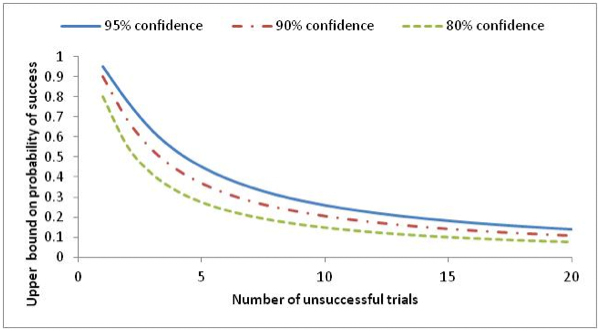
The reason this does not work is that the player has not considered how much he will lose before his eventual win. This result is true in general [2]. Consider our contestant lost $300, then lost the rest in a few rounds of “double or nothing’; in this case, three.
In order for “double or nothing” to be a viable gambling strategy, the cumulative distribution of winning has to grow faster than you are hemorrhaging money, and your losses are exponential in that they grow like 2N. At the carnival, for “double or nothing” to work, the player needs to be relatively confident that he will be successful on at least one toss before losing it all. In order to have a 50 percent chance that he would be successful at least once in three rolls, the player would need to be approximately 20 percent certain that he would be successful on any one roll. Not comforting, given that his point estimate of winning when he began playing “Double or Nothing” is zero.
“Double or Nothing” is a very good way to lose all of your money very fast.
Bonus footnote: When I was young, there was a pizza establishment in my hometown that had a video game where for 50 cents, you could win prizes, the “grand prize” being lunch. I had a high school classmate who through several weeks of effort learned the game well enough that he could win lunch every day. He got lunch for 50 cents each day for about a week before the proprietors grew tired and removed the game!
References
Harrison Schramm, CAP, PStat, is a senior lecturer at Naval Postgraduate School, splitting his time between Defense Management and Operations Research where, in addition to teaching, he runs the Contested At-Sea Logistics Lab (CASLL). He served as the inaugural chair of the INFORMS Security Conference and is a past president of the INFORMS Analytics Society.
([email protected])