


April 3, 2006 in WISIS
Mourning Loss of Peer-Turned-Mentor
SHARE: PRINT ARTICLE: https://doi.org/10.1287/orms.2006.02.06
Perwez Shahabuddin passed away on Nov. 17, 2005. He was a great friend to many of us, including me, and a terrific operations research colleague.
For as long as I'd known him, Perwez was always way, way ahead of me. When I first met him, I was in the first week of graduate school . . . and he had already finished his master's degree. As my classmates and I struggled through our coursework, Perwez was proving theorems about Rare Event Simulation. As a graduate student at Stanford working with Peter Glynn, he presented a paper at the 1988 Winter Simulation Conference (my first WSC paper would come in 2003, where Perwez - now a grizzled veteran - greeted me warmly). While I was thrashing about in search of a dissertation topic, Perwez won first prize in 1990 INFORMS George E. Nicholson Student Paper Competition for his dissertation work.
The Nicholson Prize proved to be the first of many professional awards that he would garner over an extremely successful operations research career, first at IBM's Thomas J. Watson Research Laboratory and then at Columbia University. His research work in simulation, quality modeling, and financial engineering applications was highly regarded, and he served our professional community in several prominent editorial positions, most recently as an area editor for Management Science in Stochastic Models and Simulation.
As impressive as his resume is (see www.columbia.edu/~ps147/ for more details), it fails to tell his full professional story. Although he had been born with a stutter, Perwez tackled this challenge head-on. I vividly recall his letter to the editor of the Stanford Daily in which he bravely and openly related his own experiences and struggles with stuttering while announcing that the period of May 9-15, 1988 had been designated as the first-ever National Stuttering Awareness Week in the United States.
Moreover, Perwez worked hard to eliminate this potential handicap and really did not let his stutter get in his way professionally. He was a passionate and generous teacher who communicated complex topics very effectively to his students and professional peers, and he was a tremendous presence in the classroom. His teaching skills and commitment were repeatedly recognized by his students at Columbia. In 1997, he received a Distinguished Faculty Teaching Award for excellence in teaching by the Columbia Engineering School Alumni Association. In 2004, the Society of Columbia Graduates named him the recipient of its Great Teacher Award, reflecting the "recognition of your students and your peers as a dedicated and inspired undergraduate teacher and mentor." He also served as the director of the Ph.D. program for the IEOR Department at Columbia.
Webster defines the word mentor as "a trusted counselor or guide." Since coming back to academia in 2003, I have had much cause to think about the concept of mentorship, since I believe strongly that as teachers we are responsible for providing counsel and guidance. Indeed, in the age of the Internet, broadband and distance learning, my sense is that an instructor's value proposition is less and less about conveying information and more and more about interpreting and contextualizing the material that we choose as worthy of including in our courses.
In the past, I have written about mentors such as Jerry Lieberman (www.lionhrtpub.com/orms/orms-8-99/something.html), Ward Whitt (www.lionhrtpub.com/orms/orms-12-03/frsomething.html) and Ted Vessey (www.lionhrtpub.com/orms/orms-8-04/frsomething.html). Along with Bill Carlson at St. Olaf and Fred Hillier and B. Curtis Eaves at Stanford, these are my academic "parents," and I have learned much from each and every one of them.
Recent research by psychologist Judith Rich Harris, however, suggests that "parental behaviors have no effect on the psychological characteristics their children will have as adults" [1]. Her premise is that the effect of one's peers has far more to do with our development than anyone had previously thought, and she supports it with a substantial amount of qualitative and quantitative analysis.
As a relatively new parent (my daughter just turned two!), I must confess that I'm a bit uncomfortable with Harris' discounting of my effect on my daughter's development. Nevertheless, from my own experience, her premise that our peers have a great influence on our learning and growth rings true. And in this regard, losing Perwez is indeed like losing a mentor.
From the time that I started out in operations research, he had always been a beacon shining just over the horizon, a perpetual inspiration to make as much of my abilities as I possibly could. Through his own example, he demonstrated the importance of hard work and perseverance, as well as the determination to not let obstacles stand in his way. Throughout his life and career, Perwez modeled not only sophisticated stochastic systems but also the virtues of kindness and generosity, which themselves are increasingly rare events.
I miss him terribly and only wish that I had gotten to spend more time with him, especially over the past few years. His is a great loss for us all.
References
- Harris, J. R., 1995, "Where is the child's environment? A group socialization theory of development," Psychological Review, Vol. 102, pp. 458-489.
Vijay Mehrotra is a professor in the Department of Business Analytics and Information Systems at the University of San Francisco’s School of Management and a longtime member of INFORMS.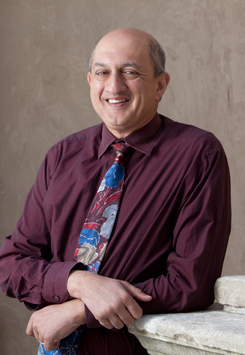
([email protected])