


April 3, 2006 in INFORMS News
Farmers Reap Benefits of DSS
SHARE: PRINT ARTICLE: https://doi.org/10.1287/orms.2006.02.15
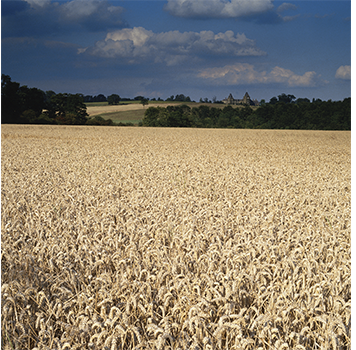
New scheduling system dramatically improves harvesting scheduling for maize farming in New Zealand
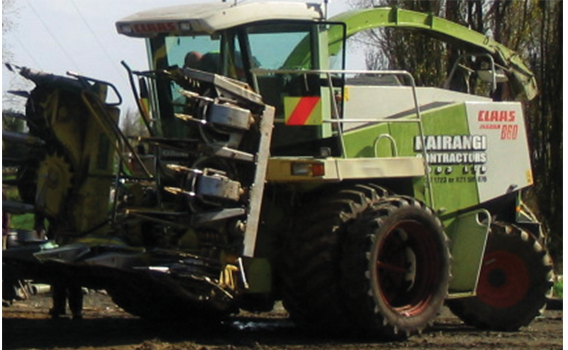
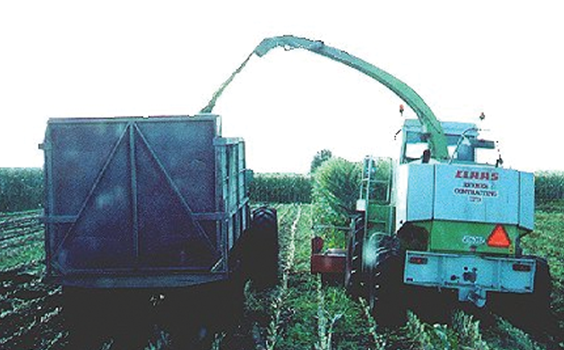
Maize farming in New Zealand is an important activity contributing to a significant proportion of the output of the agricultural sector. Commercial contractors form an important part of the harvesting process by traveling from farm to farm harvesting maize. Traditionally, commercial harvesters have difficulty in deciding when to harvest different farms within a short period in time, taking into consideration various limitations such as limited dedicated machines and crews.
We report here on the development of a scheduling and decision-making support system (DSS) that assists commercial harvesters in scheduling their activities. We also present the outcomes of the implementation of the system by a large commercial harvester.
Background
In New Zealand, the maize harvest season begins in April and ends in mid-June. The process mostly involves a contracting company that travels from farm to farm to harvest crops. The primary objective for the harvester is to decide when each farm requesting harvesting service should be visited. The schedulers must also specify the activity of each machine of each type and its crew, in each time period, in order to minimize the duration of the entire harvesting process at a given set of farms. In addition, the schedulers must deal with a limited number of dedicated machines and their trained crews that are capable of carrying out certain operations, which gives rise to binding constraints on the duration of the overall harvesting process.
During the harvesting season, a commercial harvester receives harvesting requests from numerous farms. The difficulties of resource allocation and operations scheduling are significant due to the uncertainties of the arrival of requests for service, the weather, equipment failure and the scarcity of harvesting resources. The operations manager performs the scheduling for the maize harvesting operations, and a farm-visiting schedule is generated on a weekly basis.
To establish a new farm-visiting schedule, a number of decisions must be made by the schedulers as follows:
- the visiting sequence of the farms that have requested service,
- the number of machines of each type to operate at each farm,
- the assignment of personnel of different skill levels to perform each operation, and
- the projected start and finish time of each operation, the expected total processing duration at each farm visited and the total harvesting duration time at all farms.
Of course, different combinations of resource allocation and timing of the harvesting operations can produce a wide variety of different schedules. Therefore, in order to implement an effective schedule, the schedulers must select from among a huge number of scheduling possibilities. When allocating the resources to construct a weekly schedule, two questions must be answered:
- Is the total harvesting time corresponding to the schedule of relatively low duration?
- How can the schedule be adjusted when delays occur, such as those caused by accidents, machine breakdown and adverse weather?
We assume that:
- a planning horizon, of known duration, is given,
- which farms to be serviced during the planning horizon has been decided,
- all inter-farm travel times are known, and
- the inter-farm transportation of any actual machine and crew may involve the skipping of certain farms. That is, each physical machine and its crew are not necessarily transported to each farm.
The input data needed for the analysis of a harvesting scheduling scenario include:
- the number of machines and their crews that are available to perform each operation,
- the set-up time for each type of machine,
- the set of farms to be serviced,
- all inter-farm travel times and,
- for each farm, the resource level allocation/operation/duration relationships. That is, how much if at all, operation processing times are reduced by the allocation of additional machines.
Needs Analysis
A DSS was developed based on the particular needs of a large harvesting company in New Zealand. (A discussion of the DSS approach is provided in [2].) After a thorough investigation of the company's challenges, we identified the needs of the schedulers as follows:
- A comprehensive weekly farm schedule in the form of a Gantt chart, that displays details of equipment and personnel allocation and scheduling. Due to the complexity of the multi-farm harvesting situation, it was crucial to specify every resource usage in any time period and organize them in a clear chart.
- An effective approach to the evaluation of different feasible schedules, with the objective of minimizing the total duration time of the overall harvesting process for all farms to be serviced. It was essential for the schedulers to measure and compare different possible schedules in order to select satisfactory and feasible alternatives with relatively low total operating time. Therefore, the company required a systematic approach to the calculation of the expected total duration of the entire weekly harvesting process, based on known realities. (A discussion on the realities of maize harvesting is provided in [1].)
- A resource usage summary report. The company did not have any statistical summary documentation regarding equipment or personnel working hours. In order to understand resource usage, the company desired an automatically generated report of the total work time of equipment and personnel in each week.
- An effective way of dealing with unplanned events, such as machine breakdown, road and farm accidents, and operations duration variation due to events such as unexpected weather. These events often render an existing schedule infeasible or inefficient. However, it is sometimes too time-consuming or otherwise impractical to generate a revised comprehensive weekly schedule. In this case, simple and rapid corrective measures are needed to facilitate the re-scheduling effort.
Maize Manager
MaizeManager is the name of the DSS that was developed for use by the schedulers at a large commercial harvesting company in New Zealand. By offering step-by-step guidance, the DSS aids the schedulers in establishing a feasible and satisfactory resource allocation and scheduling plan for a given set of farms, based on the practical constraints and the schedulers' preferences and experience.
MaizeManager is a specific decision support system (SDSS) and is divided into three major components: the database, the modeling base, and the scheduler interface. The scheduler interface provides pull-down menus that display farm, equipment, and personnel information. Through the windows-based interface, the scheduler can access each existing database, generate new schedules and view all relevant information.
The database component
The system database includes a farm details file, an equipment file, a personnel file and schedule files that can be interactively entered and updated. As an example, Figure 1 shows part of the database on the equipment details. As shown, the file includes fields such as equipment name, type, capacity and operation speed. Information on personnel and farm details files is illustrated in Figures 2 and 3.
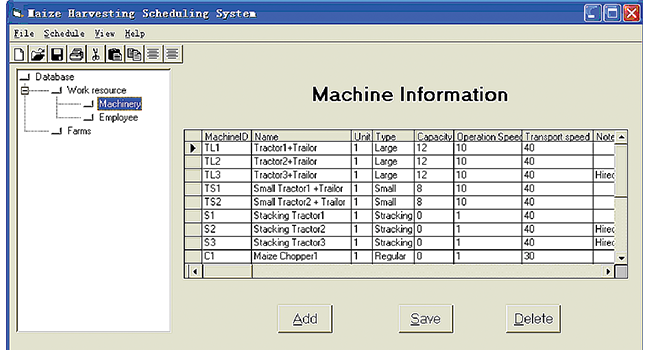
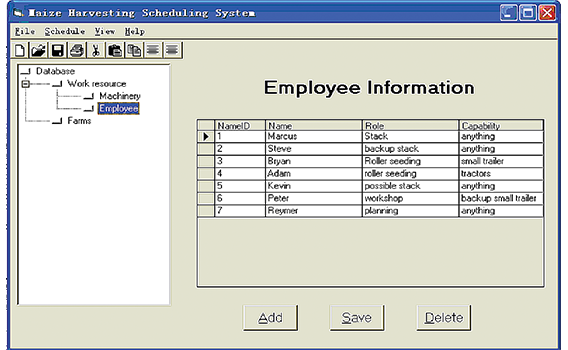
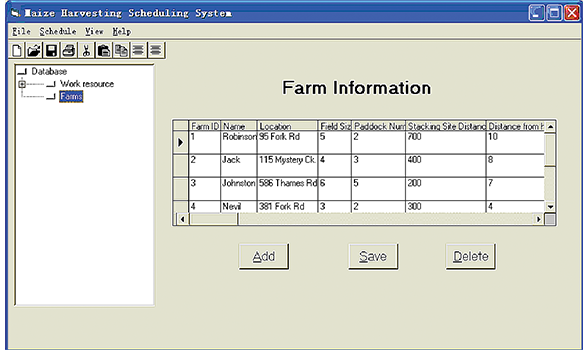
These databases are an essential part of the DSS and provide a good facility for the schedulers to update various farms and work assignment information regularly. More importantly, they provide the schedulers with necessary inputs for the maize harvesting scheduling decision-making. Any schedule generated can also be saved and be retrieved for use for future scheduling. These databases can also be easily accessed and manipulated through the File module. With the fields designed based on the schedulers' requirements, the databases are initially created by the schedulers using this module.
The model base component
The model base of the DSS consists of the following components:
- the overall schedule decision flow model,
- sets of priority rules and constraint rules based on the practical maize harvesting scenario, and
- a heuristic for the calculation of the expected operations durations. (See [3] for further details.)
The scheduling model
The scheduling model represents the entire scheduling process. The scheduler communicates with the system through dialogue boxes. As pointed out, it is far more practical to allow the schedulers to find their own "best" schedules under well-formulated constraints than to force them to accept the unrealistic schedules generated by optimization models. Therefore, by offering step-by-step guidance, the scheduling model is designed to help the scheduler establish a workable and satisfactory resource allocation and scheduling plan for the given farms.
The overall scheduling process is divided into two stages. The first stage is a multi-farm configuration. In this stage, two major tasks are performed: farm selection and operations sequencing. Particular farms are selected for the given scheduling period, usually the following week. The selected farms will then be sequenced based on practical constraints and certain optimization rules. In this step, the schedulers determine the order of farm visits within the scheduling period with the objective of achieving cost minimization. The cost factor is represented by the total inter-farm travel time.
The scheduling process must take into account all relevant factors, such as customer priority reservations and maize maturity levels at the selected farms. The sequencing process highlights the flexibility and the supporting role of the proposed DSS as the schedulers have the opportunity to determine the actual sequences of the farms selected and the scheduling of the operations at each such farm. The primary output of the first stage is the planning of the farm visit sequence, which will be consequently translated as inputs into the second stage, namely resource scheduling for each individual farm.
At the second stage, with the inputs from the previous stage including the now fixed farm visiting sequence, the DSS aids the resource allocation and scheduling activities at each farm, as mentioned above. Due to the time-sequence relationships, the farm visiting sequence produced in the first stage influences the equipment and personnel assigned and scheduled at each farm. The start time for the first operation at the first farm is initially specified by the schedulers without any restriction, based on practical circumstances. The start times of the first operation at the remaining farms are based on time constraints concerning the duration time at the previous farm and the relevant inter-farm travel. For each individual farm, the task of assigning resources is performed, including equipment and personnel allocation and scheduling.
Upon the completion of the second stage, the outputs are expressed as three inter-linked scheduling charts and the total expected work duration time. The second component comprises a series of preset constraint rules and priority rules devised from the practical realities of maize harvest operations. These modeling rules are applied to the steps of the scheduling model and are used to guide the scheduler in making realistic and effective scheduling decisions. The last component is a heuristic that is used to calculate the total expected duration of each possible schedule. This is an important part of the system model base because it enables the scheduler to evaluate different schedulings and decide on the most satisfactory one.
The scheduler interface
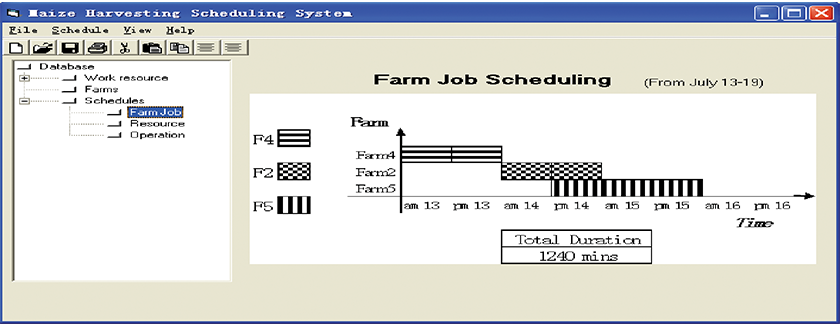
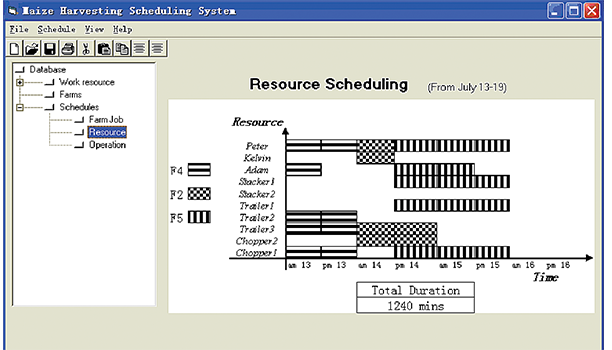
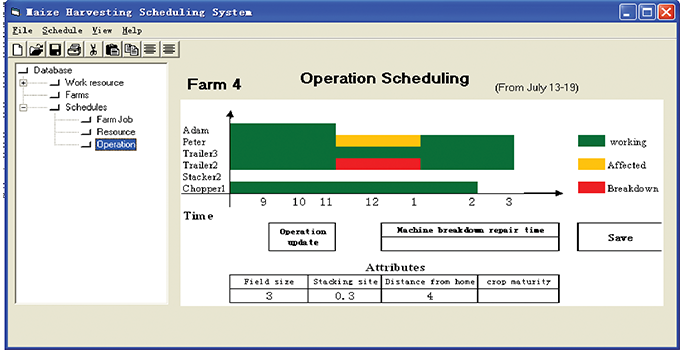
The major output of the DSS comprises several user-friendly scheduling charts. Figures 4, 5 and 6 present three such charts showing the weekly harvesting operations scheduling. The farm visiting sequence chart, depicted in Figure 4, shows the expected completion time of the entire weekly harvesting process. Figure 5 displays the comprehensive resource allocation and scheduling scheme that reflects the schedule in the farm visiting sequence chart. Here the schedulers can see the equipment that has been assigned to each farm and in which time period. Figure 6 specifies at each farm, when each piece of equipment will be operated and its start and finish times. The major attributes of each farm are also displayed. As mentioned earlier, the scheduler can update the schedule of the operations, the equipment use status, the working hours and any machine repair time.
The System Functions
Following is a summary of the functions of the DSS in assisting the maize harvesting operation-scheduling practices.
Establishing a farm work schedule
By providing step-by-step guidance in the scheduling decision-making process, this function helps the schedulers establish a workable and satisfactory resource scheduling plan at the farms to be visited, based on their experience and inspiration. This function is carried out through dialogue boxes, which serve as the communication tool between the scheduler and the system. During the scheduling process, relevant rules and criteria are preset to direct the schedulers towards feasible and efficient scheduling options. In addition to certain mandatory rules, there are also some soft constraints that the schedulers can choose to obey or ignore under specific circumstances.
Evaluation of farm schedule alternatives
This function allows the schedulers to view and compare different schedules in order to select the most efficient alternative. The expected total duration time can be calculated based on the set parameters and the scheduler inputs using the heuristic that is part of the DSS and is displayed as part of the final outcome upon the completion of the scheduling process.
Modifying an existing farm work schedule
If the schedulers are not satisfied with the current schedule and wish improvement, they can revise or fine-tune the schedule by swapping equipment and personnel between farms, adding or reducing resources, and changing the first operation start time at any farm. This function can be used by selecting "Edit" in the "SCHEDULE" pull-down menu.
Updating schedule due to equipment failure
If a piece of equipment fails during operation, the schedulers can update the schedule currently displayed by clicking on that piece of equipment and changing its work status. In order to generate a substitute schedule, the schedulers can enter the estimated equipment repair time, and all of the subsequent activities will be automatically postponed. The operation finish time, as well as the total duration, will also be re-calculated by the system.
Querying and searching particular data
The schedulers can search for information concerning any particular piece of equipment or personnel at a particular time by inputting key words. This function assists the schedulers in the resource-tracking phase. The schedulers can also retrieve any previous farm schedule by entering the desired date.
Statistics summaries
The system can generate summary reports on a weekly or monthly basis concerning the total work time of equipment and personnel. With these summary reports, the schedulers can review resource usage.
Identification of overloaded resources and infeasible schedules
A warning will pop up if the schedule violates the constraints rules and is infeasible, for example by exceeding resource availability.
Printing schedule charts
The system allows the schedulers to print out complete schedules, work sheets and other summary reports.
Impact
MaizeManager has been implemented at a large commercial maize harvesting company in New Zealand. The organization benefited from the DSS in the following ways:
- The schedules generated by the system have proven to be more logical and resource-use efficient and have resulted in significant travel and time savings.
- The system facilitates the task of resource tracking during multi-farm harvesting. It helps the schedulers identify the online operation status and whereabouts of each machine and worker. As a result, the resource utilization has improved significantly, with far less mistakes occurring due to, for example, double assignment of a resource.
- The customer details and resources have been systemized and incorporated into the DSS database, which has greatly improved the information management aspect of the company's operations.
The system also has intangible benefits, such as enabling the fine-tuning of existing schedules, the creation of entirely new schedules, strategic planning, efficient resource utilization and the flexibility to plan for and cope with unexpected situations. The DSS allows the schedulers to carry out ad hoc analysis through "what if?" queries. It also provides schedulers with a better understanding of the resource management and scheduling process, such as highlighting seemingly illogical decisions. MaizeManager has been able to improve the visibility of schedules and their associated future costs to the decision-makers, which was formerly obscured by the often unstructured interactions needed with the farmers. It provides a quick and effective assessment of the decisions that are under consideration.
Acknowledgment
The authors are grateful to Inderscience Publishers, who kindly granted permission for this article to be published, which is partly based on [1] in the list of references.
References
- L. R. Foulds and Xiao Dan Zhao, "A Case Study: A Scheduling Decision Support System for Multi-farm Maize Harvesting Operations," International Journal of Business Information Systems (to appear).
- E. Turban, 1993, "Decision Support and Expert Systems: Management Support Systems," 3rd Edition, Macmillan, New York.
- L. R. Foulds and J. M. Wilson, 2005, "Scheduling Operations for the Harvesting of Renewable Resources," Journal of Food Engineering, Vol. 70, pp. 281-292.
Les Foulds is member of the Department of Management Systems at the University of Waikato, New Zealand. The authors would like to dedicate this article to the memory of their friend Magid Igbaria, formerly of the Claremont Graduate School, Calif. Before he passed away, Professor Igbaria played a key role in the assessment of the success of FleetManager in the New Zealand dairy industry. Martin West is a member of the School of Information Systems, Curtin University of Technology in Perth, Australia.
([email protected])
([email protected])