


June 5, 2006 in INFORMS News
Edelman Award Well Worth the Wait for Warner Robins
SHARE: PRINT ARTICLE: https://doi.org/10.1287/orms.2006.03.11
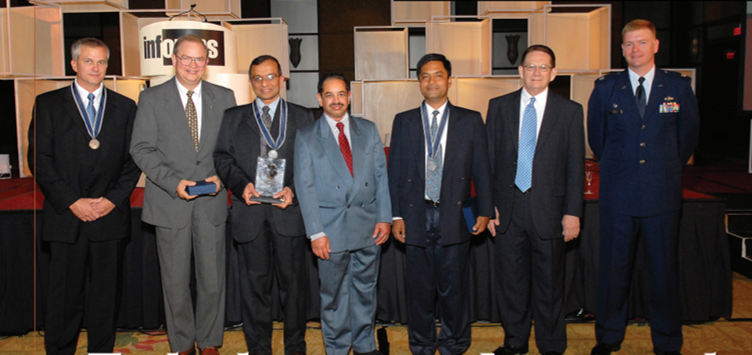
After an eight-month effort to identify and verify outstanding achievement in operations research, a day-long series of presentations from five finalists and a three-hour gala thrown in honor of it all, INFORMS bestowed the 2006 Franz Edelman Award for Achievement in Operations Research and the Management Sciences on – finally, the envelope please – Warner Robins Air Logistics Center.
With that, the music came up, the lights flashed on and the black-tie-optional-and-evening-gown audience in the ballroom of the Intercontinental Hotel in downtown Miami rose to its feet to applaud the 2006 winner of the “Super Bowl of O.R.” Given all the fanfare and suspense (for once, virtually no one besides the judges knew who had won until Russ Labe and John Milne stepped to the podium to make the announcement), it’s safe to say it was the most dramatic moment in the 35-year history of the Institute’s premier prize.
Warner Robins Air Logistics Center (WR-ALC) in Georgia, one of three such centers in the Air Force, has worldwide management and engineering responsibility for the repair, modification and overhaul of the F-15 Eagle and Strike Eagle, all C-130 Hercules models, the C-5 Galaxy, the C-17 Globemaster III, as well as their respective avionics system components. In addition, WR-ALC has worldwide management responsibility for the U-2 Dragon Lady and all Air Force Special Operations Command Aircraft. WR-ALC is also the home of the 116th Air Control Wing flying the E-8 Joint Stars aircraft.
Streamlining C-5 Maintenance
THE EDELMAN AWARD recognized WR-ALC for its use of operations research to help streamline its C-5 aircraft maintenance production line, a project worth nearly $50 million in annual cost savings, but more importantly, one that returned five additional C-5s to the operational inventory.
In a dramatic acceptance speech equal to the occasion, Ken Percell, the executive director of WR-ALC and the highest ranking civilian employee at the installation, first thanked the winning team’s Edelman coaches, Murthy Mudrageda of Maritrans and Jonathan Owen of General Motors, who “took a group of folks from middle Georgia and the University of Tennessee and helped us bond together to get a message across about the accomplishments that we’ve been able to achieve at Warner Robins through the applications of operations research principles.
“It’s a difficult message to tell,”Percell continued.“Our installation finds itself under a great deal of stress because of the global war on terrorism. And it’s something we share with one of the other Edelman competitors, the focus on saving human lives. Each day in the desert, individuals are forced to haul cargo by convoy because of the absence of heavy airlift capability. So each and every one of our team members, including hundreds of folks who work on the C-5 aircraft, keep in mind that every day and in every way they improve, they reduce the risk of loss of life we face in the current circumstances in our world. I really thank them, those 3,000 members of our aircraft maintenance group, who made this all come to a realization.”
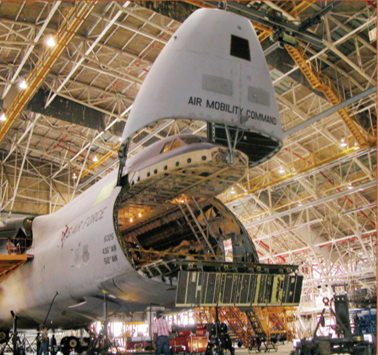
As outlined in the Edelman program, aircraft maintenance, repair and overhaul typically involve long lead times, generating a considerable loss of revenue potential because aircraft are not accomplishing their intended mission of carrying passengers or cargo, or putting bombs on targets to support combat operations.
At Warner Robins Air Logistics Center, long lead times were an even more serious issue because some of the aircraft models overhauled at the Center were in short supply and high demand. In early 2005, the Center undertook a concerted leadtime reduction effort on its C-5 transport aircraft program depot maintenance production line using Critical Chain, an operations research methodology for project management. The methodology was implemented successfully within a period of just eight months with no additional resources used.
Annual Benefits Worth Nearly $50 Million
BENEFITS TO C-5 depot maintenance customers have been immediate; the production line has returned five additional aircraft to the war-fighter’s operational inventory and provided additional revenue to the Transportation Working Capital fund estimated at $49.8 million annually. The replacement value for these aircraft is estimated at $2.37 billion.
The methodology is currently being implemented on the C-17 and the C-130 production lines, and will free up 11 dock spaces in 2006. The additional dock space gives the depot the flexibility to readily accommodate an increased number of depot maintenance inputs worth $65 million this year, with a projected $248 million increase by 2009.
The additional revenue generated is very significant compared to the current $295 million operating budget for the C-5 production line. The implementation has produced numerous other nonquantifiable benefits, such as increased responsiveness to cargo movement requirements and rapid casualty airlift response during wartime. This contributed to the Air Force’s much-needed availability and reliability of aircraft.
Percell, it turns out, is no stranger to operations research. Earlier in his career, he ran an O.R. staff in the supply chain area, so he admits he was an “easy sell”when the Edelman-winning project was first proposed. “The difficulty was trying to sell it to the workers,” he said after the ceremony.“The idea of analytical methods and approaches – and methods like Little’s Law and those sorts of things – generally don’t go over real well with sheet metal mechanics on the shop floor in the middle of Georgia. So part of what this team did was package those concepts and bring them to realization on our shop floor.”
The winning entry,“ Streamlining Aircraft and Overhaul at Warner Robins Air Logistics Center,” was presented by WRALC, the College of Business Administration at the University of Tennessee and Realization Technologies, Inc. Percell was joined on the podium by team members Bill Best, deputy chief, C-5 Aircraft Maintenance Group, WR-ALC; Mandyam M. Srinivasan, professor of business, University of Tennessee; C. Sridhar, vice president, strategic services, Realization Technologies; Jan R. Williams, dean, College of Business, University of Tennessee; and Air Force Lt. Col. Jeffery Elliott, commander, 402nd C-5 Maintenance Squadron, WR-ALC.
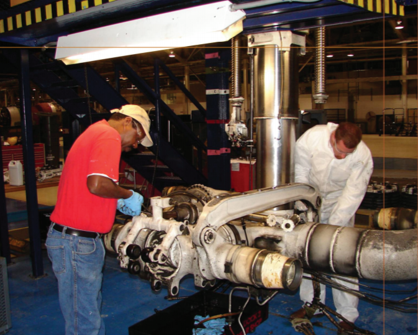
“We work very hard to do things that are relevant in our college,” Williams said. “This team is an outgrowth of one of the people at Warner Robins being in one of our executive MBA programs. Operations research is an important aspect of our program, particularly in executive education. One of our primary areas of interest is what we call ‘operations excellence,’ and this is a great example where we take a subject matter we teach and put it to work in an organization for tremendous effect.”
Percell summed up the team’s success this way: “The team we put together demonstrated that when an organization is willing to take a risk with operations research, there are great gains to be made. The recognition of our activities with this award will help others in our industry to take risks in making transitions and changes based on O.R. in order to get those big gains. Hopefully, this will make O.R. more widely known and accepted across all branches of the military.”
The other four Edelman finalists included:
- Animal Health Institute, for its application of operations research to develop new, practical quantitative risk assessment modeling methods for assessing the previously impossible-to-quantify potential risk and benefits to human health from continued use of animal antibiotics.
- Omya AG/Hustadmarmor AS, a Norwegian company honored for optimizing the supply chain of calcium carbonate slurry to the European papermaking industry.
- United States Commercial Aviation Partnership, for combining several different operations research methods to create a new approach to policy analysis. The analytical models enabled Transportation Security Agency policy-makers to better balance impacts on aviation security, passengers and the airlines.
- Travelocity, for developing a series of models to: provide estimates of consumer preference for product quality, price, brand and promotion; evaluate supplier deals; and identify compelling travel opportunities for consumers that combined to yield more than $40 million of incremental value, with a current annual run-rate of $29 million.
The complete stories of the 2006 Edelman Award winner and finalists will appear in the January 2007 issue of Interfaces.
Peter Horner is the editor of Analytics magazine.
([email protected])