


April 2, 2007 in INFORMS News
EDUCATING JAPANESE GOVERNMENT OFFICIALS
SHARE: PRINT ARTICLE: https://doi.org/10.1287/orms.2007.02.14

The National Personnel Authority (NPA) is in charge of the recruitment of government officials in Japan. There are three types of recruitment examinations: types I and II are for university and college graduates, while type III is for high school graduates. Those who pass the type I examination and are employed by a ministry are referred to as “career officials,” while others are called “non-career officials.”
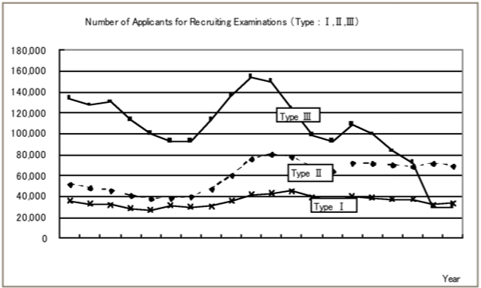
Figure 1 shows the trend in the number of applicants for the recruitment examination of each type in the last 17 years. The number of applicants reached a peak in 1995 and has been gradually decreasing every year since. We also see that in the last three years the total number of applicants is decreasing slightly by a few percentage points for types I and II, and decreasing more sharply for type III. We find that the type I applicant’s share is rather stable at around 15 percent to 20 percent, the type II share has been increasing from 22 percent to 35 percent, and the type III share has been decreasing from 60 percent to 45 percent. Additionally, looking at the academic background for type I applicants in the last 10 years or so, literature and law school graduates have stayed in the majority, slightly increasing their share from 54 percent to 60 percent. Science and engineering school graduates have slightly decreased from 32 percent to 30 percent, and agriculture school graduates have decreased from 14 percent to 10 percent.
Looking at the numbers who passed the recruitment examination over the period from 1996 to 2003, and the type of school (university) they attended, we know that shares of those who passed the examination from public schools (mostly national universities including city and local governmental universities) have been constantly decreasing in the last seven years from 82 percent to 76 percent, while those from private schools have been increasing from 17 percent to 23 percent. On the other hand, shares of the employed from public universities are rather stable at around 82 percent, while those from private universities have decreased a little from 18 percent to 15 percent. We also find that the percentages of the employed for public university graduates who passed the examination have been stable at around 42 percent in the last seven years, while those for private university graduates have decreased from 42 percent to 25 percent.
In 2004, the number of those who passed the type I examination was 1,756, an increase of six from the previous year. The number of women who passed the examination amounted to 304, the highest number in history. Women are now occupying a 17 percent share, and their number has continued to increase over the last six years. Also, we can say that the number of graduates having a master’s degree from graduate school is increasing both among applicants and among those who passed the examination. Academic backgrounds that are well represented among those who passed include science, engineering and agriculture.
Educating and training Japanese government officials in the area of policy studies has been conducted in universities, colleges and government training centers. Both central and local government offices send their staff to those schools for a period that lasts for a few weeks, a few months or sometimes even a few years. Each ministry, including the NPA, has been providing various types of training programs for different levels of government officials. In 2000, Japanese ministries provided 16,801 training courses attended by 186,838 government officials. The NPA provided 168 courses and trained 5,915 officials. Most training programs are aimed at giving government officials necessary knowledge and techniques for them to carry out their duties and responsibilities both presently and in the future.
Training programs, such as sending government officials to foreign and domestic graduate schools and government organizations, have been more popular and more common in both short-term (six months to a year) and long-term (mostly two years) programs. Short-term courses are generally for government officials who have been working for up to six years.
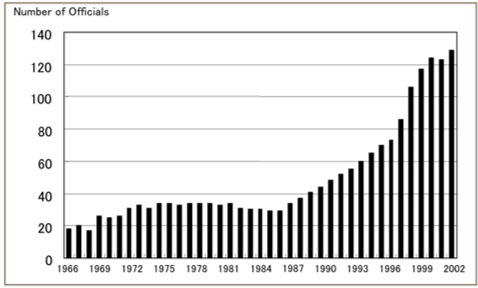
In 2001, Japan sent more than 1,500 officials to short-term courses in the United States (1,100), Great Britain (222), France (116), Germany (50), Canada (34) and Australia (12). Figure 2 (see page 45) shows the trend in the total number of these officials from 1966 to 2002. The long-term programs are mainly for the mid-career government officials who are sent to foreign government organizations and international organizations in order to work on some special research issues.
Training programs that send government officials to Japanese graduate schools are aimed at educating officials who have been working in the office from two to 16 years. To be accepted into these programs requires that applicants pass examinations provided by both the NPA and the graduate school of interest.
Japanese central and local governments send many young officials to a large number of different training institutes and graduate schools. The training courses and curricula mostly include statistics and applied courses, and they sometimes also include systems analysis and O.R. courses. Moreover, in some major graduate schools that have policy-related research programs, statistics and various kinds of O.R. courses are offered. It is in these schools where we find various kinds of research problems for master’s theses using O.R techniques.
O.R. in the Public Sector: Education and Research
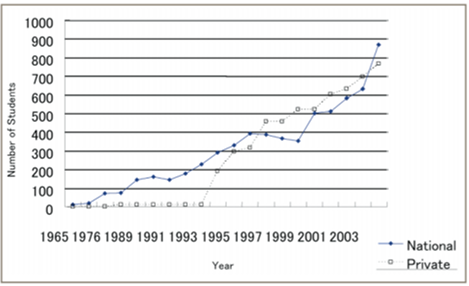
IN JAPAN, policy studies have been conducted in various schools in the university and government research institutes. Public and private universities, in particular, have been very active in creating many policyrelated schools and departments in the last 20 years. Figure 3 (see page 46) shows the increasing trend of the number of students majoring in policy-related areas.
In 1997, the National Graduate Institute for Policy Studies (GRIPS) was established. The forerunner of GRIPS was the Graduate School of Political Science (GSPS) that was part of Saitama University over the period 1977-2001. As of this writing, more than 700 foreign government officials from 60 different countries have been trained at GRIPS and GSPS. In total, we have educated more than 1,500 master’s students sent from Japanese and foreign government offices in the last 25 years, with the number of Japanese and foreign graduates being roughly equal. Master’s programs emphasize such areas as policy analysis, public policy, public administration, development studies and so on. In 2004, GRIPS accepted 230 master’s students and 50 Ph.D. students.
The number of Japanese government officials who go abroad to study in foreign graduate schools has been increasing each year. They now comprise almost 20 percent of the total type I officials compared with just 6 percent 10 years ago. Studying abroad is considered very useful and fruitful for government officials, since they can attain certain “expertise” and “specialty” in addition to gaining valuable international experience.
As in other countries, public sector organizations are divided into both central and local governments. We find that each public sector segment is described by a huge amount of statistical data obtained by various forms of processes: surveys, sampling and other collective means. Such “reliable” data, however, need to be used more efficiently and effectively, as we now find the need for various kinds of policy planning, implementation and evaluation becoming more important. However, the past contributions of O.R., both theoretical and applied, have not been strong enough in these areas, even though it has contributed in some degree. Here is where O.R. can be applied more actively and positively, and, thus, we see a bright future for O.R. in Japan, especially in the public sectors.
Educational activities of O.R. are mainly seen in the graduate schools that have policy-related programs such as public policy, public administration, public management, business administration, development studies, urban planning and so on. Statistics courses are given in most policy-related public and private graduate schools in the various forms of introductory statistics, (intermediate) statistics, statistical analysis, quantitative data analysis and statistical methods for policy analysis.
Technical courses (such as introduction to simulation, decision analysis, mathematical modeling for policy analysis) and theoretical methodology-oriented courses (such as introduction to mathematical programming, optimization model analysis game theory, discrete optimization, and AHP and DEA) are taught in some school graduate programs such as GRIPS, University of Tsukuba and Nanzan University.
In addition to common econometrics courses, specific statistical courses such as categorical data analysis, experimental designs, multivariate analysis and time series analysis are given at the University of Tsukuba’s Graduate School of Business Administration and Public Policy.
In most policy-related graduate programs students are required to write a master’s thesis whose research topics are mostly related to their own interests. Often when students are sent from central and local governments, they tend to choose their master’s thesis topics close to their own work where they have greater access to original data.
For example, following are some recent master’s thesis titles from either GRIPS or the University of Tsukuba:
- “Applying network model approaches to optimize city waste collection and transportation systems”
- “Mathematical modeling analyses on the optimal location-allocation of emergent fire department facilities and staffs based upon the regional data of the degree of risks”
- “Mathematical modeling analyses on the connectivityrobustness of the disaster prevention communication network system”
- “On the relation between voting behavior and regional characteristics”
- “Some results for impossibility theorems of social welfare function and social choice function”
- “Congestion evaluation system using road user’s recognition of congestion”
Future Prospects for O.R. in Public Sector
POLICY EVALUATION has become more necessary, important and also very common with the emerging attention to the new public management (so-called NPM). Also, a large amount of quantitative data have been gathered and prepared by all Japanese government organizations. However, we note that O.R. theory and techniques that take advantage of this data have not been applied effectively so far (this may also be the case for most public sectors in other western countries).
There are also many policy issues and societal problems that have not been considered so seriously by O.R. researchers, even though their solutions are important and needed very urgently in the near future. These global problems arise in the areas of the environment and energy resources and complex societal policy problems such as recycling, information technology industries, natural disasters, lifeline management and other related research issues such as risk analyses, risk management and effective countermeasures for the emergent situations. These all require urgent and appropriate policy decision-making. They are worthy challenges for O.R. researchers.
Conclusion
IN JAPAN, high-level government officials represented by “type I career group” are highly selective given that they passed the very competitive recruitment examination and they were employed by major ministries. Educating and training government officials, including those type I career officials, has a long history in Japan, and the style, system, goals and review process have undergone continual change up to the present. Currently, many officials are given chances to go abroad for studying at graduate schools in foreign universities. Thus, educating and training government officials has become very common. Moreover, the importance of such studies will never be reduced, as this will be one of the few chances for officials to face the “outside world” and communicate freely with people other than their colleagues.
The education and training system needs to be aimed at allowing each official to obtain certain specialty and expertise in various public policy and public administration functions, so that he or she can show his or her capability at the highest level in such areas as policy planning, policy implementation, policy evaluation and policy analysis.
We have been educating and training these officials for a long period. But still our curricula for teaching them needs to be revised continuously so that they can adapt to the social needs. We believe we have contributed enough in order that those officials with academic backgrounds in social science area such as law and economics become more familiar with quantitative theory and techniques such as statistics, systems analysis, O.R. and so on. However, as we described in the previous sections, we still have a lot of societal problems we are required to solve urgently, and we have many opportunities to apply O.R. theory and techniques. In this sense, we expect that public sector OR has a “bright future” even though a lot of uncertainty still exists in the face of our unsolved, complex problems.
In order to reform the government bureaucracy constructively and effectively, the following changes are recommended [2]:
- The mission and responsibility of each government official and each government post should be made clear.
- Government officials need to have broader international and global viewpoints and understandings.
- Every government official has to be equipped with some specialty in his or her job area.
- An evaluation and review system for checking each government official’s work accomplishments needs to be introduced in the Japanese civil servant system with reflection in promotion and salary.
The civil servant system must be revised so that the above objectives can be attained substantially and practically. This includes necessary reforms in the education and training systems. It is also important to create a review process for evaluating existing programs and determining how to organize and modify the education and training of government officials. We strongly believe that the success in public O.R.activities fully depend upon O.R. researchers and our efforts to teach O.R. theory and techniques to high-level Japanese government officials.
REFERENCES
1. Jinjiin (National Personnel Authority) (ed.), 2002, Komuin Hakusho (White Paper of Public Servants).
2. Oyama, T., 2005, “Educating and Training Japanese Government Officials: Current Trends and Policy Study Aspects,” in “The Role of Public Administration in Alleviating Poverty and Improving Governance,” Network of Asia-Pacific Schools and Institutes of Public Administration and Governance (NAPSIPAG), Malaysia, ADB, pp. 96-110.
Tatsuo Oyama is a vice president, dean and professor at the National Graduate Institute for Policy Studies (GRIPS) in Tokyo.
([email protected])