


October 6, 2008 in OR Inside
OR Inside
SHARE: PRINT ARTICLE: https://doi.org/10.1287/orms.2008.05.11

MANY TYPES OF ANALYTICS PRACTITIONERS call big companies home. Some focus on building, maintaining and running large-scale models that they can use to support a set of operational decisions on an ongoing basis. For example, logistics analysts work to continuously optimize the routing of freight in a distribution network as supply and demand conditions change. Other practitioners are in an R&D role and focus on developing and refining products containing decision-support analytics for use by others in solving specific types of problems, oftentimes implemented through software. For example, optimization algorithms lie at the heart of revenue management systems used in the services industry and enterprise resource planning systems used in manufacturing. Yet other types of analytics practitioners may mine large datasets looking for insights into customer behavior or targets for new drug development.
Another type of analytics practitioner is common to many industries and functions.We call them “analytical business consultants.”They are the sleeper stories for the application of analytics in large companies, since they are valued as much for their “soft”skills as their technical skills. They are first and foremost business problem-solvers rather than technical problemsolvers. Analytical business consultants are project managers moving from one problem to the next, bringing analytical rigor to decisions through a combination of analytics skills, consulting skills and business domain expertise. They differentiate themselves from general project managers and management consultants through expertise in business modeling, data analysis and advanced analytics as appropriate to their business problem domain. They may not even think of themselves as analytics or consulting types, but these skill sets are critical to performing their job well.

Why do we need analytical business consultants, and what kind of problems do they work on? What skills are required to achieve mastery? How does the work get done to have the highest impact? Our aim here is to offer perspectives on those questions and to build awareness of this type of analytics practitioner. Our experience stems primarily from working on supply chain and operations problems as part of an Hewlett Packard internal consulting group, Strategic Planning and Modeling (SPaM). However, we believe these lessons are widely applicable across problem areas and for any group working with a broad scope to support decision-making across multiple business units.
Analytical Business Consultants
WHILE ANALYTICAL BUSINESS consulting roles are not new, we believe they are growing in importance. The term “business analytics”has captured the spotlight in the general business community and is now seen by many as essential to supporting business strategy and maintaining a competitive edge in the marketplace [1]. As modern data centers and business intelligence tools collect and make broadly accessible large sets of data on business transactions and records, managers will want to tap into that data to gain insights and make better decisions. Analytics, defined as “the science of logical analysis” [2], allows them to do this.As the volume of data increases,the potential to apply analytics broader and deeper across the organization grows with it – far beyond the domain of a few statisticians or IT specialists, and more than can be contained by any one function,academic discipline or analytical methodology.
While there will always be niche roles for technical specialists with deep expertise in a particular methodology like optimization or data-mining, there is a growing need for generalist problem-solvers to support managers who want to drive better, data-driven business decisions. This is the role of the analytical business consultant (ABC). Their bread-and-butter analytics tools are spreadsheet modeling and data analysis skills. Unlike most generalist management consultants though, the ABC complements their basic data analysis skills with depth in some analytical areas appropriate to their problem domain. The ABC draws freely from different analytical disciplines like operations research, industrial engineering, statistics and economics to suit the type of business problem being addressed. They start with a business problem first, and then bring to bear data and analytical methods as appropriate.
Unlike technical specialists, they complement analytical expertise with both business domain expertise and strong consulting skills to properly frame, structure and communicate problems and solutions. Their objective is not just to analyze, but also to drive action through their insights, recommendations and tools. As shown in Figure 1, they can do this by either providing a recommendation on a one-time strategic decision, or by developing decisions guidelines or a spreadsheet tool [3] to support ongoing decisions. The O.R. community is well positioned to play the role of analytical business consultant. The practical application of different kinds of analytics to business decision-making has always been a common theme in the O.R. community [4].
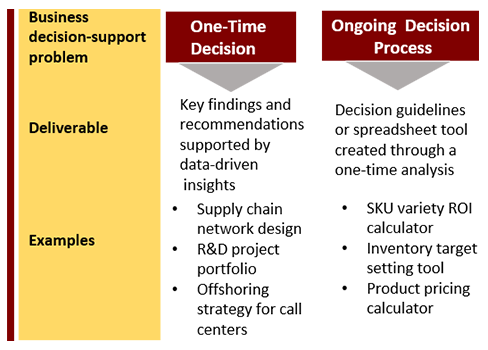
one-time strategic decisions or changes in ongoing decisions processes.
ABC Skills
ANALYTICAL BUSINESS consultants can be found across a wide variety of business domains, including supply chain management, forecasting, product or R&D portfolio management, pricing and sales operations. Developing some expertise in a business domain is important to be an effective problemsolver, so this is a point of differentiation between different analytical business consultants. The point of commonality between ABCs are the foundational skills in analytics and consulting, as shown in Figure 2. When working in a project mode and moving from one problem to the next, it is critical to have a strong foundation of basic analytics and consulting skills.
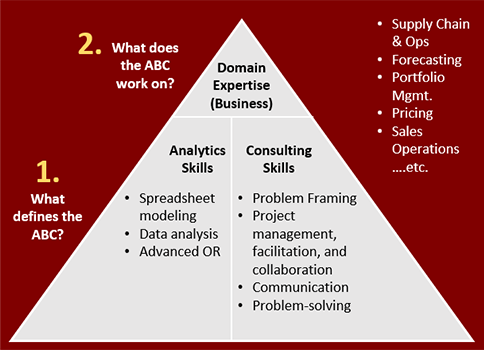
Let’s consider the analytics skills first. There are what we call “advanced O.R. skills”that are nice to have but not essential for the ABC’s general problem-solving. This includes optimization, simulation, decision analysis and regression analysis. These are commonly taught in O.R. education, and the applicability depends largely on the problem type. For example, optimization is good tool to have in the toolkit when working on logistics networks, and decision analysis is good to know when working on R&D portfolio management.
In contrast, data analysis and spreadsheet modeling are the two “must have” skills that are required for the ABC regardless of problem type. A good analytical consultant should have a proficiency with analyzing large data sets and structuring and building spreadsheet models that is well above the average MBA graduate or project manager. These are the bread-and-butter analytical problem-solving tools used in large companies. Any analytics practitioner who works with a diverse project team needs to speak the same analytics language as the rest of the team: spreadsheets and basic data analysis. By “data analysis”we are not referring to what is taught in a basic statistics class, and by “spreadsheet modeling” we do not mean the ability to use a software application like Excel. Rather, they are crafts, in much the same way that writing an effective report or delivering an effective presentation is a craft. As with any craft, the difference between skilled and novice craftsmen is dramatic.
The good news is that the crafts of data analysis and spreadsheet modeling are quite teachable. The bad news is that data analysis and spreadsheet modeling are seldom-required parts of training in O.R. programs and are commonly learned through mentorship from more experienced analytical business consultants. Basic analytics skills are not highly mathematically complex, but they can take you far.
Data analysis skills are required to quickly and easily manipulate large datasets to explore hypotheses,evaluate trends and prioritize between the important and not so important aspects of a problem. This requires the abilities to clean data through automated VBA scripts or Excel functions; manipulate data through pivot tables or relational databases like Access; identify and visualize trends graphically; compare statistical measures like mean and standard deviation between comparison groups; and construct Pareto charts to isolate root causes or dominant factors in the variable of interest (total cost,product returns,late deliveries,etc.).
Spreadsheet modeling skills are required to efficiently manipulate and analyze data in spreadsheets, as through appropriate use of pivot tables, data tables, data filtering functions, dynamic graphs, histograms, statistical functions, text functions, lookup functions and linkage to databases. Spreadsheet modeling skills are also required to build highly readable spreadsheet models quickly and error-free. Examples of best practices in model building are separating inputs, calculations and results; structuring the flow of logic from top to bottom and time series from left to right; using only one formula per row or column; using named ranges for readability of formulas; using formatting for description rather than decoration; avoiding hard coding constants into formulas; and building in error traps and check sums [5].
Now let’s consider consulting skills. In “Flawless Consulting,” Peter Block defines a consultant as “a person in a position to have some influence over an individual, a group, or an organization, but who has no direct power to make changes or implement programs... most people in staff roles in organizations are really consultants, even if they don’t call themselves consultants” [6]. Whether working as an internal consultant, project manager or in a staff role, the analytical business consultant draws on the skills shown in Figure 2. The consulting skills consist mainly of project management, collaboration and facilitation; communication; and problem-solving [7].
Problem-solving skills include both framing and problem structuring that should come before any significant modeling effort. Problem framing asks the question, “What problem should we be trying to solve?” It is seeking clarity on the problem objectives, alternatives, constraints and uncertainties. As the example in Figure 3 shows, it is looking “up”to scan for higher level issues that need to be addressed first, looking “sideways”for parallel issues that must also be addressed, and looking “down” for lower level issues that can present barriers to implementation.
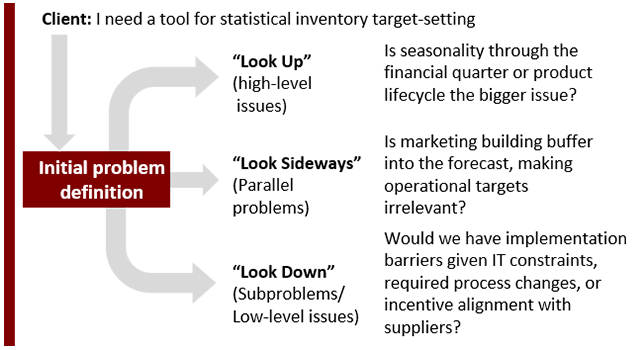
we be trying to solve?”
Problem structuring is about understanding the full range of issues affecting a problem and then breaking the problem into smaller questions that can be answered through more targeted analysis. In general, we are faced with complex, ambiguous problems, and we want to make our analysis job as easy as possible through good problem structuring. We want to use what we know about the problem to develop an initial hypothesis about what the problem and solution is, and then break that hypothesis down into sub issues that can be explored through subsequent data and analysis [8].
As Figure 4 shows, a hypothesis-driven approach to problem structuring allows us to focus and simplify whenever possible. We want to start with a broad set of issues to make sure we aren’t missing key aspects of the problem – we would rather be roughly right and comprehensive rather than precise but irrelevant. We then funnel the issues through a series of interviews, analysis and team discussions until we are able to clearly articulate the insights and “so what’s” from the analysis.
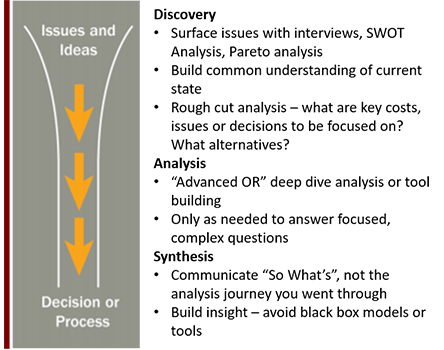
us to focus and simplify the analysis on the most important issues.
One pitfall to avoid is diving immediately into one aspect of a problem because it looks familiar or because it is a technically interesting problem to solve. This does not necessarily mean that it’s the most important part of the problem to be working on. Another temptation that we want to avoid is to try to build what we call a “parallel universe model”that tries to answer any and every possible question that might be posed through a set of inputs and outputs in a complex, black box model. Some clients will ask for this and some analysts will want to build it because of the technical challenge, but modeling and analysis will not be effective without the focus brought by good problem framing and structuring skills. Resist the temptation to build a parallel universe model.
Project management, facilitation and collaboration skills are important, since the ABC must be able to bring together a team to tackle a problem together. Collaborating with a team, rather than working as a pair of hands or in a technical expert role, is essential to building broad commitment to a strategy. Also, the ABC will typically be a neutral third party who is in the best position to effectively plan and coordinate tasks, manage decision meetings, establish ownership and commitment, and plan implementation. When stakeholders from different functions, business units or regions need to all support a decision to ensure a high likelihood of implementation, an ABC’s unbiased position is a valuable asset. Capitalizing on that asset requires good project management and facilitation skills.
Communication skills are another set of “soft”skills that are critical to driving alignment on decisions and commitment to action. The ABC must be able to structure ideas and write presentations and reports that communicate the rationale behind the recommendations in a compelling fashion that management can easily understand. If the analyst only does the analysis and convinces herself what the right solution is, that is only solving half of the business problem. As many veteran analysts have discovered, the attitude of “trust my recommendation because I’ve done the modeling” does not inspire a lot of confidence from decision makers. The modeling and analysis is just a tool to get to the insights.
A good presentation or report should not be about the analysis journey; it should be about sharing insights and building intuition behind the conclusions. To have commitment to action, decision-makers need to convince themselves that they have the right solution. Analysis should help the ABC cut through all the problem complexity and noise and point management towards the few key facts and data they need in order to a quality decision. In the end, the decision should be easy, no matter how complex the problem was at the start.
Of these skills, problem-solving skills are the most fundamental, the hardest to learn and the most often overlooked. They are learned through trial and error of seeing problems and attempting to fit frameworks around the problem to make it tractable. They are overlooked because it is easier to fall back on the alternatives and analytical methods that one is familiar with, rather than probing and surfacing the real underlying issues and developing creative alternatives. Analytical methods like optimization, simulation and regression are tools for analysis, which is only one aspect of problem-solving.
Mastery of analytical business consulting requires one to be good in all the basic analytics and consulting skills, and great in some. The ABC is a well-balanced generalist with pockets of excellence in certain analytics skills, consulting skills and domain expertise. This is in contrast to a technical specialist, who may be world-class in one or two technical skills, but lack some of the more foundational analytics and consulting skills.
Putting It All Together
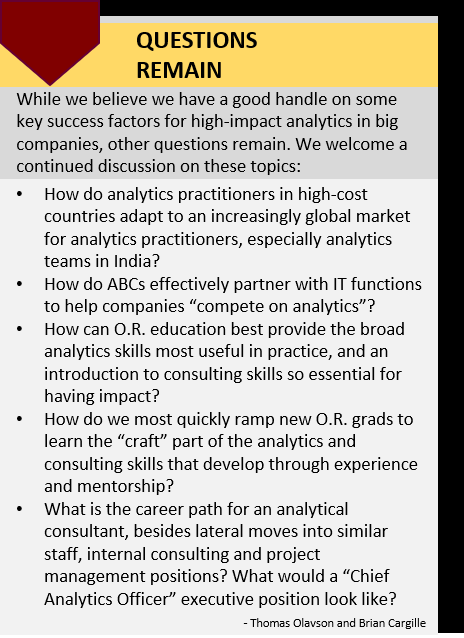
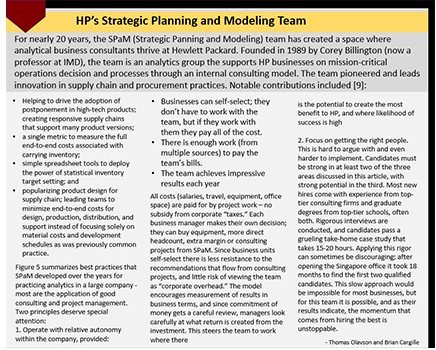
FOUNDATIONAL SKILLS and analytics and consulting can position a person to have high impact in an organization. A team of analytical business consultants with the right governance processes in place can have even greater the impact. Figure 5 summarizes a set of best practices that the SPaM team has developed and refined over the years to be effective analytical business consultants through all parts of a project cycle. We won’t go into details here, but these are mostly the application of good consulting skills throughout a project, and reinforcing some of those skills through processes like project contracts with the client.
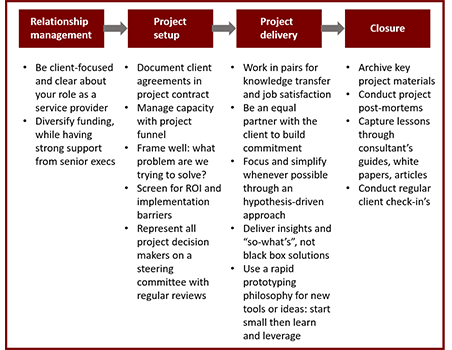
group like the SPaM team at HP.
Besides processes, what makes a team approach especially powerful is the knowledge sharing that occurs across a team of ABCs working across a range of businesses. While all ABCs should be good in the foundational skills, each will also likely have some specialized expertise to contribute. There will be natural differences in experience levels, and each will bring different experiences from their projects. If ABCs work in pairs and have regular forums for knowledge sharing, a natural mentorship model will emerge to develop analytics and consulting skills, and there will be a cross-pollination of ideas and experiences to drive innovation and diffusion of best practices across a company. If you add to that mix knowledge brokering with a network of outside contacts in academia and industry, then you have a real innovation engine for business processes.
REFERENCES
1. A number of recent publications in the general press have documented the rise of business analytics. See for example: Davenport, Thomas H. and Jeanne G. Harris, 2007, “Competing on Analytics: The New Science of Winning,” Harvard Business School Press; Baker, Stephen (Jan. 23, 2006), “Math Will Rock Your World,” BusinessWeek.
2. Analytics: Dictionary.com, Random House, Inc.
3. Tools developed by the ABC are most often developed in Excel and sometimes in Access. Using these common platforms make these tools easy to develop through rapid prototyping and highly portable. For more on best practices for spreadsheet tool development, see Olavson, T. and C. Fry, “Spreadsheet Decision Support Tools: Lessons Learned at HP,” Interfaces (forthcoming).
4. The INFORMS “Science of Better” Web site defines O.R. as “the discipline of applying advanced analytical methods to help make better decisions,” www.scienceofbetter.org/what/index.htm.
5. For a more in-depth discussion on spreadsheet modeling, refer to “Spreadsheet Modeling Best Practices” by Nick Read and Jonathan Batson, IBM Business Dynamics, April 1999 (www.eusprig.org/smbp.pdf). For a more concise set of guidelines, see the “New Guidelines for Writing Spreadsheets” by John Raffensperger at the University of Canterbury Department of Management. (www.mang.canterbury.ac.nz/people/jfraffen/spreadsheets/index.html).
6. Block, Peter, 2000, “Flawless Consulting: A Guide to Getting Your Expertise Used,” Jossey-Bass/Pfeiffer, 2nd edition.
7. For those in a more explicit consulting role, consulting also requires client relationship management skills to build trust and effectively match consultant expertise to the clients needs for the greatest impact. “The Secrets of Consulting” by Gerry Weinberg is a good reference on client relationship management skills.
8. The hypothesis-driven approach to problem structuring is described in Rasiel, E., “The McKinsey Way,” McGraw-Hill, 1999. 9. See the HP SPaM article in Wikipedia: http://en.wikipedia.org/wiki/HP_SPaM
Thomas Olavson is the director of HP’s Strategic Planning and Modeling team (SPaM). Brian Cargille is the APJ manager of HP’s Strategic Planning and Modeling team (SPaM).
([email protected])
([email protected])