


October 6, 2008 in INFORMS News
ROAD TO THE WHITE HOUSE
SHARE: PRINT ARTICLE: https://doi.org/10.1287/orms.2008.05.12
At this writing, just after the conventions, the polls and the pundits say the presidential election is too close to call, a real horse race. To at least one analyst, however, the result was already pretty much a sure thing nearly two years ago: a win for the Democrats.
OR/MS Today readers may remember Allan Lichtman, professor of history at The American University in Washington, D.C. He was the subject of feature articles in these pages in 1996, 2000 and 2004. More significantly, he has attracted quite a bit of coverage in the news media, and his books continue to sell well. His model deserves to be taken seriously, as it has correctly predicted the popular vote outcome of every U. S. presidential election since 1984, including George H. W. Bush’s comeback from nearly 20 percent behind in the polls in 1988, and Al Gore’s narrow win in 2000.
His predictions are based on 13 questions (see box), each with a “yes” or “no” answer. “Yes” answers favor the incumbent party. If five or fewer answers are “no,” the incumbent party retains the presidency; if six or more are “no,” the challenger wins.
For this election, Lichtman says the Republicans have lost Key 1 (the 2006 mid-term election was a huge setback), Key 3 (the incumbent-party candidate is not the current president), Key 6 (long-term economic growth), Key 7 (there were no significant policy changes during this term), Key 10 (the Iraq war is widely regarded as a failure that has cost the United States much support from its allies), Key 11 (there were no major military or foreign-policy successes) and Key 12 (the incumbentparty candidate is not very charismatic or a national hero.) They seem likely to lose Key 5, as well, as many people believe the country is sliding into a recession, and Barack Obama’s charm and appeal could still turn Key 13, although that’s not easy, as only the two Roosevelts, Eisenhower, Kennedy and Reagan have turned it in the past century.
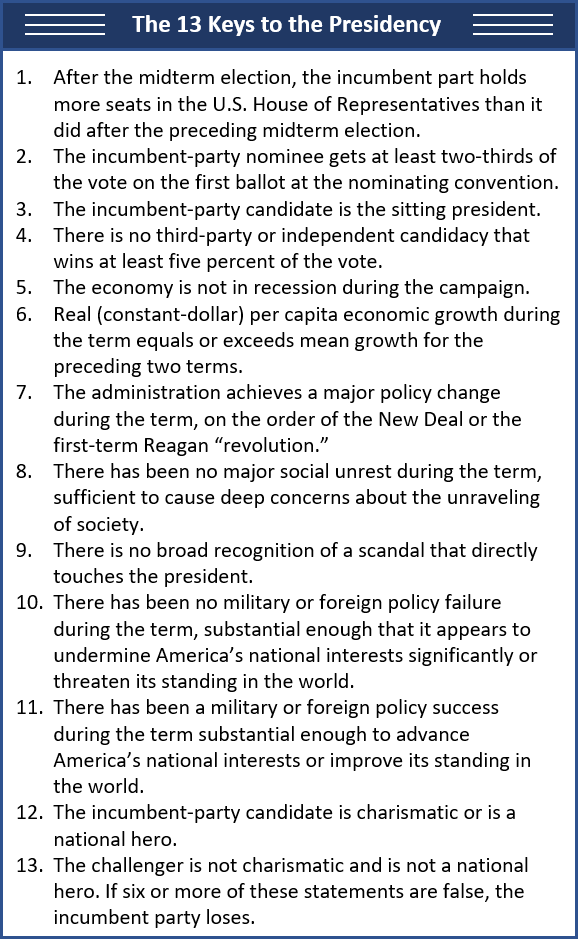
The Republicans hold Key 4, the significant third-party presence, because no candidate seems likely to get five percent of the vote, the criterion for turning this key. Key 2, the contest for the incumbentparty nomination, falls to the challenger if no candidate comes to the convention with two-thirds of the delegates, so John McCain’s unexpectedly easy victory for the nomination kept this key for the Republicans, contradicting Lichtman’s 2005 prediction. The Republicans hold Keys 8 and 9 as well, at least so far, as there is no widespread perception of scandal and no major social unrest. This still leaves them four keys short of what they need, however, with the Democrats holding one more than they need, and two keys still undecided.
Not Just Theory, Statistical Science
LICHTMAN EMPHASIZES that his method is based on a solid statistical model that incorporates a test of competing theories of politics, and the prediction results validate some of the theories and contradict others. The “keys”are based on a statistical pattern recognition algorithm for predicting earthquakes, implemented by Russian seismologist Volodia KeilisBorok. In English-language terminology, the technique most closely resembles kernel discriminant function analysis. The highest plurality of the popular vote, not the electoral vote that actually decides the presidency, is the criterion, which means that in three elections – 1876, 1888 and 2000 – the “winner” as defined in this method did not end up as president. Out of nearly 200 questions, which were all binary (“yes” or “no”) variables, the algorithm picked those that displayed the greatest difference between the proportion of the time the variable was “yes” for years when the incumbent party won and the corresponding proportion for years when the challenging party won, using all U. S. elections from 1860 through 1976 as the training set. Interestingly, the single most powerful variable was the key that turned out to be critical in 2000 – the presence or absence of a significant contest for the incumbentparty nomination.
Lichtman also points out that a number of other variables didn’t have much effect: the challenging party’s nomination contest, adverse reports on candidates’ health, running mates and endorsements,among others.“The point,”he asserts,“is that elections are less about campaigning than people like to believe, and more about governance. That doesn’t mean one party could just stay home, do no campaigning at all, and still win if the keys were in its favor. It does mean, though, that the little ups and downs in the campaigns don’t have all that much effect,no matter what the pundits claim. The people are sensible, and they decide based on how well the party in power has governed.”
But What About ...?
CLEARLY THERE ARE DIFFERENCES this time from past presidential elections. The obvious one is the first black majorparty candidate for president, and then there is the female candidate for vice-president, as well as changes in media coverage, technology and fund raising.“This election will be a severe test of how robust the model is, as so many new factors are in play,” Lichtman acknowledges. “On the other hand, this model has been extremely robust under a wide range of conditions. The elections we included go back to the horse-and-buggy days. The technology is different. Communication is different. The geography is different. The electorate is different. It still works. So there’s good reason to think it will still work this time.
“We had a female running mate in 1984, and it made no difference,”he adds.“The vice-presidential candidates don’t seem to matter.”
Race is different. There is a tendency for black candidates’ actual vote to run 3 percent to 5 percent behind their poll numbers; this is sometimes called the “Bradley Effect”because of the 1990 California election for governor, in which Los Angeles Mayor Tom Bradley – an African American – lost despite being consistently ahead in the polls. “Some analysts claim that’s greatly diminished now,” Lichtman says,“but we don’t know, and in any case we haven’t seen a nationwide election with a black candidate until now.”
Things to Watch
SO HOW CAN WE TELLwho is likely to win? As the election nears, here are a few things experienced political analysts usually watch:
Where the candidates campaign, especially after midOctober. A candidate who is leading spends more and more time appearing in states thought to be leaning to his opponent, but close. A candidate who is trailing tends to keep going back to shore up states he was expected to carry.
Whose issues become the focus. The adage is, “whoever defines what the campaign is about wins.” In 2004, Kerry’s attempts to focus on his claims that Bush had handled foreign policy badly did not succeed; the Bush campaign emphasized lifestyle issues with moral implications, such as gay marriage, and kept Kerry on the defensive about his war record. In 1992, after Bush Senior had enjoyed historically high approval ratings for his handling of the first Gulf War, Clinton won by keeping the voters’ attention on the economy and domestic policy.
Resignations or dismissals of key aides, regardless of the stated reason. Hot arguments culminating in someone leaving are almost invariably publicly attributed to other causes, so as not to impair the campaign. There is friction with colleagues and problems at home in most campaigns, but people are more likely to keep putting up with it all when they think their candidate will win.
Turnout. Turnout by younger voters, blacks and Latinos is notoriously more variable than for other voters. These blocs tend to be heavily Democratic. Getting these votes out could be critical to the outcome in several states.
Organization. A veteran politician, an early and deeply involved backer of Hillary Clinton, told this reporter, “Obama has the best organization I’ve ever seen for a Democrat. If Hillary Clinton had matched his organization, with the other advantages she had at the start, she would be the nominee.”This factor affects all the others, including: fund raising, effectively targeting ads and appearances, maintaining cohesion within the campaign and get-out-the-vote efforts.
And How Well Will They Govern?
AN IMPORTANT ASPECT of modern campaigning is targeting: using specialized surveys and predictive methods to identify persuadable blocs of voters and the issues that will appeal to their interests, or fears or dislikes. Most of the negative campaigning tactics we see are based on targeting analyses that indicate what will work. This raises an important scientific and political question: The “keys” model indicates that presidential elections are all about governance, and that campaign tactics do not matter much. Targeting analyses, however, support a different conclusion and lead to a different kind of campaign – and most likely to a different approach to governance.
Beyond the “horse race”of the campaign, candidates’leadership and organizational skills and approach, including their targeting-based perceptions of the voters’preferences, obviously go on to affect how the nation is governed. Distinguished political scientist and highly successful novelist (he co-authored “The Ugly American” and “Fail-Safe”) Eugene Burdick described both modern targeting and the potential dangers of using it for large-scale political manipulation in his first novel,“The Ninth Wave,” in 1956. He revisited the subject in 1964 to update his information and illuminate the danger more clearly in “The 480.”(480 was the number of strata in the most effective national targeting surveys in use at the time.) Both books deserve renewed attention, as their warnings still apply.
If the machinery of modern campaigning is sufficient to propel a mediocrity or even an evil-doer into power, as Burdick warned, dire presidential failure becomes more likely. George Reedy, press secretary to Lyndon Johnson, observed that the pressures and inducements of the presidency, pulling the president out of touch with the voters, are hard to resist. These factors, in Reedy’s view, led Johnson to abandon politically astute practices that had served him well in the Senate, relying more and more on a small circle of trusted advisors and less and less on broad consensus-building.Writing as the Nixon administration began to exhibit similar tendencies toward closed-innercircle decision-making and personal hostility toward dissenters, Reedy expressed concern about whether anyone would prove equal to the job, but then predicted, “The more probable outcome of our current difficulties will be a ‘man on horseback’ – a George Wallace with a broader appeal or a Ronald Reagan with greater depth. It is certain that faced with a choice of chaos or suppression of dissent, most people will accept suppression of dissent. The human spirit cherishes freedom, but this spirit is within men and women in varying degrees – and for most, stability has a higher priority.”
Historian James David Barber, also writing during the Nixon administration,identified four basic character types of presidents, depending on whether they were “active”or “passive,”that is,how deeply they plunged into the tasks of the presidency, and “positive” or “negative,” whether they seemed mostly confident that they could do good for the country or more concerned about protecting their reputations against adversaries.The “active-negative” type, he argued, often produced disastrous failures, such as Wilson’s impasse with the Senate over the League of Nations, Hoover’s resistance to measures to ameliorate the Depression,and Johnson’s abandonment of domestic policy goals to become enmired in Vietnam. His ideas, updated through 1992 in subsequent editions,are still taken seriously,though obviously not universally accepted.What is not controversial is:
- Presidents’ decision-making style and process are critical to how well they do, regardless of ideology.
- This topic merits more attention than it has received, both in choosing one’s candidate and in helping whoever wins govern.
- This is a subject to which O.R. analysts, with proper effort to acquire the subject-matter background, could make a valuable contribution.
Conclusions
NEW MODELING TECHNIQUES show great promise both for predicting elections very well and for targeting messages to blocs of voters. There is cause for concern, however, that such methods, misused, could seriously undermine the quality of government that ensues. Increased attention to decision-making processes and structures, also using new O.R. methods among other approaches, could do much to prevent or reduce such difficulties. O.R. analysts would do well to learn about these analytical methods and issues and to contribute to improving national-level decision-making.
REFERENCES
1. Barber, James David, 1992, “The Presidential Character: Predicting Performance in the White House,” Prentice Hall, Englewood Cliffs, N.J.
2. Burdick, Eugene, 1956, “The Ninth Wave,” Houghton Mifflin.
3. Burdick, Eugene, 1964, “The 480,” McGraw-Hill.
4. Lichtman, Allan J., 2008, “The Keys to the White House: A Surefire Guide to Predicting the Next President, 2008 Edition,” Rowman & Littlefield Publishers, Lanham, Md.
5. Lichtman, Allan J., 2000, “The Keys to the White House, 2000,” Madison Books, Lanham, Md.
6. Lichtman, Allan J., 1996, “The Keys to the White House, 1996,” Madison Books, Lanham, Md.
7. Lichtman, Allan J., and DeCell, Kenneth, 1990, “The Thirteen Keys to the Presidency,” Madison Books, Lanham, Md.
8. Lichtman, A. J., and Keilis-Borok, V. I., 1981, “Pattern Recognition Applied to Presidential Elections in the United States, 1860-1980: Role of Integral Social, Economic and Political Traits,” Proceedings of the National Academy of Science, Vol. 78, No. 11, pp. 7230-7234.
9. Reedy, George, 1970, “The Twilight of the Presidency,” New American Library, Cleveland, Ohio.
10. Samuelson, Doug, 2004, “Does O.R. Hold the Keys to the White House?” OR/MS Today, October 2004, pp. 36-39.
11. Samuelson, Doug, 2000, “Gore Wins! At Least That’s What the Model Says,” OR/MS Today, October 2000, pp. 24-26.
12. Samuelson, Doug, 1996, “Unlocking the Door to the White House,” OR/MS Today, October 1996, pp. 28-30.
13. Vedentam, Shankar, Aug. 25, 2008, “In the Quake Model, Rumblings Favor Obama,” The Washington Post, p. A3. There is also a follow-up on-line interview about this article, available on the Web.
Douglas A. Samuelson is president of InfoLogix, Inc., a consulting company in Annandale, Va. Samuelson worked as a paid campaign staffer in a U.S. Senate campaign in Nevada in 1970, as a county coordinator in a gubernatorial campaign and targeting analyst for a local campaign in California in 1974, and as a Federal Civil Service policy analyst from 1975 to 1982. He has been a longtime contributor of columns and articles to OR/MS Today and Analytics magazines.
([email protected])