


April 6, 2009 in INFORMS News
THE RESETTLEMENT OF REFUGEE FARMERS
Post-WWII partition problem involving India and Pakistan suggests O.R. may play a relevant role in today’s geopolitics.
SHARE: PRINT ARTICLE: https://doi.org/10.1287/orms.2009.02.14

Operations research, as we all know, has the uncanny ability to find application in a wide variety of fields. From finance to music to healthcare to homeland security, the list is endless. But precisely because of its wide applicability, there remain plenty of unconventional examples that slip under the radar and remain unknown. In these examples, the methods of O.R. often get used, but not consciously.
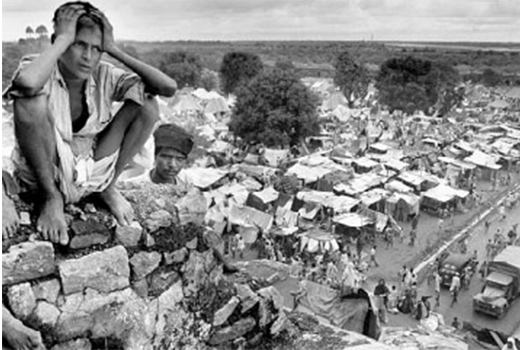
One such remarkable example dates back to late 1940s when the Indian subcontinent was partitioned. Two nations, India and Pakistan, were formed as a result of the partition; both simultaneously gained their independence from Britain. Overnight, immediately after independence, Pakistan emerged as a Muslim-majority nation, while Hindus were the majority in India. The sudden insecurity of minorities in the two countries prompted mass migrations. Millions of Hindus and Sikhs who found themselves in Pakistan left for India, while similarly large numbers of Muslims in India left for Pakistan. To this day, the aftermath of the Partition – which unleashed a spate of violence, rioting and the loss of cherished ancestral homes – continues to haunt the two nations.
What is less known, however, is the effort that went into resettling the displaced peoples who were now landless refugees. One of the largest cross border migrations in human history inevitably became the largest resettlement operation in the world. How was this monumental task accomplished? And how was operations research involved? There’s a glimpse of this in a chapter of the book “India after Gandhi,” by the well-known Indian historian and writer Ramachandra Guha.
The Resettlement Problem
GUHA DOES NOT SPECIFICALLY CALL the resettlement effort an O.R. problem, but reading through the section, one recognizes all the classical elements of optimization. The problem can be summarized as follows:
The northern Indian state of Punjab was one of the partitioned provinces. West Punjab was now in Pakistan and East Punjab in India. The Hindu and Sikh farmers who had moved to the Indian Punjab had abandoned 2.7 million hectares of land in Pakistan. But they now had to be settled on only 1.7 million hectares left behind by Muslim farmers who had fled the opposite way. How should the now depopulated land in the Indian Punjab be redistributed among the newly arrived Hindu and Sikh refugees? The problem was made more complex by three additional factors:
- Each refugee family had a claim on how much they had owned prior to emigrating.
- The fertility of the land differed; there were dry, unirrigated districts as well as lush, irrigated regions.
- There were demands that families and neighbors be relocated in the same way as they had been in West Punjab. If possible entire village communities had to be recreated.
Given that there were nearly half a million claims, one can imagine formulating a large-scale linear or math program to solve the problem under some assumptions. The decision variables would be how much land to allocate and where to allocate. The objective function would be to minimize the difference between claims and actual allocations.
Even by today’s standards there would be huge number of constraints and variables. It is fair, however, to assume that with computers some “optimal”and implementable solution can be developed. But let us look at how Indian Civil Service (ICS), which had no computing technology of any sort, did the resettlement back in 1948-50.
The Heuristic Solution
TO BEGIN WITH, the ICS assigned each family of refugee farmers four hectares irrespective of their past holdings.Viewed through an optimization lens, the four-hectare allotment is an initial solution – by no means optimal, but something to start with while a better allocation was designed. The families, meanwhile, could get loans to buy seed and equipment. They could also make claims as to how much land they had owned and left behind in West Punjab. The ICS then verified these claims in a democratic open assembly. Since entire villages had migrated, claims could be verified to a fair degree of accuracy. Those refugees who tended to exaggerate their claims were deterred by the open assembly method.
The allotment began once the data collection phase was complete. Sardar Tarlok Singh of the ICS and a graduate of the London School of Economics designed a heuristic allocation scheme. The scheme used two key concepts: the standard acre and the graded cut.
Standard Acre attempted to account for the variations in the fertility of the land. It measured the amount of land that could yield about 40 kilograms of rice. In the dry, unirrigated districts, about four physical acres of land were equal to one standard acre. In the more irrigated colonies, each physical acre corresponded to one standard acre.
Graded Cut, on the other hand, taxed the claims according to the size of the claim. Since the refugee farmers had left behind more land than they now inherited, every claim had to be taxed. The higher the claim, the more it was taxed. For the first 10 acres, the cut was 25 percent; between 10 and 30 acres, 30 percent; and so on. If the claim was more than 500 acres, a whopping 95 percent was taxed. The victim who suffered most was a woman whose husband had owned 11,500 acres across 35 villages, but now had to be content with 835 acres in a single village.
Graded Cut is clearly a heuristic.The taxing mechanism might have left too much land unassigned,and many claimants dissatisfied.Or,given that the overall reduction in total land was about 38 percent (the farmers had left 2.7 million hectares behind and now were being resettled on 1.7 million hectares), the taxing may not have been strict enough. The exact details are unknown.
What is known, though, is that by November 1949 – a year and a half after the resettlement began – nearly 250,000 allotments had been made. Even the soft constraints, such as settling families and neighbors together, were met to a large extent. By 1950, a countryside that had been depopulated by the Partition was now teeming again. The heuristics might have been simple, but they helped solve a complex, large-scale allotment problem in the aftermath of a traumatic event.
Indeed, settling the refugees, who had left behind homes and had lost many family members to violence, was one of the first and vital tasks that newly independent India undertook.
Halfway across the world, in the summer of 1947 – the same time that the partition of the Indian subcontinent took place – George Dantzig conceived the famous Simplex algorithm. That same fall, the classical diet problem was solved using the algorithm. The problem had only nine constraints and 27 nonnegative variables, but took 120 man-days to solve; worksheets were glued together and spread out like a tablecloth to assist in determining the solution [1]. This puts the enormity of resettlement problem in perspective. With half a million people making claims, even an awareness of the Simplex method could not have helped the Indian Civil Service.
Nearly 7,000 officials were needed for the resettlement effort; they constituted a refugee city of their own. The problem occupied them for a period of three years. Imagine the paperwork and the records that had to be kept and retrieved; imagine the disputes among the refugees, the flared tempers and the jealousies. But imagine also the perseverance of everyone involved. Operations research in practice is often like this: large numbers of people coordinating their efforts, working against odds, and using information intelligently to come up with workable solutions.
Finally, the resettlement problem is not just an isolated problem from history. It still has relevance in our time. With so many people displaced by wars, civil conflicts and natural disasters, there is much to be learned from this example from 60 years ago. Operations research can clearly play a pivotal role in solving such problems.
REFERENCES
1. Bazaraa, M., Jarvis, J., and Sherali, H., 2005, “Linear Programming and Network Flows,” Wiley (third edition).
Hari Balasubramanian is an assistant professor of Industrial Engineering at the University of Massachusetts, Amherst. His research interests are in operations research applied to healthcare delivery.
([email protected])