August 3, 2009 in Innovative Education
Soldier, Rhodes Scholar, Operations Researcher
WEST POINT GRAD JOSHUA LOSPINOSO’S “INTEREST IN MAKING GOOD DECISIONS” OPENS A WORLD OF OPPORTUNITIES FOR HIM IN MILITARY INTELLIGENCE.
SHARE: PRINT ARTICLE: https://doi.org/10.1287/orms.2009.04.18
Neither legendary Confederate Gen. Robert E. Lee – who rose to the top of his class at the United States Military Academy at West Point during the 19th century when it was largely an engineering school – nor bad boy World War II tank commander Gen. George S. Patton – who managed to graduate the academy despite his struggle overcoming dyslexia – could have imagined a modern graduate quite like Joshua Lospinoso.
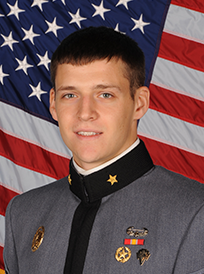
“He’s a bright kid, smarter than I’ll ever be,” says his West Point advisor, Professor Timothy T. Elkins, chair of Force Transportation at the Point.
Lospinoso, who graduated with a rank of lieutenant, is every proud operations researcher’s dream, representing the brain trust of tomorrow and the potential of the profession’s bright young people to bring creative O.R. applications to military, government, and private sector challenges.
Lt. Lospinoso grew up in Florham Park, N.J., near the training site of the New York Jets of the National Football League. During his high school years, the tragedy of Sept. 11, which disturbed young people throughout the New York City metropolitan area, led young Josh to consider serving his country in the military. He originally enlisted in the Coast Guard, but when he learned that he had a chance to attend West Point, he applied and began attending after a year in the Guard.
Since boyhood, he had had an interest in math and statistics. As a teenager he learned that there was a major called O.R. “I have always been interested in making good decisions,” he says. “Finding that there was a major in that lent itself to my personality.”
The computational aspects of programming and algorithms fascinated him, as did modeling – a plus, considering his interest in economics, which relies heavily on modeling.
As his studies continued, he began focusing on a new area that built on his computational strengths: military intelligence. He completed a West Point “advanced individual academic development” stint at the National Security Agency, where he cemented his interests.
“We collect so much data and it’s hard to process,” he says. “O.R. and applied math are all over the place at NSA. That piqued my interest.”
So did the emerging field of network science, an area that fascinated the budding intelligence analyst. Network science (which was the focus of an Operations Researchweb site forum study and discussion last fall) examines connections among diverse physical, informational, biological, cognitive and social networks.
“It’s a refocusing, explaining social systems and biological systems from a macro, rather than individual, perspective,” he observes.
West Point has a Network Science Center, and Lospinoso applied his studies at the center to his work at NSA.
“One contribution I made was paving the way for NSA to implement the network science approach to solving intelligence problems,” he says.
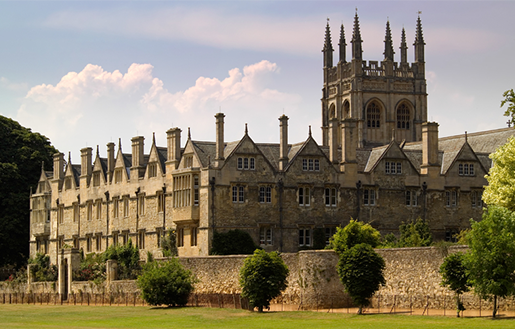
Lospinoso will continue doing research in network science during his Rhodes Scholarship at Oxford University, where he will pursue a doctorate in statistics. The prestigious Rhodes Scholarship, named for Cecil Rhodes, and one of the first international scholarships, underwrites an American student’s education at Oxford University. Only 32 Americans annually receive Rhodes Scholarships, which fund a two- to four-year postgraduate education.
The Rhodes scholarship committee looks for broad interests and a sense of public service. As one might expect, the competition is fierce. “I’ve never seen anything like it,” Lospinoso says of the application process.
The committee requests a relatively brief 1,000-word essay by the applicant – but with just 1,000 words to make a case for fully funded study at one of the most highly regarded universities in the world, Lospinoso says that it was the most difficult essay he has ever written. The committee also requests personal recommendations and the student’s transcript. All that, if the applicant qualifies, earns him an interview with the Rhodes application committee.
Lospinoso qualified, and the day of the interview stood out. “It was harrowing,” he recalls.
He remembers arriving on a Friday and attending cocktail hour with previous recipients of the Rhodes Scholarship. Then came the interviews with the panelists.
“They’re notorious,” he says. “They’re in your face. I got grilled for an hour and a half.”
But the grilling proved worthwhile: Lospinoso earned his scholarship and, at Oxford, will study with Professor Thomas Snijders, formerly of the University of Groningen in the Netherlands.
There he hopes to continue research into a technique that he has explored, actor-oriented social networks. He foresees this research providing him with the resources to model social networks and network behavior for use in intelligence work, which matches suspicious behavior against empirical, network data.
For one used to the American academic approach to postdoctoral study, the experience at Oxford will be a decided change. Lospinoso expects to spend three years that will be devoted entirely to conducting research with Professor Snijders before defending his dissertation.
At Oxford, there is “a greater scope than in the U.S. – there’s no coursework, all research,” he says.“It’s a great opportunity to hone in on the exact problems I want to study.”
Looking back, Lospinoso credits the educational atmosphere at West Point with his success earning the Rhodes Scholarship and NSF grant. Lospinoso benefited from mentoring with people like Professor Elkins and from the informal guidance of a faculty primarily consisting of experienced army officers who intersperse formal studies with advice on planning for an army career. With small classes, he got to know his instructors well and their advice helped him set his future path and apply both for the NSF grant and the Rhodes Scholarship.
In particular, he remembers the value of a Capstone project that he completed at the military academy. “It was a really great project,” he recalls.
In a West Point Capstone project, for two semesters upper classmen join four-person teams, select a project with an advisor and work with real-world clients, employing techniques that they’ve learned in their initial years at the academy. In Lospinoso’s case, he worked with the U.S. Army Intelligence Center at Fort Huachuca, Ariz. His team helped set criteria for identifying decision analysis software that would be used in social networking. That software provides network visualization and serves as an intelligence analysis tool for military intelligence analysts.
“The intelligence community gets inundated with information,”Lospinoso explains, pointing to billions of cell phone and text messages transmitted daily. The Capstone team’s goal was to help intelligence officers sift through these, achieve their specific mission, and, ultimately, save lives.
Massive intelligence data can be examined using a couple of approaches, he explains: one is to write an algorithm to sift through the information. But that model doesn’t incorporate the all-important human element.
Ideally, “the software package is supposed to take information from various sources: communications, travel documents and anything you can think of, then fuse it to one picture that commanders can look at,” he says. “This lends itself well to network science. You have financial information, travel data – and all of it is relational. We compared software packages that do this – it’s all tremendously complicated. Private contractors are developing solutions and it’s hard to decide which package is best. We evaluated, tested against the constraints and came up with an optimal solution for the intelligence center.”
“They did some nice work for the fort,” recalls his advisor, Professor Elkins.
Asked about his future, Lospinoso says he expects to remain with military intelligence, possibly returning to serve with the National Security Agency.
“I feel strongly about serving in the military. I owe the Army a lot for these opportunities,” Lospinoso says with the kind of determination that led this young lieutenant to do sophisticated work in military intelligence, earn an NSF grant and win that most coveted of academic prizes, a Rhodes Scholarship.
No bio information within this article.