


December 7, 2009 in INFORMS News
DASKIN, TRICK RECEIVE KIMBALL MEDALS
SHARE: PRINT ARTICLE: https://doi.org/10.1287/orms.2009.06.23in
Mark S. Daskin, professor and chair of the Industrial and Operations Engineering Department, College of Engineering, University of Michigan, and Michael A. Trick, associate dean, Research, and professor of operations research at Carnegie Mellon’s Tepper School of Business, received the 2009 George E. Kimball Medal for distinguished service to INFORMS and the O.R. profession. Committee Chair Charles McCallum presented the medals at the 2009 INFORMS Annual Meeting in San Diego, Calif.
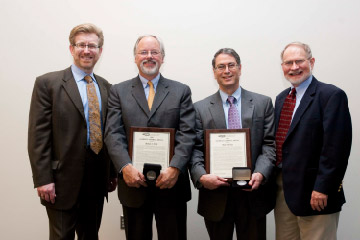
Michael Trick and Mark Daskin and Committee Chair Charles McCallum (l-r).
“At these somewhat trying economic times, everyone is looking for return on investment,” Daskin said in accepting the award. “I can honestly say that working for INFORMS and related professional societies has been a huge ROI for me in terms of meeting friends and influencing the profession.”
Recalling his 15-year involvement with INFORMS in a variety of official capacities including a term as INFORMS president, Trick said he’s “learned an awful lot about social capital”while enjoying working with the “absolutely tremendous” INFORMS staff. The bottom line, he concluded, is “letting the world know about all the wonderful stuff we’re doing.”
Following are excerpts from the citations:
Mark S. Daskin: Professor Daskin’s research focuses on the application and development of operations research techniques for the analysis of transportation, supply chain, and manufacturing problems. He is the author of over 50 refereed publications as well as a text entitled, “Network and Discrete Location: Models, Algorithms, and Applications.” …
Within INFORMS and its predecessor organizations, Professor Daskin has served as an associate editor and the editor-in-chief of Transportation Science (1990-1994). He was the program co-chair for the 1993 TIMS/ORSA meeting. He served as the vice president for publications of INFORMS (1996-1999) when INFORMS initiated the PubsOnline system.
In 2006, he served as the president of INFORMS with a focus on both publications and membership diversity. During that time, he wrote the software that INFORMS uses to report review times for its journal submissions. He has served on the INFORMS strategic planning committee, the Transportation Science editor-in-chief search committee (2002 and 2008) and the INFORMS nominating committee (1998, 2005, and 2007). He is currently a member of the INFORMS Fellow Selection Committee. Outside of INFORMS, Professor Daskin has served as the editor-inchief of IIE Transactions (2001-2004) and as the chair of the Industrial Engineering and Management Sciences Department at Northwestern University (1995-2001).
Daskin is the recipient of the Fred C. Crane Award for Distinguished Service from the Institute of Industrial Engineers as well as the Institute’s Technical Innovation Award. He is a Fellow of both INFORMS and the Institute of Industrial Engineers. …
He has also received Northwestern University’s McCormick School of Engineering Advisor of the Year Award. He was part of an Edelman finalist team. He was the recipient of a Fulbright Research Award as well as a National Science Foundation Presidential Young Investigator Award.
Michael A. Trick: Professor Trick’s research is in the application of integer and constraint programming in scheduling and resource allocation. His most visible work has been in optimal sports scheduling where he has written a number of papers on both the theory and practice of scheduling. Other work of his has been in the areas of computational social choice and in transportation scheduling.
Professor Trick served as the founding editor of INFORMS Online from 1995- 2000. During this period, IOL greatly expanded its scope and offerings and became the preeminent site for operations research information. He was elected to the INFORMS Board in 1998 as Director-at-Large, and was elected President of INFORMS for 2002. During his Presidential year, Professor Trick stressed the value members get from INFORMS and emphasized the social capital aspects of society membership.
The fiftieth anniversary of ORSA/ INFORMS coincided with his Presidential Year, and resulted in a number of activities, including a special issue of Operations Research and recognition for the history of ORSA and INFORMS at the Annual Conference. The year was also the inaugural year for the INFORMS Fellow’s program, so Professor Trick welcomed the inaugural class which contained many of the luminaries from throughout the history of operations research.
From 2004-2009, Professor Trick represented North America on the Administrative Committee of the International Federation of Operational Research Societies, with responsibility for meetings issues. He continues to sit on a number of INFORMS committees, including the Public Information Committee and some ad-hoc strategic planning committees. He is an Area Editor for Operations Research and an Associate Editor for INFORMS Transactions on Education. In 2006, he was General Chair for the INFORMS Annual Meeting held in Pittsburgh, the largest annual meeting up to that time.
Professor Trick continues to use information technology to expand recognition of the field of operations research through his blog and other outlets. His blog is the most read OR blog on the Internet with more than 1,000 daily readers and is a key introduction to our field for many from outside of it.
SHARE: