


June 7, 2010 in INFORMS NEWS
Changing the war with analytics
Top U.S. intelligence officer in Central Asia recommends massive overhaul of how information is gathered and utilized.
SHARE: PRINT ARTICLE: https://doi.org/10.1287/orms.2010.03.12
As the war in Afghanistan escalates and the United States continues to debate its strategy there, one top-level U.S. officer in the region has an unusual recommendation: use more O.R.!
Well, actually, he never mentioned operations research explicitly, but he was talking about better ways to find patterns in voluminous information, how to use those patterns to direct better decisionmaking, and how to organize to do a better job of collecting and utilizing information. Those are the sorts of tasks we in O.R. like to claim we do strikingly well.
Maj. Gen. Michael Flynn, the senior intelligence officer for Central Command (CENTCOM, which is responsible for efforts in Afghanistan, Iraq and Pakistan and the surrounding region), and two co-authors disseminated their findings in a report published in January by the Center for a New American Security (CNAS), a Washington, D.C., think tank. They concluded that intelligence efforts to date have been largely ineffective because of delays, poor information sharing and a mismatch between where information is most accessible and where it is most needed. Their recommendations should be of great interest to O.R. analysts both for their likely effect on the use of O.R. in the war effort and as examples of applying O.R. to try to improve a complex decision-making process.
Maj. Gen. Flynn and his co-authors assert,“Eight years into the war in Afghanistan, the U. S. intelligence community is only marginally relevant to the overall strategy.” They elaborate, “Because the United States has focused the overwhelming majority of collection efforts and analytical brainpower on insurgent groups, the intelligence apparatus still finds itself unable to answer fundamental questions about the environment in which U.S. and allied forces operate in and the people they are trying to protect and persuade.” Quoting General Stanley McChrystal, the overall commander of CENTCOM, the authors continue, “Our senior leaders – the Chairman of the Joint Chiefs of Staff, the Secretary of Defense,Congress, the President of the United States – are not getting the right information to make decisions with ... The media is driving the issues. We need to build a process from the sensor all the way to the political decision makers.”
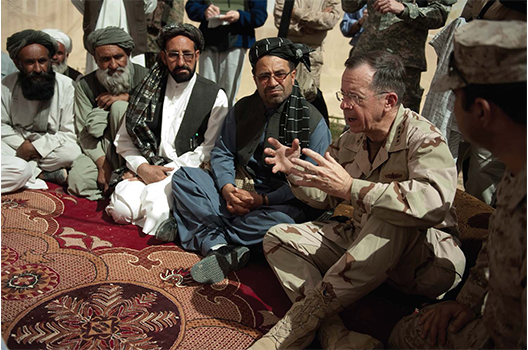
Marjah, Afghanistan. Getting information from such meetings to the battalion level and below is critical.
The Problem at Present
IT IS WELL UNDERSTOOD by now that conventional warfare alone, even using the United States’ vast expertise in informationbased coordination of small unit operations (usually called “net-centric warfare”), will not prevail in Afghanistan, any more than it would have in Iraq. The U. S. military has had much to learn about counterinsurgency and irregular warfare methods, along with a greatly expanded effort to understand and influence the political and economic situation. The turnaround in Iraq is mostly attributable to success in this learning. Still, there is much more to be done; one round of intensive learning is not enough. The authors explain, “The highly complex environment in Afghanistan requires an adaptive way of thinking and operating. Just as the old rules of warfare may no longer apply, a new way of leveraging and applying the information spectrum requires substantive improvements. The ISAF [International Security Assistance Force] Joint Command (IJC) under the leadership of Lt. Gen. David M. Rodriguez has made some recent innovative strides with the advent of the ‘Information Dominance Center.’ This type of innovation must be mirrored to the degree possible at multiple levels of command and back in our intelligence community structures in the United States. In no way is this a perfect solution and the United States will continue to adapt. However, the United States must constantly change our way of operating and thinking if we want to win.”
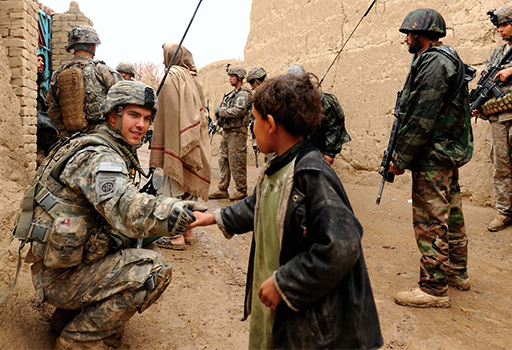
child while on a dismounted patrol at a village in southern Afghanistan.
One critical problem the authors point out is that analytical capabilities tend to be concentrated at higher levels of command (brigade and division) and back in the United States, while the most critical needs for intelligence are at the small unit (battalion and company) level where most tactical operations are carried out. They explain, “At the battalion level and below, intelligence officers know a great deal about their local Afghan districts but are generally too understaffed to gather, store, disseminate and digest the substantial body of crucial information that exists outside traditional intelligence channels. A battalion S-2 [intelligence] shop will, as it should, carefully read and summarize classified human intelligence (HUMINT), signals intelligence (SIGINT) and significant activity (SIGACT) reports that describe improvised explosive device (IED) strikes and other violent incidents. These three types of reports deal primarily with the enemy and, as such, are necessary and appropriate elements of intelligence.
The highly complex environment in Afghanistan requires an adaptive way of thinking and operating.
“What lies beyond them is another issue. Lacking sufficient numbers of analysts and guidance from commanders, battalion S-2 shops rarely gather, process and write up quality assessments on countless items, such as: census data and patrol debriefs; minutes from shuras [council meetings] with local farmers and tribal leaders; after-action reports from civil affairs officers and Provincial Reconstruction Teams (PRTs); polling data and atmospherics reports from psychological operations and female engagement teams; and translated summaries of radio broadcasts that influence local farmers, not to mention the field observations of Afghan soldiers, United Nations officials and non-governmental organizations (NGOs). This vast and underappreciated body of information, almost all of which is unclassified, admittedly offers few clues about where to find insurgents, but it does provide elements of even greater strategic importance – a map for leveraging popular support and marginalizing the insurgency itself.”
Another problem is an over-emphasis on enemy activity. The authors claim:“… Enemy-centric and counter-IED reports published by higher commands are of little use to warfighters in the field, most of whom already grasp who it is they are fighting and, in many cases, are the sources of the information in the reports in the first place. Some battalion S-2 officers say they acquire more information that is helpful by reading U.S. newspapers than through reviewing regional command intelligence summaries.Newspaper accounts, they point out, discuss more than the enemy and IEDs. What battalion S-2 officers want from higher-up intelligence shops are additional analysts, who would be more productive working at the battalion and company levels. … Is that desert road we’re thinking of paving really the most heavily trafficked route? Which mosques and bazaars attract the most people from week to week? Is that local contractor actually implementing the irrigation project we paid him to put into service? These are the kinds of questions, beyond those concerning the enemy as such,which military and civilian decision-makers in the field need help answering.They elicit the information and solutions that foster the cooperation of local people who are far better than outsiders at spotting insurgents and their bombs and providing indications and warnings ‘left of boom’ (before IEDs blow up).”
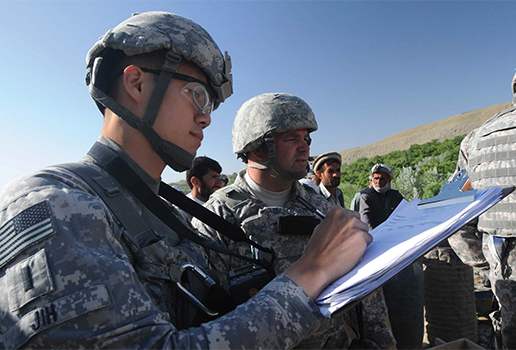
inspecting a section of the road from Parwan to Bamyan with Craig Marshall, a U.S. Army Corps of Engineers
representative to the team, in the Parwan province of Afghanistan. The team is inspecting culverts, power poles
and bridges, which are considered critical structures.
The authors continue, “… [M]erely killing insurgents usually serves to multiply enemies rather than subtract them. This counterintuitive dynamic is common in many guerrilla conflicts and efforts and is especially relevant in the revenge-prone Pashtun communities whose cooperation military forces seek to earn and maintain. The Soviets experienced this reality in the 1980s, when despite killing hundreds of thousands of Afghans, they faced a larger insurgency near the end of the war than they did at the beginning.”
The Recommendations
TO IMPROVE THE QUALITY and timeliness of intelligence reaching operational commanders,Maj. Gen. Flynn and his co-authors propose these initiatives:
- “Select teams of analysts will be empowered to move between field elements,much like journalists, to visit collectors of information at the grassroots level and carry that information back with them to the regional command level.
- “These items will integrate information collected by civil affairs officers, PRTs [Provincial Reconstruction Teams], atmospherics teams, Afghan liaison officers, female engagement teams, willing nongovernmental organizations and development organizations, United Nations officials, psychological operations teams, human terrain teams and infantry battalions, to name a few.
- “These analysts will divide their work along geographic lines instead of along functional lines, and will write comprehensive district assessments covering governance, development and stability. The alternative – having all analysts study an entire province or region through the lens of a narrow, functional line (e.g. one analyst covers governance, another studies narcotics trafficking, a third looks at insurgent networks, etc.) – isn’t working.
- “The analysts will provide all the data they gather to teams of “information brokers” at the regional command level who will organize and disseminate – proactively and on request – all the reports and data gathered at the grassroots level.
- “These special teams of analysts and information brokers will work in what the authors are calling Stability Operations Information Centers. [The authors discuss how these Information Centers cooperate with, and in some cases replace, “Fusion Centers.”]
- “These Information Centers will be placed under and in cooperation with the State Department’s senior civilian representatives administering governance, development and stability efforts in Regional Commands East and South.
- “Leaders must put time and energy into selecting the best, most extroverted and hungriest analysts to serve in the Stability Operations Information Centers. These will be among the most challenging and rewarding jobs an analyst could tackle.”
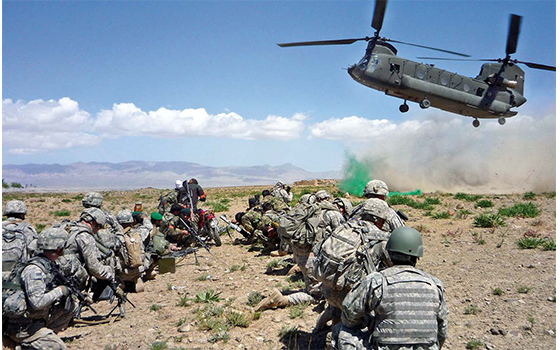
Kheyl in the Zormat district of Afghanistan’s Paktya province, prepares to land.
Implications and Concerns
TO LONG-TIME O.R. ANALYSTS, these ideas sound familiar, invoking Philip Morse’s dictum,“Put the analysts on station, so that they can see the problems for themselves.” In World War II, however, these were mostly civilian analytical teams attached to military units, and the problems they addressed were mostly about conventional combat operations. Maj. Gen. Flynn’s arrangement would involve mostly active duty military officers, and hence would imply some serious changes in promotion criteria and other career incentives. Analytical efforts to improve operational results, both combat and non-combat,would apparently carry more weight than they do now relative to direct combat command experience. So far, there has been little public reaction from the most senior levels of the military about the prospects for this kind of change.
If anything like this restructuring does occur, it would portend a substantial change in the military leadership’s view of how to win – and, indeed,what winning means.Training and encouraging a country’s own leaders to establish and maintain a stable government, not dependent long-term on the United States, is a very different goal from incapacitating anyone in the country who might oppose U.S. interests. If political and economic action is becoming increasingly inseparable from the military’s mission, the military’s view of its mission and required capabilities will continue to evolve, as will the country’s leadership’s management of the military. How these changes would affect the role and importance of analysts, how best to accomplish the objectives these proposals are meant to address, and how the implied change in the roles of military and leadership might work out are all worthy subjects for serious analytical study.
The challenges are substantial, and the solutions are not obvious – nor entirely within the control of the U.S. military, much less just the military’s intelligence and analysis functions. Anthony Cordesman, a frequent and highly respected commentator on the Iraq and Afghanistan conflicts, among other topics, writes,“President Obama’s new strategy for Afghanistan is critically dependent upon the transfer of responsibility for Afghan security to the Afghan National Security Forces (ANSF).… Creating the forces needed to bring security and stability is a far more difficult challenge than many realize, and trying to expand Afghan forces too quickly, and creating forces with inadequate force quality,will lose the war.America’s politicians, policy-makers and military leaders must accept this reality or the mission cannot succeed.”He concludes,“In short, the war will be won or lost by the ability to improve both ANSF quality and quantity. It will be determined by whether the U.S. and its allies will provide the necessary resources and time, and whether progress is assessed with ruthless honesty and without false claims and exaggeration.The present ANSF force goals for 2011 are so high that they may not meet expectations. The heritage of eight years of inadequate resources, massive shortfalls in trainers and mentors, failing to set the right force development goals and false progress reports cannot be overcome by 2011.”
Conclusions
CLEARLY NEW RIGOROUS but flexible approaches to improved collection and use of intelligence in the Afghanistan effort are important and valuable now, and there are challenges and opportunities here for those prepared to tackle them.An interesting experiment in how to do this is now under way, directed and supported from a very senior level,with considerable promise but also with serious potential pitfalls.
Some O.R. analysts with strong defense backgrounds are likely to find exciting career prospects in this work.A few other analysts, at a greater remove from the operational components of the U.S. effort, might usefully contribute by offering careful, creative and, most important, practical guidance on how best to gather, share and use information in a complicated set of decision-making processes, under intense time pressure and with great uncertainty, in a complex organization. Still others may help by assessing how to translate lessons from police work, economic development and education, among other subject areas, into forms that will work in a poor, largely agricultural country with a culture very different from that of the United States. In all cases, spending the time and effort required to understand the problems well, and to recognize the operational and data constraints, will be an essential first step. In short, the opportunity here is not for every O.R. analyst, but for a few, it promises to be immensely rewarding and possibly a great benefit to the country and the world.
REFERENCES
1. Eliot Cohen, 2002, “Supreme Command: Soldiers, Statesmen and Leadership in Wartime,” Free Press.
2. Anthony Cordesman, with assistance by Adam Mausner and Jeffrey Carson, April 20, 2010 (review draft), “Shaping Afghan National Security Forces: What It Will Take to Implement President Obama’s New Strategy,” Center for Strategic and International Studies, www.csis.org.
3. Maj. Gen. Michael T. Flynn, Capt. Matt Pottinger, Paul D. Batchelor, “Fixing Intel: A Blueprint for Making Intelligence Relevant in Afghanistan,” Center for a New American Security, www.cnas.org.
4. John Nagl, 2002, “Learning to Eat Soup with a Knife: Counterinsurgency Lessons from Malaya and Vietnam,” Praeger.
5. Thomas Ricks, 2009, “The Gamble: General David Petraeus and the American Military Adventure in Iraq,” 2006-2008, Penguin.
6. Douglas A. Samuelson, June 2003, “The ‘Netwar’ in Iraq,” OR/MS Today.
7. Douglas A. Samuelson, Summer 2009, “The Turnaround in Iraq,” Analytics.
SHARE: