


August 6, 2018 in Viewpoint
Why women-focused tech products are the next big boom
SHARE: PRINT ARTICLE: https://doi.org/10.1287/orms.2018.04.07
Technology and tech hardware design has traditionally been male-dominated, but that is changing, and greater change is on the way. As technology becomes increasingly intrinsic to our day-to-day lives, more and more emphasis and value will be placed on universal design, creating necessity for designs by women, with women in mind.
As one of the world’s biggest brands, Apple provides a key example. When Apple first released its health app with the intent of making almost every aspect of your body’s daily functions quantifiable, there was no sign of a menstrual or reproductive cycle tracker, something that women have been doing “analogue” (which here means counting on a calendar) since time immemorial. Apple almost immediately rectified the situation, adding these features into the design. However, Apple couldn’t hide the fact that they had effectively forgotten about women.
This example demonstrates that it makes no difference how much money or resource you have to throw at a problem. Without a varied and diverse team, you will make glaring mistakes and miss huge opportunities. The level to which the STEM (science, technology, engineering and mathematics) industry is male-dominated is the precise size of opportunity for female-designed products.
A less recent, yet highly significant, example is seat belts. Once the automobile age was established enough for women to be driving, women almost immediately refused to transport their children (and themselves) at hitherto unknown speeds without better safety measures; i.e. seatbelts. Women’s perspective and priorities made cars safer for everyone.
Diversity increases creativity, and (most importantly to STEM) innovation. Combining this demand for untapped talent in a hugely lucrative sector with the thousands of brilliant girls and women ready to break the poverty cycle in developing nations, creates the potential for a match made in heaven.
It is absolutely vital that relevant corporations and organizations are proactive in creating opportunities for the STEM women of the future, and research shows the best way to do this is to start early. A huge 70 percent of girls are interested in STEM subjects, but 70 percent of those then self-select away by age 11 due to a lack of confidence in math. By supporting young girls’ interest in STEM, educators and parents can provide them with the confidence to explore that huge range of possibilities.
NRG Energy sponsors a competition called FIRST. Students fund, design, brand, build and program industrial-size robots that then compete against other robots. NRG makes funds available to children who can’t afford college, thereby providing approximately $50 million in college scholarships each year. From this, 33 percent of female participants went on to study engineering, and more than 75 percent of FIRST alumni are either studying or currently employed within a STEM profession.
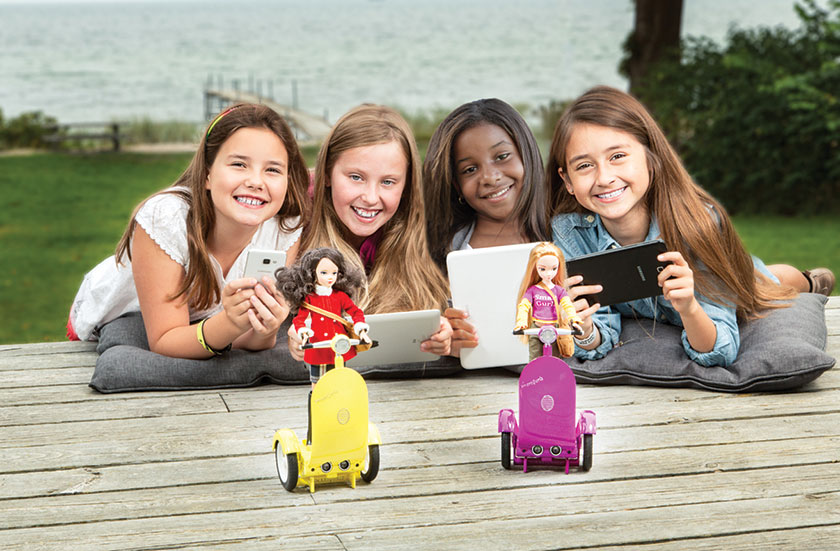 About 70 percent of girls are interested in STEM subjects, but 70 percent of those then self-select away by age 11 due to a lack of confidence in math.

Sharmi Albrechtsen, CEO of SmartGurlz.
Can we start even earlier? There are solutions other than competitions that are applicable to young girls. For example, SmartGurlz offers a range of educational toys targeted at young girls to teach them how to code. The dolls highlight the simplicity of play-learning adaptation. By combining a tablet app with robotic “dolls” on self-balancing scooters, young women are coding within 60 seconds. The app features games and requires basic coding to control the robot and mixes the inspiring and attractive doll-type characters with math, logic and programming skills. All while keeping a child engaged.
These types of toys are designed by women to appeal to their younger selves. By knowing what engages young girls, it’s possible to get them interested in tech. Although toys that teach coding are nothing new, the majority have been designed by men and therefore tend to appeal to boys. What is needed is tech by both women and men.
In other areas where the workforce is primarily female, take nursing for example, endless possibilities are created when more of that workforce comes from a technological background. Streamlined processes, technological developments, machine optimization … all inspired by the people “at the coal face,” with technological knowledge and patient care at its heart.
Before founding the dating app Bumble, Whitney Wolfe co-founded Tinder. It was her experiences after leaving Tinder and the online bullying she was subjected to while going through a high-profile sexual harassment lawsuit that planted the seed for Bumble: to stop what happened to her from happening to others.
“The reason I started Bumble was because I wanted a solution to the experience I went through, and it was something that I could see many women face,” she said. “So, I built a dating app where only women could make the first move, and we built a brand that was built on the foundations of female first, empowerment and respect.”
Looking back to our earlier examples, it’s clear that encouraging young girls into STEM industries and subjects will benefit not just women, but everyone. The call out is for companies to act now and benefit later, or risk falling behind and stagnating while more diverse, vibrant (and feminine) workforces flourish.
Sources
https://journals.aom.org/doi/abs/10.5465/amr.1996.9605060217
https://www.forbes.com/sites/andrealoubier/2017/11/16/the-future-of-women-engineers/#3c2df444ac3c
Sharmi Albrechtsen is CEO of SmartGurlz (https://www.smartgurlz.eu/), a robotics company that focuses on teaching young girls how to code using a range of fun, engaging dolls on funky scooters that are controlled through simple coding. Albrechtsen was given AdWeek’s 2017 Disruptor Award for Championing Gender Diversity in Advertising and Tech. She was appointed to an accomplished panel of judges for the 2018 #Femvertising Awards Honoring Excellence in Pro-Female Advertising, and she battled investor sharks on ABC’s “Shark Tank” (November 2017).