


August 6, 2018 in Innovative Education
Innovative Education: Analyzing master’s programs in analytics
Growing market demand spurs more analytics programs, thus providing more opportunities for innovative education, but finding the right niche is critical for long-term success.
SHARE: PRINT ARTICLE: https://doi.org/10.1287/orms.2018.04.09
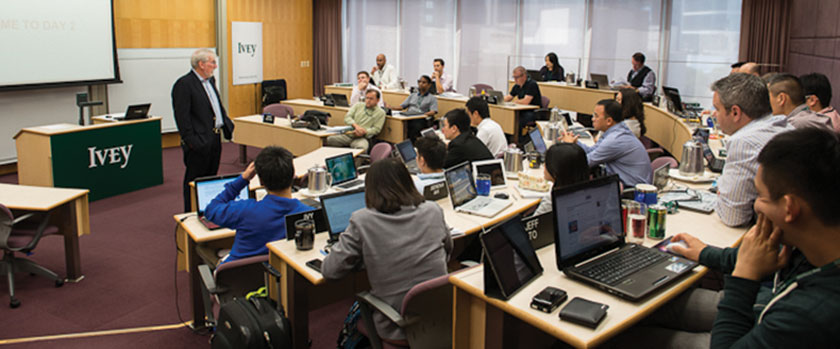
A glance at the advertising in OR/MS Today will confirm that there’s a wealth of master’s degree programs in some form of “analytics” offered by a wide variety of academic and for-profit institutions, with most introduced over the last 10 years or so. These programs aim to meet the current high demand from corporations and not-for-profit organizations for analytics professionals. Among these new programs is the Ivey Business School at Western University’s MSc-Business Analytics degree, which has tried to be innovative in part by including a required summer practicum spent in an organization working with analytics professionals.
The School has taken on the role of finding summer practicums for its students, and I have been involved in setting up and managing these, as well as being involved in the permanent job placement of our MSc students. This effort has involved many conversations with analytics professionals and team leaders, as well as human resource officers with responsibility for recruiting new analytics talent. These conversations have changed my view of OR/MS practice and lead me to conclude that there is much good news for schools with analytics programs, but also several challenges that will require innovation and creative thinking.
Target Market Niche
The good news is that (as many others have reported) the demand for students with analytics skills is very strong with many firms reporting difficulty finding qualified analytics talent. A second piece of good news is that the market for analytics talent is highly diverse and fragmented with many niches, but no single program can expect to meet the demands of the entire market. Most programs should be able to identify a target market niche and focus on developing talent to meet the demands of that smaller segment of the market. I think it will be important for MSc programs to think carefully about what resources to use in their programs to produce graduates who match the requirements of their target market.
For business schools such as Ivey, an obvious market niche is the interface of business and analytics with many organizations, particularly banks and consulting firms, who report difficulty recruiting new talent with strength in both analytics and business. Recruiters told me that there is a chronic shortage of the type of person who can look around the organization and identify “sweet spots” where analytics contributions can create advantage and can then champion or direct an analytics project to capture this advantage. There appears to be good opportunity for business schools to differentiate their analytics graduates from those in other disciplines by ensuring that their students have a strong business education in addition to their strength in analytics. Adding business courses, however, will greatly reduce the time available for analytics instruction.
Marketplace Demands
The major challenge I see resulting from the demands of the marketplace arises from the limited classroom time available in the one- or two-year MSc program. Organizations are impatient and appear to be looking to hire students who can immediately contribute to their analytics team, but I don’t think the OR/MS community has come to grips with what entry-level analytics professionals will actually be expected to do when they start work. The challenge for OR/MS-trained faculty is that the market now expects analytics professionals to be able to find their own data, extract and clean the data, and prepare extensive descriptive statistics including informative graphics. Predictive modeling appears to be highly valued, but the market hasn’t yet and fully endorsed the value of prescriptive models.
Analytics studies have always been driven by data. An early step in the most basic OR/MS problem-solving process involves finding useful data. Not so long ago if we found 30 or 40 data points (or “records”), we were pretty happy: After all, in classical statistics large sample statistics kick in at a sample size of about 30.

Ivey Business School Professor Peter Bell recommends that master’s degree programs in analytics find and fill a market niche.
At the Ivey School of Business, we have a long history of trying to prepare our students to be effective in the business world, and we have embraced a pedagogy where almost every class involves an intensive student discussion of a real business issue presented in the form of a case. Since we require cases to make this pedagogy work, my faculty colleagues and I have written a great many cases over the years, the great majority of which are decision-focused and based on real business problems. Since our students are not expected (or “allowed”) to bring materials outside the case into the class discussion, our cases include any data necessary to build one or more models and arrive at a reasonable plan of action. Most of our cases include less than 100 data points although one of my recent cases on detecting fraud at a major bank (“RBC Social Network Analysis,” Ivey 9B17E005) includes 13,731 records.
A former student now working in business analytics told me that his initial database query on a recent project yielded 6 billion records. Perhaps some cases will begin to appear containing databases with billions of records, but the data would likely still be provided. Recruiters are expecting the students they hire to be able to go and find the data, and innovative thinking is required if we are to successfully deliver classroom experiences that provide students with the skills to do this.
‘Hack the Case’
Since our usual types of cases have quite limited value in teaching students to find relevant data, my Ivey colleagues introduced a live “Hack the Case” event where students were presented with a live problem from a major bank and, with consulting help from a major consulting firm and a software house, were tasked to recommend a path forward for the bank. After a full week of accessing private and public databases (more than 50GB of data on about five million customers), extracting and cleaning data, and performing descriptive and predictive analyses, the student teams made their presentations to bank executives and prizes were awarded.
The event consumed a full week of our MSc program and was expensive in both faculty time and money to organize, but the postmortem conversations were very positive. The bank reported that it found some good ideas in the analyses presented by the student teams, but I was struck by the number of students commenting on how surprised they were at the complexity of all the available databases and the difficulty in identifying useful variables and extracting the relevant records. Several students reported that the most time-consuming activity of the week was cleaning the data.
Exercises such as “Hack the Case” provide student exposure to a rich set of issues, but they take program time and reduce the classroom time available for the more advanced analytics favored by OR/MS-trained faculty. We probably need to add additional exercises along these lines, but where will the program time come from? What will we have to give up?
In Search of Useful, Clean Data
Analytics shops don’t have people tasked with finding useful data for the model builders; the modelers are expected to do this themselves. Conversations with recruiters and students looking for careers in analytics suggest that the skill of finding useful data has become a required hurdle to overcome to be hired. Even very small firms are accessing public data bases to extract data to drive their analytics. Recruiters are examining our students’ vitae to find out whether they understand data structures, what public databases they are familiar with, what query languages they know, and what software they are able to use to handle whatever volume of data appears from a database query and needs to be “cleaned.” These topics have not been given much attention in OR/MS although relevant articles are starting to appear [for example, the recent Interfaces special issue on “Applications of Analytics and Operations Research in Big Data Analysis” (Vol. 48, No. 2, March-April 2018)]. Adding this necessary content to our programs presents some challenges and will also require innovation in teaching methods. For example, how do we teach data cleaning?
At Ivey we have long focused on the use of Excel as the calculating engine in our core business degree courses, but Excel becomes cumbersome or impossible as data sets become larger. Most analytics groups in industry have favorite in-house software (SAS, R, Tableau, etc.); consequently, recruiters are scanning students’ vitae looking for candidates whose software skills match the house favorites. Students are aware of this and are trying to learn a variety of software so they can present a rich list on their vitae. Teaching software skills to a level where the student can perform productive work is time consuming but may still not meet the immediate needs of the market. Last year we spent most of two full days exposing our MSc students to a query language (SQL) but still had two students rejected by one firm for a summer practicum because they were not at a level with SQL where they could be useful without excessive hand-holding.
Computer-Generated Graphics
Computer-generated graphics have emerged as an essential component of analytics. It is generally accepted by those not involved in OR/MS that feeding decision-makers with graphical displays of data will improve their decision-making. Graphics generating software houses (particularly Tableau) have done a masterful job of marketing the value of the graphical display of data, and analytics shops often see a mostly descriptive analysis (maybe with some predictive analysis) complete with graphics as the end-point of their projects.
While advanced analytics professionals have tried to make the case for prescriptive models, most of the analytics houses don’t seem to be there yet. OR/MS journals have been publishing articles on computer-generated graphics (including some of my own) since about 1980, and a recent article (“A Practitioner’s Guide to Best Practices in Data Visualization,” Jeffrey D. Camm, Michael J. Fry, Jeffrey Shaffer, Interfaces, Vol. 47, No. 6, pp. 473-488) suggests continuing interest in this area. Our experience introducing Tableau to our MSc students suggests that it is much easier to teach students how to use the software than it is to teach them what to do with the software. Considerable innovation will be required to help us move from understanding how to produce beautiful graphic images to framing a problem solution through informative and useful graphics that will provide a decision-maker with an unbiased and uncluttered perspective on a critical decision situation.
I have not mentioned artificial intelligence, machine learning, deep learning or a number of other topics that will interest some OR/MS faculty and certainly have market value. How will these be squeezed into the programs? What topics will they push out? In my view, these topics properly belong in programs targeted specifically at these market niches.
The future looks very bright for analytics, but not all of the new analytics master’s programs will survive. Those that are innovative and designed to address the needs of a specific target market niche will be successful in meeting targeted enrollments without breaking the bank trying to recruit students. Other programs will struggle to attract sufficient students to cover costs. Presumably the market for analytics talent will decide which programs will flourish . . . and which programs will fail.
Acknowledgment
I acknowledge my colleagues at Ivey Business School, particularly Professors Greg Zaric, Fredrik Odegaard and Mehmet Begin, who have done stellar work and spent many hours designing and developing a very successful and innovative curriculum for our new MSc–Business Analytics program.
Peter C. Bell is a professor at the Richard Ivey School of Business at Western University, in London, Ontario, Canada.
([email protected])