


August 6, 2018 in Innovative Education
Innovative Education: Recycling ocean plastic into the supply chain
Student project: University of Michigan’s Tauber Institute grad students team up with Dell Technologies to address global problem
SHARE: PRINT ARTICLE: https://doi.org/10.1287/orms.2018.04.13

In sponsoring a 2017 student team project at the University of Michigan Tauber Institute for Global Operations, Dell Technologies presented the challenge of developing an Asia-based ocean plastics supply chain for product packaging, designed to significantly reduce the total landed cost of ocean plastic by 73 percent over the current state.
Dell has been an active sponsor of Tauber team projects since 1999, and is represented on the Tauber Institute’s Industry Advisory Board by Piyush Bhargava, its vice president for global operations. The Tauber team for this project consisted of grad students Dan Partin, who is working on Master of Business Administration and Master of Environment and Sustainability degree, and Allison Ward, a member of the Engineering Global Leadership Honors Program (EGL), which leads to BSE in Materials Science Engineering and MSE in Industrial and Operations Engineering degrees.
The team’s challenge: identify and justify the best market for ocean plastic in Asia Dell’s packaging among its global markets.
Dell Technologies is one of the largest privately held global companies that provide a broad range of technology products for the consumer, education, enterprise and government sectors. In addition to its line of desktop and notebook PCs, Dell offers network servers, data storage systems, printers, Ethernet switches and peripherals such as displays and projectors. With the recent acquisition of EMC Corporation, Dell Technologies is also now one of the biggest storage and enterprise services companies in the world.
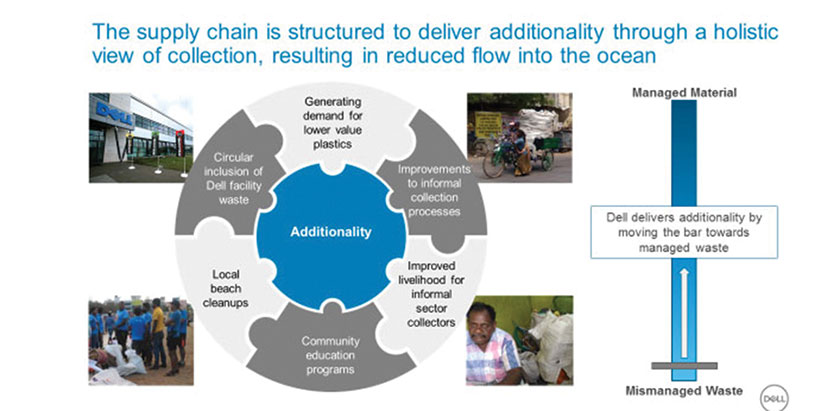
The supply chain is structured to deliver a holistic view of collection, resulting in reduced flow into the ocean. Source: Tauber Institute
Based in Austin, Texas, Dell has a rich history of supply chain and packaging innovation. As part of its commitment to ocean health outlined at the 2017 United Nations Ocean Conference, Dell pledged to source and incorporate 10 times its current annual ocean plastic usage into its packaging, amounting to up to 160,000 pounds annually, by 2025.
More than 8 million tons of plastic enters the ocean each year, a growth rate that by 2050 would result in more plastic in the ocean than fish. Dell’s strategy to tackle this looming environmental crisis is to create a supply chain that intercepts land-based mismanaged waste within 50 kilometers of the shore, thereby targeting plastic at its highest economic value and addressing the root cause of ocean plastic early in its life cycle. In 2016, Dell conducted a pilot in Haiti to source and incorporate 16,000 pounds of ocean plastic into a packaging tray for Dell’s XPS-13-inch notebook. This Tauber project adapted the Haiti pilot to South Asia to capitalize on regional economic advantages and target the world’s leading source of ocean plastic.
“Using our expertise to address global challenges like ocean plastic is at the core of the Dell 2020 Legacy of Good commitment,” says Oliver Campbell, Dell Technologies director of procurement and packaging engineering. “Already several key products are using ocean-bound plastic in their packaging, and we are continually increasing our efforts to benefit local communities and the environment globally. Finding and utilizing long term sustainable sources of ocean plastic is vital to our sustainability goals and our work to pioneer this method of plastics procurement.”
Dell engaged the Tauber team and set the stakes high. The team’s goal was an improved waste management infrastructure that would result in not only improved communities, but also remove millions of plastic bottles’ worth of material from the ocean. Better yet, Dell believes the process can be replicated and brought into other regions of the world. In fact, the company hopes it has to be replicated, as its goal is to someday put Dell out of the ocean plastics business in each location. The scope of the project included:
- Research study on global ocean plastics supply chain possibilities
- Identify and justify the best market for ocean plastic in Asia
- Scope plan and required work documents for supply chain initiation in the chosen market
- Life cycle cost analysis (LCA)
- Implementation plan for ocean plastic supply
- Short- and long-term supply strategy
“South Asia – countries like China, Indonesia, Philippines, Vietnam, Thailand – [account for] almost 60 percent of the contribution to ocean plastic pollution, so we really gave Tauber Team Dell a clean slate to figure out how we wanted to scale the supply chain in any one of those countries and coming up with a fact-based recommendation that we can take forward and would be implementing in the next six months,” Bhargava says.
Adds Ward, “Our summer internship project was to create a supply chain that would help Dell source more ocean-bound plastic for its packaging in an environmentally and economically friendly way. We’d do that by extending the supply chain from Haiti to South Asia.”
Lessons learned along the way
In addition to the obvious advantage of doing significant work at a top-tier company while still enrolled as students, Tauber team members indicated they learned the following lessons during the project:
- Visiting India opened their eyes to the extent of the ocean plastics problem. It was very humbling to meet the informal collectors, and it put their heart behind the project even more.
- Ocean plastic goes beyond just beach clean-ups. The root cause is unmanaged waste infrastructure, which needs to be developed to fully address the problem.
- Many stakeholders, both internal and external, were affected by the supply chain. It was important to collaborate and gather perspectives from all parties.
- Addressing ocean plastic not only has an environmental impact, but also creates economic opportunities in Indonesia and India for collectors, processors and manufacturers.
- Dell is truly behind the ocean plastic cause and catalyzing industry change. The project goes beyond Dell by creating a working group to dramatically increase the impact on ocean health.
The outcome: a new cost-effective supply chain and $350,000+ savings in one year.
The Tauber team’s proposed supply chain delivers scalability with the production capacity to source nearly 500 times Dell’s commitment of ocean plastic usage, or the equivalent of 1.8 billion plastic bottles annually. It also reduced the total landed cost of ocean plastic by 73 percent over the current state, and by 31 percent and 16 percent against prevailing recycled and virgin plastic prices, respectively.
Here are some of the ways the Tauber team reached these goals:
Developed a scalable and cost-effective supply chain to source ocean plastic from Southeast Asia, reducing raw material costs up to 73 percent while diversifying the supplier network.
Reduced manufacturing costs by 51 percent with a sourcing allocation strategy, allowing Dell to effectively remove the equivalent of 3.6 million plastic bottles from the ocean annually.
Collaborated with key stakeholders to analyze and recommend potential next use cases for Dell to exceed a public goal by 700 percent, totaling 1.1 million pounds of recycled plastic annually.
Holistic Approach
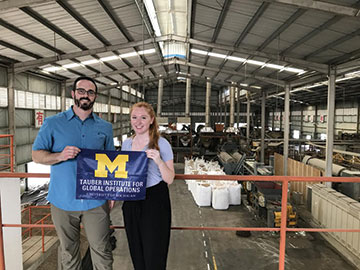
Tauber grad students Dan Partin (left) and Allison Ward defined a cost-effective supply chain for ocean plastic. Source: Tauber Institute
The scope of work described in the project had its challenges. Faculty advisor Steven Skerlos pointed out that, “Generally, operations projects begin with known inputs and a tried-and-true supply chain. This project had to concern itself with material quality questions, as well as a question of who would supply the ocean plastic. Navigating extra layers of complexity and uncertainty was a hallmark of the student performance and a testament to their determination and skill.”
The Tauber team project at Dell benefited from exceptional individuals and interpersonal dynamics across the board. Partin and Ward took the challenge of their project and ran with it.
“The students had to establish contact and engage themselves, relatively quickly, with a complicated reverse supply chain,” Skerlos adds. “They traveled to China, Indonesia and India, and created meaningful relationships that created fast iteration on supply chain opportunities.”
“Finding ocean plastic was only the first step in the journey,” Ward says. “We knew other important supply chain factors must be taken into consideration, such as cost and continuity of supply, but a key focus of our project was to deliver additionality. This meant we had to demonstrate that Dell’s intervention would make a positive impact on ocean health that would have not otherwise been created. To do so, we created a holistic strategy that would improve the existing waste management structure, targeting the root cause of the problem, not just a symptom. This approach considered the livelihoods and practices of informal sector collectors, local beach clean-ups and community outreach programs, and increased demand for low-value plastic.”
The Tauber team first defined a cost-effective supply chain for ocean plastic that could be scaled to meet growing demand. Building on previous internal and external research, the team defined viable sourcing locations of ocean plastic based on a variety of factors, including the availability of mismanaged waste, processing infrastructure and logistical simplicity. Onsite visits in South Asia validated ocean plastic availability and confirmed the capability of local suppliers to source, clean and process the material. Pricing, capacity and quality certifications were modeled along with logistics, manufacturing costs, taxes and risk factors to define optimal supply chain scenarios for delivering ocean plastic resin to current Dell manufacturing sites in China, as well as scenarios that co-located manufacturing in regions with suppliers.
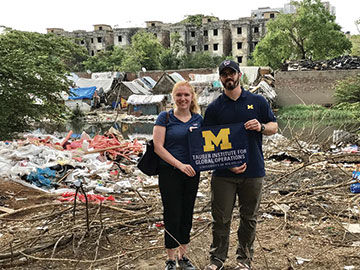
Tauber Institute for Global Operations grad students Allison Ward (left) and Dan Partin onsite in South Asia, where ocean plastic pollution is a growing concern.
Source: Tauber Institute
The Tauber team went to Shanghai and Xiamen in China, as well as Chennai in India. The team then identified and recommended that Dell certify three Indonesian and Indian partners as viable sources of ocean plastic and co-locate packaging manufacturing in these countries. The proposed supply chain delivers scalability, with the production capacity to source nearly 500 times Dell’s commitment for ocean plastic usage, or the equivalent of 1.8 billion plastic bottles annually.
Co-locating manufacturing of the current XPS-13-inch packaging tray with sourcing also reduced manufacturing costs. At the conclusion of the project, the Tauber team successfully delivered an innovative supply chain capable of delivering scalability and cost-effectiveness to both Dell and other like-minded companies.
The project team also included Dell’s Adam Bushong, who served as project manager of the Ocean Plastics Initiative, and faculty adviser Ravi Anupindi from the Ross School of Business at the University of Michigan.
“It was a daunting task, but through collaboration inside Dell, with external experts and with the support of the Tauber Institute for Global Operations at the University of Michigan,” Ward says, “we proved out a model for Dell that could make an ocean plastic supply chain a reality.”
About Tauber team projects
Each two- to three-person Tauber team consists of graduate students in Engineering, MBA, and/or MSCM programs. Along with receiving high-level corporate support from the sponsoring company, each team is advised by a College of Engineering and a Ross School of Business faculty member and overseen by a Tauber Institute co-director. The projects begin on-site in May and continue for 14 weeks. Students present the results of their projects and compete for over $40,000 in scholarships at the U-M Tauber Institute’s annual Spotlight! event, held each September in Ann Arbor, Mich. Spotlight! provides outstanding opportunities for students and corporate partners to establish relationships while exploring innovations in operations and manufacturing.
The 2017 Tauber team projects resulted in $575 million in savings, according to sponsoring company calculations, an average of $18.5 million per project over three years.
To learn more about the Tauber Institute for Global Operations, visit http://www.tauber.umich.edu/ or call (734) 647-1333.
As a footnote, Dell was specifically recognized for its work on the Ocean Plastic initiative by Fortune Magazine, which highlighted Dell in its list of 50 companies that are changing the world. “I think the Fortune article really speaks to your leadership, and the Tauber/Michigan advantage which you brought to the initiative,” Dell’s Campbell said in addressing the Tauber team.
Theresa Ceccarelli is the marketing manager at the University of Michigan’s Tauber Institute for Global Operations.
([email protected])