


October 8, 2018 in Remembrances & Reflections
Thomas L. Saaty: immortal intellectual giant
A year after his passing, another look at the creator of the analytic hierarchy process, his final work and everlasting impact.
SHARE: PRINT ARTICLE: https://doi.org/10.1287/orms.2018.05.12
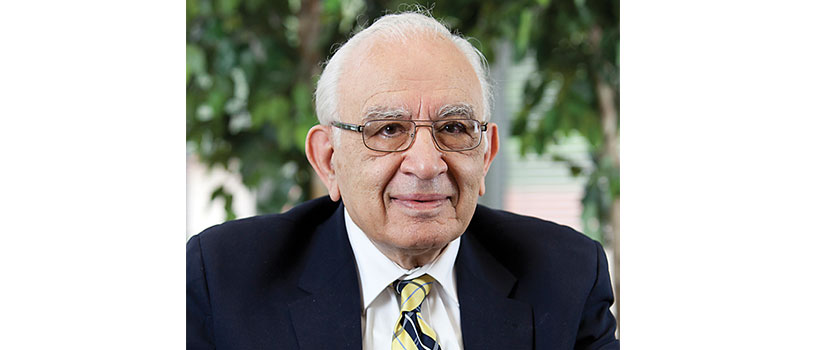
Thomas L. Saaty, a world-renowned scholar, distinguished professor at the University of Pittsburgh, creator of the decision-making analytic hierarchy process (AHP) and analytic network process (ANP) and our advisory editor, passed away on Aug. 14, 2017 at the age of 91. Along with recognizing the one-year anniversary of his death, this tribute focuses on the last years of his life and his final work, with which many readers might not be familiar with.
Professor Saaty made many fundamental contributions to operations research, analytics and mathematics, and his published research has accumulated more than 104,000 citations by other researchers, with an h-index of 93 (i.e., 93 publications each with more than 93 citations). This large number of citations to his work is a clear manifestation of his immense impact on management science, business, pure and applied mathematics and other fields of science.
Saaty had a huge intellectual influence on the theory and practice of OR/MS. His ideas and methods have, in turn, been applied by many non-OR/MS scholars in diverse areas such as the military, engineering, environment, medicine, economics, political science, sociology and psychology. Like a weeping willow – very humble yet wide-ranging with many branches – Saaty and his work continue to touch almost all sciences.
Passionate and Creative
Despite a 14-month long battle against cancer, Saaty remained passionate about creativity and research until the very end of his life. Shortly after his death, Saaty’s lovely wife Rozann recalled that during that time, “… he lived life as usual, teaching his classes at the University of Pittsburgh (his last Creativity class ended in June), as well as writing books and papers. Tom lived an amazingly productive life that I was privileged to share for the 53 years of our marriage. He had an unbelievable mind, memory and intellectual curiosity. He was my personal Wikipedia; I could get the answer to anything about AHP and ANP (book and page number), or statistics about countries around the world or facts about geography. His mind never failed him. Two weeks ago, he was teaching the doctor attending him in his sick bed a clever proof he had of the Pythagorea.”
Although he had been bravely battling a grave illness, Saaty continued to contribute outstanding work to literature, including papers that were published in 2017 and 2018 [1]. On June 1, 2017, he submitted the paper “Origin of Neural Firing and Synthesis in Making Comparisons” (co-authored by Luis G. Vargas) [2] that was published on July 11, 2017 in the European Journal of Pure and Applied Mathematics, just one month before his passing. Saaty saw its publication and expressed his appreciation.
Saaty’s final paper [3], entitled “An Indicator of One’s Life Satisfaction,” was submitted by Jerry Zoffer and Lirong Wei, his co-authors and colleagues at the University of Pittsburgh, on April 18, 2018 – eight months after Saaty’s death – to the European Journal of Pure and Applied Mathematics. The exciting paper was published on July 31.
According to co-author Zoffer, the paper – the last of Saaty’s illustrious career – fittingly describes the use of the analytic hierarchy process in an area where it had not previously been applied. Saaty, Zoffer and Wei developed an AHP model over 58 criteria and subcriteria available in cumulated literature related to satisfaction or fulfillment. These criteria/subcriteria cover all dimensions from human rights and love relations to health and charity, and from shelter and housing to climate.
Along with the paper, Saaty, Zoffer and Wei developed a Microsoft Excel template as a powerful spreadsheet tool so that readers can rate their satisfaction on each of the subcriteria in the structure to obtain an overall measure of satisfaction with their life. Someone who feels they have a perfect life would get 100 percent. The Excel template can be used by any individual to determine what grade they get in life satisfaction. As a user-friendly and entertaining tool, readers may download the model to assess their level of life satisfaction proposed in the paper at https://bit.ly/2Cynau5.
Saaty Still Teaches
Given that Saaty was bravely battling a deadly disease, it is meaningful and appropriate that his final work and papers involved neural activity and life satisfaction. It’s as if through his final lecture, he still teaches and leaves us a legacy of brain and logic (science) and life satisfaction through which he and his co-authors provide an analytical recipe for happiness and success in life.
It is also poignant to note that Saaty was first recruited to the Katz School of Business at the University of Pittsburgh (where Saaty served for 38 years until his death) by Dean Emeritus Jerry Zoffer, a co-author of Saaty’s last paper on life satisfaction.
Saaty once said to the first author of this article, “We all have to go sometime.” While Professor Saaty is now gone, he is intellectually immortal and will keep enlightening us forever.
“The best way to honor his memory is to spread awareness of AHP,” says his wife Rozann.
We gladly do!
References
- Eyüp Çetin, Barıs Kiremitci, 2018, “Pride and Passion: Remarks on Thomas L. Saaty’s Final Papers,” European Journal of Pure and Applied Mathematics, Vol. 11, No. 3, July 2018, pp. 893-897. Link: https://www.ejpam.com/index.php/ejpam/article/view/3316
- Thomas L. Saaty, Luis G. Vargas, 2017, “Origin of Neural Firing and Synthesis in Making Comparisons,” European Journal of Pure and Applied Mathematics, Vol. 10, No. 4, July 2017, pp. 602-613. Link: https://www.ejpam.com/index.php/ejpam/article/view/3074
- Thomas L. Saaty, H. J. Zoffer and Lirong Wei, 2018, “An Indicator of One’s Life Satisfaction,” European Journal of Pure and Applied Mathematics, Vol. 11, No. 3, July 2018, pp. 553-574. Link: https://www.ejpam.com/index.php/ejpam/article/view/3313
Eyüp Çetin is a professor of operations research and statistics. He formerly served as the founding dean of the Faculty of Transportation & Logistics and former vice dean of the School of Business at Istanbul University. In addition, Çetin is affiliated with the Department of Business Administration at University of Zurich, Switzerland, and with New York Business Global, USA. He also serves as co-editor of the European Journal of Pure and Applied Mathematics. Barıs Kiremitci holds a Ph.D. in operations research and is affiliated with New York Business Global, USA. He is also a co-editor of the European Journal of Pure and Applied Mathematics.
([email protected])