
February 4, 2019 in Wargaming & AI
Mosaic wargame series
Assessing the tactical application of AI as a major component.
SHARE: PRINT ARTICLE: https://doi.org/10.1287/orms.2019.01.15
Recent issues of OR/MS Today have featured cover stories on wargaming (October 2018) and artificial intelligence (December 2018). This article examines the nexus of these two activities: conducting a wargame in which artificial intelligence (AI) is a major component.
The need for the wargame series has arisen from an understanding that technology alone is not sufficient to gain an advantage – either in warfare or business. In order to fully capitalize on technological advances, the “operating concepts,” which in business translate to externally facing views and use cases, need to mature at a rate commensurate with the technology itself. Thus, the purpose of the Mosaic wargame series is to simultaneously refine both. Early in the wargame series, we decided that we wanted to use a human AI emulator [1] to elicit new concepts from the players. As our thinking evolved, we ended up building our own simplistic controller.
Background: Concepts vs. Technology
Using a new technology to improve current concepts constrains it to the imagination of yesterday’s concept developers. Furthermore, the proliferation of new technologies will likely enable adversaries to pursue similar advancements and deny the U.S. military an enduring advantage. This kind of move-countermove cycle played out several times during World War II and the Cold War [2] for example in radar vs. electronic warfare (EW), submarines vs. anti-submarine warfare (ASW) and nuclear weapons [3].
A way of envisioning the relationship between technology and operational concept is depicted in Figure 1. As the figure shows, the combination of disruptive technology and revolutionary concept can be implemented all at once, as with precision strike using third-party targeting in the U.S. “Assault Breaker” concept. A disruptive technology can also be initially deployed in support of an evolutionary concept, such as using the aircraft carrier as a scout platform for battleships or the F-35 being used as a strike-fighter like its predecessor, the F-16. The disruptive technologies can later support revolutionary operational concepts that create a new competitive regime, like the aircraft carrier as a multimission weapons system or the F-35 as a command, control, communications, computers, intelligence, surveillance and reconnaissance (C4ISR) platform [4].
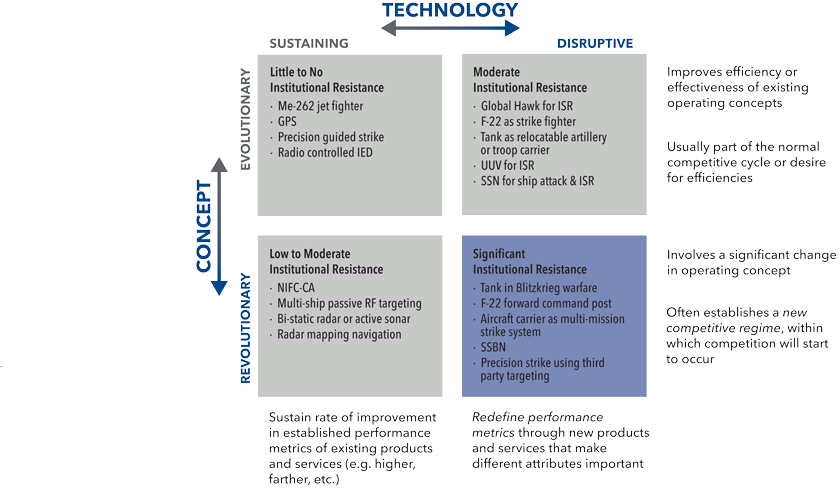
Figure 1: Concepts and technology in military innovation.
Wargaming Combinations of Concept and Technology
The maturation of successful commercial innovations, or combinations of a new product and a use case, can be depicted using “S-Curves” [5] that show how the innovation’s performance improves in relevant metrics over time. Generally, an innovation slowly improves at first, accelerates as the technologies and operational concepts mature, and eventually reaches a point of diminishing improvements when the technology has been fully exploited in service of that particular use case or operational concept. This model helps explain how some commercial innovations, such as smart phones [6], can seem boundless for a time but eventually reach their limits.
The S-curve model can also be applied to combinations of revolutionary military concepts and disruptive technologies. The most impactful of these combinations established a new competitive regime and have been characterized as revolutions in military affairs [7]. During World War II and the Cold War, U.S. leaders leveraged the emergence of new competitive regimes as part of overarching strategies to gain a prolonged advantage, as described in Figure 2.
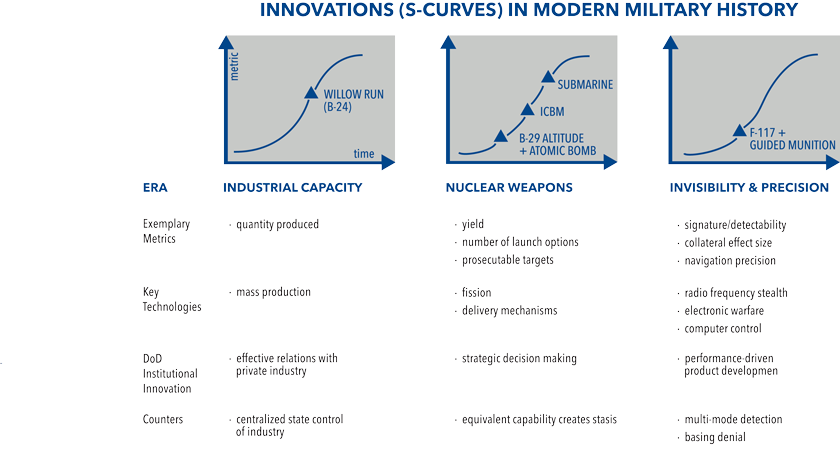
Figure 2: S-curves for historical trends in military advantage. Each curve is triggered by a technological event, and then reaches maturity, necessitating another advance.
Assessing AI in a Wargaming Construct: the Mosaic Series
Military forces are typically assessed either in medium- to large-scale simulation modeling environments to include campaign analysis (see Morgan et. al, 2017 [8]) or in human-in-the-loop wargames. Typically, a wargame is used to develop new concepts using fixed manpower and equipment. In a traditional wargame, human players are placed on two sides, representing the belligerents (henceforth “Blue team” and “Red team”), and a human adjudicator, or “White cell,” serves as a referee. The Mosaic series wargames are novel, because they focus on the implications for concepts of operation, force packaging, and command and control (C2) processes of a proposed addition to the Blue team’s command cell (vice battlefield) – specifically, a pseudo-AI system.
This Mosaic Controller (henceforth, Controller with a capital “C”) used in the wargame series is not a true AI, but rather a heuristic that contains some of the properties of an AI. It is used to give the (human) players a notional C2 process against which to explore the attributes that one would want in an actual controller. This is key within the innovation framework presented above, as it allows insights about technology and employment to be developed simultaneously, thus speeding progress along the AI “S-curve.”
The C2 process used in the wargame relied on human command by the Blue teams and machine control by the Controller. During wargame play, the Controller takes high-level commands from the players and returns a set of force employment options presented as a “menu.” These options – called “Courses of Action” – are the starting points for the Blue team’s actions each turn. These courses of action assign forces available to multiple battles occurring in different locations across a large area. By design, the number of inputs from the users is small, to simulate the players not having access to every detail of the command process. Keep in mind that the research question is not to build a perfect controller, but rather to discover what attributes are best in a controller, and that these discoveries may sometimes be made by counterexample.
From a technical perspective, the Controller’s task is an assignment problem with multiobjective utility criteria and a series of side constraints, some of which are nonlinear. This class of problem is known to be computationally difficult. In developing our wargame controller, we had to choose between two fundamental approaches. The first, which we quickly abandoned, was to set up mathematical programming assignment problem, with a host of constraints, including that each force package needed to be sufficient and none of the elements could be assigned simultaneously to multiple packages, as well as “preference” inputs to the Objective, such as the players desire for manned/unmanned mix and risk tolerance.
We took an alternate approach, in which we used the known attributes of the force list combined with the commander (Blue player’s) preferences and priorities. Each force element is assessed in decision space as to how much their presence furthers the (human) commander’s desired attributes. This approach allows us to add arbitrary complexity to our tool without worrying about runtime, because the problem is solved genetically and is specifically formulated to always return a feasible solution. An effectiveness measure based on Lanchester’s model (see Engel 1954 or Similar [9]) is computed for each force component, given the Blue player’s (imperfect) information. These are combined and presented to the players as a Figure of Merit (FOM).
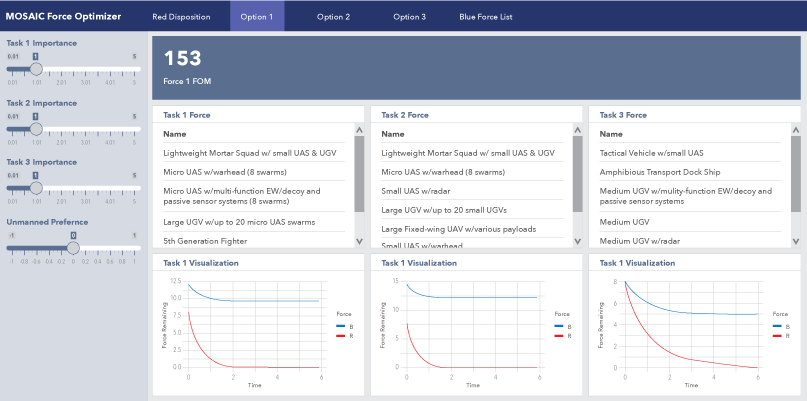
Figure 3: Example of Mosaic Controller dashboard, built in the R language using the “Shiny” toolkit. The overall mission is broken into three tasks, which have forces assigned in the lists. A depiction of the hypothetical battle trace from Lanchester equations is shown in the graphs below each force list. The Task Importance sliders determine each battle’s relative contribution to the overall Figure of Merit.
Control vs. Adjudication
The Controller makes a recommendation of assignment to the human players. While this uses the same fundamental ideas as adjudication, they are not the same. Specifically, the Controller uses the player’s estimates of the situation, as well as their preferences. The adjudication has the advantage of knowing “ground truth.”
As “decision maneuver” superiority was an explicit objective of this game, teams were assessed a “time penalty” based on the amount of time it took them to choose their course of action. This penalty was assessed against a unit’s overall effectiveness. While in most cases, the teams rapidly chose their courses of action, in some cases the penalties could be as high as a 40 percent degradation in performance. In a few cases, the time penalty caused a numerically superior force with superior characteristics to be defeated in the game.
Results and Conclusion
At the time of writing, this project is ongoing, and our assessments are still preliminary, so we will only “sketch” some of the lessons learned.
First and foremost, the adjudication was accepted by the teams. We, the Controller’s architects, were greatly surprised by how readily the Controller’s recommendations were accepted by the wargaming teams. Specifically, in some cases players attributed features and qualities to the Controller that we know were not part of the design. This is in stark contrast to our expectations before the first event, when we went so far as to have contingency plans in place should the players revolt against the construct (!).
Secondly, it became clear in the course of our wargame that as players became familiar with the capabilities of the Controller, they were simultaneously inventing both new ways to use it as well as new things to use it for. Extrapolating, it is clear to us that developing such an ambitious project in the real world will not be a “turn key” exercise, but rather a spiral development with incremental releases and feedback, as each instance creates new things to use it “for.”
Both of these issues appear to be ripe for follow-on exploration.
About CSBA
The Center for Strategic and Budgetary Assessments (CSBA) provides timely, impartial and insightful analyses to senior decision-makers in the executive and legislative branches, as well as to the media and the broader national security establishment. CSBA encourages thoughtful participation in the development of national security strategy and policy, and in the allocation of scarce human and capital resources. CSBA’s analysis and outreach focus on key questions related to existing and emerging threats to U.S. national security. Meeting these challenges will require transforming the national security establishment, and we are devoted to helping achieve this end.
References & Notes
- The irony of using a human emulating a machine emulating a human is not lost on us.
- https://csbaonline.org/research/publications/what-it-takes-to-win-succeeding-in-21st-century-battle-network-competitions
- http://www.airforcemag.com/MagazineArchive/Magazine%20Documents/2016/June%202016/0616offset.pdf
- https://ndupress.ndu.edu/Portals/68/Documents/jfq/jfq-66/jfq-66_85-93_Laird-Timperlake.pdf?ver=2017-12-06-115714-667
- http://www.galsinsights.com/the-innovation-s-curve/
- https://www.ben-evans.com/benedictevans/2017/3/22/the-end-of-smartphone-innovation
- https://apps.dtic.mil/dtic/tr/fulltext/u2/a360252.pdf
- Brian L. Morgan, Harrison C. Schramm, Jerry R. Smith, Jr., Thomas W. Lucas, Mary L. McDonald, Paul J. Sánchez, Susan M. Sanchez and Stephen C. Upton, 2018, “Improving U.S. Navy Campaign Analyses with Big Data,” Interfaces, Vol. 48, No. 2, pp. 130-146.
- J. H. Engel, 1954, “A Verification of Lanchester’s Law.” J. Operations Research Soc. of America.
Harrison Schramm, CAP, PStat, is a senior lecturer at Naval Postgraduate School, splitting his time between Defense Management and Operations Research where, in addition to teaching, he runs the Contested At-Sea Logistics Lab (CASLL). He served as the inaugural chair of the INFORMS Security Conference and is a past president of the INFORMS Analytics Society. Bryan Clark is a senior fellow at CSBA. He previously served as special assistant to the chief of Naval Operations and director of his commander’s Action Group. Dr. Dan Patt joined the CSBA as a nonresident senior fellow after serving at the Defense Advanced Research Projects Agency (DARPA) as the deputy director for the Strategic Technologies Office. He supported the deputy secretary of defense in leading an effort to define a new modernization initiative for the Department of Defense. In this role, he advised the 2017 National Defense Strategy drafting group. He is also the chief executive officer at a commercial robotics and artificial intelligence technology company.
([email protected])