


May 29, 2019 in INFORMS Prizes & Awards
Edelman Award: A Coach’s Perspective
A personal, behind-the-scenes look at the award process and prep, competition and drama.
SHARE: PRINT ARTICLE: https://doi.org/10.1287/orms.2019.03.09
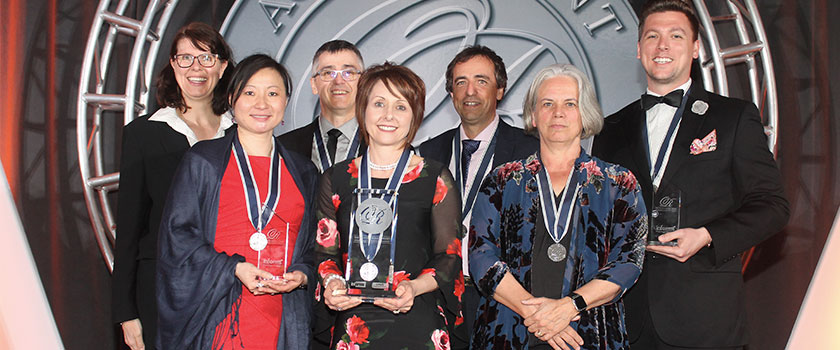
It was near the end of the Edelman Gala on a spring evening in Austin, Texas. Emcee Peter Bell swam in triplicate in front of me: one version of him live onstage, and two other virtual Peters on screens: one far stage left and the other far stage right. The coral roses on our table appeared to be about a foot across each and very slightly fuzzy. Everything’s bigger in Texas. It had been a very long day, and I had just taken off my glasses.
I had been coaching the Louisville Metropolitan Sewer District (MSD)/Tetra Tech Edelman entry team for the past few months, and Peter was about to announce the winner.
The voices rang in my ears.
“The sexiest thing...” This was a quote from one of the videos in the Sewer District presentation. Not often heard in the context of wastewater management, but you heard it here first.
“Oh my gosh, mom, you got to coach the potty project!” This was from one of my teenagers.
“I hope they don’t get my feet in any pictures.” Due to a slight wardrobe snafu (and a rather Californian sensibility about footwear), I was wearing navy blue tennis shoes, white athletic socks and a black business suit. Yes. To the Edelman Gala. Don’t tell my mom. I was lucky the official photo cut everybody off at the knees.
“And the winner is …” Peter Bell turned to look at our table. “The Louisville Metropolitan Sewer District with Tetra Tech!”
The team Ann Bixby and I coached was selected the winner of the 2019 Edelman Award for Achievement in Advanced Analytics, Operations Research and Management Science. This is how it happened, from a coach’s perspective.
Once Upon a Time …
It all started back in October 2018, when I (re-)joined the Edelman Committee. At the time, we had 26 applications for the prestigious award, which by December had been narrowed to a pool of six finalists.
Our chair, Pooja Dewan, somewhat randomly assigned me to coach the Louisville MSD/Tetra Tech entry. As a coach, my world narrowed from 26 broad submissions into the optimized pipes of Louisville and the good people who ruled them. I was allowed to speak Edelman with my Louisville/Tetra Tech team, and with my co-coach Ann Bixby, and that was about it. Communications with the judges had to go by email through Dr. Dewan.
It had been an exciting winter. By January, our team was pulling together the presentation outline. I don’t remember February. March saw the “Resoundingly Human” podcast recorded, and we fielded written questions from the judges. By April, we had videos and testimonials recorded, and we had become good and interested in the PowerPoint presentation. (The competition was April 15.)
The team’s jobs were pretty clear. Louisville MSD’s job was to keep the waterways of Louisville clean. Tetra Tech’s job was to provide the computerized control systems to do so. Together, these two organizations were pulling together one presentation to summarize 20 years of work and over $200 million of cost savings in a 40-minute presentation.
My job? To help the team tell the story in a way that would highlight what the judges wanted to see: verifiable dollar impact, innovative applications of O.R. to real-world problems and transportability to other domains. In other words, I had to help the team communicate value at the rate of six months of effort and $5 million in savings per minute of presentation time.
Eleven days before the competition, I was on a 7:30 a.m. (Pacific Time) call, where I heard the disembodied voices of the team overlaid against the PowerPoint for the first time. There were two Kentucky drawls: Angela Akridge, P.E., the chief engineer for the MSD, and Wolffie Miller, P.E., MSD project manager. There were two Tetra Tech French accents dialing in from Quebec, Canada: Dr. Martin Pleau, our chemical engineer, and Dr. Francois Grondin, our mathematician and programmer. An energetic voice belonged to Diana Qing Tao, M.S., director of Business Development for Tetra Tech, also calling from Quebec. A more sedate American accent came from Los Angeles, from Dr. Leslie Shoemaker, executive vice president of Tetra Tech. And, of course, there was me, from the University of Arkansas, with my O.R. Ph.D. tucked up my sleeve. Collectively, we were about 2.712 linear algebra classes shy of being the Wikipedia entry under the phrase “Hopelessly Overeducated.”
The slides were still a little rough; Figure 1 shows a sample of our internal revisions eight days before the competition.
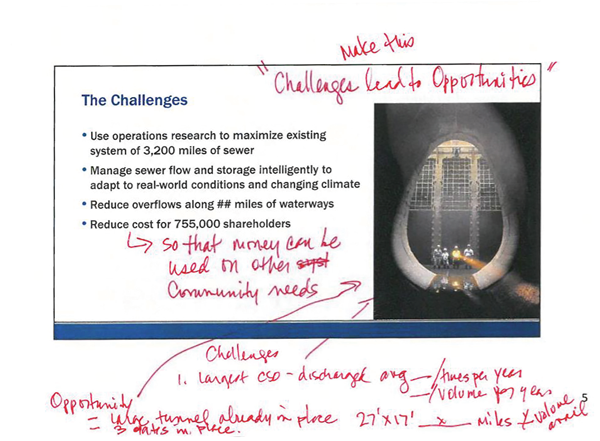
Figure 1: With just one week to go until the competition, we were still making heavy internal changes to our slides.
Two Days Out
Two days before the competition, by Saturday at 6 p.m., Diana, Martin and Francois had made it to Texas from Quebec, and Leslie and I had arrived from California. Angela and Wolffie had run into travel delays from Louisville. We held our practice anyway. Diana had the script in a Word document on her laptop, and Leslie and Diana continued to edit and rephrase it. We ran through the whole presentation, with Diana reading for the missing folks. The time came in at 35 minutes. Spot-on.
Retooling continued. We cleaned up typos. Was the line showing cost reduction obviously downward enough? Did the flow chart flow? The script said one thing, but the slide showed something else – which did we mean? Can we express 600 million gallons of overflow reduction into a number of Olympic-size swimming pools?
One day before the competition, Sunday morning, we had an 8:45 a.m. practice time in the actual competition room, complete with stage, teleprompters and audiovisual presentation equipment. There were the judge’s tables: two long tables covered in black cloth, with nine microphones, nine water glasses, nine little dishes of mints and nine writing tablets. Tomorrow, these nine chairs would decide the competition. Today, they felt larger than life.
Sunday morning brought us Angela but no Wolffie. Angela had spent the previous 24 hours in airports of various flavors, and she had arrived in Austin without any luggage and only one hour of sleep. She was going to rehearse with the team and then needed to go out shopping for some clothing to wear for the presentation tomorrow. Wolffie was still airborne.
I settled into a judge’s chair to watch.
The teleprompters fired up the scripts, and the team filed on stage. The presentation flickered to life on the big screen, and all of a sudden the videos were playing pretty, clean waterways. The overflowing toilet. A stop-action illustration of the pipes beneath the Louisville streets, containing some optimized storm water. A happy screen with an interview of an employee. The final “thank you.”
It was then time for me to play judge. “How exactly did you calculate the $200 million in savings?” “How much data do you need to run this?” “So, it’s a large mixed-integer linear program. Besides its size, what’s so hard about it?” “Louisville is only one city. How can you be so sure this technology can be used anywhere else?”
We weren’t smooth. The wrong script was loaded at first; one team member couldn’t see the teleprompters without contacts. We didn’t have the introductions or handoffs polished. And we needed to encourage team members who weren’t presenting to sit straight up, paying rapt attention, as if they had never seen a sewer before.
After our Sunday morning time in the presentation room, we had more last-minute rehearsing. Monday 8 a.m. was the deadline to get the finalized script to the audiovisual crew. We added in some convincing phrases. Leslie changed a slide to read, “Build Big or Manage Smart.” Angela recounted being a young engineer needing to sell this technology 20 years ago, to be told by the more experienced project manager that it would be implemented “over my dead body.” It was now that we wordsmithed her next phrase: “... Nearly 20 years later, I’m delighted to let you know he’s alive and well …”
Big Day a Blur
The day of the competition, Monday, was a blur. I was off judging the spring Freestyle O.R. Supreme Hackathon. (It was for this occasion I could get away with tennis shoes for the morning.) I was still in my tennis shoes Monday afternoon, when the Louisville MSD/Tetra Tech team filed on stage. Wolffie was wearing a plaid bow tie. Angela was wearing some clothing purchased in Austin for the occasion, plus a jacket borrowed from Diana. Leslie had on heels. Martin looked as geeky as ever, and Francois sat near me in the audience. Diana stood nervously off to the side.
Dr. Dewan introduced our team, and our PowerPoint slides lit up the room. It turned out that a different (but still wrong) script had been accidentally loaded, and Leslie had to stop reading from the teleprompter and move to her paper notes. Angela had to move the microphones and work hard to see over the podium. Leslie was crisp as she told the judges how Louisville had to “Build Big or Manage Smart.” Angela timed the pause in her “over my dead body” story perfectly, and the entire team nailed the time at 38 minutes. The real judges did indeed ask about the $200 million in savings.
And then it was just a few hours until we were sitting at a table at the front of the Gala, peering around roses at Peter Bell in triplicate, waiting for the awards to be announced.
Carrie Beam is a clinical assistant professor in the Department of Industrial Engineering at the University of Arkansas. She holds a Ph.D. in industrial engineering and operations research, and has taught introduction courses in operations management, decision support systems and analytics, probability and statistics, as well as Lean Six Sigma, maintenance and reliability, risk management and a variety of other operations management topics since she began with the program in 2012. She has been teaching online since 2007.
([email protected])