


June 3, 2019 in Government & Analytics Summit
2019 Government & Analytics Summit broadens INFORMS’ advocacy efforts
Former Army Secretary McHugh urges policymakers to think about how O.R. can inform their decision-making.
SHARE: PRINT ARTICLE: https://doi.org/10.1287/orms.2019.03.16
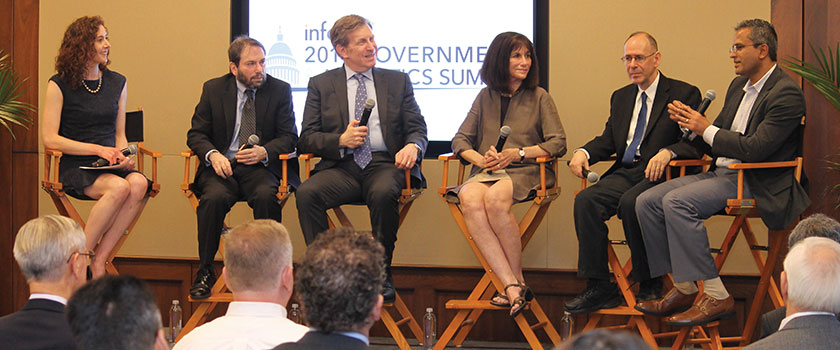
The 2nd annual INFORMS Government & Analytics Summit drew an attentive crowd to the Rayburn House Office Building on May 20 in Washington, D.C. Participants came from industry and academic institutions, both private and public, including the U.S. Naval Academy, University of Maryland, Virginia Tech, SIAM, Congressional staff and several federal agencies and institutes.
Summit attendees – which included both analytics experts and novices – witnessed a sampling of what operations research (O.R.) and analytics can do through a keynote speech and an expert panel discussion, proving that O.R. and analytics can efficiently and effectively make a positive impact on society.
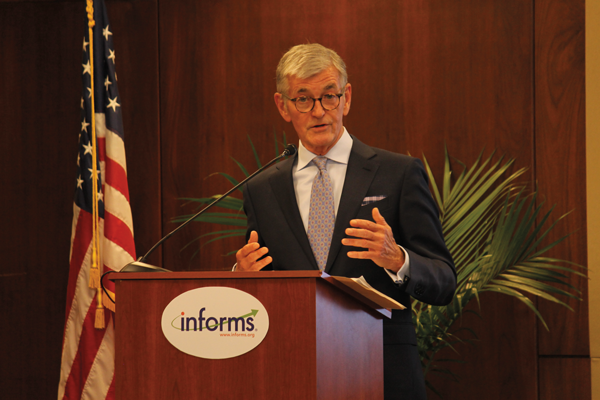 Keynote speaker and former Secretary of the United States Army John McHugh (left) was deeply appreciative that Capitol Hill employees and others from the surrounding D.C./Maryland/Virginia area took the time to attend the event. Secretary McHugh shared an anecdote demonstrating that the government learns from history to advance society. Calling it the “two moose problem,” McHugh described two friends who take an annual trip to Canada to hunt moose, hiring a bush pilot to get them to the remote location. This year the friends have a new pilot, who reminds them that at the end of the week, no matter how well they do, they can only bring home one moose. At the end of the week-long adventure, the pilot returns to pick up the hunters – who are waiting to board the plane with not one but two moose. After some back-and-forth between the hunters and pilot – and a bit of guilting – the pilot was finally convinced to take both hunters and both moose. He backed up plane, revved to its highest RPM, began to take off, and the plane flipped. After they came to – one friend asked the other, “Where are we?” to which his friend replied, “About 100 yards farther than we got last year.” See how McHugh tells the story here.
As for INFORMS and its relationship to government, McHugh said that INFORMS’ deep involvement in “today” activity is so important to how the government does business and how they work. “Regardless of your policy area,” he said, “think about how O.R. can inform your decision-making for important solutions.” Key federal programs – national and health security, mail delivery and census – are based in large part on data analytics and O.R. The common connection in all of these is the reliance on converting data into information and information into insights, resulting in better decision-making. He noted that there are countless examples of less expensive and more effective solutions – many of which were discussed in the panel following his keynote.
Secretary McHugh is no stranger to data analytics, even though he is not a data scientist and looked to those “smart people” for help during his education and beyond. Math is used to solve problems and emerged as a critical tool during World War II. In the decades that followed, O.R. has been involved in the never-ending fight to keep America free. Organizations across the globe have adopted these tools. McHugh noted that modeling is still used today in many industries from positioning responders and routing aircraft and buses, to scheduling sports teams and how baseball teams position their fielders (sabermetrics). O.R./analytics is the science behind solutions that people need and deserve, McHugh said.
He continued by saying leaders in Washington should fully capitalize on using O.R. and analytics (with help from INFORMS). McHugh himself faced significant change during his time in office – budget reduction, force restructuring – and relied on sound decision-making, which relied on O.R. and analytics. He had to leverage analytics throughout the U.S. Army to increase operational effectiveness – data led the decision-making process. He modernized forces that made the Army more efficient and effective, even within constrained budgets. According to McHugh, the U.S. military has the best supply chain operations in the world – moving vehicles, people and food; paying people; equipment storage and allocation. And how do these pieces work together? In large part, data. “As Congress tackles these and other problems like AI, sharing economy and smart cities – the opportunity to leverage O.R. is greater and more important today than perhaps ever,” McHugh said.
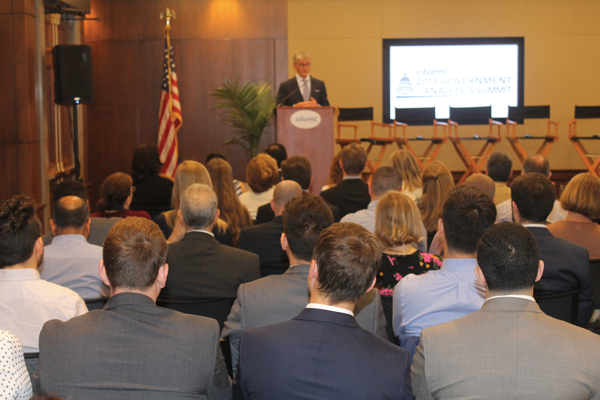 In conclusion, Secretary McHugh urged Summit attendees to reach out to INFORMS to help their respective institutes and industries make sense of data to make better decisions. For specific examples of how O.R. and analytics can be used, McHugh turned it over to the panel.
This year, the panel was combined into one conversational, moderated session, compared to last year’s three concurrent panels. Per INFORMS 2019 President Ramayya Krishnan, this intentional change was a device to informally describe what O.R. and analytics bring to the table and allow for audience questions and discussion. Summit Committee chair Laura Albert from the University of Wisconsin-Madison said this change allowed for the discussion of principles that cut across all sectors as opposed to focusing on one sector. (Last year, panel breakouts covered healthcare, transportation and security.) “It was fun to talk about working with stakeholders, challenges with data and how every good solution starts with a bunch of conversations that happen over a long period of time – and those principles really came out in the way the panel was [set up] this year,” she said.
Moderated by Albert, the panel included five experts who shared case studies of successful O.R. and analytics in both the public and private sector and provided a better understanding of O.R. in government decision-making. Each panelist described at least one major project they worked on that used O.R. to solve a problem.
Bala Ganesh, vice president of Corporate Engineering at UPS, said in simple terms that UPS “picks stuff up and moves things and delivers them, either by air or ground.” All these processes need O.R./analytics.
Karla Hoffman, professor in the Systems Engineering and Operations Research department at George Mason University, worked with the Federal Communications Commission (FCC) on the first-ever, two-sided spectrum auction to address the rapidly growing need for wireless spectrum. This work contributed more than $7 billion to reduce federal debt, and TV channels could remain where they were on selection. The auction relates to 5G and the future, allowing very high-end frequency to be used for drones. Hoffman has been involved in the policy world her entire career; her first job with the National Institute of Standards and Technology used O.R. and analytics analysis for any government agency that didn’t have that kind of tech within their own agency. Now, agencies such as the IRS, Energy Department and Department of Transportation all have analytics staff.
Sheldon Jacobson, Founder Professor of Computer Science at the University of Illinois, got into government work in 1996. He found airline safety interesting and received a $1,000 grant for research, which became a precursor to TSA PreCheck. Jacobson has also studied nonmedical interventions for obesity by considering how transportation impacts obesity and using O.R. and analytics for these problems.
Don Kleinmuntz is an analytics consultant and adjunct professor of IT, Analytics and Operations at the University of Notre Dame’s Mendoza College of Business. He was part of a start-up company for advancing analytics in healthcare systems, which provides organizations with tools for the objectives of saving lives, saving money and solving problems. The current emphasis in healthcare is on value-focused care – providing better care with less money, which requires O.R. and analytics to answer important questions.
David Shmoys, Laibe/Acheson Professor of Business Management and Leadership Studies at Cornell University, and research consultant to Lyft, has been involved in a range of activities in the sharing economy. He said, “Urban mobility has changed dramatically in the past 10 years. Sustainable options like bike share or scooters have transformed D.C.” O.R. and analytics frames these new mobility options to figure out if we are reaching goals and if the digital platform system is being used properly.
After panelist introductions came the deep-dive with questions from Albert and the audience members. Some key takeaways from the panel discussion include the following.
Finding problems to solve with O.R. is not always an easy or quick task. Most organizations did not come to the panelists with their exact problem, but with data or a goal, and they had to frame the problem using O.R./analytics as the tool to make a difference. Many long conversations are had with the organization, industry and policymakers to determine the problem and best plan of action to solve it. Shmoys said that seven years ago, the director of Citi Bike came to him and said, “We don’t have any analytics, but we have a goal to start every rush hour with every station half full.” They had 12,000 docks and 6,000 rideshare bikes – and a problem. Little by little the model evolved and gave a pricing value for what the next bike and that station would have system-wide.
There is no one-size-fits-all solution to problems that need O.R. Shmoys’ advice: “Start with a system model, see what works and what fails, and tweak as you go along.” Ganesh uses “what-if” scenarios and a combination of O.R. and machine learning techniques to predict what’s possible, while Kleinmuntz prefers to look at best practices from cross-industries and balance them while paying attention to constraints. Kleinmuntz suggested looking at both public and private sectors to find out what works and what doesn’t, and then pull that information into your own space. Jacobson noted that after 9/11, aviation security was one-size-fits-all, but it didn’t work. He suggested using information about passengers to inform models to reduce cost and increase system security. He developed and analyzed models to prove it could happen, which became multilevel passenger screening, or what many people know as PreCheck. Albert summarized that borrowing ideas from another sector and applying them to your own works because it is the same process and techniques, just applied to different problems.
Problem-solving objectives are just as much about increasing quality/value as cost reduction, if not more. Jacobson said that he doesn’t think of cost saving as an objective, it’s more about value, and understanding the trade-offs between the two.
“I know it sounds like you can get your cake and eat it too, but so much of what we do is talking about saving money and using resources efficiently, we forget that on the flip side we’re actually delivering a good service,” Albert said.
Artificial intelligence (AI) plays a role in O.R. and offers a range of tools for the appropriate problem. But it is complementary to, not instead of O.R. tools. For Shmoys, AI is essential in modeling. However, he said there is a range of touchpoints where new technology from AI is only half the problem/solution. AI tools can help O.R. tools and we should make full use of its potential. Kleinmuntz agreed, saying that technology is better than it used to be, but people and processes are holding AI back. The analytics community has a lot of knowledge not just on how to make better judgments but how to enforce them for real people and real problems. Jacobson pointed out that O.R. and AI are both about modeling for informed decision-making. AI has the attention right now because of diagnostics and the medical community – it is very tactical. He thinks the best foot forward is strategical and there is a big opportunity for prospective analytics.
Involving the public and stakeholders in decision-making is critical to the field of O.R./analytics. This will help build trust and confidence that the work done by O.R. professionals considers ethical, privacy and security issues. Krishnan noted that addressing these issues is a real opportunity for INFORMS to take on questions of algorithm transparency and model bias. It is a huge issue as we think about using AI and O.R. tools more broadly to support high stakes decision-making.
Kleinmuntz says that on principle, you need wide participation in decision-making – all stakeholders at the table giving in to the process. This could include members of the public, government and private sector stakeholders, but public participation is especially important.
Everything starts with a conversation. Most people don’t know how to solve a problem but know that there is one – all they need to do is ask. Shmoys noted that most university programs in O.R. are looking for interesting projects of companies in need and will match them with teams of students to see if doing good O.R. to do good can emerge from a partnership. Organizations and companies do not need to have any math or modeling experience to get help, and it is easy to get started. “If the person you’re talking to requires you to know math before talking meaningfully to you, you are talking to the wrong person,” said Kleinmuntz.
Better data makes better decisions. At UPS, Ganesh starts every project with structuring data, then defining the problem. The process looks at data framework or foundation to get variables needed to solve the problem. Initial phases of the process connect proper silos of data. Insight is more important than just the numbers. “It is easy to say ‘just use Google Maps’ but from our perspective it is important to get to the destination and then get to the next destination from there. There are layers combining external (weather) data and traffic data and fuel data, which aligns with data collection,” said Ganesh. According to Kleinmuntz, when it comes to data, more is better than less and good data is better than bad. But it does happen when there is not enough data, or no relevant data are available, and this is when O.R. professionals use expert judgment.
What to Expect
Both Laura Albert and 2019 INFORMS President Ramayya Krishnan noted that the Government & Analytics Summit is still a work in progress. Each year is an improvement, and they are still looking for ways to get INFORMS members involved and connected to real problems, mainly as experts, but also with connections that help foster and further their research.
Krishnan said, “We need to continue this in a sustained fashion because [government and public policy] is a really important stakeholder and consumer of what it is we do at INFORMS.” He thought Karla Hoffman said it best during the panel when she said it is all about working on real, important, practical problems applying the tools we have, but equally well these problems and applications drive new foundational work and have the ability to advance the science. “Having that closed loop is an idea that works really well for us to partner with government and public sector and public policymakers,” Krishnan said.
“I see [the Summit] as being one part of our broader advocacy efforts,” he said, “We are currently engaging on the Hill and in the Senate and Congress in various committees.” The objectives of these engagements include: brand elevation for INFORMS, better awareness of what it is we are doing; better funding for O.R. and analytics work from federal agencies; and leaders in public and private sectors turning to INFORMS as a source of advice and expertise to help solve upcoming challenges.
