


July 9, 2019 in What's Your StORy?
What's Your StORy? Matt Saltzman
SHARE: PRINT ARTICLE: https://doi.org/10.1287/orms.2019.03.21
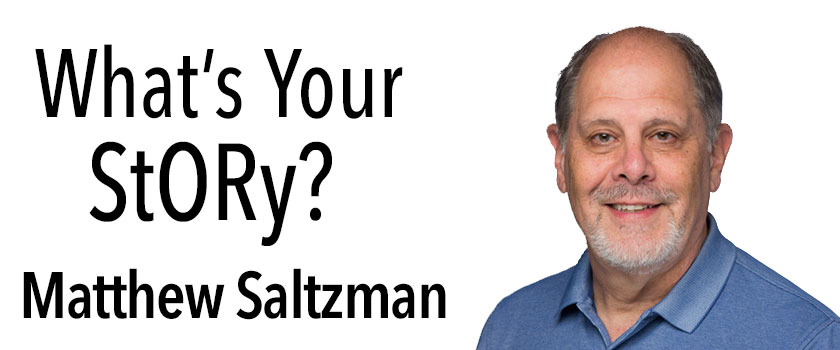

Name: Matthew Saltzman
Employer: Clemson University
Job Title: Associate Professor of Mathematical and Statistical Sciences
Member of ORSA and/or TIMS and INFORMS since 1981
 What prompted you to enter this field? Why?
My undergrad degree was in math with a concentration in computer science. Math was a way to position myself to choose a field later. Theoretical computer science–a fairly new discipline at the time–seemed arcane and not very applicable–like, what is this NP-completeness stuff really good for? O.R. seemed like a good way to apply math to real-world problems that people cared about. After some time as a programmer/analyst at a company specializing in information technology for manufacturing, I went back to grad school and took integer programming, and now I know why NP-completeness is important: it tells us something about what problems are hard and how to approach them. In my career, I've focused mainly on general-purpose computational tools that can be applied to a variety of real-world problems.
 How have you seen the O.R. field change since you first entered it?
Early O.R. in the 1960s and 1970s (before my time!) overpromised what it could do to solve real problems. When I started grad school in 1980, we were at the start of two revolutions that have made it possible to deliver on that promise: dramatic advances in computer technology and algorithms. Since then, we’ve seen a transformation in our ability to solve large, difficult instances of many problems, and O.R. has become integrated into a huge variety of human-machine systems. Operations researchers have also built bridges to other disciplines where we can absorb their methods and they can absorb ours. Constraint programming, machine learning, and statistics come to mind. Some things haven’t changed much: we still see tensions between academics and practitioners.
 How long have you been part of COIN-OR? Why is the foundation important to computational O.R.?
I've been involved with COIN-OR since its inception at IBM Research in 2000. I was the first non-IBM person brought in. The foundation was created in 2004 to manage the project independently from IBM and prove that it was viable in the community. The foundation had two missions: (1) to provide infrastructure (which wasn’t widely available at the time) for building communities focused on software, and (2) to provide a platform for publishing software that would encourage development of high-quality, reusable, sustainable tools and provide recognition for academic developers. We achieved the first goal quickly, but other platforms have come online that do that better than our small organization can (namely GitHub). So now we are transitioning our community support infrastructure to GitHub and Google G Suite and planning to refocus on that second mission.
 What about your career might surprise us?
I haven’t had the opportunity to work on applied problems as much as I might like, but I am coauthor on a paper that is well outside the mainstream O.R. literature. It assesses forces acting on the human jaw as part of a study on TMJ syndrome. The analysis involved a quadratic program with 12 variables and nine constraints. So while we work on methods for solving very large problem instances, it turns out that even small instances can have important applications.
 What is the best advice you’ve received that you would want to pass on to your students?
(1) Mathematical thinking is an important tool that can help you contribute to advances in almost any discipline. If you don’t know what you want to work on, do math. If you know what you want to work on, do some math as well. (2) Hone your computer skills!
 How could we promote analytics careers to high school students?
I don’t have a lot of experience working with high school students, but if I had the opportunity to try, I would look hard at two ideas:
(1) Tell stories. I think looking at applied problems with real impact and seeing the real benefit that analysis can provide would generate excitement. (2) Experiment. Computer simulations at the appropriate level of challenge for students can give them a sense of both how the methodology can succeed and how it can go wrong. It’s important to give tasks that aren’t too dry or deep but also aren’t too simple and mundane. Surprise is good.
 For lack of better words, how has winning the INFORMS Impact Prize, impacted your career?
One problem with doing software development as an academic is that the reward structure at academic institutions really isn’t set up to recognize the effort involved in developing reusable, sustainable tools supporting research as well as it does more traditional endeavors revolving around knowledge discovery and creation, even though good software tools can make those traditional-type activities–and the transfer of knowledge to other fields and to practice–much more productive. The Impact Prize demonstrated that the O.R. field really does value that effort. I think that the Impact Prize has encouraged those of us in academia to keep focused on the challenges that the COIN-OR project has faced and on advancing the cause.
 If you had to work on only one project for the next year, what would it be?
I have several projects going (including a major push on advancing the state of COIN-OR), but if I had to pick one right now, I think I'd pick redistricting.
The legislature in my state of South Carolina is considering legislation to reform the state’s redistricting process. I am working on getting up to speed with the statistical analyses that back up the lawsuits in other states and applying them to South Carolina Congressional and legislative districts. Those are focused on assessing the prevalence of gerrymandering in existing maps. As we get closer to the 2020 Census and the task of drawing new maps, there are optimization methods being developed to create fair maps. I am studying those methods and I hope I can contribute to their development or at least apply them to the practical problem of drawing my state’s maps.
 Which INFORMS journal do you read the most? Why?
Journal on Computing. I’m interested in all aspects of computing and how they influence what’s going on in O.R. and vice versa.
 What would you name the autobiography of your life?
I haven’t come up with a clever title, but if it’s a professional autobiography, the subtitle might be “Extending the Reach of Computing in Operations Research.”
 Have you ever solved a Rubik’s cube?
In grad school (Rubik’s cubes were pretty new), we had a seminar on the connection to group theory and we learned an algorithm for solving them. I never got very fast and I haven’t kept the skill up, but I think I have four or five lying around, including one of the originals.
 Name three uses of a stapler that has no staples.
(1) Light duty hammer
(2) The kind with a staple remover tab can still do that or pull thumbtacks
(3) Prop for my cell phone when I want to watch a video
