


July 30, 2019 in Communication
Persuasion Wars, Part 2
Why we care and what we should do: a continued examination of the power, use and misuse of persuasion from Aristotle to modern-day analytics.
SHARE: PRINT ARTICLE: https://doi.org/10.1287/orms.2019.04.05
“This is not information warfare; it is warfare over the meaning of information.”
- Ajit Maan [1]
“Every pixel on every screen of every internet app has been tuned for maximum persuasion.”
- Roger McNamee [2]
Attention has become a commodity, information an asset category. Some examples of persuasion efforts are relatively benign:
- A used-car salesman wants to sell you that car.
- A politician wants you to vote for her.
- A sports apparel company wants to sell you those sneakers.
- A cellular provider wants to sell you their service.
- You want her to go on a date with you.
Persuasion is more and more effective and powerful than ever, and the surfaces for its implementation and cycle speed of new opportunities and vulnerabilities are increasing. We live within a matrix of connectivity, with a central axis of accelerating change in the Noosphere (sum of knowledge known to man), in the Technium (modern system of culture and technology), and in the expanding understanding of man. We even see change in man himself through advanced augmentations. These changes allow much more effective persuasion.
Man is a complex adaptive system of and within other complex adaptive systems. The currency of these systems is information, but information has been weaponized. We have information conflict with its attendant ascendency of the importance of persuasion. Personal data has emerged as a new asset class [3]. According to a Harvard Business Review article, “Persuasion depends mostly on the audience” [4]. The panopticon, a vast array of information-gathering methods and metrics, fused with artificial intelligence (AI) and machine learning (ML), human-curated and augmented human analytics, allows would-be persuaders to know the audience. With research, surveillance and analysis, messages can be personalized (micro-targeted using new persuasion profiles) for the optimal density of learning moments. Surveillance and rhetoric are informed by new advances in multiple disciplines such as AI, behavioral and social psychology, social signals, captology, dynamics, and cognitive and information sciences.
Persuasion forces are ubiquitous. A “number of possibilities exist at an indeterminate number of levels, all simultaneously and across time, space and scale” [5]. Persuasion operates at all levels of power: political, diplomatic, commercial, military, financial, educational and personal. The low barrier of entry into persuasion battles means there are many players. With these changes come increased connectivity and complexity, resulting in lessened predictability. This necessitates more rapid iterations of persuasion forces and counterforces. Persuasion science has joined the art of persuasion, thereby increasing effectiveness.
Potentially Malignant
Some persuasion efforts are potentially malignant. When the civility and argumentative complexity of public discourse declines, trust in democratic institutions decreases. “The more polarized (and uncivil) political environments get, the less citizens listen to the content of messages and the more they follow partisan cues or simply drop out of participating.” The new “science of deliberation” provides some mitigating counterforce [6].
Journalism’s new emphasis is more relevant to persuasion. The news cycle has morphed into a continuous information flow. The news media driven by the “structural crisis” [7], the implosion of its business model and the Internet’s providing facts to all is going “Beyond News” [8], beyond reporting the facts (the five Ws). It seeks to create “networks of persuasion,” to garner trusted attention, to be more interpretive, more generative, not just informative, more about meaning and identity as evinced in its stories and interpretation [7]. Professor of journalism Mitchell Stephens of New York University advocates “wisdom journalism vs. journalism” that is often, to borrow Benjamin Franklin’s words, “filled with knowledge of what is best for us as a society” [8]. This is persuasion. This new view of journalism is disturbing, as Zeynep Tufekci says, “the most effective forms of censorship today involve meddling with trust and attention, not muzzling speech itself” [9].
Facebook, Twitter, LinkedIn, Google, YouTube, Instagram, Snapchat and WhatsApp are among the dozens of platforms that influence directly, using persuasion science, by their default rules, and by what they crowd out. Defaults influence without persuasion or coercion. These media are engineered to be addictive for massive engagement [10]. In the book “Irresistible,” Adam Alter sketches addictive technology’s use of compelling goals that are just beyond reach, irresistible and unpredictable positive feedback, a sense of incremental progress and improvement, tasks that become slowly more difficult, unresolved tensions that demand resolution and strong social ties [10]. “Through the technology embedded in almost every major tech platform and every web-based device, algorithms and the artificial intelligence that underlies them make a staggering number of everyday choices for us…[including] how we consume our news…and search” [11].
Malignant
Additionally, we are seeing increasing examples of distinctively malignant persuasion efforts (internationally and nationally). We have worried that our devices might spy on us. Voice activated devices must listen and process words to activate. The software control for activation is designed elsewhere. We have speculated that smart TVs might be created with hidden cameras so that not just conversations, but also video images could be captured. We didn’t realize that someone has just such a device, asking us to install a spying device in our own homes – and pay for the privilege of being spied upon.
People with concerns about Facebook’s past privacy actions must have had an impact. (See Roger McNamee’s book, “Zucked” [2].) The Facebook page on Portal privacy [12] declares:
- You can completely disable the camera and microphone with a single tap or block the camera lens with the camera cover provided.
- Facebook doesn’t listen to, view or keep the contents of your Portal video calls. Your Portal conversations stay between you and the people you’re calling.
- For added security, Smart Camera uses AI technology that runs locally on Portal, not on Facebook servers. Portal’s camera does not use facial recognition and does not identify who you are.
- Like other voice-enabled devices, Portal only sends voice commands to Facebook servers after you say, “Hey Portal.” You can delete Portal’s voice history in your Facebook Activity Log.
This is fine until Facebook decides to change what it is actually doing, with or without telling the customers.
“Social media platforms have been implicated as a key vector for the transmission of fake news” [13]. Audio fakeries exist (see Montreal-based company Lyrebird) and visual fakeries are nascent (see Chinese company iFlytek) [14]. Vision is man’s dominant sense and we now live with “deep fakes” – videos compiled to make it appear that a person says or does something they never said or did. AI-generated fake news makes truth elusive. “A machine designed to create realistic fakes is a perfect weapon for purveyors of fake news” [15].
Psychological operations (PSYOP) now operates in our world of ever accelerating changes in the Noosphere and the Technium [16]. Understanding and inducing intergroup hostility and aggression is a current topic of study [17]. AI and machine learning are changing man’s cognitive and behavioral decision dynamics. This morphology of increased complexity and adaptive connectivity spans new communities of knowledge requiring more transdisciplinary expertise and collective lifelong learning. This broader knowledge of those accelerating changes must be coupled with the tacit knowledge of the local complex adaptive systems, e.g., with the understanding of the ecologic spheres of influence and conflict and battles of “competitive control” [18].
What Should We Do?
The country has to worry about more effective spying and manipulation by foreign actors. However, we also have to worry about more effective spying and manipulation by our technology corporations and data brokers.
Create a team empowered with an Eratosthenes affiliation.
The response can be envisioned in five parts: structure, management, talent, enhancement and sufficient operational freedom (Figure 1). We call one essential component of this an Eratosthenes affiliation (after Eratosthenes, a third century B.C. scientist, mathematician and philosopher). This affiliation was and is a methodology to collect new knowledge (single salient advances, emergence and meta-knowledge) from around the known world, winnow it down, and make it available in a useful, curated form.
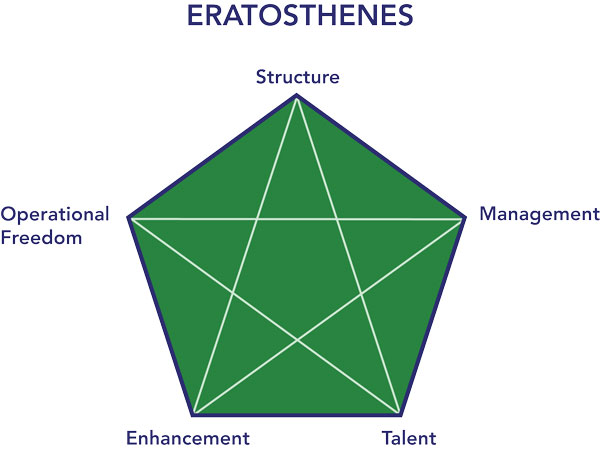
Figure 1: Organizational requirements.
Structure has at its center trust and candor. It is dedicated to multidisciplinary lifelong learning for all, features connectivity within the team and without. Some connections should be continuous but with the capability for microstates (temporary confluences that inform). A transformational mindset and the capacity for rapid response and quick iterations are essential.
Management must view talent recruitment and development as key. Management must subscribe to the vision of accelerating change in the Noosphere, the Technium, man and the knowledge of man. Managers should be connectors and encourage the questioning of default rules within a challenging, clement environment.
“Your approach to hiring is all wrong,” refers to the fact that “the majority of people who took a new job last year weren’t searching for one: someone came and got them” [19]. Talent recruitment-development-retention is a central management responsibility. To attract talent there should be trust and candor, meritocracy, recognition and career development offerings, opportunity to find meaning in their work, mastery in their field and sufficient operational freedom [20].
Talent is required for multiple traditional and new communities of knowledge that compose the art/science of persuasion. For superiority, these include rhetoric and narratology (mastery of storytelling) including video and narrative warfare, captology, computational propaganda, psychology, learning science, cognitive science, and human and digital network science.
Manifold cognitive enhancement is necessary for the individual, team [21] and environment (ambient intelligence). Enhancement by collective learning should flow from the team microstates as well as from the network of consultants, optimally involving a variety of types of associations from on-call to special projects. Ongoing information feeds from sensing and spying, both traditional and digital, are assumed.
We need an Eratosthenes affiliation for the 21st century. The organization can be viewed as a team or set of teams. Because the breadth of knowledge required is larger than a single person or small team can be expected to possess, the team must have a network of collaborators (Figure 2). Some of these collaborators will be closely linked to the team (C), as shown by the bold connections. Some will be only moderately (M) or weakly linked (W), as shown by the light and dashed connectors. Some collaborators will be more distant (D), only linked through the closer collaborators. The team members and collaborators should be augmented with AI/ML and other cognitive artifacts and supported with superior connectivity, both live and virtual.
Figure 2 depicts the structure that urgently needs the Eratosthenes affiliation. The Eratosthenes methodology will detect and send information to the team and to the network. Its structure will involve AIML-augmented computer and information scientists, experts from academia, military, industry and security. It will have the capacity for curation and will look for morphing ontologies and salient single advances. Augmentation of intelligence, problem-solving and creativity are iteratively interactive and adaptively extant and essential.
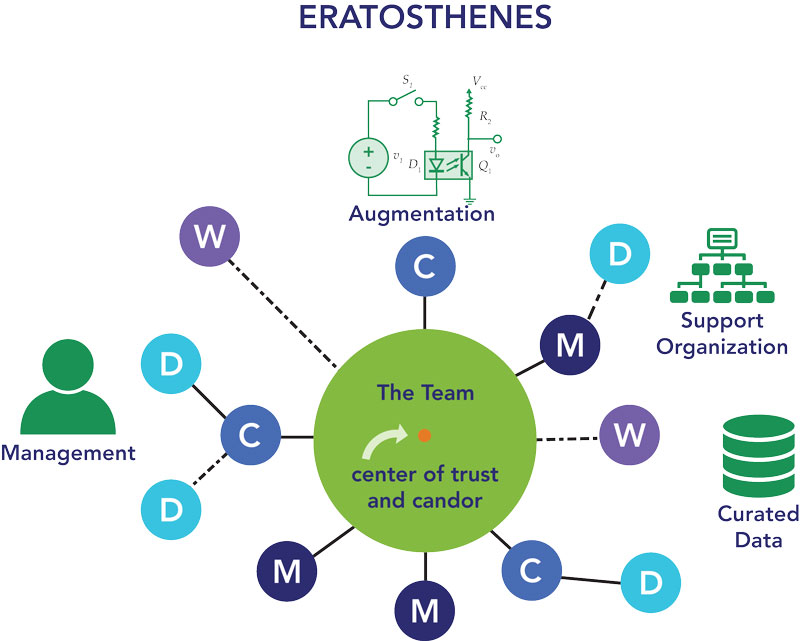
Figure 2: The team and its myriad support connections.
Rationale
Lt. Gen. Michael Flynn said, “Publicly available information is now probably the greatest means of intelligence we could bring to bear” [22]. This new aspect of the taxonomy of intelligence is obviously relevant to all learning ecosystems including education and propaganda. Controlling of morphing misinformation machines (processes) can be accomplished only with knowledge of authors, articles, rumors, images, the publishers and platforms. However, there is too much information for a single person or standard team.
In today’s matrix of accelerating change in sensing, the need for nascent technology and emergent science beyond spying and public knowledge is critical. Facility is required in using the massive digital social platforms and apps, advances in new learning and cognitive science, AIML-augmented foresight, captology, computational propaganda [23], data science, network science, individual and organizational behavioral science (such as social membership markers [24], emotionally intelligent technology, fake news [25], biometrics, sociometrics and neuroscience). Within the domain of operations and actions, individual or group, military, civic, financial or moral, health or education, successful persuasion is salient and increasingly requires expert digital facility, as well as expertise in the multifaceted art/science of persuasion. However, there are too many fields of expertise needed for a single person or a standard team.
The persuasion wars require the talent to recognize fleeting moments of potential digital influence. These moments require the capacity to evoke temporary confluences that inform (microstates) both within the active team or from larger networks of consultation (scalable microstates). The capacity to capture propitiously timed attention lends itself to persuasion. The persuasion wars also require recognition of, and facility for, dealing with dilemmas that can’t be changed but might be “flipped” to some advantage versus treated as a problem to be solved [26]. The talent required will not be found in an ordinary person or team.
An Eratosthenes-enabled team addresses the knowledge explosion and will attract talent in today’s competitive environment for the best and brightest. Favored access to be in the vanguard of the knowledge explosion will entice talented recruits, even in today’s hypercompetitive talent recruitment environment. The opportunity to gain mastery in their fields of knowledge will aid motivation and retention. And the team structure provides a unique resource that will empower learning and creativity. Providing individual and team multifaceted cognitive enhancement and lifelong transdisciplinary learning will be talent multipliers. Having the talent, connectivity, structure and technology to learn and innovate will capture the creativity of small, smart groups. Utilizing a “stake in the outcome” versus “perks of rank” and an environment where results, not rank, are celebrated and rewarded will produce the desired results [27].
The desideratum is skill in persuasion for information dominance. More importantly an Eratosthenes entity will empower security for both kinetic and non-kinetic military superiority. Some country will do it or is already trying or perhaps has begun.
Identify the Problem – as it Evolves
The Eratosthenes-enabled team will look for the salient emergents and the part of the future that is here, but unevenly distributed, that is unknown to the team and network of consultants. Without such a system we become ever more provincial in the accelerating world of new ideas and technology. Security for boundary and signal control will be necessary, and it will utilize hybrid human/AIML systems and be a facilitator for AIML dominance.
The team can address predictably and systematically irrational human aspects [28] as evinced by the work of Herbert Simon, Daniel Kahneman and Richard Thaler, all Nobel Laureates. The work of Michael Bernstein, Ph.D., at Stanford, on team optimization is relevant as is the work of Alex Pentland, MIT Human Dynamics Lab, in the field of social intelligence optimization.
For example, sufficient distributed authority and operational freedom are essential to reduce radicalization: “timing is critical: by the time potential recruits are sold on the ideology, it’s too late to influence.” The micro-targeting method developed by Google Jigsaw may prevent the sympathetic from becoming radicalized. To wit, there is an advantage in getting your story in first. There has been some success with radicalization avoidance using personal engagement by individuals attuned to their social conditions [29]. Rapid, ultra-concise personalization is required. This is similar to the off-line world where “a persuader should make a concentrated effort to meet one-on-one with all key people he or she plans to persuade” [30]. To be able to influence behavioral swarms one must address the structure and language (at times coded language) of connectivity and the swarm’s capacity to migrate to a different venue [31]. Interrupting connectivity is often a powerful way to prevent group action. In conflict ecosystems, orchestrating persuasion, coercion and effective administration often provides control [18].
Act
Certainly, the individual can and should act to identify and rebuff personal persuasion attacks; however, that is not enough. As a society, we must use persuasion to fight the persuaders. To win, we must have organizational persuasion superiority.
Persuasion superiority starts with expertise in the art/science of the narrative (narratology) [1] and Aristotle’s Rhetoric [32], the persuasion principles of Cialdini [33, 34], Fogg [35] and Thaler [36]. Trans-domain AIML-augmented persuasion science has been added to rhetoric and narratology.
The surfaces of conflict are expanding as the metrics of time and scale accelerate and vulnerabilities and opportunities increase. Information superiority is imperative to enable persuasion superiority and persuasion superiority is imperative to enable information superiority.
References
- Maan, A., 2018, “Narrative Warfare,” Narrative Strategies, Ink.
- McNamee, R., 2019, “Zucked: Waking Up to the Facebook Catastrophe,” New York: Penguin Press.
- Hardjono, T., Shrier, D., and Pentland, A. (Eds.), 2016, “Trust::Data: A New Framework for Identity and Data Sharing,” Visionary Future LLC.
- Chamorro-Premuzic, 2015, “Persuasion Depends Mostly on the Audience,” Harvard Business Review, June 2.
- Gaddis, J. L., 2018, “On Grand Strategy,” New York: Penguin Press.
- Dryzek, J., Bachtiger, A., Chambers, S., Cohen, J., Druckman, J., Felicetti, A., et al., 2019, (March 15), “The crisis of democracy and the science of deliberation,” Science, pp. 1144-1146.
- Wihbey, J. P., 2019, “The Social Fact: News and Knowledge in a Networked World,” Cambridge, Mass.: MIT Press.
- Stephens, M., 2014, “Beyond News: The Future of Journalism,” New York: Columbia University Press.
- Tufekci, Z., 2018 (February), “The {Divisive, Corrosive, Democracy Poisoning} Golden Age of Free Speech,” Wired, https://www.wired.com/story/free-speech-issue-tech-turmoil-new-censorship/.
- Alter, A., 2018, “Irresistible: The Rise of Addictive Technology and the Business of Keeping You Hooked,” New York: Penguin Press.
- Hosnagar, K., 2019, “A Human’s Guide to Machine Intelligence,” New York: Viking Press.
- Facebook, 2019, Portal Privacy. Retrieved March 29, 2019, https://portal.facebook.com/privacy.
- MIT Technology Review, 2019 (Jan. 25), pp. 348, 374.
- Fontaine, R., and Frederick, K., 2019 (March 16), “The Autocrat’s New Tool Kit,” The Wall Street Journal, pp. C1, C2.
- MIT Technology Review, 2018, Vol. 121, No. 2, pp. 50-53.
- Kelly, K., 2016, “The Inevitable,” New York: Viking Press.
- Sapolsky, R., 2017, “Behave: The Biology of Humans at Our Best and Worst,” New York: Penguin Books.
- Kilcullen, D., 2013, “Out of the Mountains: The Coming Age of the Urban Guerrilla,” Oxford: Oxford University Press.
- Capelli, P., 2019 (May-June), “Your Approach to Hiring Is All Wrong,” Harvard Business Review.
- Pink, D. H., 2009, “DRiVE: The Surprising Truth About What Motivates Us,” New York: Riverhead Books.
- DARPA, 2019 (March 14), “Artificial Social Intelligence for Successful Teams (ASIST) Proposers Day.” Retrieved May 2, 2019, https://www.darpa.mil/news-events/artificial-social-intelligence-for-successful-teams-proposers-day.
- Singer, P. W., and Brooking, E. T., 2018, “Like War: The Weaponization of Social Media,” Boston: Houghton Mifflin Harcourt.
- Woolley, S. C., and Howard, P. N. (Eds.), 2019, “Computational Propaganda: Political Parties, Politicians, and Political Manipulation on Social Media,” New York: Oxford University Press.
- Moffett, M. W., 2018, “The Human Swarm: How Our Societies Arise, Thrive, and Fall,” New York: Hatchett Book Group.
- Villasenor, J., 2019 (Feb. 14), “Artificial intelligence, deepfakes and the uncertain future of truth.” Retrieved April 27, 2019, https://www.brookings.edu/blog/techtank/2019/02/14/artificial-intelligence-deepfakes-and-the-uncertain-future-of-truth/.
- Johansan, B., 2007, “Get There Early: Sensing the Future to Compete in the Present,” San Francisco: Berrett-Koehler Publishers.
- Bahcall, S., 2019 (March-April), “The Innovation Equation,” Harvard Business Review, pp. 74-81.
- Ariely, D., 2009, “Predictably Irrational (revised and expanded edition),” New York: HarperCollins.
- Altran, S., Axelrod, R., Davis, R., and Fischhoff, B., 2017 (Jan. 27), “Challenges in researching terrorism from the field,” Science, pp. 352-354.
- Conger, J. A., 1998 (May-June), “The Necessary Art of Persuasion,” Harvard Business Review, pp. 84-92.
- Ganesh, B., 2018, “The Ungovernability of Digital Hate Culture,” Journal of International Affairs, Vol. 71, No. 2, pp. 30-49.
- Aristotle, 2004, “Rhetoric,” (W. R. Roberts, Trans.), Mineola, NY: Dover Publications, Inc.
- Cialdini, R. B., 2009, “Influence: Science and Practice (fifth edition),” Boston: Pearson.
- Cialdini, R., 2016, “Pre-Suasion,” New York: Simon & Schuster Paperbacks.
- Fogg, B. J., 2003, “Persuasive Technology,” Amsterdam: Morgan Kaufmann Publishers.
- Thaler, R. H., and Sunstein, C. R., 2008, “Nudge,” New York: Penguin Books.
Dean S. Hartley III is principal, Hartley Consulting, which provides operations research support to military, medical and commercial organizations. Kenneth O. Jobson, M.D., is chairman of the board of the International Psychopharmacology Algorithm Project (www.IPAP.org) and a retired psychiatrist.
([email protected])
([email protected])