July 25, 2019 in Innovative Education
Practice makes students (near) perfect professionals
Where there’s will and skill, there’s a way: Award-winning professor recounts his career transforming students into successful, confident professionals with practical acumen.
SHARE: PRINT ARTICLE: https://doi.org/10.1287/orms.2019.04.06
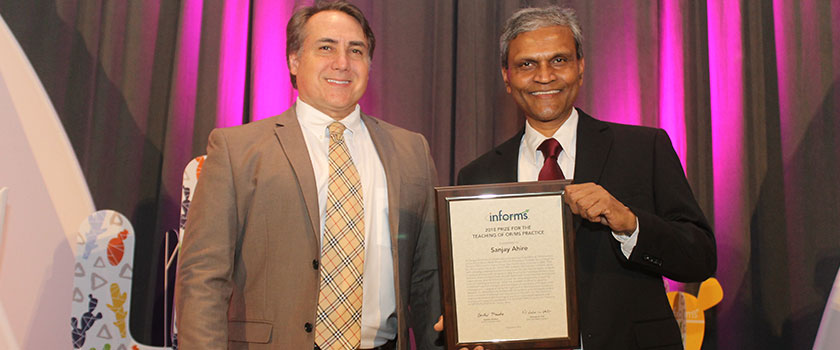
Editor’s note: OR/MS Today invites the most recent recipient of the INFORMS Prize for the Teaching of OR/MS Practice to contribute an article to the magazine’s annual special issue on innovative education. We ask for a brief description of the award winner’s teaching background and experience, the reasons for their success, as well as their teaching philosophy and advice for their fellow O.R. educators. Following is the story of 2018 teaching prize recipient Sanjay Ahire.
The 2018 INFORMS Prize for the Teaching of OR/MS Practice has been one of the most rewarding recognitions of my academic career. Honestly, I think it rates higher than my scholarly research article with more than 2,400 citations. After all, past winners are stars in our profession in their own right and have represented elite institutions. So, in this article, I have a point to make and a story to tell. The point: contributing to students’ practical analytical capabilities is possible regardless of the context. The story: my 20-year journey of helping students apply seemingly abstract analytical competencies that often get left behind in classrooms.
“We don’t have enough support from administration.”
“We need to hire true practitioners to do this.”
“We don’t have the right quality of students.”
“We don’t have an industry base to support this.”
“Our job is to teach – it is up to students to translate our teachings into practice when they graduate.”
“We have to prioritize research for tenure and incentives. Any time spent with students beyond reasonable classroom teaching is counterproductive.”
We all have heard these common refrains across university corridors regardless of the size, stature or nature of universities and business schools. But let us stop and think; don’t we owe our existence to students and their parents who finance our professional careers? If teaching and mentoring of students is a nuisance, we belong in research organizations – not at universities, certainly not at universities with teaching or teaching-research missions. In this article, I would like to share my career experiences of transforming students in three different schools into successful and confident professionals with practical acumen, and doing so synergistically with research goals.
First initiative: Indiana University South Bend (fall 1998-spring 2000). It all started in fall 1998 when I joined Indiana University South Bend (IUSB) Business School. With only one core operations management course at the undergraduate and MBA level to go on, and with one eye on research to make tenure, my colleagues thought I was crazy when I decided to incorporate field projects into the class, creating teams of three or fewer students to work with local organizations. How could it be possible to teach students their first course in operations management and expect them to concurrently do a field project, especially at a commuter school in a regional midwestern town with a much more reputed school just around the corner?
Well, with commuter students also working “real” jobs, the mandatory class requirement was browsing the entire textbook in the first two weeks (only chapter vignettes, chapter summaries and problems) and settling on a project topic. During that timeframe, the emphasis was for students to discover “what was possible” and not “how to do it.” Thereafter, each team would complete a specific project in a local manufacturing or service organization even as the class learned various specific operations management topics and tools. They ended up applying specific OR/MS techniques such as line balancing, linear programming, MCDM and queuing to complete a meaningful project, and I ended up spending hundreds of hours mentoring the teams through project scoping, data collection, analysis and recommendations. This continued for two years across 125 projects from a single core operations management class – with cumulative outcomes so significant that the initiative ended up as the winner of the prestigious POMS Wickham Skinner Teaching Innovation Achievements Award in 2002.
Second initiative: University of Dayton (fall 2000-spring 2006). My success at IUSB opened up an opportunity at the University of Dayton where I led the design and implementation of a brand new operations management major that fulfilled my vision of helping students focus on learning systematic coursework in operations management and process improvement before they executed similar consulting projects in larger organizations in the capstone consulting class (OPS 495).
For this purpose, I convened an Operations Management Advisory Council that attracted divisional managers, VPs and even COOs from firms such as GM, multiple divisions of GE, NCR, Miami Valley Hospital and Wendy’s International to partner in the consulting initiative. I also assembled a team of excellent, like-minded colleagues including professor Michael Gorman, who collaborated with me to mentor 36 high-impact projects that produced more than $18 million in savings generated by student teams. We were also one of the finalists for the 2005 INFORMS Wagner Prize based on our work with GE Consumer Products. Needless to say, the practical projects led to some excellent career opportunities for the students, and the program has continued to thrive.
Third initiative: University of South Carolina (fall 2006 onward). My longest and most comprehensive efforts to link students with practice have been realized over the past 13 years at the University of South Carolina, where I was hired in 2006 to lead the development and implementation of the undergraduate operations and supply chain (OSC) major and to revamp the MBA OSC concentration. It has been a tale of uniquely successful entrepreneurship on the part of our leadership team that originally included me and professor Manoj Malhotra and later professor Jack Jensen and other colleagues. I co-led the design and implementation of a new major, improving upon the University of Dayton model, complete with capstone consulting project experience for our students in conjunction with some of the largest Fortune 500 firms spanning automobile, electric, pharmaceutical, healthcare, nuclear energy and retail sectors.
We have interlaced Lean Six Sigma and classic OR/MS techniques throughout the curriculum. Over the years, more than 260 front-burner projects have been executed by our student teams under the mentorship of our faculty experts – using the project methodology I championed – to improve internal operations and supply chains in more than 30 partner firms while identifying more than $250 million in savings. I mentored or co-mentored more than 100 of these projects in organizations such as Atrium Health, Colonial Life, Cummins, Eaton, Johnson & Johnson, McLeod Health, Palmetto Health, PwC, Siemens, Sonoco, UPS and Walmart. In addition, I mentored more than 50 projects in regional nonprofits (food banks, homeless shelters, rural health departments) through a core class in business process management.
Equally important, I also led an industry-validated Lean Six Sigma (LSS) Green Belt Certification initiative in collaboration with Leslie Pemberton, VP Global Quality at Sonoco Products Company (a Fortune 500 firm) to certify more than 1,100 of our graduates with this valuable qualification at the start of their professional careers. An experiential component of certification was evaluating consulting projects from the capstone class conducted by our capstone student teams under faculty guidance. It is rare for 21- or 22-year-olds to walk into their first job with a substantive operations/supply chain improvement project experience and an LSS Green Belt.
Why does this all matter? Because now the program is consistently ranked among top 15 OSC programs in North America by Gartner Research, and we were one of this year’s finalists for the prestigious INFORMS UPS George D. Smith Prize for the most practical program. Most importantly, our students are pursuing exciting careers with premium compensations in top consulting firms such as McKinsey, IBM, Accenture and Deloitte, as well as in top manufacturing and service firms across and beyond the United States.
Common Thread: The CAPPS Framework
competent, passionate practitioners.
The successful experiences at IUSB, University of Dayton and University of South Carolina can be traced to the CAPPS© Framework reflecting my teaching philosophy. Note that this framework is really applicable to any professional field where potential to apply practical techniques/tools exists.
CAPPS: Capability + Ambition + Passion + Process = Success
Under this end-to-end view of our role in student success, first and foremost, we should teach and mentor students to develop a real passion for the OSC field. We should cultivate their ambition for acquiring deep and broad knowledge in this field, as well as striving for practical competencies that experienced professionals possess (why wait?). And we should do everything in our power to help students achieve an unexpected level of capability and expertise in these practical competencies in the OSC field through a systematic set of academic curricular and co-curricular processes. And, finally, we should close the loop with mentoring students to achieve the ultimate success in landing jobs and careers that do justice to their proven competencies. I think it is a much more holistic view of our role (beyond traditional classroom teaching), one that leaves lifelong, positive imprints on students.
How have I practiced the CAPPS framework? Industry-validated LSS Green Belts for the large number of our graduates represent a salient example of a rare “capability” imparted to the students. To enhance the professional credibility of this initiative in the eyes of students and employers, I went through multiple levels of certification myself and became the first tenured professor to receive the highest practice designation (Six Sigma Master Black Belt) from the American Society for Quality. Instilling in students a sense of “ambition” to acquire both technical (OR/MS and process analytics) and softer skills and actually apply them to help organizations of all stripes (large and small, manufacturing and service, for-profit and nonprofit) has been a common thread across all three of my experiences.
Successful application of analytics to actual organizations has for years kindled strong passion in students about the value of their competencies. For example, when students worked on projects to help Harvest Hope Food Bank, SC HIV/AIDS Council or SC Thrive, developing highly sophisticated optimization models in these organizations, the sense of passion, pride and fulfillment in them is palpable. It is the same sense of accomplishment that radiated from the students who helped hospitals improve their blood labs and emergency departments and the team that optimized global staffing for PwC’s anti-money-laundering practice. The second “p” represents “process,” including curricular processes as well as co-curricular initiatives such as focused career workshops, personally recruiting numerous new and large employers to recruit graduates, and even helping employers understand the unique value that such graduates bring on day one, and convincing them to upgrade graduates’ career tracks and compensation packages. Success of such an intense and comprehensive approach has been evident in students’ first post-graduation jobs and longer-term careers in leading firms in all sectors.
Teaching vs. Research
While I have invested the better part of my career teaching innovations focused on enhancing students’ successes in thinking critically and using analytics to improve decision-making and processes, my teaching and research have not become a zero-sum game between the two. Quite the contrary. Practical teaching has allowed me to immerse myself in the field, consistently talking with managers of various types of organizations about their operations, processes and supply chain challenges. This has, in turn, informed my research in operations improvement strategies, and I have used my field insights directly in my scholarly research articles. In fact, I have articulated “actual contributions to better operations and process improvement strategies” as one of my applied research streams.
Over the years, my work on innovative projects and their extensions have led to nine published articles in Interfaces (now the INFORMS Journal on Applied Analytics), the Institute’s flagship journal for applied research. This work has also helped me educate top and middle managers on synergies between different “brands” of operations improvement (Lean and Six Sigma) and the value that advanced OR/MS and analytics bring to creating real business value. Finally, the practical perspective has helped me to identify “relevant” research issues and questions for scholarly academic research.
Generalizability
What is the generalizability of this approach? I think anyone could replicate it, as long as there is the will and skill to do so – the skill to do (practice) in addition to teach the practical tools and skills, and the will to see synergies between applied teaching and industry outreach and research goals. The research might turn out to be of a different strand, but the overall satisfaction of improving students’ professional lives might be worth the effort. Actually, it could improve research quality due to the opportunity to acquire a better grounding of research in practice.
Could it be possible that students will resist? I have yet to come across a student who, after realizing the professor’s passion for his or her excellence and long-term professional success, will resist working hard or learning and grasping skills and competencies whose utility is immediately proven.
Will the university mind? Not sure about this one. The incentives may be misaligned and might actually penalize these types of efforts. The best strategy could be to find synergies between your research stream and the practical teaching initiatives. As university professors – especially in professional schools – come under increasing scrutiny from students, parents and taxpayers, incentives might eventually align to evolve a more holistic definition of faculty performance and success.
In the meantime, I hope my story shows that regardless of the context of the school or infrastructure, if there is will and skill, it is possible to create initiatives, provide students with real practical skills, and help them become competent and passionate practitioners of these skills. Our students going on to become individual success stories and keeping us alive in their memories could be the best legacy . . . and might very well have been the reason why we chose to be university professors in the first place.
Sanjay Ahire is a professor of operations and supply chain management, Moore School of Business, University of South Carolina, where he is co-director of the USC Operations and Supply Chain Center and co-champion of the Sonoco-USC Lean Six Sigma Green Belt Certification Initiative. He is the 2018 recipient of the INFORMS Prize for the Teaching of OR/MS Practice.