


October 9, 2019 in What's Your StORy?
What’s Your StORy? Margret Bjarnadottir
SHARE: PRINT ARTICLE: https://doi.org/10.1287/orms.2019.05.07
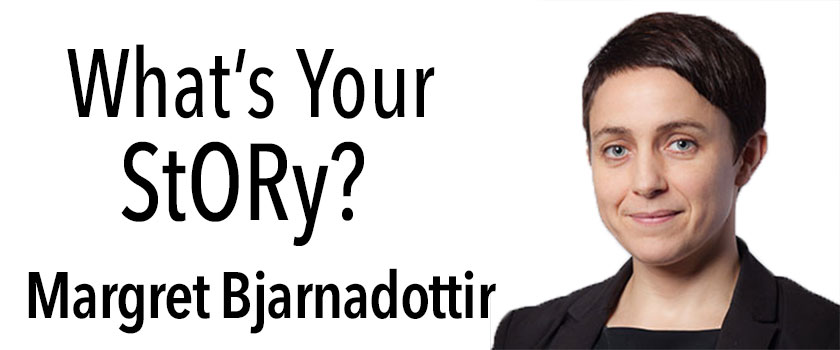

Name: Margret Bjarnadottir
Employer: Robert H. Smith School of Business, University of Maryland
Job Title: Assistant professor of management science and statistics
INFORMS member for 15 years
 What prompted you to enter the field of O.R. and analytics?
As an undergrad, I took an introduction to O.R. and I just fell in love with the math behind O.R. and from there I knew what I wanted to do.
 You do work in “People Analytics” – can you briefly describe what that means and what kind of work that entails?
If you think about how analytics have been applied throughout the HR department, now you see a lot of work and innovation happening in the field of HR Analytics or People Analytics. So, for example, a lot of startups trying to better match demand with openings, how to better match employees with employers. But my work has actually focused on the gender pay gap, or any demographic pay gap for that matter. If an organization is faced with a demographic pay gap, what should they do? How do you close the gender pay gap, whom should they give raises to and how much? That has been the active stream of my work for the past 2-3 years.
 Have you figured out how to close the pay gap?
Actually, we have academic publications on this, and we look at what some of the unintended consequences of equal pay legislation could be, so what should we be looking out for? If we are the government and monitoring, how should we monitor? I am also helping companies apply this in the real world. I have a small startup on the side that is helping companies actually correct for these biases in their pay structure.
 How could we promote analytics careers to high school students?
I’ve done presentations for Girl Scouts. Trying to introduce this way of modeling the world really. Instead of trying to talk about something sophisticated, we were trying to think about “okay, how do we predict how may scoops of vanilla ice cream we sell versus chocolate ice cream we sell.” Then talking about how we can make better decisions and how we can use data. I think it’s just a matter of packaging to be honest. Because the intuition behind a lot of what we do is so intuitive. A good way I have found is, put forward a problem and ask people to guess what a good solution is, which may be a routing problem, or how do you move the inventory? And then you can show that by intuition you get a certain answer, but if you solve it optimally, you could save an additional 30%. That is how I go about it when I talk to younger audiences.
 What’s the best advice you have ever received that you would pass on to your students?
I think the most important thing is to work on something you like. Because at the end of the day, you need to do the work, and if you don’t like it…
 Do you have a favorite part of the Annual Meeting?
The plenaries and keynotes. Margaret Brandeau gave an excellent 90-minute talk on the opioid epidemic, modeling how interventions need to be applied, what we need to think about. She had built a humongous simulation model of the interactions with how people get introduced to opioids, how they go from opioids to heroine, how you need to introduce them to rehab, etc. It is very related to some of my work, so we have been thinking about early intervention for opioids. How early can we help the physicians determine that somebody is a chronic user of opioids? Because once you are a chronic user of opioids, it has all been downhill with bad outcomes associated with it. That put my kind of small research in a broader concept, and it was an excellent talk.
 How do you strategize your time at the Annual Meeting? What do you try to do? What do you look forward to?
I try to attend as many sessions as I can, because the field has grown so much, so this is really a nice way to get a feel for what’s going on across the broad spectrum of topics, because in my research I am very focused in certain areas. I find if I shop around a little bit, often times there are things happening in maybe retail that we can be applying over in healthcare. So, I try to learn as much as I can. It is also fun to catch up with old colleagues from grad school.
 What advice do you have for women in OR/MS careers?
I would say my biggest advice would be to find a good mentor. Someone to help you guide, both the politics but also being a female in academia. That is my number one recommendation.
 What’s your idea of comfort food?
Ice cream!
 What is your favorite weekend activity?
I have three kids, so they eat up my weekend, so I very much just focus on the kids and doing something together. Recently, it has been soccer.
