
October 7, 2019 in Issues in Education
Bored students, bored classrooms! What to do?
SHARE: PRINT ARTICLE: https://doi.org/10.1287/orms.2019.05.14

Educators do not always agree on topics about the classroom, but most would acknowledge that keeping students active and engaged in the classroom is challenging. Many recent articles in the education literature aim to address this issue. For example, techniques such as “flipped classrooms” have emerged to engage students, but many such advances have had mixed results in application.
In this column, we will discuss a survey we distributed to 245 juniors and seniors in the College of Business at James Madison University asking them about boredom in the classroom. Of the 245 students surveyed, we received 208 complete responses. We distributed the survey to a core undergraduate course in operations management.
A central theme is that engaged students are more successful and perform better than bored students. Thus, we decided to investigate boredom in our classrooms as a steppingstone to a project that addresses how to mitigate boredom in the classroom. Our first step was to conduct a survey and ask the following research questions:
- Do students obtain most of their knowledge for the course outside of the classroom?
- What do students like most about their learning experience in the classroom?
- What do students like least about their learning experience in the classroom?
The survey had many questions, but in this column, we will focus on these three because answering them was key to establishing a baseline for future research hypotheses and analysis.
Do students obtain most of their knowledge for the course outside of the classroom?
The following question appeared on the survey, and students selected a discrete integer value between 0 percent and 100 percent to answer the question: Assuming that a score of 100 percent shows your mastery of the course material, on average, what percentage of it is gained in the classroom?
The box-and-whiskers plot (Figure 1) shows the breakdown of student responses to the question.
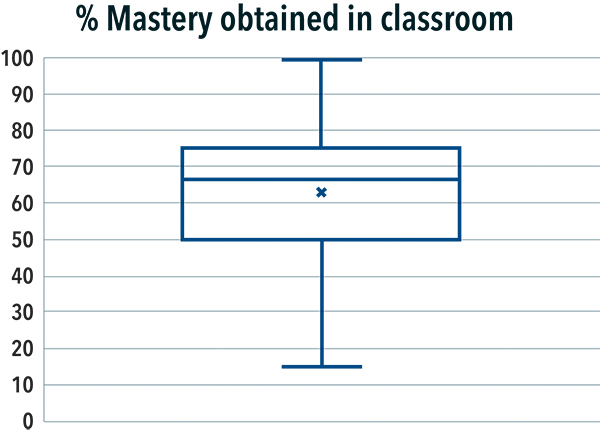
The mean score to the question was ~63.16% and the median was 66.5%. The first and third quartiles were 50% and 75%, respectively. Although we do not have a baseline to compare, it seems reasonable that the central 50% of students obtain between 50% and 75% of their mastery of the course material during class time.
We also surveyed how much time students spent on average during a week to study outside of class. On average, students claimed to have spent around 6.05 hours per week studying outside of class.
What do students like most about their learning experience in the classroom?
Questions No. 2 and No. 3 in this survey were free response questions, so we used some basic text-mining techniques to extract information and make inferences. The responses were broken down into “tiers,” and comments from the top two tiers are listed below:
Tier 1:
- Engaging, interactive classes: Many students listed their favorite parts of the classroom as instructors who were engaging and held interactive class sessions. Many listed hands-on activities and collaborative assignments as factors for positive classroom experience.
- Personality and attitude of the professor: Students listed many personality traits of the professor that attributed to a positive classroom experience – namely, funny, passionate, helpful, engaging and essentially “caring” about the students’ well-being.
- Using real-world examples: Many students felt that using real-world examples in class helped keep them engaged. Having problems that they can relate to made it easier to activate their learning in the classroom.
Tier 2:
- Exercises and practice: Students enjoyed having additional exercise and practice during and outside of class to help them prepare for exams. This may not have a direct relationship with being engaged in the classroom, but it was a prevalent item mentioned nonetheless.
- Teamwork: Students thoroughly enjoyed working in teams (which is a substantial part of this particular course) on the class projects. Many students mentioned that developing rapport with the team during the project helped them establish relationships with students that they otherwise would not have. Thus, they expanded their network to study and prepare for exams.
- Responsiveness: Many students appreciated having a professor that was helpful and simply available during office hours.
- Explaining logic behind concepts and formulas: Another commonly listed item was that students enjoyed having the professor explain the intuition behind concepts and formulas. Apparently, having that connection to “why it matters” in an everyday setting improved the classroom experience for many students.
Overall, many of the items listed in Tier 1 and Tier 2 may not directly link to mitigating boredom in the classroom, but nonetheless may help establish some basic principles as to reasons why students like their learning experience in the classroom. It is reasonable to suggest that as students enjoy their learning experience in the classroom at a higher level, they should become more active and engaged (and thus, less bored).
What do students like least about their learning experience in the classroom?
As in the previous section, following are the top responses along with some explanation about the students’ responses.
- Boring: Students listed “boring” as the top classroom detractor by a large margin! Many reasons were given, but some prevalent reasons were:
- not passionate,
- too much lecture,
- teaching at you instead of to you,
- reads off of PowerPoint slides.
The consensus of the above items points to a professor who lacks individualistic or creative manners in relaying the course material. Being indifferent, reading off slides and talking at you are common to one another in that they remove the personal aspect of the classroom experience.
- Ignoring questions: Students also mentioned that ignoring questions was prohibitive to a positive learning experience in the classroom. This could be ignoring questions during class time or not responding to emails, etc. (In some ways, this could be the converse of the positive attribute of responsiveness in Tier 2 above.)
- Too much material: Many students felt that courses with lots of material could be overwhelming. This is a concern mapped to curriculum, however, and not within the control of an instructor.
In summary, our survey was an effective tool to investigate some baseline data and information about students’ boredom and overall experience in the classroom. We plan to investigate this study further and ultimately develop ideas to help improve the classroom experience for our students.
Baback Vaziri, Ph.D., is an associate professor in the Department of Computer Information Systems and Business Analytics in the College of Business at James Madison University. Elham Torabi is an assistant professor of computer information systems and business analytics in the College of Business at James Madison University.
([email protected])