


December 5, 2019 in BAC@MC
Business Analytics Competition in NYC
Hosted by Manhattan College, event offers a win-win-win experience for students, teachers and professionals.
SHARE: PRINT ARTICLE: https://doi.org/10.1287/orms.2019.06.09

In 1999, I wrote my first OR/MS Today article about experiential learning and how it can be an effective teaching tool. I used the unlikely metaphor of swing dancing. I explained that, much like the dance, the connection between the experiential exercise and the students, as leader and follower, is vital. Equally important is the unstructured freedom to explore and discover. I argued that the coexistence of connectivity and freedom is an essential balance, and thus concluded: “It don’t mean a thing if it ain’t got that swing.”
More recently, literature on teaching and learning describes experiential learning as the process of learning by not doing as much as it is by doing. The Ying and Yang provide the opportunity to experience and reflect. The push and pull allow the learner to conceptualize and experiment. Today we refer to effective experiential learning by many names, most commonly as high-impact practice. Alas, my swing dancing days are over (too high impact for my knees). Yet I continue to seek the ever-elusive ability to swing every time I engage students in the exciting process of learning.
Today in business analytics, experiential learning holds the promise of bridging the gap between theory and practice and preparing students for the challenges of the real world. Whether it’s using analysis software, working on real projects with real data, demonstrating decision consequences through role playing or games or tackling case studies, many instructors have found great value in engaging students in the art of the practice.
Fueled by big data, analytics competitions and hackathons have been gaining momentum as venues for experiential learning. Many universities, companies and government agencies have sponsored such competitions in various forms. In this article, I describe the Business Analytics Competition at Manhattan College, an intercollegiate competition and conference for undergraduate students. It’s an annual event in its sixth year. Every year my colleagues and I design the curriculum for the competition and organize events for the conference. It’s a responsibility we take seriously and joyfully. And every year we witness tremendous professional growth in analytics students as they tackle an experiential learning exercise with an innate ability to swing.
The Business Analytics Competition at Manhattan College
The event, which we fondly call BAC@MC [1], provides an exciting opportunity for undergraduate students studying business analytics (or related fields) in any accredited university to test their knowledge, hone their skills and network with other students and professionals in New York City. Competing students not only engage in the art and science of decision-making, but they also practice their ability to draw business insights from a comprehensive analysis of relevant data. BAC@MC features a two-phase competition starting in February and ending with a two-day conference in May. Both phases require student teams to analyze competition-specific data sets.
For phase one, teams consisting of up to four students, under the supervision of a faculty advisor, are given a substantial data set along with several open-ended research questions to work on at their home institutions. They analyze the data sets and develop solutions to the questions. Each team prepares and submits a poster summarizing their analysis and solutions. All participating teams must submit their poster prior to a specified deadline (early May). At the end of the semester (late May) all the teams and advisors get together on the Manhattan College campus for a conference with speakers and networking activities and to continue the competition.

Students enjoy the craziness of Midtown Manhattan,
including a visit to Microsoft.
The intensive two-day on-campus conference takes place during the third week of May, the week after our end-of-year graduation ceremonies. The timing allows us to use available campus residences to provide affordable accommodations in New York City for the participating students. Over the last five years, around 30 universities, predominantly from North America, but also from Europe and the Middle East, have participated in the competition. More than 20 of these universities have participated in multiple BAC@MC competitions. The night before the official start of the conference we organize a New York City excursion to allow the competing student teams to unwind, get to know each other and enjoy the craziness of Midtown Manhattan. These excursions have included a Liberty boat cruise, a night of bowling in Times Square and a visit to the Midtown headquarters of Microsoft.
The conference officially starts with a keynote speaker who shares his or her expertise in the field of analytics and discusses with the participating students the promise and realities of the practice. A number of prominent speakers have delivered the conference keynote, including Anne Robinson, past president of INFORMS, who gave a thoughtful and engaging talk in 2016. Her talk was one of the highlights of that year’s conference for students and faculty alike.
The keynote address is followed by the team poster presentations. Students present their work to the phase one judges – the faculty advisors of all the teams. For this first phase, the advisors make an ideal set of judges because they are familiar with the data sets and questions.
In the afternoon, the second phase of the competition begins. Teams are provided with additional questions and data on the same or similar theme and are asked to prepare slides containing their analysis, insights and recommendations to be presented to a panel of practitioners. Participating teams are then directed to their designated room in the college library where they work all night long, if they so desire (and many do). We provide dinner and snacks. Otherwise they are on their own until breakfast the next morning when we collect their prepared slide presentations. On the second day, teams give their presentations in different rounds to different panels of judges. The judges for this phase are professional networking partners representing many different industries. A few weeks prior to the competition, we provide these judges with the competition questions, data sets and possible analyses that students’ presentations might include. In addition, we conduct a judging preparation meeting wherein we guide them through the material and discuss the judging rubric and competition rules. When the evaluations of the presentations in phase two are completed, teams’ overall scores are computed by combining the scores of phase one (academic evaluation) and phase two (practitioner evaluation).
The evening award ceremony concludes the program of events. Now running on adrenalin, the students, advisors and hosts alike enjoy a dinner followed by a speaker, and, not a minute too soon, the announcement of the results. The top three scoring teams are recognized and receive monetary awards. Additional teams are recognized as honorable mentions, including the best poster presentation.
Curriculum
Every year, members of the organizing committee of BAC@MC select a theme for the competition and design analytical research questions around that theme. This is the hardest and most important part of the preparation for the competition. The challenge for those of us who design the curriculum is twofold. The first is to articulate business questions around a relevant theme that is deemed to be familiar and important to the majority of undergraduate students. It must be a topic that they can readily explain not only during the course of the competition but also as part of their overall educational and career development. Preferably it is a topic that they are likely to be passionate about and willing to invest the time and energy to research and analyze.
The second step is to select and acquire relevant data. From our experience, acquiring proprietary data sets that are targeted toward clear business questions typically have many strings attached. Such data sets are hard to come by and usually require much heavy scrubbing. Obscuring the data to the satisfaction of the provider may interfere with the clarity of the question and make it harder to discern meaning from its analysis. On the other hand, publicly available real data sets are easy to grab. But typically, such data sets are maintained for the sake of reporting rather than exploring research questions. From our experience, using publicly available data to address specific questions often requires merging multiple sources and formats. We have successfully used both types of data sets in our competition and concluded that each type may provide its own valuable experience for the students.
At this point, returning to the first step and examining the level of complexity of the research questions is important. How much of the analysis should be dictated and how much should be left for the students’ interpretation? Achieving the perfect balance is an art that we are developing with each competition and getting better at it every year. Our first objective is to go beyond “here is the data; what does it tell us?” (descriptive), to “here is the data; how can we use it?” (predictive and prescriptive). The second objective is to highlight business relevance in the analysis questions. Finding data sets that include financial information can be challenging but necessary for formatting economic impact questions. In recent years we have come to recognize, to our delight, that drawing from basic OR/MS modeling can help us achieve both objectives, and design questions that are both simple at some level and very complex at another.
In the process of designing the curriculum for the competition, we approach the two steps iteratively. First the question, then the data, then back to the question, data and so on. The day we finalize the questions and data sets for the competition is a joyful day of celebration. Let the dance begin.
BAC@MC 2019
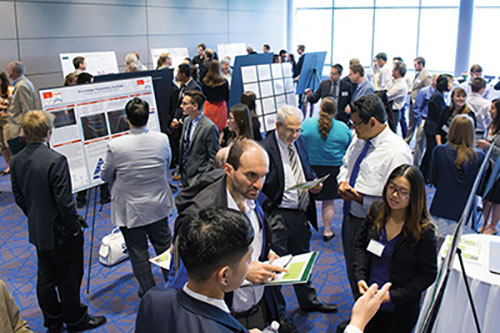
Each team prepares and submits a poster summarizing their analysis and solutions.
In the 2019 competition, the theme focused on renewable energy. Student teams were asked to assess if New York State could achieve Governor Cuomo’s goal of producing 50% of the state’s electric energy using renewable resources by the year 2030. Teams were provided a massive data set that included hourly electric generation at each of the state’s 11 regions for the past nine years. To facilitate accurate generation forecasts, additional data were provided. For example, we included historical information about the recorded hourly temperatures, the decrease in demand due to user efficiency, the decrease in off-the-grid private generation such as the use of solar panels, and the increase in demand due to the growing use of electric vehicles. To assess production capability, teams were provided information about the annual generation and capacity of each of the state’s 700 generation units. By analyzing all or part of the information, student teams could provide a descriptive assessment of the current status of the use of renewables and a predictive assessment of the status by 2030. The data set also included cost information related to building a range of types of new electric generation capacity, allowing teams to develop a prescriptive recommendation for the optimal way to meet the 50% renewable generation goal.
For phase two of the competition, teams were asked to consider the theoretical impact of a substantial increase in the use of electric vehicles throughout New York State. They were to assess how that increase might impact the renewable energy goal stated in phase one. Would it require a substantial and perhaps highly expensive increase in generation capacity? How might that impact electric energy costs to consumers? The provided data set included information about driving habits in New York State and the efficiency of electric vehicles. The state’s ability to handle this increase would depend, to a large degree, on the time of day the vehicles are charged. Thus, teams were also provided with hourly marginal costs for electric generation in order to assess the financial impact of charging vehicles at various times of the day.
Both phases of the competition allowed teams to take a variety of approaches and demonstrate the use of a wide range of analytical tools. The descriptive and to some extent the predictive analysis allowed all teams to achieve some initial levels of success. The possible prescriptive analysis provided a full challenge for the efforts and creativity of every team.
The Ability to Swing
Like any experiential activity that bridges the teaching endeavor with practice, and engages smart and motivated students, BAC@MC has all the prerequisite elements for a high-impact learning experience. It is easy to identify those elements, I once called the ability to swing, in terms of the four components often discussed in the teaching and learning literature.
- The concrete experience (connection): The competition is well grounded in the knowledge of business analytics. The exercise requires, at some level: knowing how to retrieve, organize and clean large data sets; designing data visualization schemes; understanding the interpretation of statistical analyses; employing data mining techniques; developing decision models; and articulating conclusions and recommendations. Therefore, the competition is an exercise in applying academic knowledge to a real-life/practical situation. Furthermore, it affords an opportunity for each team to go beyond the element of application and onto the second component of effective experiential learning.
- The reflection (examining knowledge versus results/lead-and-follow): The students who participate in the competition possess varying levels of academic proficiencies. We design the curriculum of the competition with the hope that each one of them will experience an “aha” moment (or two) through reflective observations. Of course, reflections are impacted by predetermined knowledge, but they often spark the need to adjust one’s knowledge in order to meet new challenges. Regardless of their analytics background, the inherent nature of the competition leads all students to undergo meaningful reflections. Students are forced to contemplate their often unintuitive findings and how they might contradict their previous knowledge. They then develop questions and observations that determine the need to further research and understand newly acquired information.
- The conceptualization (reinforcing the connection): The next element in experiential learning is channeling reflective experiences into the conceptualization of new knowledge. The competition provides enough motivation to foster this reinforcement of knowledge. It is clear to students that they need to learn more about the target industry’s ins and outs, whether it’s electric energy or online fashion marketing. The more they understand the complexities of the data, the more they seek new tools and techniques, and the more they hone their business analytics knowledge.
- Experimentation (trying new moves): Armed with the new concepts, students are ready to test their expanded knowledge. Exercises with defined conclusions, even those requiring complex solutions, may imply an end to the experimentation process. The competition questions are designed to be open-ended, even when they are well-guided. Our objective is to encourage seemingly endless exploration. The competitive environment helps with this objective. We are always impressed with the depth of the analysis performed by the student teams, but what is equally gratifying is their realization that more could be done to fully answer the questions at hand.
During the competition, the ability to swing takes place in a recurring loop: experiences become concrete knowledge, spark deeper reflections, help develop new understandings, leading to more focused experimentation … and so the beats move on. We are well on our way to designing the next competition. We welcome ideas and suggestions and invite you to join us for BAC@MC 2020! For more information contact [email protected] or visit https://Manhattan.edu/BAC.
Reference
BAC@MC: What People Say
Teaching
“BAC@MC is a great competition that assesses student skills, from managing a large amount of data to visually presenting information to a wide variety of stakeholders to lastly, problem-solving under time constraints with new and important information and communicating that information to a panel of industry and subject matter experts. It is a competition that we will be returning to year after year.”
– Advisor: Kieng Iv, University of Waterloo
“The Manhattan competition has been a tremendous learning experience for our students. They’ve been able to apply the methods and concepts we teach in a real-world situation and learned to better communicate their findings to others. Participation in the competitions has been a difference-maker when talking to potential employers, as they can demonstrate they have practical analytics experience.”
– Advisor: John Lochner, Hamline University
Practice
“BAC@MC is definitely one of the better business analytics competitions in the country. The quality of participants, the organization of the competition and the involvement of the industry is impressive and very relevant to the requirements of the industry. A good recruiting source for analytics leaders and a very good avenue for displaying talent for the universities.”
– Judge: Gaurav Anand, analytics manager, Google
“I was very impressed by the quality of the competition. From the planning to the execution, the event was extremely well-run providing students with a challenge and environment very close to what they will experience in the ‘real business world.’ The caliber and talent of the student competitors was outstanding.”
– Judge: Paul Thompson, VP Global Healthcare Product Development, DXC Technology
Salwa Ammar is a business analytics professor in the O’Malley School of Business at Manhattan College and the chair of BAC@MC 2020.
([email protected])