
December 5, 2019 in Congestion Management
Zero Congestion: Controlling and Eliminating Urban Traffic Congestion
A capacity-constrained trip-assignment pathway to congestion management.
SHARE: PRINT ARTICLE: https://doi.org/10.1287/orms.2019.06.11
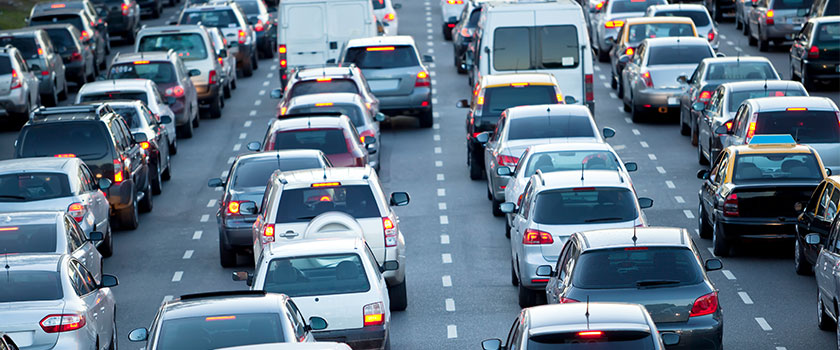
As urbanization of the world’s population increases, all large cities have seen greatly increased pressures on their transportations systems [1]. Efficient transportation is the key to the social and economic well-being of any metropolis. As a city’s transportation system is stretched beyond its limits, its ability to grow and be socially and economically prosperous becomes problematic.
In many major cities, as more people use automobiles, more goods are delivered by truck, and more for-hire vehicles have been added, traffic congestion is at an all-time high. A few cities (London, Singapore) have implemented “congestion pricing” programs loosely based on the theories of Nobel Prize-winning economist William Vickrey [2] with some level of success. This article presents an alternate approach that promises to control, and if fully implemented, eliminate traffic congestion. It is based on operations management theory, in particular the just-in-time approach to factory production that manages both capacity and demand in an efficient, optimized way.
Background
Trying to mitigate congestion is not a new enterprise. As villages grew into towns, and towns into cities, and cities into metropolitan areas, each faced a continuing struggle to build the transportation systems needed to accommodate, facilitate and encourage that growth. However, once built, each city’s street capacity became essentially fixed. With the creation of the automobile, congestion took on a new set of problems. The volume of motorized vehicles changed the efficiency of streets. The professional field of “traffic engineering” was created to establish standards for road design and driving behavior. Of course, prosperous cities grew faster than new roadways could be built. In addition, new roadways created new development, which always seemed to create more traffic than the planners had predicted [3].
Within a few decades of car production, the great established cities of the world were faced with substantial traffic congestion, particularly at certain times of the day. As cars became more polluting and greater energy consumers, legislation was passed in an attempt to limit the negative effects of congestion. Pollution and mileage standards were imposed at the state (California) and federal levels. Congestion-mitigating approaches were touted (but rarely implemented) to deal with the pollution and energy concerns, but never really to solve the congestion problems.
What could a city do? The “engineering/contractor” approach was to build more roads. The era of highway construction came to an end when it was realized that there was only so much space available, and that these highways often limited rather than helped cities develop. By the second half of the 20th century, a number of congestion mitigation techniques were considered, even built into the laws. The Clean Air Act [4] required cities to have plans at the ready if their pollution predictions did not comply with federal standards. Failure to comply would result in the loss of federal funds. Carpooling was seen as a potential way to mitigate these problems, but the percentage of pooled vehicles, even where special-use lanes have been created, is still low.
Around this time, the notion of congestion pricing became part of the discussion. It was believed that either a congestion charge or some form of variable pricing at tolls could be set up to either limit people’s use of automobiles or shift their use to “off peak” periods. Today, pricing schemes are more interested in raising money for public infrastructure rather than controlling congestion. Without the limitations imposed by either the pollution or energy consumption standards, as a country gets wealthier, automobile use increases (China and India). Today, in many cities, congestion is at a crisis level.
Different Perspectives: Driver vs. Traffic Engineer
From a driver’s perspective, congestion occurs when vehicles ahead result in slower speeds. Modern technology can tell drivers the expected time and best route to take. But the new technology is not congestion management in any real sense. The time from Point A to Point B can be divided up into “time devoted to driving at speed,” “traffic signal wait time” and “waiting or slow down (lost) time due to congestion.” The Zero Congestion method would seek to reduce or eliminate any congestion-related lost time. If eliminated, people would be reasonably assured of a “congestion-eliminated,” travel time-optimized trip. The vast majority of people would be better off in that they could productively use the “found” time.
From a traffic engineering perspective, congestion occurs when demand exceeds capacity. Maximum urban street grid capacity is, with exceptions, virtually fixed. Demand is variable. Generally speaking, in most cities, traffic demand is greater than the capacity during either the morning or evening rush hour, and it is less than capacity at other hours of the day. As rush hour ends, the demand falls below capacity and the congestion is reduced.
The best way to control or eliminate congestion is to control or coordinate both demand and capacity. And since capacity is essentially fixed (with exceptions), controlling congestion boils down to controlling demand, something congestion pricing attempts to do indirectly and independently of capacity. To begin the discussion of how the Zero Congestion approach is different than the economist’s approach, the next section discusses how the economists view congestion and the weaknesses of their approach.
Vickrey’s Method
Vickrey’s idea of congestion pricing, introduced in the 1970s, was based on standard economic theory of behavior. The basic observation is that in congested systems, each additional user imposes incremental congestion costs on all other users. Thus, users internalize only a part of the total waiting costs they create by joining the system. This results in more usage than optimal. If these additional costs (externality costs) could be computed and charged back to the users who create them (internalized), then the externality problem is resolved, and the congestion levels will be reduced to their optimal levels.
Note that congestion pricing was intended to address the issue of external congestion costs, not the costs of financing and maintaining the roads. In practice, congestion prices cannot be optimally computed. Instead, Vickrey’s system is often replaced by a simplified two-tier pricing system, where tolls are set low (or even zero) during low congestion times, and they’re set high during peak hour. If the differential in pricing is large enough, economic theory predicts that usage during the peak demand periods will be reduced as Vickrey had predicted. London and Singapore are often cited as cities that have adopted this approach.
Congestion pricing systems are often viewed by their proponents as a panacea, since in theory it allows a city to address in one stroke both the congestion and revenue problems.
Capacity Constrained/Trip Assignment Approach
Rather than affecting traffic intensity indirectly by pricing (“the invisible hand” affect), the Zero Congestion approach manages it directly by taking into account the system’s given capacity and scheduling/reserving every trip. It promises to control and – if fully implemented – completely eliminate traffic congestion while maintaining existing levels of service. The approach is general enough to allow each city to strike a unique, customized balance among several competing municipal objectives: raising revenues, promoting a sense of social justice and fairness, supporting civil services and allowing the city’s various business sectors to prosper.
The idea, simply stated, is to install a reservation system for vehicle trips (RSRS - routing, scheduling and reservation system) [5] during predictable congestion periods such as rush hours. The application of this idea to transportation systems was not feasible in the past due to their vast scale and enormous complexity. Today’s available technologies and algorithmic frameworks can be adequately modified to support such a system. More importantly, it is extremely compatible with futuristic scenarios that include a large number of self-driving vehicles.
To demonstrate the main logic, consider a simplified system with a single origin, a single destination and a single path connecting the two. Assume that the travel time between origin and destination, in periods of no congestion, is 30 minutes and that the capacity of the system is 60 cars per minute. Now divide the daily commute time into a sequence of time slots, say five-minute intervals. We can view the “inputs” to the system as the number of cars entering the system at each time slot. Similarly, the “outputs” are the number of cars arriving at the destination of each interval. In periods of low traffic demand, the number of inputs at a certain time interval will equal the number of outputs arriving at their destination at the corresponding lagged interval, 30 minutes after departure. The key observation is that as long as the rate of inputs is below capacity, the traffic will flow adequately. The plan is a way to make demand remain within capacity, or if not, to charge a fee to anyone causing the demand to exceed capacity and therefore create congestion.
The idea is to schedule vehicle trips such that the demand for street space does not exceed flow capacity. This will be calculated at the street segment level on a time unit by time unit basis. Users will request a route to take them from Point A to Point B and be given a route that does not exceed capacity. If none is available, users will be given either an alternate time choice or choices that will include a congestion and environmental charge since their trip will cause the demand on a street segment to exceed its capacity, thus creating congestion for those who have been assigned that segment when demand was below capacity.
The plan is to have continuous real-time monitoring of traffic conditions (VMS - Vehicle Monitoring System) on every street and highway in a city, and real-time monitoring of every vehicle operating in that city. In addition, the system will have all current and future individual trip origin and destination requests stored and evaluated. Also stored will be the real-time capacity of every street and highway segment in the city’s transportation grid. Some capacity would have to be “reserved” for emergencies and spontaneous trips (taxi service). However, less would be needed under this plan since the roads would already be flowing predictably smoothly. Just imagine how much better this would be for ambulances and police and fire vehicles. With that information, a user can “schedule” a trip and be assigned a route and a time. Assuming they adhere to that schedule, they will not receive a congestion charge. Adjustments to the route without adding a charge can be made in real time as conditions change. Special consideration would be given to truck deliveries or other pre-registered vehicles. Real-time adjustments would have to be made for unplanned or capacity-reducing street blockages such as sanitation trucks, fires, accidents, permitted construction or other typical obstacles to free-flowing traffic.
Implementation/Technology
The technology currently exists to implement such a strategy. Minor adaptation would be needed. First, the ability to know how many vehicles are at any given moment using any particular street segment is currently available. Second, the RSRS would have a standard and real-time capacity estimate of each street segment. Third, the reservation system would keep logs of scheduled, intended trips and provide an optimal routing to the user. Fourth, it would communicate to the user that route and make corrections due to unusual or unexpected circumstances. Lastly, an “enforcement” component to capture intruders or nonregistrants currently exists for red light and speed cameras. The software programs and algorithms including route optimization routines have already been developed. There are currently several companies who have the technology to refine their systems to implement this right now.
On the user side, GPS or E-ZPass systems currently monitor vehicles. Everyone would have to be connected to the system in one way or another. But that is already happening. More and more vehicles have an E-ZPass reader in their cars or use one of the directional apps. Cameras have been developed and put in place that read license plates. Those cameras could supplement other monitoring means. One additional advantage to having all vehicles monitored would be public safety. Currently, a substantial number of unlicensed drivers are operating vehicles. Some cause accidents – hit and runs – and get away with their crime.
The cost of implementing such a system would have to be considered. But given the rate of improvements in technology and their resulting lower cost, the possibility of this being cost effective is high. Congestion pricing systems are currently in place with similar technology. So, although cost is always a concern, it should not be an impediment to developing the concept.
Revenue Strategies
The main advantage of congestion pricing is the money it raises for mass transit and infrastructure. The effort to eliminate congestion (Zero Congestion) might be seen as defeating that objective. However, there are many reasonable ways of charging for this service that would raise a substantial amount of money. A city could choose one of many charging strategies. First, the system could set a charge for each reservation. A fee as small as $2 for cars and $5 for trucks could raise a substantial amount of money in a large city. That fee could be “dynamically” set – higher in rush hour, lower at other times. An alternate could be to have a bidding algorithm for which people could bid for key rush-hour times/routes. Another alternative could be to have an annual “membership” fee with unlimited reservations.
Second, it doesn’t eliminate the possibility of placing tolls on any or all parts of the street network if they were deemed preferable or in addition to other charges. Third, as mentioned, a significant penalty charge could be imposed on anyone violating the pure scheduling approach. Unscheduled trips or “violations” of the schedule route could result in congestion charges. Someone driving without a scheduled route will be monitored, and if they enter a street segment and by doing so, create more volume than capacity, they could be charged a congestion fee. That fee could be fixed, or it could increase as the overall demand increases beyond capacity. Part of the violation fee could be rebated to the “honest” users. Fourth, all trips could also have a small environmental charge based on the length of the trip whether or not they incurred a congestion fee.
Since high pricing during rush hour would have a much harsher effect on poor drivers, the charges could be made “progressive” in the following way: At tax time, for states with an income tax, someone could attach the report of their charges to their tax filing, and based on their income level, receive credits toward their income tax. The higher the income, the less the credits.
Implications
Can a city allocate the use of an asset by scheduling? Most do now. Municipal golf courses almost all have reservation systems. Other parts of parks such as tennis courts are allocated this way. A city almost always has the right to limit or charge a fee for the use of public assets. More specifically, can the city allocate the use of its street space in this way? Can it limit who uses what streets when? Cities do it now in various forms such as bus lanes, bike lanes and HOV lanes. Should commercial traffic be given a scheduling priority? Should residents be given priority over out-of-towners? Could high income people pay a priority charge to be given first choice for reserved slots? These economic questions would have to be addressed.
The issue of privacy should always be a concern, but regarding observing and controlling the public space, that issue has already been resolved. The government has the right to control the use of public space and monitor who is using it. E-ZPass and Red Light cameras already do that.
This article has outlined a broad range of issues associated with a different approach to solving urban grid congestion problems by using a scheduling system to limit traffic to the constraints of capacity. The author believes this approach is superior or at least complementary to the congestion pricing approach conceived of by Vickrey.
Author notes: Riccio and Zemel [6] offered an alternate approach to the Vickrey congestion pricing model for reducing and perhaps eliminating traffic congestion in a street grid by using the principles of operations management [7], just-in-time management [8] and factory physics [9] instead of economic theory. Extensive work on this subject has been done by Liu, Yang and Yin [5] and others, but exclusively for limited access highways.
References
- Janette Sadik Khan and Seth Solomonow, 2016, “Street Fight: Handbook for an Urban Revolution,” Viking, Penguin Random House.
- William S. Vickrey, 1969, “Congestion Theory and Transport Investment,” The American Economic Review, Vol. 59, No. 2, Papers and Proceedings of the Eighty-first Annual Meeting of the American Economic Association (May), pp. 251-260, https://www.jstor.org/stable/1823678.
- Gilles Duranton and Matthew Turner, 2009, “The Fundamental Law of Road Congestion: Evidence from U.S. Cities,” University Toronto Department of Economics, Sept. 8 (https://www.economics.utoronto.ca/public/workingPapers/tecipa-370.pdf).
- “History of the Clean Air Act,” 2013, Environmental Protection Agency, Aug. 8.
- Wei Liu, Hai Yang and Yafeng Yin, 2015, “Efficiency of a Highway use Reservation System for Morning Commute,” Transportation Research Part C, Vol. 56, pp. 293-308, https://doi.org/10.1016/j.trc.2015.04.015.
- Lucius Riccio and Eitan Zemel, 2019, “Zero Congestion – Executive Summary,” https://www.zerocongestion.org.
- F. Robert Jacobs and Richard Chase, 2018, “Operations and Supply Chain Management,” McGraw Hill.
- Taiichi Ohno, 1988, “Toyota Production System: Beyond Large-Scale Production,” CRC Press: Boca Raton, FL.
- Mark Spearman, 2000, “Factory Physics,” McGraw-Hill.
- Eitan Zemel and Jaiwei Zhang, 2019, “Algorithms for Zero Congestion,” https://www.zerocongestion.org.
Lucius Riccio, Ph.D., teaches analytics, operations and statistics at NYU’s Stern School of Business. A former winner of the ORSA President’s Award and a finalist in the INFORMS Edelman Award Competition, he has held a number of government and private sector positions, including NYC Transportation Commissioner, NYC MTA Board Member, staff member of the President’s Commission on Law Enforcement Productivity, partner in Gedeon GRC Engineering and member of the USGA Handicap Research Team. Prior to teaching at NYU, he taught for 25 years at Columbia University’s business, engineering and public affairs schools.