December 10, 2019 in President’s Desk
O.R., analytics and AI woven into fabric of INFORMS
SHARE: PRINT ARTICLE: https://doi.org/10.1287/orms.2019.06.14
As my time as INFORMS president draws to a close, I thought it appropriate to review the incredible progress that has been made this year in expanding the reach and impact for our community overall, and with regard to advancing our focus on the critical intersection of operations research (O.R.), analytics and artificial intelligence (AI).
In my first column as president (Feb. 3)[1], I wrote, “the more collaboration and problem-driven research that exists, the more real-world examples of impact that we share, the more we engage with leaders in and out of government, the more opportunities will be presented for O.R. and analytics professionals to tackle the next sets of important and exciting problems.” I believe that even more passionately now than I did then.
From the start of my tenure as president, INFORMS has been working to better understand, articulate and capitalize on the rapid ascension of AI as a priority for business and an imperative for policymakers. Stated differently, we have sought to ensure that our community, and our work in O.R. and analytics, has the opportunity to fully contribute to and benefit from considerable interest in the research, teaching and practical aspects of AI’s development and implementations.
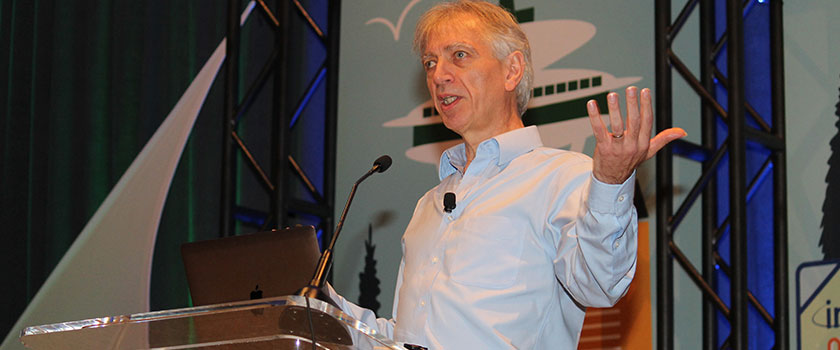
You might recall that this began with the appointment of an ad hoc AI Strategy Advisory Committee (AISAC), comprised of Pascal Van Hentenryck, Radhika Kulkarni, Phebe Vayanos and Madeleine Udell. Over the course of the year, the AISAC has done a tremendous amount of work in this regard, culminating in the development of our internal roadmap or whitepaper, and its presentation in Seattle. To that end, I highly encourage you to read the whitepaper [2] and watch the plenary presentation on INFORMS AI Strategy by Pascal and myself [3].

AI-related Activities
Beyond this set of critical efforts, however, the recognition of the future of AI to our community is manifesting itself in a variety of other ways. In fact, a number of activities have been taking place across several key areas. Some of these include:
- Developing and modeling curricula for AI courses that can be taught in OR/MS/analytics programs
- Creating learning opportunities to teach educators about AI, which will ideally lead to them incorporating it into their lessons
- Information Systems Research is planning a special issue called “Humans, Algorithms and Augmented Intelligence: The Future of Work, Organizations and Society” [4]
- Organization Science is planning a special issue called “Emerging Technologies and Organizing” [5]
- TutORials is considering an edition on AI
- Multiple briefings have taken place between INFORMS leaders and the U.S. House of Representatives and Senate AI Caucuses, as well as with the White House and other senior staff on Capitol Hill
- A variety of columns have been written and published in the media
- Written testimony was submitted to the House Science Committee about AI and the future of work
We Have Only Just Begun
Indeed, inside of a year, the mindshare surrounding the relationships or dependencies between O.R., analytics and AI is becoming operationalized into the fabric of INFORMS and our community.
But this also means we have only just begun. In the months and years ahead, many of these activities will continue to take shape and expand. We anticipate another whitepaper will be completed and developed to be shared not just within INFORMS, but across other disciplines that are also contributing to AI’s continued development and other stakeholders. This in turn will guide our partnership strategies with sister societies around joint workshops and conferences. Early progress on this dimension is already being seen with SIGEC of the ACM. In addition to the whitepaper, the AISAC and others will be working to ensure early ideas and programs will continue to be developed and current and future INFORMS leaders, volunteers and other members will be innovating and contributing in ways we cannot yet anticipate or imagine. If you are interested in joining in these efforts or contributing in other ways to our AI strategy, please let me know.
Over the past several decades it has become commonplace for U.S. political figures to ask the public whether they are better off now than they were a few years before. As I reflect back on my year as your president, I can enthusiastically ask and answer the same question about INFORMS.
We are stronger and more vibrant now than ever before, thanks to the hard work and dedication of each and every one of our members, volunteers, Fellows, committee chairs, societies, my colleagues on the board and the professional staff at INFORMS headquarters.
As my term draws to a close, I am excited by our future. Whether it is the continued focus on AI, or our vital initiative on diversity, equity and inclusion within our fields, or the countless other activities INFORMS undertakes each and every day to accomplish our mission and fulfill our vision.
Thank you for the opportunity to have served as your president, and for the privilege of being part of such a dynamic group of friends and colleagues.
References
- https://pubsonline.informs.org/do/10.1287/orms.2019.01.04/full/
- https://cdn2.hubspot.net/hubfs/3449182/INFORMS_AI_Whitepaper.pdf
- https://youtu.be/5beyzv3Mjfg
- https://pubsonline.informs.org/doi/10.1287/isre.2018.0784
- https://pubsonline.informs.org/pbassets/OS_special_issue_emerging_technologies_andorganizing_2019withlogos-1554151898287.pdf
Ramayya Krishnan is the Cooper Professor of Management Science and Information Systems at Carnegie Mellon University. He is dean of the Heinz College of Information Systems and Public Policy and served as 2019 president of INFORMS.