


February 4, 2020 in O.R. Legacies
Like father, like son and daughter
All in the family tree: INFORMS rich with O.R. legacies
SHARE: PRINT ARTICLE: https://doi.org/10.1287/orms.2020.01.15

What’s in a name? In some families, sharing a surname (and some physical features) might be as far as the similarities go. Other families, however, share much more – like their love of math. Or mathematical modeling. Or teaching math modeling.
With that in mind, we went in search of longtime INFORMS members whose children followed them into the profession – O.R./analytics legacies. What are the odds? Very slim, actually. A study by Ancestry.co.uk found that only 7 percent of children end up in the same job as their parents. Let’s face it, kids dream of becoming famous musicians, doctors and professional athletes. What 10-year-old ever said they wanted to be an operations researcher when they grow up, even the child of an O.R. professional?
Data scientists at Facebook analyzed a giant sample of roughly 5.6 million parent-child pairs to map father-son and mother-daughter occupation pairs and found that while parental occupations may affect the likelihood of children following in their footsteps, the absolute percentage of it happening is low. Many factors are at work in determining why some children choose similar career paths to their parents, including the passing of genes, setting examples, providing opportunities and advice, and shaping values.
Many of the protégés we interviewed noted that they would’ve never even considered operations research as a career field if it weren’t for their parent(s). Operations research and analytics are especially unique in this way because it is not a “family business” you can go into or take over once your parents retire. O.R. and analytics are not very well known, yet – you have to run into it or be exposed to it, and that is just what these parents have done for their offspring. They have exposed them to the wide, wonderful world of O.R. and what it can do to help people solve problems and make better decisions for a better outcome.
So how did these and other INFORMS members end up in the small percentage of parents and children who share the same occupation? From perhaps inheriting pure math aptitude, to your parents making you do the old OR/MS Today puzzles, to finally figuring out what it really is your mother or father does for a living and deciding that it sounds intriguing, each story that follows is unique and makes it easy to see how these families found their way into that 7 percent.
The Wikums
Erick and his son Anders
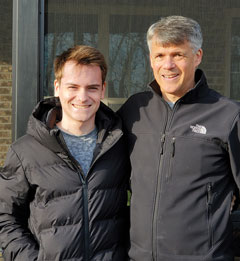
Erick Wikum attended the U.S. Air Force Academy as an undergrad. He sought advice from various officers regarding his major, expressing his interest in and aptitude for mathematics. One officer suggested that he apply math in operations research (O.R.). Erick took that suggestion and studied math and O.R. at the Academy and later at Georgia Tech, where he received both his Master’s and Ph.D. in operations research. He then worked for several big names in O.R. and analytics – Norfolk Southern Railroad, Schneider National, IBM and Tata Consultancy Services – but it was starting out on his own in August 2008 (right before the Great Recession) that Erick describes as the biggest challenge of his career. After struggling mightily for 18 months on his own, Erick returned to industry to practice O.R., but in 2017 he tried again and found the going to be considerably better. As an independent consultant with Wikalytics, he assists clients in identifying, framing and solving problems using advanced analytics.
No, his son Anders (pictured left) does not work for Wikalytics. Anders is an undergraduate student at Cornell University studying – you guessed it – operations research. He transferred from the University of Illinois after studying physics for a year, only to realize O.R. was what he really wanted to do. Although Anders is only in his third year, he plans to stick with O.R. “for sure,” with a little math and computer science on the side.
“I think the [plan to go into operations research] was always in the back of my mind, but I also think I wanted to avoid it at first,” Anders says. Looks like he came around. “A lot of the stuff that we used to talk about when I was little was about supply chain, and that is definitely not an area that interests me,” he adds. It really boiled down to Anders not knowing all that O.R. encompasses (supply chain ≠ operations research). His preferred areas of interest are queuing theory and probability theory.
“I was proud to see that. Even if he didn’t say he did it directly because of me, I was still pretty pleased to see him going in that direction,” Erick says of Anders’ decision to switch from a physics major to an O.R. focus. “My son will have great opportunities, and it’s only going to get better as data and mathematics and computer science progress.”
Erick says that even though his son heard all the conversations about what he did for a living over the years and, and Erick sharing PuzzlOR puzzles with him as a kid, he truly thinks that Anders decided on O.R. through independent thinking. In other words, Anders did not consult the consultant on his choice of studies.
Outside the O.R. world, Erick and Anders share a passion for tennis. Erick taught Anders how to play when his son was in 5th grade, and Anders continued to play throughout middle school and high school and even into college. The father-son tennis duo has even dabbled in pickle ball, which Anders describes as “mini tennis with weird paddles instead of racquets and wiffle balls instead of tennis balls … and a lot less running.”
Erick’s fatherly advice to Anders: Familiarize yourself with both sides (academia and industry) and talk to people to understand what life looks like, what work is done and what a typical day looks like. If you’re going to go into an applied area, pick an industry that interests you and learn as much as you can about it.
Sounds like a solid decision-making process.
The Weintraubs
Andres and his son Gabriel
If you follow the INFORMS Edelman Award competition from year to year, you might remember a finalist team a few years back who applied operations research (O.R.) techniques at the Chilean Professional Soccer Association (ANFP) to schedule soccer leagues in Chile. A mixed-integer programming approach allows ANFP and the University of Chile to consider a variety of constraints and objections including transparency, fairness, team preferences, geography (travel, weather) and TV implications, increasing viewership, attendance and ratings. As of 2016, the economic impact of this work was about $60 million, and the work has now been extended to schedule professional basketball and volleyball games.
Andres Weintraub, INFORMS Fellow and President’s Award winner, spearheaded the soccer-scheduling effort. In addition to being an Edelman finalist in 2016, Andres was also a finalist in 2011 and Edelman winner in 1998. A professor in the Department of Industrial Engineering at the University of Chile, Andres remembers the challenges of beginning an O.R. career in Chile, home to important companies, but there was a time when none of them were using O.R. Now, the country uses it in shipping, mining and other industries, and of course, scheduling soccer teams.
Born in Chile, Andres’ son Gabriel moved to the United States in search of new O.R. opportunities. With an undergraduate degree in industrial engineering in hand, Gabriel settled in California with his wife and attended Stanford University, where he received an M.A. in economics and Ph.D. in management science and engineering. “It was new, what he was doing – the interface of O.R. and economics,” his father says. “I find this integration very interesting.”
According to Gabriel, when he first started working at the interface of O.R. and economics it was “a bit unusual, but in the last 10 years there has really been an explosion [of interest], and the profession is having a lot of influence in the industry.”
Gabriel credits his dad with exposing him to the field of O.R. and helping him realize that math can have a practical impact and an economic career can be fun. “My dad is very passionate and really enjoys his career: working on interesting problems, interacting with smart students and colleagues; it’s a flexible lifestyle,” he says. “Being exposed to that was helpful in choosing O.R. and an academic lifestyle.”
According to Gabriel, his father’s career advice didn’t come in verbal form, but by example, because it was easy to see that Andres was passionate about his work and would go to work and come home happy every day. It helps that the Weintraubs are doing meaningful work, but Andres remains humble. “You get recognition, which is really nice, but you don’t work for that,” he says. “It’s the path you enjoy. It is not worthwhile to work toward getting recognition.”
After taking the nonverbal cues from his father and pursuing a career in O.R., Gabriel felt it was necessary to move to the U.S. not only for more opportunities, but to separate his burgeoning career from that of his father’s. “I had to build my own identity,” he says. “I started working in an area that was different than what he was doing (O.R. and logistics versus economics). It was helpful to build my own path.”
After 10 years teaching at Columbia Business School, Gabriel returned to Stanford in 2016 where he is an associate professor of operations, information and technology. Now that Gabriel has made a name for himself within the field of O.R., Andres introduces himself as “Gabriel’s father.”
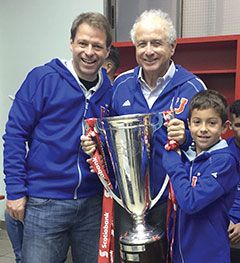
Andres and Gabriel travel to see one another a couple times a year – Andres to California and Gabriel and his family to Chile. They try to keep family and their profession separate because “everyone else gets bored.” Instead, they share another passion – professional soccer. Their favorite team is, of course, La Roja (Chile). They’ve also roped in Gabriel’s son Matias by taking him to matches in Chile and meeting the players in the locker room, particularly after their team Universidad de Chile (which was originally associated to the University and for which Andres is on the board) won the first division national league in 2017. (See Gabriel, Andres and Matias (l-r) pictured above.) They were also at the final match of the Copa America 2015 in Santiago and 2016 in New Jersey. Chile won both finals – the only times in the country’s history. I wonder if Andres scheduled those.
The Weins
Lawrence, his son Alex and daughter Nicole
 While the chances are slim that your child will follow in your professional footsteps, especially in a demanding, technical field such as operations research, what could possibly be the odds of two of your children following the same path? Larry Wein and his wife (who he met at Stanford while they were both pursuing Ph.D.s in operations research) must’ve done something special to have two of their three children fall in love with math and choose to continue the family legacy.
Alex Wein is a post-doc at the Courant Institute of Mathematical Sciences at New York University and conducts research in theoretical computer science, while his sister Nicole is a doctoral candidate in theoretical computer science at MIT. Nicole’s studies focus on graph algorithms, e.g., finding shortest paths in networks; Alex’s research focuses on a mix of computer science and statistics and applied math. Even more amazing, the siblings independently pursued theoretical computer science, and Nicole says she was as surprised as anyone when they ended up in the same field.
“I assumed I would always do something different than Alex because I thought we were different,” Nicole says. “I didn’t think I’d fit in the world of math. He was very much a math person. It wasn’t clear to me that I’d be doing math.”
Larry concurs: “With Alex, it didn’t surprise me. I saw [his passion for math and computer science] at a young age; he’d spend his free time making video games. Nicole loved ballet and that was her main passion until later in high school.”
Growing up, the Wein children were to some extent encouraged to enjoy doing math puzzles or riddles and then discussing them afterwards. According to Alex, “Our parents would try to teach us some math stuff so I think it was a little bit in our upbringing from an early age.” However, Alex says he wasn’t super serious about math until college, and then he discovered theoretical computer science on his own. Nicole agreed that she didn’t feel like their parents pushed them to pursue math careers. She even admits that growing up, she didn’t really understand what it was her dad did, but she figured it out in college after taking a couple O.R. courses.
“Our mom really encouraged us to do what we wanted to do,” says Nicole. “She didn’t care what we wanted to do or if we were really good at it. I always liked math in school but didn’t do it as an extracurricular. It wasn’t until college that I discovered I wanted [math] to be my career,” she says.
Adds Alex: “Maybe implicitly we grew up knowing that this was a thing that you could do and had role models in that role. To some extent, I didn’t feel like I was intentionally trying to follow in his footsteps. The lifestyle of [dad’s] job was appealing to me.”
Larry has a B.S. in operations research and industrial engineering from Cornell University and a Ph.D. in O.R. from Stanford University. He was a professor at the MIT Sloan School from 1988-2001 and then returned to Stanford to teach and has been there ever since. He is currently researching crime solving – how best to process sexual assault kits and their cost effectiveness, and forensic genealogy as a new way to solve violent crimes.
Well-known in the field of O.R. and throughout INFORMS, Larry is an INFORMS Fellow and a recipient of several INFORMS awards, including the Saul Gass Expository Writing Award (2005), President’s Award (2007), Erlang Prize (1993), Kimball Medal (2010) and Lanchester Prize (2008). In addition, he served as editor-in-chief of Operations Research from 2000-2005. “INFORMS has been my intellectual home for my whole career since undergrad,” he says. “I’m lucky to be a part of that community.”
When it comes to his kids following his footsteps, Larry agrees with Alex and Nicole, saying, “In the sense of parenting I don’t think I did much to influence them. They may have seen my lifestyle and said, ‘that looks like fun.’ They both have the same passion for math and applied math that I do, and I think it just came naturally to all three of us.”
Although perhaps not intentional, the Wein legacy continues. How could it not when you have a family that would spend some of their family vacations discussing math or arguing about a math problem, and birthdays playing their own version of the game Balderdash, but instead of words with fake definitions, they use academic paper abstracts and made-up paper titles? Alex recalls debating the famous Monty Hall Problem (Door No. 1, 2 or 3) on a family camping trip “a long time ago.” Nicole remembers the argument, but says she was too young to participate.
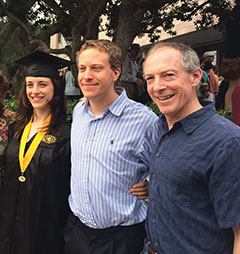
Regardless of how Alex and Nicole ended up where they are, Larry is indeed a proud father. (See Larry (right) celebrating Nicole's graduation with Alex, pictured above.) He remembers when he was their age and developing the competence, confidence and passion for applied math. According to Larry, “It’s nice to see both of them get the bug and enjoy it, because I can relate to that.” That figures.
The Roths
Al and his son Aaron
Nobel Prize in Economics winner Al Roth was not always an economist. He has three degrees in operations research (O.R.): B.S. from Columbia University, M.S. and Ph.D. from Stanford University. He first heard about O.R. one summer when he worked in the O.R. group of a Washington Army Laboratory called Harry Diamond Labs. When he returned to Columbia the next fall, he looked into O.R. and realized it gave you lots of flexibility to look into things, and you didn’t have to be really good at engineering drawing to participate, which were two positive aspects for Al.
Since his undergraduate and graduate days, Al has seen the O.R. field change significantly. For example, the O.R. department at Stanford from which he received his Ph.D. no longer exists. It was merged with another department to form what is today the Department of Management Science and Engineering. This particular instance reflects the history of the turmoil within the field of O.R. There are fewer freestanding O.R. departments – most are now a contraction like OR/MS or OR/IE. (For more history lessons, see Peter Horner’s article about the 25th anniversary of INFORMS and how the Institute came into existence.)
Luckily, the central tools of O.R. have remained essential, with the addition of other mathematical tools such as computer science and economics. While Al’s son Aaron may not be old enough to have experienced this history, he agrees that Al’s description of computer science at the moment is accurate. “What drew me in to computer science was the idea that basically you could study whatever you wanted and it could still count as computer science,” Aaron says. “The toolkit, or the computation lens with which to study the world, computer scientists view this as, of course, the right way to study the world. I like that [computer science] includes people who study game theory, evolution, and privacy and fairness (like me). We are all welcomed to call ourselves computer scientists.”
Surprisingly, Aaron never took an O.R. class, but a lot of what he does at the University of Pennsylvania’s Department of Computer and Information Science might have at one point been called O.R. – theoretical computer science, studying algorithms from a math perspective, using historically O.R. tools like linear programing and other optimization techniques.
Al never technically “switched” from O.R. to economics. He signed up to be an engineer but got interested in markets and the disciplinary boundaries moved around him to create market design. He says this combination is a good thing because market design requires both attention to detail and mathematical sophistication, which makes operations researchers a natural for jumping into the economics side. So what do a computer scientist and an economist have in common? According to the Roths, there are a surprising number of connections between what Al and Aaron do. Although not an economist, Aaron’s work touches on game theory and stable matching, which is closely connected to Al’s work. Another connection has to do with the point of view of computer scientists and economists, and increasingly of operations researchers. Computer science is not the science of computers but the science of computation, which is the science of everything, and that’s how economists feel about economics, which is, coincidentally, also the science of everything.
Aaron ended up in this connected field despite growing up in the Roth household, according to Al. “There was nothing about Aaron growing up that made me think he’d become a scholar,” Al says jokingly. In earnest, Aaron says, “Growing up it wasn’t clear to me that there were jobs out there that didn’t involve Ph.D.s since everyone in my family had one. Growing up the way I did influenced me to study math. I always figured I’d get a Ph.D. and probably become a professor. My dad always made teaching seem like a fun job so it was attractive.” Even his extended family is an academic one – Aaron’s wife Cathy also has a Ph.D. in mathematics from MIT. At least at family holidays they can talk about interesting topics and only bore about half the people there.
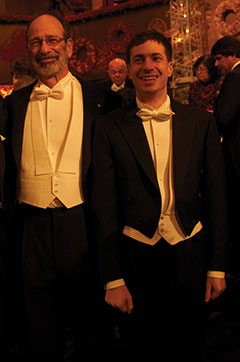
When they aren’t discussing algorithms, winning Nobel Prizes (see Al and Aaron (right) pictured celebrating above) or writing books – Aaron’s general audience book “The Ethical Algorithm” about the science of designing algorithms that embed social values like privacy and fairness was published in November 2019 – Aaron and Al can be found engrossed in all things children and grandchildren, respectively. “We often talk about the grandchildren and what they’re eating,” Al jokes. Aaron and his wife have two small children, and although they are too young to tell if they’ll also get Ph.D.s, there’s hope. “We’ve got potty training nailed, so that’s a good start to the Roth legacy,” cracks Aaron.
One thing’s for sure – the Roths have a lot of fun and love jokes, – but all joking aside, Al says he is very proud of Aaron. “It’s very nice to sometimes have someone say with surprise, ‘You’re Aaron Roth’s dad!’” he says. “It’s also nice to see the way he’s developed important new ideas that cross over into O.R. – looking at fairness in an algorithmic way.”
Al gets the last laugh: “Everyone should read Aaron’s book; it makes a great gift!”
Insert winking face and laughing emoji.
The Elmaghrabys
Wedad and her father Salah
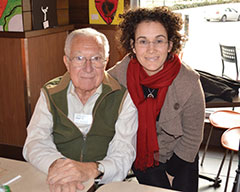
INFORMS had the great pleasure of knowing and working with internationally renowned operations research (O.R.) educator Salah Elmaghraby for nearly 40 years before he passed away in June 2016. According to his daughter Wedad, Salah “got into O.R. before it was O.R.” He was the one of the very first operations research Ph.D.s awarded at Cornell University: Salah (pictured left with Wedad (right)) was there from the start.
While Wedad also has a degree from Cornell (undergraduate operations research and industrial engineering), she says that she didn’t intentionally follow in her father’s footsteps. “He never told me and we never discussed what I should study. He thought I should do nuclear engineering, because he thought it was interesting. Any conversation with him was going to include some history of math aspect and the beauty of statistics or probability,” says Wedad. “He never said ‘study O.R.,’ rather, ‘look at the amazing history of these disciplines and what you can do with it.’ What he did say, however, was “love what you do and never work a day in your life.”
Borrowed from an inspirational poster, the words couldn’t ring truer for Wedad and her sister Karima, who also got the teaching bug from Salah. They would often visit Salah at North Carolina State University in Raleigh where he established and directed the first interdisciplinary Graduate Program in Operations Research. Salah retired as director in 1990, but he continued teaching for 20 years. Wedad loved seeing Salah’s eyes sparkle because he loved what he did: teaching, working with students and debating ideas. It was through those visits that Wedad thought, “I want that – that’s amazing.”
Wedad adds, “It was never a job [to my dad]. It was something he easily loved and was part of him – it was him. When I was a junior faculty and my dad was in his late 70s, he would still clock more hours than me. He was in constant work mode.” Salah and his wife Amina often hosted students for dinner at their home, and every summer the young Elmaghraby family would travel the world going to wherever Salah had a conference to attend. “Once we left for college, he would take sabbaticals and go away for three months; it was a lifestyle,” says Wedad. “I’m enjoying the lifestyle now.”
After graduating from Cornell, Wedad received an M.S. and Ph.D. in O.R. and industrial engineering from the University of California, Berkeley where she realized her specific research interests did not align with that of her father’s O.R. methodology. She pursued economics and market design, and became the first operations management hire at New York University Stern School of Business.
Due to the two-body problem, Wedad left NYU after a short time to teach at Georgia Tech’s H. Milton Stewart School of Industrial and Systems Engineering (where she became good friends with INFORMS 2020 President Pinar Keskinocak) while her husband Ҫaḡlar taught at Emory University. When her husband was transferred to Washington, D.C., Wedad joined the faculty at the Robert H. Smith School of Business at the University of Maryland, where she’s been since 2006.
Even though Wedad has a strong and separate career path from that of her father’s, she was used to being introduced as “Salah Elmaghraby’s daughter,” which she said was not a weird thing to do, especially coming from The Middle East. Salah was born in Egypt where it is normal to be introduced based on your relatives. It wasn’t until Wedad heard people doing this in her professional circle that she realized it meant something – her name meant something – and she was proud to have learned about his legacy.
Wedad recalls an INFORMS conference where Larry Wein, among others, would look at her name tag and ask: “Are you related to THE Elmaghraby?” Ironically, Wedad also recalls an incidence when someone approached her father about an auctions paper written by Elmaghraby, but it wasn’t his. It was written by his daughter, and Salah was proud to have such great work by Wedad be confused for his own.
To some extent, Wedad’s future career goals mirror those of her father. Thinking back, Salah went to NC State in his 40s with the goal and opportunity to grow a program. “I see myself having similar itches,” Wedad says. “I see myself going somewhere to grow a program.”
Outside of teaching, Wedad enjoys gardening and yoga and spending time with her three children, whom she hopes will follow her and “appreciate the gift of being a professor,” but if not, to “not undervalue the gift of learning.”
The Elmaghrabys have indeed shared their gift of education with the O.R. world. Salah’s life’s work revolved around investing in other’s education – that of his children as well as his students. “If you don’t have education, you’re disposable,” he used to say. Perhaps sad, but true. He believed in it so much that he would “go out of his way to help anyone who wanted to further their education,” Wedad says. “It’s an amazing attribute that a lot of people don’t have.”
The world needs more Elmaghrabys.
The Bixbys
Robert and his daughter Ann

Angewandte Mathematik, or applied mathematics for you non-German speakers, is the common denominator between Ann Bixby and her father Bob. Well, that and German. While an undergraduate at Rice University, Ann spent her junior year abroad in Germany, but at the time, the advisors at Technische Universität Berlin had absolutely no idea what to do with a student whose main focus in study wasn’t German, but far from it – applied math.
“On a scheduled call with my parents, I asked Dad if he had any advice, when he realized he had a couple friends on the faculty of Technical University of Berlin and suggested I just show up at their office, so I did and ended up taking combinatorial optimization and linear programming,” says Ann. “I really enjoyed these courses, which were the first advanced O.R. that I did in school, and never looked back.” As a double major in applied math and German, Ann’s focus turned to O.R. after her fateful study abroad. She then received both an M.S. and Ph.D. in industrial engineering from Northwestern University.
Bob also has an industrial engineering and O.R. background, with an undergraduate degree from the University of California, Berkeley, and a Ph.D. from Cornell University. In 1987, Bob co-founded CPLEX Optimization, which was acquired by ILOG in 1997. Bob is currently a board member at Gurobi, which he co-founded in 2008.
Bob credits colleague and “supply chain visionary” Tom Baker for getting him started in the business side of optimization. “We met at an NSF-funded conference at SUNY Buffalo and hit it off,” Bob says. “A couple years later, he needed a linear programming (LP) code to use within his ‘MIMI’ [software] at his company Chesapeake Decision Sciences. It was a successful collaboration that really essentially led to CPLEX Optimization.” Chesapeake Decision Sciences was then bought by Aspen Technology in the late 1990s. Bob thinks his knowledge of AspenTech and connection to Tom Baker was part of the reason Ann applied to work there in 2000. At the beginning of her application process, someone asked Tom “why should we look at Ann?” to which he replied in a one-word email: “genes.”
Ann and Bob agree that there was never any sense of trying to direct Ann or her siblings to do one thing career-wise in exclusion of another. “I was good at math and liked it,” Ann says, “but the fact that I had a mathematician as a father helped in the way that I knew it would be a good job. In about third grade I announced I was going to be a mathematician.”
Bob says that when Ann decided to go in her direction, he was indeed happy about it, but there was never any attempt to steer her. Except for maybe toward Rice University, where Bob was teaching, so Ann could attend a first rate university and receive full tuition as an undergraduate as well – no brainer. She even took two classes taught by Bob in the Mathematical Sciences department. “It was fun and challenging in the sense that if I was going to take a class from my dad, there was no way in hell I wasn’t going to do really well in that class,” Ann purports.
Over time, Bob gradually retired from Rice University – officially retired in 2000, but he continued to teach in the business school for several years. His real retirement occurred in 2017 when Gurobi was sold to Thompson Street Capital Partners (TSCP). Although officially retired now, Bob says that to this day he can get totally engrossed in watching a mixed-integer programing problem get solved. He has an innate love of doing benchmarking, which he continues to do for Gurobi, and he still teaches a master’s level numerical linear programming class in Germany at Friedrich-Alexander-Universität Erlangen-Nürnberg.
It has become tradition that Ann visits Germany while Bob is there teaching and gives one of his lectures, where she talks about what it’s like to actually work with customers and build real-world problems. “It’s very popular with students,” Bob says. “I was teaching a similar class at Rice, but the course at Germany is much more math. Rice used case studies, and I invited Ann to give a lecture one day. She gave a nice talk and the very next time the class met, several of the women in the class said that her lecture was great and that now they really understood what I’d been talking about.”
Both fluent speakers, when in Germany, Ann and Bob have one rule: speak German only, no English, including when they are teaching. Back home in Houston, however, they try to keep O.R. talk to a minimum. “Every once in a while one of us will have something on our mind that’s bugging us, or I’ll ask Ann how the latest model is going,” Bob says. “That really gets us going and then we end up by ourselves.” Ann adds, “And if we talk about it in German then Mom’s eyes really glaze over. That’s our trick.” Poor mom.
To this day, there are still times when people recognize Ann’s name and know her as Bob’s daughter, and every once in a while there are times when Bob’s recognized for being her dad. He specifically remembers a time when this happened: during the 2005 Edelman Award competition. “I was in a room where Ann was presenting, and I was standing next to Steve Robinson (an old friend of Bob’s and an INFORMS past president),” Bob says. “I said to him: ‘Hey Steve – that’s my daughter!’ to which Steve replied: ‘oh no, you’re her father.’”
Gut gemacht, Bixbys. Well done.
The Armacosts
Robert and his son Andrew
“When you have a father who takes a very measured and analytic approach to decision-making, it undoubtedly has an influence on you. I was just a curious kid trying to figure things out. When I saw the types of things he was doing, even as a high school kid, I didn’t have a full appreciation for all the work he was doing other than it sounded cool to use math to solve interesting problems. When he said that I seem to reason through problems similar to him and told me to look at operations research (O.R.) or industrial engineering as a field to study in college, I thought, ‘Hey, I’ll take your advice – sounds good!’ He put me on the path I am, and boy was he right. I couldn’t imagine being in a field other than the one I’m in and I owe it all to dad.”
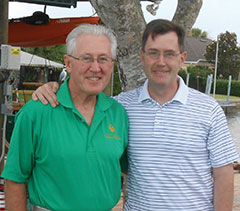
Sounds like dialogue from a feel-good family movie, and it sort of is. This is Brig. Gen. Andrew Armacost whole-heartedly attributing his career path and success to his father Robert. While he may have influenced Andy at the outset of his schooling, Bob says that once he started, Andy didn’t need his help or tag along behind him. Bob boasts about Andy’s academic and professional achievements, describing Andy’s “great work” as an undergraduate at Northwestern University and graduate student at MIT, where he earned a Draper Fellowship, wrote a master’s thesis on railroad optimization and was awarded best dissertation of the year when he graduated with his Ph.D. in O.R. (See Bob and Andy (right) pictured on the left.)
“He didn’t need me at all,” says Bob, “he was very capable and later went to the Air Force Academy and he did it all on his own.”
Andy remembers a slightly different version. “Through my dad I saw his service in uniform and saw him as a professor and operations researcher. He had to segment his career in two halves, and I’ve been fortunate that in 30 years of my active duty, 20 years were at the Academy where I was able to do both – serving my duty and serving my students,” he says.
Andy notes that a discussion between his dad and someone from the Academy created an opportunity that, “I would’ve never known about and never been on that trajectory if it wasn’t for him.”
To which Bob replies, “He paved his own way. I was really pleased when he went to the Academy, and they picked him even though they were full. I knew he had the capability and would impress the heck out of those folks, and he found out he really loved teaching and working with young people. I knew education would be a great career for him. His success in the Air Force and his recognition for his contributions to O.R. education in particular make me very proud.”
Are you beginning to see a pattern here?
Although we may never know who to side with in this family – does Andy owe it all to Bob or did he pave his own way? – one thing they certainly agree on is that the role of INFORMS in each of their careers needs to be acknowledged. Andy says that Bob was an amazing catalyst for him when it came to joining INFORMS (here we go again). Bob told Andy he should be involved in INFORMS, that it would be good for him and he’d meet some nice people.
“Like a good son, I agreed and jumped right in,” Andy says. “The value dad told me I would derive out of INFORMS he spoke so strongly about, but I could never imagine how true his words were.”
Bob joined the Operations Research Society of America (ORSA) in 1969 as a student. He was very active in the society and its successor, INFORMS, over most of his career. He has presented numerous papers at ORSA/TIMS and INFORMS meetings spanning 1970-2006 (attending 35 total conferences in that time). Bob became actively involved in ORSA affairs in 1983 when incoming president Dave Schrady asked him to be part of the Membership Committee and help with a comprehensive survey of the membership to determine the future direction of ORSA. According to Bob, his work on this committee was probably the most significant professional service accomplishment of his career.
Bob remained active on the membership committee through 2000 and was the chair from 1990 to 1996, which was unusual because chair appointments were typically for one year. Bob and the committee proposed several major initiatives such as ORSA Fellows and professional certification, which were both later adopted by INFORMS.
“INFORMS was an important part of my O.R. career and my whole career and professional development,” Bob says. “I have a hard time distinguishing the O.R. field from my connections with ORSA/TIMS.”
Bob and Andy first attended an ORSA/TIMS conference together in 1993 in Chicago, and Bob introduced his son to roughly 40 or 50 INFORMS colleagues, leadership members and staff members. “I felt the power of networking there,” Andy says. “It was my first example of getting to know people and having a chance to benefit from relationships that [Bob] developed and using that as a springboard to make my own.”
Andy’s career has taken many positive twists and turns based on his O.R. background and propensity for leadership having served in the Air Force, as well as his higher education leadership and administration experience (he was dean of faculty at the Academy). On June 1, he will become president of the University of North Dakota (UND). He says he will stay true to his O.R. roots and look for opportunities at UND: How can budget constraints be more efficient? How can they predict how many students will show up on campus? O.R. methods can be put into play and he will continue to have an O.R. mindset as president of UND.
At home, Andy’s wife would politely bow out of conversations involving Andy and Bob and reminded them of their propensity to talk about what’s near and dear to their hearts – O.R. and education. Luckily in his home, Bob can talk shop all he wants because his wife Julia is also an operations researcher. He says, “We spent a lot of time collaborating on research, so it was our normal dinner conversation.”
When they aren’t turning 100% of their conversations into an O.R. or teaching discussion, Andy and Bob can be found in a family band (Andy on bass guitar and Bob on a 12-string) or “having a catch.”
Whether it was hiring Andy as a research assistant while teaching at Marquette University to reprogram some of his doctoral work, or the 75 (!) textbooks he loaned to Andy, one thing’s for certain, Bob has some amazing predictive powers.
The Camms
Jeff and his daughter Allison
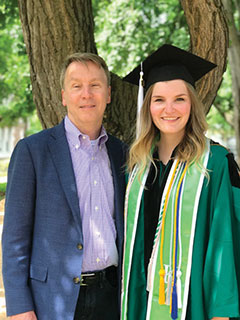
By now I’m sure you’re seeing a pattern in these O.R. families that both parties – parents and children alike – say there was never any pushing or steering the children toward following the parent’s career path. We finally have a family that acknowledges the parental influence. Meet the Camms. (See Jeff and Allison pictured right.)
After spending 31 years at the Linder College of Business at the University of Cincinnati, Jeff Camm is now associate dean of business analytics at Wake Forest University. Jeff holds a B.S. in mathematics from Xavier University and a Ph.D. in management science from Clemson University. His wife Karen also has B.S. in mathematical sciences from Clemson. Their daughter Allison received her Bachelor of Applied Science in May 2019 from Washington University in St. Louis and is now a data scientist at 84.51º in Cincinnati (her home city) where she deals directly with consumer data for the company, which is owned by Kroger.
When Alli was in high school, Jeff remembers trying to get her to take a computer programming class, which he says she strongly resisted. Fast forward to college and Allison decided on her own to major in math – Jeff and Allison agree on this. When Allison told her dad what she had decided, he “was secretly jumping up and down and clapping,” Jeff says.
“I always knew I wanted to study math, but for a long time resisted computer science because I was a girl in STEM and thought coding was for gamers,” says Allison. “The summer after my freshman year in college, my dad said, ‘you can come back to Cincinnati and have your summer job selling snow cones, but if you do we’re both going to take an online course on Python.’ So we took the course on Python. I loved Python and now love coding in general.”
After that summer, Allison decided to minor in computer science and was the teaching assistant for a few computer science classes at WashU as well. She says, “That introduction to coding was what set me down a data science/applied math track, so thanks dad for making me take that course with you.”
Looking back even further, Allison recalls asking her dad to make math problems and practice tests for her when she was a kid. Jeff would comply, but tell Allison that she would have to show all her work. Often times, Jeff remembers, “she would say, ‘I just know that’s what the answer is’ or ‘I did it in my head’ – and she’d be right! But I told her she’d get points taken off if she didn’t show why. She was always very quick mathematically.”
And when Allison was really young, Jeff had her doing long division on the back of menus at restaurants. “We’d race to see who could get to the answer first,” Alli recalls. “We don’t do that quite as often now.” Jeff even brought six-year-old Allison along with him to an INFORMS International Conference in Maui, but she wasn’t giving presentations quite yet.
Although having children of her own is “a long way down the line,” Allison says she would be similarly excited – like Jeff – if she could share her love of science and math and O.R. with a kid one day. “I would say he’s happy that of his three daughters, the youngest one finally decided on a similar career path to his,” she notes.
Now that she’s back in Cincinnati, Allison runs into some folks who know her dad from his 31+ years working in the city. She says she has moments when people ask how her dad’s doing. “I’m happy to talk about my dad when people ask about him, or about his program at Wake Forest, because he does really cool, interesting work,” Allison says. “But I also do really cool, interesting work. I don’t like underselling our relationship or the influence he had on me going into the field. That being said, I also know I have to do good work, and I have to back it up and show that I know what I’m doing – I know what I’m made of.” She’s apparently made of sugar and spice and applied math aptitude.
The Hilliers
Fred and his son Mark (and almost his granddaughter Sarah)
The family who publishes together, sticks together. Isn’t that how the saying goes? Either way, it certainly applies to this particular operations research (O.R.) family. After graduating from Stanford University with a Ph.D. in industrial engineering (IE) with specialization in O.R., Fred Hillier wrote his first textbook with Jerry Lieberman, who happened to be his freshman advisor and the man who’s Intro to O.R. course single-handedly led Fred to the O.R. profession. First published in 1967, the textbook, titled “Introduction to Operations Research,” has been translated into more than 15 other languages. It is the most widely used textbook of its kind and continues to do very well – the 11th edition comes out this month. After Lieberman’s passing nearly 21 years ago, Fred continued the book editions on his own.
“The textbook was so important to the field that I really wanted to focus on it to keep it going with the same high standards,” Fred says. So much so that he took early retirement from Stanford to work on the sixth and subsequent editions. By doing this, Fred has been able to keep it up-to-date and continue introducing new developments into the textbook, which is used in classrooms around the world.
In 1999, soon after the publication of the sixth edition, Fred’s son Mark joined him in the exciting world of textbook writing. Their book, “Introduction to Management Science: A Modeling and Case Studies Approach with Spreadsheets,” has six editions, and soon to be a seventh. The emphasis of this textbook is on modeling and using case studies, with heavy use of spreadsheets.
So how did this father-son duo get here? “My son always had exceptional math ability and interest, and I thought he’d be a great fit for O.R.,” Fred says. “I didn’t know at the outset that we’d become co-authors, that is a bonus.” According to Fred, since he and Mark are both very mathematically inclined, they turn out to be a great team. Fred is the wordsmith and Mark is the spreadsheet guru. Mark agrees that working with his father has “pretty much been great.” He likes working with Fred, except for perhaps when they are nearing a deadline and his phone is constantly coming up “Dad.” They even published a research article together, “which was fun,” according to Mark.
“I always loved math,” Mark notes, “but never fully understood what my dad did.” Fred would tell Mark that he “applied math models to make better decisions.” This job description intrigued Mark, but he wanted to know more about what his father did, which compelled him to take an undergraduate Intro to O.R. course, using none other than the fourth edition of his father’s textbook. Fun side note: Mark was born the year the first edition of the textbook came out, so he literally grew up with the book.
“I fell in love with the subject,” Mark says. “That class threw me into the O.R. field.” For Mark’s senior project, Fred and Jerry Lieberman contracted him to build an O.R. software tutorial, which was updated and used as part of the textbook’s fifth and sixth editions. More recently, Mark has prepared the solutions manual for the 10th and 11th editions.
Mark, like his father, has M.S. and Ph.D. degrees from Stanford. Mark started his Ph.D. in the O.R. department at Stanford (the very department his father helped to create), but says he was somewhat turned off by the overly theoretical aspects of the workload and had even considered dropping out because he was much more interested in applications and industry. Luckily, Fred suggested that Mark switch to the IE department, which includes a very similar subject matter but more applied. (In 2000, these departments and one other were merged into what is now the Department of Management Science and Engineering.) “Advising me to do that rather than give up, and having gone through that, I’m very thankful because I love my career in academia,” Mark says.
Mark is currently an associate professor of quantitative methods at the University of Washington’s Foster School of Business, where he’s been since 1993. “Mark is a wonderful teacher and has won 30 teaching awards, including twice the most prestigious teaching award at the Foster School of Business,” Fred boasts. He is referring to the PACCAR Award for Excellence in Teaching. Because it is voted on by students, Mark says that makes it especially meaningful to him and proves that his students appreciate what he’s offering in the classroom.
“I don’t think I could ever possibly live up to all my father has done in the field,” Mark says. “My forte has been my teaching, and I would love to be appreciated not only as a scholar but as an excellent teacher. And not only teaching, but implementing what I teach, which includes continuing with more editions of our joint textbook. I will certainly keep going as long as [my father] is willing, and may continue on my own beyond that.”
When they’re not hunkering down for a textbook deadline, Fred and Mark can be found traveling the world together. Every year, since 1967, the entire extended Hillier family goes to the Stanford Sierra Camp on Fallen Leaf Lake near Lake Tahoe, which is run for Stanford alumni. The first year they went was when Mark was a baby. More recently, in June 2018, just the two of them took a cruise around Greenland and Iceland in celebration of finishing the sixth edition of their textbook. This was not your average cruise, it was an expedition, where they saw polar bears . . . and just the water between them.
The Hillier family legacy story would not be complete without mention of a few more members: Fred’s wife Ann, Mark’s late wife Christine and their oldest daughter Sarah. “I need to give my wife credit to her time in statistics and O.R.,” Fred says. “She’s been a real help.” On all the earliest editions of the book, Ann would do all the typing and she understood the subject matter given her background, with degrees in statistics and a minor in O.R. According to Fred, she’s still very supportive. Christine created a solutions manual for the first edition of their management science textbook.
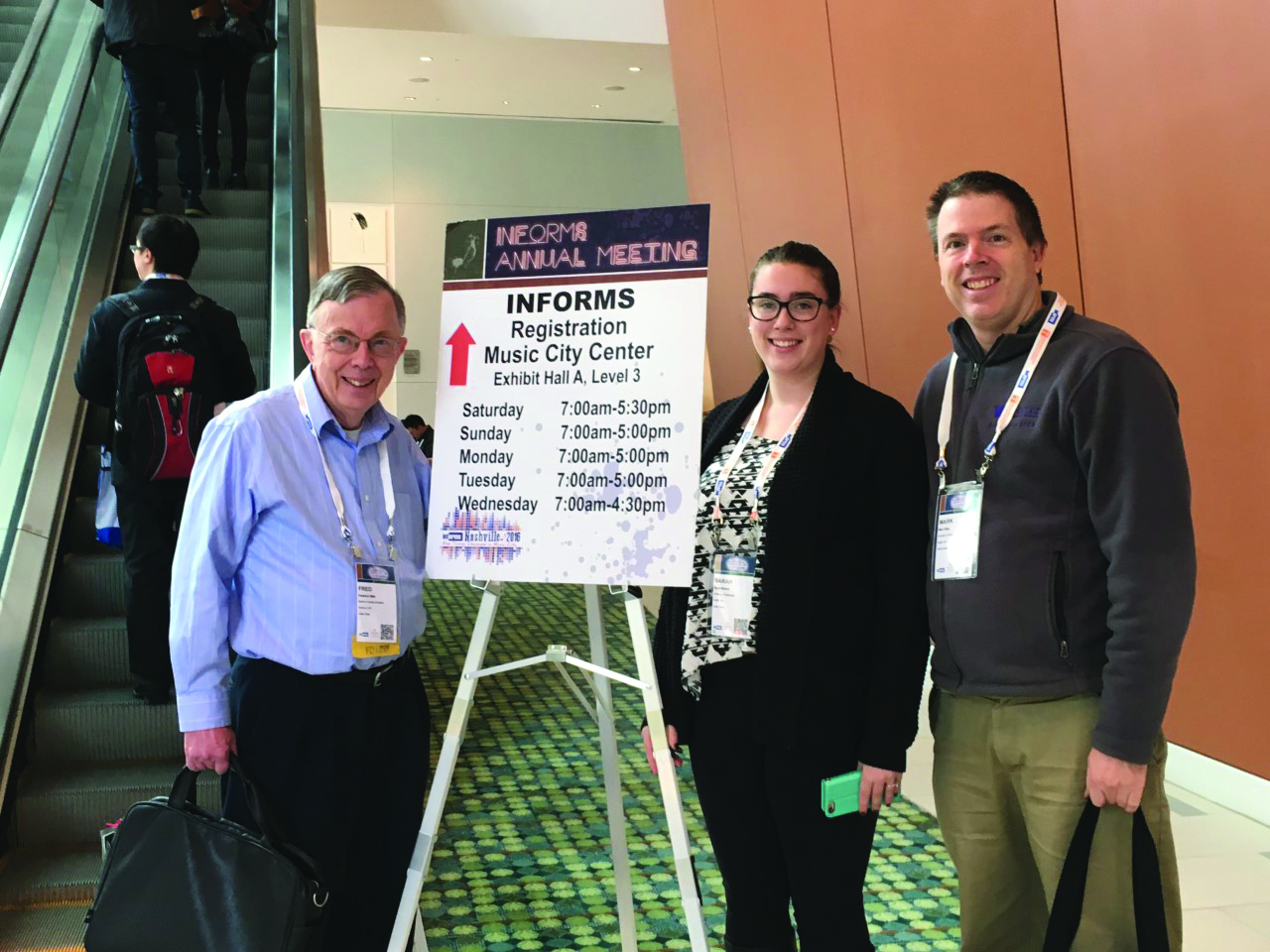
The Hillier’s were this close to getting a third generation into the O.R. legacy. “We had great visions of a textbook Hillier times three,” Mark laughs. His oldest daughter Sarah was top of her class as a math major at Lawrence University, and she started in the Ph.D. program in operations management in Mark’s department at the Foster School. She even attended the 2016 INFORMS Annual Meeting in Nashville as a student member with her dad and grandfather - see Fred, Sarah and Mark pictured above. Sarah stuck with the Ph.D. program for a year before deciding that the research aspect wasn’t for her. She ended up receiving a master’s in teaching and is currently teaching math at the middle school level. Close enough.
