
April 3, 2020 in Forest Sustainability
Forest Plantations in Brazil
The race toward sustainability with the help of operations research.
SHARE: PRINT ARTICLE: https://doi.org/10.1287/orms.2020.02.03
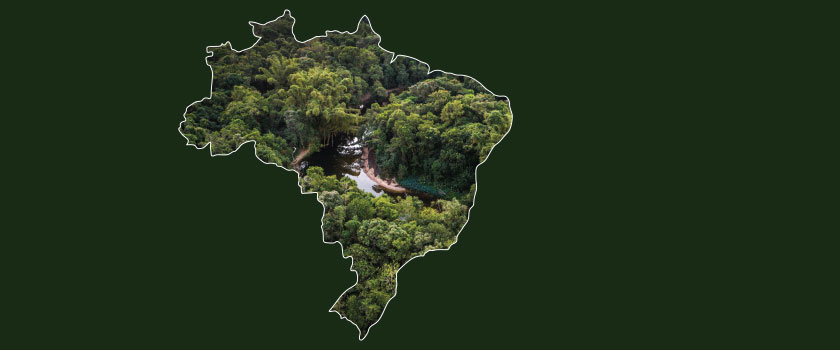
While the Brazilian economy showed a slight growth of 0.11% in GDP in 2018, the industrial forest plantation sector grew 13.1% in 2017 to reach total revenues of $22 billion. The tree-based industry, which includes wood flooring and panels, pulp and paper lumber and charcoal, grew much more compared to the performance of large sectors such as manufacturing and agriculture. In 2018, the forest plantation industry accounted for 1.3% of Brazilian GDP and 6.9% of industrial GDP [1].
With an area of influence spanning approximately a thousand municipalities in 23 Brazilian states, the total area for industrial forest purposes in Brazil was 7.83 million hectares in 2018, which corresponds to 1% of Brazilian territory. Forest plantations play a crucial role in protecting the natural forests – Amazon and Atlantic, which represent 59% of Brazilian land – by preventing them from being cut to supply any timber-based industry.
São Paulo, the wealthiest Brazilian state, has recovered 230,000 hectares of Atlantic Forest in the last 20 years, according to MapBiomas [2], which now accounts for 20% of the São Paulo territory. The other southern states (Mato Grosso do Sul, Paraná, Santa Catarina, Rio Grande do Sul) no longer decrease their forest cover due to environmental protection public policies.
The forest plantation sector is well-suited to strengthen Brazil’s targets according to the Paris Agreement, which aims to reduce greenhouse gas emissions by 43% compared to 2005 values; restore 12 million hectares of forests; encourage integrated crop, livestock and forest production over 5 million hectares; completely halt illegal deforestation, bringing the share of renewable energy up to 45%; and expand consumption of biofuels.
In this context, sustainable production processes of timber have become the norm. South America has continued the expansion of wood pulp production with an increasing number of new pulp mills being built in Brazil, Chile and Uruguay. According to the Food and Agriculture Organization (FAO), these three countries accounted for 15% of global wood pulp production and 33 percent of exports in 2016 [3]. Fiber furnish [4] production has been consistently increasing in Brazil, where fast-growing planted forests give the country a competitive advantage in the manufacturing of wood pulp exports in 2016 [3]. Pulp and paper demand is expected to grow by 2.7% a year, reaching 747 million tons by 2030. Following this trend, the Brazilian pulp industry has increased 5.9% per year over the last 15 years, guaranteeing its position in the international market scenario [5]. According to the Indústria Brasileira de Árvores (IBÁ) [1], by 2022, the sector will invest more than $ 5.7 billion in new plants. Moreover, Suzano – a pulp and paper company – recently announced the construction of a new plant in Mato Grosso do Sul.
Operational Efficiency, Productivity
Planted forest timber of eucalyptus, pine, teak, paricá and acacia has become more expensive. The sector’s inflation was 1.5 times higher than the average Brazilian inflation over the last 20 years. Meanwhile, forest plantations’ productivity stabilized in the 2000s after 30 years of cumulative growth [1]. In 2018, Brazil’s average productivity for eucalyptus plantations was 36 cubic meters per hectare per year, while for pine, the number was 30.1 million cubic meters.
Since the 1970s, the Brazilian pulp industry has invested in the quality of its plantations, including investments in technology such as photosynthetic capacity and higher wood density. In 2018, sector companies invested $6.6 million on forest research. One of the remarkable results of these efforts is the availability of a variety of suitable genetic materials for plantations. Genetic variability may now contribute to further productivity growth [6, 7, 8].
In this scenario, forest managers want to maximize their profits by looking for operational efficiency and more productive and adapted genetic materials [9]. Meanwhile, industry managers want to receive a regular and suitable mix of raw material to maximize their productivity [10]. Both sides must operate under strong environmental constraints, reinforced by Brazilian Forest Law, which brings a third group of stakeholders into this controversial scenario.
Furthermore, the required optimization process triggered a series of mergers among the major industrial forest plantation companies to take advantage of logistics synergies. During the last two years alone, Suzano merged with Fibria, Bahia Specialty Cellulose (BSC) merged with Lwarcel, and Ahlstrom-Munksjö merged with MD Papéis. While creating better logistics scenarios, the mergers also brought other operational challenges to optimize, such as transportation costs, forest equipment transportation, technical team’s allocation and revisions to the supply chain, including seedlings and fertilizers. It should be noted that the forest plantation industry is vertical; the owners of the plants also own 70% of the land used to produce the raw material. Therefore, in this scenario, when industry companies merge, forest management merge.
History of O.R. in Forest Plantation Sector
Behind the scenes of the race toward forest sustainability and efficiency, hundreds of engineers and consultants are dealing with massive databases, complex optimization models and information systems to support forest operations and management decisions. When we founded our first forest consulting company, Athena, in 1999, we aimed to work on optimized forest planning. We wanted to apply O.R. to create profit-optimized, long-term plans to determine where, when and how a harvest operation should happen every year. At the time, we had three initiatives:
- Inside Aracruz (now owned by Suzano), the first pulp company created in Brazil, which started during a partnership with the University of Chile led by an Aracruz employee.
- Led by Professor Miguel Taube Netto from UNICAMP (University of Campinas), a software named PlanFlor was deployed in an old pulp company named Florin (now owned by Suzano) in São Paulo. Later, PlanFlor was implemented in two or three companies.
- Led by Professor Luiz Carlos Estraviz Rodriguez from the University of São Paulo, the working group GT-Plan was created to train forest engineers on the use of linear programming applied to forest management. Ripasa, Champion, Acesita, Flodenberg, CAF (they have other names today) and other companies sent their engineers to the training sessions that started in 1985. Professor Estraviz developed software to support the training activities. The software, named Gerador, was developed using the old Fortran language.
Along with myself, the founders of Athena included Professor Estraviz and Mauro Assis, a computer programmer. Our first client was Copener (now BSC) in the Bahia northeastern state. In the first year of operation, we realized that it was impossible to have any planning system because we had no structured data to use. We then started an adventure of organizing forest databases. We went to every Brazilian state and almost all forest companies dealing with maps, stand data, inventory data, operational data and much more. The ideas and concepts on how to organize a forest database were uncontrolled spread. There was no way back.
In 2005, it became possible to develop a planning module to compose our set of data-driven modules. That was the start of a new era: having appropriate data to plan forest management. Our first important project on optimized planning was in Suzano. In that same year, we made an agreement with Remsoft, a Canadian group, to discontinue our recent-born planning module and integrated our data-driven modules to Woodstock, the Remsoft module, to address long-term forest planning.
In subsequent years, we sold Athena to Savcor, a Finnish group, who kept going with the responsibility of organizing companies’ data. They took the technology to Europe. Brazilian competitors such as Inflor, Kersys and Brisa had matured, contributing to the cause. Now structured SQL databases occupy every single forest company in Brazil, from small to very large ones. Later, the Finnish group sold the company to an American firm, Trimble. Today, many other companies are working across Brazil offering systems designed to serve forest management planning teams.
Other companies have developed forest management decision support systems, both simplistic and complicated, local and foreign, so we have several good options. Among them is Optimber, developed by Professor Júlio Eduardo Arce from Paraná State; and Romero, developed by our team and designed to support forest investment decisions.
Finally, our forest O.R. teams are free! We can do what we were born to do: math modeling. It is now possible to take an active part in the race toward sustainability and efficiency described earlier.
O.R. Models, Methods Applied to Forest Plantation Sector
Models and methods to address the forest plantation sector in Brazil, which is 100% private land-owned, have their first group of constraints settled in environmental issues. The Brazilian framework of laws that control environmental licenses, land use and forest management is intricate and has significantly improved over the last two decades. These laws regulate the way landowners use their land. They explicitly establish the amount of land a rural property should preserve for environmental purposes or to maintain untouched. That untouched area serves to protects soils and water streams; in Brazil, it’s called APPs – permanent preservation areas. Reserved areas must keep a constant stock of wood and forest cover, called RLs (legal reserves).
Basically, forest management in Brazil is undertaken either by a group of workers in a private company or by a federal or state team of public officials. The importance of the legal framework becomes clear when Brazilian forest managers consider spatial context and scale dimensions. For example, the spatiality of forest operations in public or private property is intrinsically constrained by law. Side banks of rivers, water springs and hilltops must be excluded from production purposes in the property as protected areas (APPs).
Depending on the geographical location of the property, native forests must be maintained as RLs in 80% (Amazon region) or 20% (other Brazilian regions) of the property area. Clear-cutting is not allowed in legal reserves, and in these areas, a long-term forest management plan is always required to implement harvest or plantation operations. Conventional crops; perennial cultivation of coffee, rubber trees and fruit trees; forest plantations such as eucalyptus, pine, teak, paricá and acacia; and other similar activities are constrained to the remaining area.
As a result, private forests are cultivated in patches neighboring APPs and RLs, which means neighborhood interrelations should be considered when these planted forests are spatially distributed in the property. Considering Brazilian regulations, the most critical environmental concerns guide the decisions before the model as previous constraints; they are not even considered as alternatives.
Strategic Planning Modeling
The most common model type used in Brazilian forestry today, a strategic planning model, is a harvest-scheduling, long-term model with no neighborhood interrelations. It deals with multiple objectives and usually involves a group of decision-makers with different backgrounds. The planning horizon is no more than 21 years for eucalyptus plantations and 50 years for pine, teak, paricá and acacia.
No matter the solver used, nor the IT system to build the matrix and interpret results, strategic planning models always consider multiple alternatives of forest management for each management land unit. The land unit is a stand, or a group of stands, represented by polygons in a map. In Brazil, the average area of a forest stand is 20 hectares (about 50 acres), with smaller stands in the southern regions and larger stands in the northern ones. Those alternatives are related to cutting ages and silvicultural activities applicable to the region and to the tree species that are considered for planting. Each management alternative has, over the years, its costs, productivities from several products, and environmental impacts that can be expressed in numbers of any indicator.
Constraints of these models usually involve logistics, industrial capacities and quality demands; forest equipment capacities; and social demands and local environmental concerns related to watershed preservation. The objective function is frequently the net present value (NPV) of the project. However, when using goal programming techniques, these models consider other objectives such as investments, environmental impacts, industrial production, operational efficiency and forest sustainability.
Linear programming and mixed-integer programming methods are usually used to solve these problems. When the problems include many logistics variables, we have used heuristics to solve them. Those models and methods embedded in “forest management & decision support systems” (FMDSS) are operated by forest engineers prepared by universities from Brazil and abroad. Thirty-five years after the introduction of O.R. concepts applied to forest management, the forest industry sector can count on a good group of engineers prepared to operate any FMDSS.
To complete the description of behind-the-scenes O.R. work in the Brazilian forestry sector, we should recognize how computers and solvers have become more potent over the last few years. Given that our models usually deal with millions of variables and millions of constraints, the advancement in computing power has been crucial. During the past three months, I have personally been involved with a model that has almost 7 million variables. After a matrix generation of 19 minutes, the solver took only six minutes to solve it. Unquestionably, information technology has been fighting on our side. Otherwise, it would not be possible to support the decisions our sector is involved in.
Brazilian forest O.R. teams – planning departments and consulting companies supported by FMDSS and forest databases – are behind the scenes calculating the impacts of mergers, industrial expansions, cost cuts, environmental impacts of forest operations, tree species and genetic material allocations, raw material supply, returns on investments and more.
Of course, there is room for improvement. We must continuously add many features to our models and methods. We must apply stochastic programming to address risk and uncertainties; multicriteria to solve conflicts among different groups of stakeholders and support group decision-making, participatory planning; and much more.
The coming years will bring additional challenges. We will be there prepared to support decision-makers from the Brazilian industrial forest plantation sector.
References and Notes
- IBÁ - Instituto Brasileiro de Árvores, 2019, Relatório 2019, Livro, 80.
- MapBiomas: Collection four of the “Annual Series of Coverage and Land Use Maps of Brazil,” https://mapbiomas.org/en.
- FAO, 2017, “Global Forest Products - Facts and Figures,” https://doi.org/I7034EN/1/12.17.
- In FAO’s forest products statistics, the fiber used to manufacture paper and paperboard is referred to as “fiber furnish.” This includes recovered paper (wastepaper), other fiber pulp and the wood pulp used to make paper.
- IBÁ, 2017, Relatório 2017, Indústria Brasileira de Árvores, https://doi.org/10.1017/CBO9781107415324.004.
- Ferreira, C., Fantini, M., Oliveira, R., Colodette, J. and Gomide, J. L., 2018, “Critérios de Seleção de Clones para maximizar rendimento e qualidade da cellulose,” Any, 1-14.
- Gomide, J. L., Colodette, J. L., Oliveira, R. C. de and Silva, C. M., 2006, “Caracterização tecnológica, para produção de celulose, da nova geração de clones de Eucalyptus do Brasil,” Revista Árvore, Vol. 29, No. 1, pp. 129–137, https://doi.org/10.1590/s0100-67622005000100014.
- Queiroz, S. C. S., Gomide, J. L., Colodette, J. L. and Oliveira, R. C. de, 2004, “Influência da densidade básica da madeira na qualidade da polpa kraft de clones hibrídos de Eucalyptus grandis,” Revisita Arvore, Vol. 28, No. 6, pp. 901-909, https://doi.org/10.1590/S0100-67622004000600016.
- Gomide, J. L., Fantuzzi Neto, H. and Regazzi, A. J., 2010, “Análise de critérios de qualidade da madeira de eucalipto para produção de celulose kraft,” Revista Árvore, Vol. 34, No. 2, pp. 339-344, https://doi.org/10.1590/s0100-67622010000200017.
- Mokfienski, A., Colodette, J. L., Gomide, J. L. and Carvalho, A. M. M. L., 2008, “Relative Importance of Wood Density and Carbohydrate Content on Pulping,” Ciência Florestal, Vol. 18, No. 3, pp. 401-413.
This article appears in INFORMS Analytics Collections Vol. 9: Feeding the World through Analytics.
Visit this collection for free access to more articles showcasing how the field of agribusiness is making rapid advancements using analytics.
Silvana Nobre is CEO of Atrium Forest Consulting, which provides consulting and management services and optimized forest planning, as well as IT solutions, decision-support systems and analysis of public policies for the forestry sector. Nobre holds Ph.D. and MBA degrees in forest management from Polytechnic University of Madrid, Spain, and Federal University of Lavras, Brazil, respectively.