


April 3, 2020 in International Retailing
International Seller Beware: The Perils of Global Retailing
Why does international expansion present such a challenge for even the largest of retailers?
SHARE: PRINT ARTICLE: https://doi.org/10.1287/orms.2020.02.07

International products fill the shelves of the stores where we shop. In the United States, we see Heineken beer from the Netherlands, Samsung electronics from Korea and Ferragamo shoes from Italy. When Americans travel, they see Budweiser beer, Android phones and Nike shoes on shelves abroad. Manufacturers seem to be able to expand rapidly to overseas markets.
While retailers have had some success in international expansion, there have also been many high-profile failures. In 2009, the French retailer Carrefour entered and departed from the Russian market within four months. In 2006, Walmart withdrew from both Germany and South Korea. In 2015, Target wrote off $5.4 billion to discontinue its Canadian venture, closing all 133 stores and terminating 17,600 workers. These are not isolated incidents. Multinational retailers all have a hard time increasing their global footprint. Not a single one of them is established in all five of the world’s largest markets.
I came to the U.S. from Turkey in 2012. As I experienced my own cultural assimilation, I began to think about why international expansion is such a challenge for retailers. I set out to study this problem by creating a data set that includes several major categories of retail, tracking successful and unsuccessful expansion attempts. In this research, I seek to explain why multinational retailers have difficulty establishing themselves in foreign markets.
International expansion is clearly a priority for retailers. In the data set I collected to study this issue, two-thirds of the retailers (Exhibit 1) started their internationalization at least 25 years ago. The multinational retailers in my study also have been willing to cast a wide net, entering many countries and not necessarily the “obvious” ones. Only 11.6% of these retailers entered fewer than five foreign markets over the last 15 years, and many entered 20 or more. They did not simply engage with the most populous countries; the countries with the largest total number of entries were Poland, Hungary, Bulgaria, Czech Republic and Romania.
In the 1990s and early 2000s, retailers tried to be present in as many markets as possible. More recently, a changing retail landscape has made retailers become more selective, according to Planet Retail, a leading provider of global retail intelligence. Tightening government restrictions and fluctuations in the economic standing of host countries create challenges for the successful expansion of retailers. However, even absent these obvious negative shifts, my research suggests we would still see market exits. So, what is behind such surprising departures as Target’s exit from Canada after such a brief time?
The Data Set
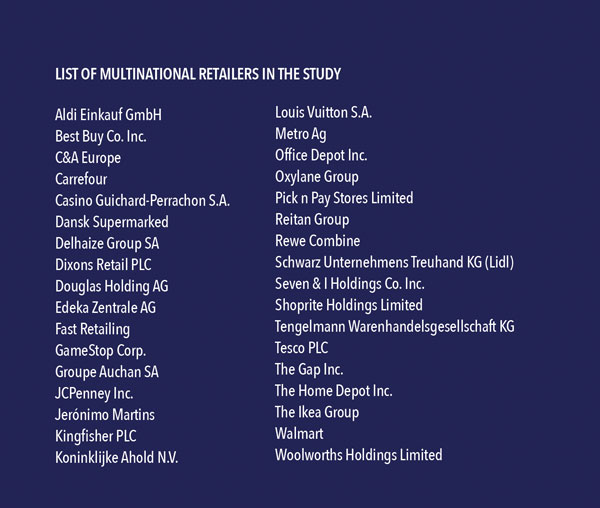
There wasn’t an existing data set to study retail longevity that spanned retail categories such as grocery, fashion, electronics, etc., so I created one. I started with a list of top retailers from Deloitte. I eliminated those that only operate online or only in their home country. Finally, I identified retailers that had exited a host country in the period of my study, 1996-2013. For those 34 multinational retailers, I scoured the business press, case studies and company websites for evidence of their internationalization experiences.
I compiled 224 cases, each a multinational retailer’s foray into a host country. The cases are split into two categories: 1) retailer’s exiting from the host country between 1996 and 2013 (48 cases); and 2) retailers still operating in the host country in 2013 (176 cases). Thus, my data set focuses on retailers who have made at least one exit and includes both “exit” and “stay” cases for those retailers. The key variable in the study is longevity, defined as the duration of stay in the host market measured in months.
Each case includes variables related to a retailer’s international expansion (e.g., total number of host countries, years after first internationalization, new market entries in the last 15 years, and market share growth at home) and measures related to a given host country (e.g., a retailer’s market share growth, its total number of stores, average market share of its top five retailers, and external pressures from its political, regulatory and economic environment). With this data, we can compare what makes for a longer vs. a shorter stay in a host country.
Modeling
For the empirical analysis, I employed the Cox proportional hazard model [1, 2], because it has the capacity to simultaneously examine both the event (exit or stay) and duration (longevity). The model handles censoring of survival times and does not require the researcher to know the underlying distribution of the survival function for estimation. It assumes that each covariate has a multiplicative effect in the hazard function that is constant over time.
In my study, the hazard is market exit. If the hazard ratio of an independent variable is close to 1, then that variable does not affect longevity. If the hazard ratio is less than 1, then the variable increases longevity. Lastly, if the hazard ratio is greater than one, then the variable decreases longevity.
Results of Analysis
The analysis reveals some strong patterns in what predicts retailer longevity in a foreign market. The predictive factors include several characteristics of the multinational retailers themselves, such as their experience in internationalization activities. Some of the results are surprising.
Scope of international operations: For every additional country in which a multinational retailer operates, we see greater longevity of their presence in new countries. For every additional country in which the multinational retailer operates, longevity is 9.2% (p < .001) higher. One interpretation is that companies that do a lot of expansion improve their ability to do it. Of course, we can’t rule out the interpretation that companies that are good at expansion do more of it, because we can’t randomly assign scope of operations to a retailer and watch what happens! In any case, the scope of the international operations is a significant predictor of longevity in new markets.
Years of international experience: In contrast to the scope of international operations, the length of a retailer’s international experience is inversely related to longevity. Each one-year increase in the multinational retailer’s internationalization experience is associated with a 1.8% decrease in its longevity (p < .05). Perhaps this seems counterintuitive. If the scope of activity (number of countries) predicts longevity, we might also expect that duration of activity (length of experience) positively predicts longevity. Instead, we see the opposite.
Experience can work both ways. In this case, the pattern suggests that multinational retailers with greater international experience are better positioned to assess the future of a particular venture more realistically and prevent further losses with a swift exit. Such retailers might be better equipped to focus on a better opportunity elsewhere. For instance, in 2014, video game retailer GameStop closed all of its stores in Spain after spending nine years there. International Executive VP Mike Mauler announced a plan to redeploy its resources in other markets with greater potential for return.
Pace of international expansion: Multiple haphazard market entries within a short time can adversely impact retailer longevity. For instance, Walmart entered South Korea and Germany almost simultaneously. This was ambitious considering its entry into China just a few years prior and the remarkably different markets in South Korea and Germany. Competing with established discounters like South Korean E-mart and German Aldi proved difficult. Eventually, significant losses discouraged shareholders, and Walmart exited both countries in 2006. Leading retailers, such as Carrefour, Ahold and Casino have suffered similar fates many times.
Best Buy started its international expansion in the early 2000s and entered China in 2006. Only three years later, without having achieved promising market share there, it entered Belgium, Spain, the United Kingdom, Ireland and Turkey, all of which it subsequently left in less than five years. Limited international experience coupled with aggressive expansion prevented Best Buy from establishing itself in overseas markets and forced the giant retailer to refocus on its home market due to substantial financial loss.
Overall, I find that the pace of international expansion is negatively related to longevity. Every additional country entered in the last 15 years is associated with shorter longevity of 9.5% (p < .01).
Market share growth at home: For every 1% increase in market share growth at home, we see a greater retailer longevity of 4.8%. As home markets are still key in retailing, multinational retailers are well advised not to invest in internationalization at the expense of a strong focus at home. When growth prospects are promising at home, retailers become better equipped to provide the financial resources necessary for international expansion.
In 2016, the Finnish retailer Kesko sold its grocery business in Russia to Lenta, the country’s largest hypermarket chain, for 158 million euros. Mikko Helander, the CEO of Kesko, said in a press release that the retailer will concentrate on its home market because growing in Russia would have required significant investments. Similarly, Belgian supermarket chain Delhaize sold 39 supermarkets in Bosnia and 54 in Bulgaria in 2014, after only three years of operation, in order to focus on the company’s core business.
Market share growth in the host country: My study strongly supports the need for managers to immediately build a strong presence in their foreign markets in order to generate market share growth and sustain investments in the long run. For every 1% increase in market share growth in the host country, multinational retailer longevity increases by 3.5% (p < .001).
The process of building a profitable store network takes considerable time and requires large investments that might not pay off for decades. As a representative case, Walmart spent 15 years to break even in China, illustrating the need for a considerable war chest to support foreign ventures. However, some multinational retailers prefer to enter a foreign market incrementally, expanding only if they become successful. Such retailers do not open enough stores to achieve a high market share but follow “wait and see” or “trial and error” strategies borne out of fear of over-investment and high sunken costs in the event of failure. In total, every additional store in the host country increases retailer longevity by 0.2% (p < .1).
 Retailer type: Retailer type affects the extent of retailer dependence on local supply chains and regulations in the host country, as well as the ease of market entry and exit [3, 4]. I examined both grocery and non-grocery retailers (e.g., fashion, home improvement, electronics) and found that grocery retailers have shorter longevity in foreign markets.
The case of grocery retailers highlights some of the challenges of international expansion. It is more difficult to penetrate a host market for a grocery retailer due to the greater needs for localization, lower margins, large volume of products with complex logistic requirements and high real estate costs. Non-grocery retailers are less dependent on local supply chains.
Conclusion
As Burt et al. [5] explain, “Models of internationalization focusing on growth patterns and development alone are inadequate. At the moment, retail internationalization theory would seem to be covering only one part of the internationalization story.” Managers of multinational retailers should be curious to see the whole picture.
Even market research, though, is not a cure-all for the challenges of internationalization. For example, the chief information officer of Best Buy announced that the firm conducted a massive amount of market research for two years before its entry into Turkey. The retailer left the market after only 14 months.
While market exit can seem like a safe option to halt high tangible costs, the intangible costs can be devastating due to reputation loss. Unfortunately, many multinational retailers tend to refrain from making market exit data publicly available due to their concerns over reputation and a desire for confidentiality of their experiences, as well as competitive reasons. I surmise that even within a firm, the transfer of knowledge gained from market exit experiences is limited; departure of top management teams soon after a market exit incident makes it difficult to evaluate what went wrong in retrospect.
Several markets abandoned by multinational retailers over the past decades have become attractive once again, with some retailers reentering. For instance, Taco Bell reentered the United Kingdom after Mexican food increased in popularity. Dunkin’ Donuts returned to Russia after 11 years in response to Starbucks’ recent success there. Lastly, Ikea reentered Japan after 20 years, learning from its past mistakes and conducting extensive marketing research. Because reentry is an option, I encourage the managers of multinational retailers to carefully analyze their market exit experiences.
Finally, I note that some of the potentially “easy” explanations such as environmental factors (the negative impacts due to political, regulatory or economic conditions) in a host country were not strong enough to be statistically significant in my study, although there are certainly cases in the data where these external forces are important (like Louis Vuitton leaving Argentina in 2012 or Auchan and Carrefour leaving India in 2014). The good news is that according to my study, business essentials like managerial experience and wise decision-making exemplified by cautious international expansion have stronger associations with longevity than do these uncontrollable externalities.
References
- Cox, David Roxbee, 1972, “Regression models and life-tables (with discussion),” Journal of The Royal Statistical Society, Vol. B34, pp. 187-220.
- Cox, David Roxbee and David Oakes, 1984, “Analysis of survival data, Vol. 21,” CRC Press.
- Streed, Odile and Gérard Cliquet, 2013, “International Market Expansion of Retail Networks: Determinants of Market Entry Failures,” in “Network Governance,” Springer, pp. 87-106.
- Swoboda, Bernhard, Stefan Elsner and Dirk Morschett, 2014, “Preferences and performance of international strategies in retail sectors: An empirical study,” Long Range Planning, Vol. 47, No. 6, pp. 319-336.
- Burt, Steve L., Kamel Mellahi, T. P. Jackson and Leigh Sparks, 2002, “Retail internationalization and retail failure: Issues from the case of Marks and Spencer,” The International Review of Retail, Distribution and Consumer Research, Vol. 12, No. 2, pp. 191-219.
Ozlem Tuba Koc is an instructor at the University of Colorado Boulder. She earned a doctoral degree in marketing, with a specialization in international business, from Georgia State University.
([email protected])