April 6, 2020 in Elderly Long-Term Care
Transforming long-term care for elders in Taiwan
Leveraging supply chain information, AI and blockchain technology, Asia University team aims to improve financing, business performance, service quality and customer satisfaction.
SHARE: PRINT ARTICLE: https://doi.org/10.1287/orms.2020.02.14

The world population is rapidly aging. According to the United Nations, in 2014, seniors (ages 65 and over) made up 25.8%, 21.1% and 21% of the populations of Japan, Italy and Germany, respectively. By 2030, those percentages are projected to increase to 32.2%, 27.9% and 25.5%. In total, there were 962 million people over age 60 in 2017, consisting of 13% of the world population, and the number will increase sharply to 2.1 billion by 2050 [1, 2].
The situation is more stringent in Taiwan, where 7.1% of the population were over 65 in 1993, 14% in 2018 and projected to be more than 20% by 2026. Taiwan will transition from an aged society to a super-aged society in only six years, making it one of the fastest-aging nations in the world [3]. The rapid aging of society will create enormous challenges for supply chain, financial optimization and pressing social concerns for both Taiwan and the world to sustainably support elder care and living.
Elderly people have special needs regarding food, supplements, shopping, transportation, entertainment, medical and healthcare, security, financial management, etc. It is therefore paramount to apply operations research and analytics to optimize limited manpower, resources, service quality and financial management to better serve the elderly and alleviate the social impacts of an aging populace. Stakeholders include care receivers and their families, care institutions and personnel, product producers, commerce catered to seniors, social welfare institutions and governments. These stakeholders constitute a gigantic and intricate ecosystem that entails many small, medium and micro enterprises (SMEs). These unprecedented societal transitions present great challenges and tremendous business opportunities.
Currently, long-term care establishments are mostly SMEs and social enterprises with limited IT support. They are generally small in capital and tend to lack verified financial statements or reliable credit-related records that loan-issuing banks require. Therefore, cash flow and financing, as well as digital transformation, remain major hurdles for sustainable development in the elder care industry.
Although the finance industry has vocally entered the financial management and insurance of the elderly, they mainly target affluent elites. However, recent innovations in FinTech and supply chain finance have the potential to revolutionize financial services in the silver economy [4]. A smart digital platform that collects, processes and analyzes information related to the silver economy, accumulates trusted and secure credit history, and provides low-cost digital capabilities can help optimize the operations of the care ecosystem, reducing risk for care institutions, and most importantly, better serving the needs of the elderly and their families.
With support from the Ministry of Science and Technology of Taiwan, an Asia University research team led by university VP Grace Lin has been exploring stochastic credit rating models, leveraging supply chain information and AI and blockchain technology since 2016. The team is launching a startup called United Financial Intelligence (UFI) to help SMEs build up credit profiles to lower financing obstacles by integrating innovative business models and emerging technologies to achieve the goal of inclusive financing. UFI’s mission is to assist SMEs with digital transformations to improve business performance, service quality and customer satisfaction.
To create a robust supply chain information-sharing platform, UFI adopted a highly flexible and scalable API management and blockchain-based ecosystem platform as a service (PaaS) by Fusion$360 [5]. The team built a highly flexible, omnichannel platform for managing supply chain information, transactions, supply-demand matching, risk control and financial services. UFI intends to start with the long-term care industry, which presents a market of trillions of dollars in the wake of the global aging trend. The Government of Taiwan amended the Long-Term Care Service Act on June 19, 2019 to greatly encourage private sector investment in long-term care. The total grant-making for Long-Term Care 2.0 will increase to NTD $40 billion annually starting in 2020 [6, 7]. In view of this ongoing trend, a great number of long-term care facilities have begun their expansions. Enormous business opportunities bring along the need for vast amounts of capital and creates demand and opportunity for UFI to enter the blockchain-based supply chain finance market as a common service platform for the silver economy (see Figure 1).
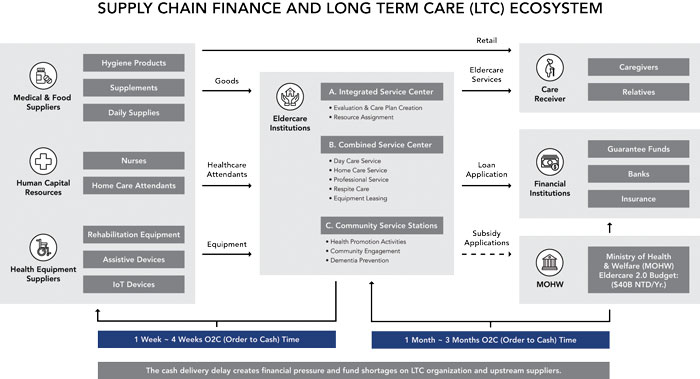
Duo-FinTech Technologies
Recent cases of disruptive supply chain finance, such as Alibaba’s Ant Financial [8, 9], find their niche by analyzing online transactions and social and behavioral data in their e-commerce platform to uncover the creditworthiness of SMEs. Credit data is updated in real time, so loans can be approved in minutes rather than weeks. Unfortunately, most companies are still reluctant to share their operational information with financial organizations due to privacy and security concerns, as well as limitations to information availability. Conventional financial institutions still face challenges such as lack of transparency, inability to validate transactions, and high costs to authenticate credit-related information for SMEs.
To tackle these issues, UFI leverages blockchain’s characteristic in inalterability to ensure supply chain traceability and enhance lenders confidence as the first step in realizing supply chain finance. UFI’s blockchain-based platform enables clients to manage their operations and exchange information securely without a dedicated IT team. Traceable data can be automatically issued or imported directly with digital signatures by the issuers. The information owner has full control to decide when, how and with whom to share information, and the ability to retract sharing at will. Secondly, UFI creates a “united credit rating” by extending the traditional, financial data-based credit rating to include trusted operational data and supply chain partners’ information. Credit profiles for each stakeholder are accumulated to support risk management. Continual analytics and artificial intelligence (AI) are used to determine the robustness of the united credit rating, and to monitor patterns of healthy operations and detect abnormalities.
Cross examination of multidimensional, credit-related information gathered over time, together with blockchain’s properties of immutability, greatly enhance anticounterfeiting and credit rating reliability (see Figure 2).
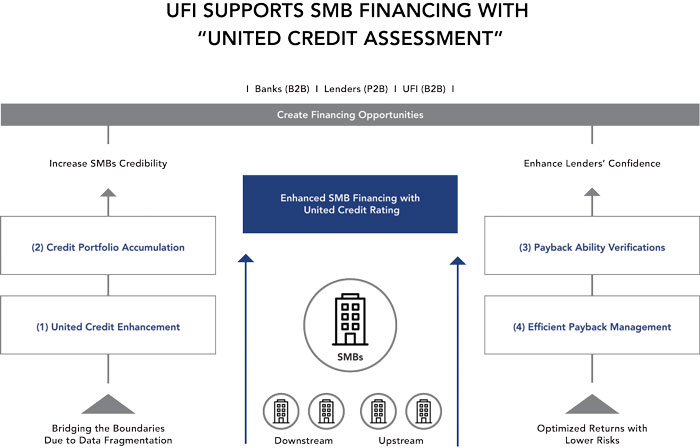
Fusing Financial and Homecare Services
Since most long-term care establishments (LTCs) are SMEs, it is exceedingly challenging, if not impossible, for individual institutions to build their own advanced solutions to optimize operations and build up credit. After interviewing about 200 LTCs, UFI has pinpointed critical information for a united credit rating, as well as pain points that LTCs face in their digital transformation. UFI aims to resolve these pain points by supporting eldercare institutions in five areas: financing enablement, insurance selection, homecare management, resource management and online to offline (O2O) commerce. UFI also helps bridge digital gaps by providing a platform for regional consolidation and mobile services. All five areas involve operational and financial data that can enrich a united credit profile, strengthen risk assessment, and meet the development needs of the care ecosystem. Figure 3 provides an overview of the five major financing and operational services.
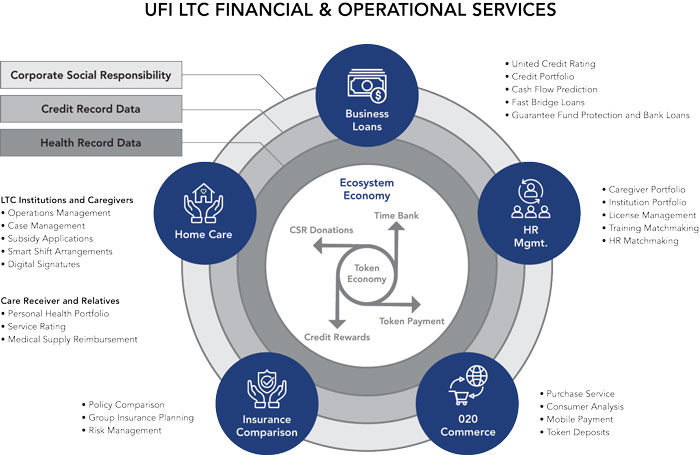
Let’s take a closer look at the five service areas:
- Lending service (business loans): A hybrid B2B (business-to-business) and P2B (peer-to-business) lending model was designed to relieve SMEs from financial distress. To eliminate financial risk caused by insufficient information in the long-term care industry, UFI focuses on accounts receivable financing in the early phase. By submitting supplemental funding declarations (accounts receivable documentation) for approval, long-term care institutions will be able to secure initial funding. By gradually incorporating the other four services below with financial information to establish a reliable united credit rating and credit profile, UFI will help SMEs acquire funding from banks to expand their business. For enterprises that have favorable united credit ratings, but are unable to secure conventional bank funding, UFI plans to offer funding through P2B loans. By augmenting bank finance with united credit backed B2B and P2B lending, UFI infuses more flexible funding models into the supply chain finance.
- Insurance selection: Certain insurance policies are federally mandated in long-term care. UFI’s digital insurance services enable SMEs to upload insurance information online to ensure compliance, including property insurance for office and vehicles, business liability insurance for elderly transportation services, and accident insurance for field and home care personnel. It helps compare premiums and values of current insurance policies and offers recommendations for collective bargaining. This insurance service helps collect operational information regarding property, personnel and customers to enrich UFI’s united credit rating and mitigate financial risk.
- Human capital service: The care industry is highly dependent on human resources. UFI offers intelligent LTC human capital and training course matching services. It also helps caregivers and institutions manage personnel profiles and licenses. A time bank and token economy jointly developed with Fusion$360 were incorporated to encourage volunteer participation and solicit corporate social responsibility donations to help economically disadvantaged elders.
- Home care service management: A mobile service management platform supports the management, communications and coordination among care institutions, caregivers and care receivers. It offers LTCs and caregivers operations management dashboards, a mobile check-in service and digital signature validation, case management, subsidy applications and smart shift arrangements. It provides care receivers and their families with care records, health records, feedback forms, etc. This tool will greatly enhance service quality and management effectiveness. Information gathered here would also be of great value to the united credit rating.
- O2O home delivery e-commerce: Long-term care service is usually accompanied by demand for medical equipment, assistive devices, medical supplies and supplements. UFI, supported by Fusion$360, creates a blockchain-based O2O platform for online and offline ordering and delivery. It provides service and purchasing dashboards and analytics for service optimization and credit portfolio enrichment.
Future Prospects after Successful Pilots
Before 2018, all long-term care establishments in Taiwan were nonprofit organizations. Mostly small operations with limited collateral, they often struggled to obtain loans from financial institutions. During the UFI LTC supply chain financing trial run period in 2019, UFI applied its innovative united credit rating system and credit profiling methodology to help secure loan approval and credit guarantees for repayment [10] from the Small & Medium Enterprise Credit Guarantee Fund of Taiwan (Taiwan SMEG) for two long-term care institutions at different scales: DadaZen and the Show Elder [11, 12] (Figures 4 and 5). The successful matches have provided both institutions with funding for daily operations, additional rehabilitation and fitness equipment, and business expansion.


In summary, UFI leverages AI and blockchain technologies to create united credit ratings and credit profiles to support financing and insurance needs of SMEs. Intelligent scheduling and resource matching between care givers and receivers across establishments and regions, and personal health record buildup and alerts are being developed to create digital support for the eldercare ecosystem. UFI is the first to introduce blockchain token economics to support cash flow, process digitization, reliable bookkeeping, hybrid supply chain finance and crowd funding, as well as corporate social responsibility and time banks for volunteer service in the long-term care industry. UFI has launched several successful supply chain financing and service pilots for eldercare providers. Eventually, care receivers’ market opportunities will extend to the economic circles of their families. In order to fulfill the vision of a reciprocal and sharing ecology in the industry, UFI will continue to leverage the Taiwan government’s Long-Term Care 2.0 and collaborate with global partners and corporate social responsibility resources to achieve inclusive finance for an aging population.
References
- “World Population Aging,” 2017, United Nations, New York.
- Emily Brandon, 2014, “10 Rapidly Aging Countries,” US News, June 16, https://money.usnews.com/money/retirement/slideshows/10-rapidly-aging-countries?.
- “Population Projections for the Taiwan: 2018~2065,” August 2018, National Development Council, R.O.C. (Taiwan).
- “McKinsey on Payments - Supply-chain finance: The emergence of a new competitive landscape,” Vol. 8, No. 22, Oct. 2015, McKinsey.
- Fusion$360, a Fintech company in Taiwan, www.fusions360.com.
- “National Ten-year Long-term Care Plan 2.0, 2019,” Ministry of Health and Welfare, R.O.C. (Taiwan), https://www.mohw.gov.tw/cp-4344-46546-2.html.
- Office of the President R.O.C. (Taiwan), https://www.president.gov.tw/News/25012.
- Alibaba Cloud - Supply Chain Finance, https://www.alibabacloud.com/solutions/financial/supply_chain_financing.
- Ant Financial – Inclusive Finance, https://www.antfin.com/brand.htm.
- Small and Medium Enterprise Credit Guarantee Fund of Taiwan (Taiwan SMEG), https://www.smeg.org.tw/.
- DaDaZen with United Daily News in Taiwan, January 2020, https://money.udn.com/money/story/5635/4284962, https://www.dadazen.com.tw/.
- ShowElder with InfoTimes in Taiwan, January 2020, https://www.chinatimes.com/realtimenews/20200107000478-260210?chdtv, https://showelder.org/.
Grace Lin is the founder of UFI.ai. She has served as chair professor at Tzu Chi University, Asia University, China Medical University and Soochow University, Taiwan, and as a vice president at the Asia University, Taiwan. She was VP and general director for the Advanced Research Institute and Data Analytics Technology and Applications Institute at the Institute for Information Industry (III), Taiwan, from 2011 to 2016. Before that, Dr. Lin worked for IBM US for more than 16 years within IBM Global Business Services and IBM Thomas J. Watson Research Center as CTO, director for Innovation and Emerging Solutions, senior manager for Supply Chain and eBusiness Optimization and research staff member. She was a member of the IBM Academy of Technology and an IBM Distinguished Engineer. Dr. Lin is an INFORMS Fellow. Han-Chao Lee is a VP at Fusion$360.com on temporary assignment at iABC, Asia University, as a chief strategy officer with a focus on blockchain research and development. Previously, he was a deputy director general of the Data Analytics Technology and Applications Institute and the Cloud System Software Institute at III. Ya-Hui Chan is a director of big data analytics and service model design at Fusion$360.com. She was an associate professor at Asia University from 2016-2017, and a manager and researcher at the Advanced Research Institute and Data Analytics Technology and Applications Institute at III. Ko-Yang Wang, Ph.D., is founder and chairman of the FinTech startup, Fusion$360.com in Taiwan that is developing an API-based financial innovation platform to support inclusive financial and associated services. He is also chairman of the Taiwan FinTech Association. Dr. Wang previously served as an EVP at III, and before that, he was a partner and practice leader for business process management at IBM Global Business Service.
([email protected])