


April 6, 2020 in Innovative Education
STEM education ‘BLOSSOMS’ in China despite virus
MIT program teams up with Peking University to offer online lessons to quarantined students.
SHARE: PRINT ARTICLE: https://doi.org/10.1287/orms.2020.02.27
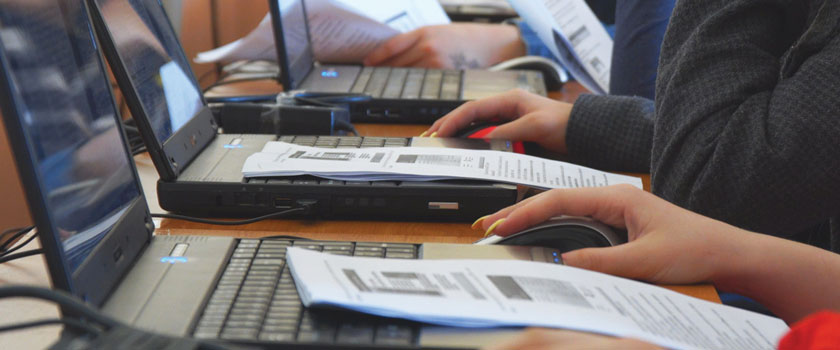
“I greatly appreciate the MIT BLOSSOMS project for sharing these joyful online courses for us who cannot go to school during the outbreak of coronavirus. It makes me more interested in STEM!”
– Anonymous high school student in China, using the Internet to study and learn at home while the coronavirus forced school closures in the first quarter of 2020
“The form of BLOSSOMS lessons are new and energetic; they are great complements to the courses that schools give to students during the virus outbreak period.”
– An anonymous Chinese high school teacher
Avid longtime readers of OR/MS Today will recognize MIT BLOSSOMS; the magazine has carried three earlier stories about it, the first in 2010 [1]. Since its founding a decade ago, the MIT BLOSSOMS program, in partnership with 10 countries, has created more than 200 active-learning STEM classes for high school teachers and their students around the world. The STEM content includes the sciences (biology, physics and chemistry), engineering and mathematics, the latter featuring a solid dose of operations research (O.R.)! The lessons, all delivered on open source video, are free and move in short segments, about three to four minutes each. At the end of each segment, the students are presented with a challenging question, at which point they turn off the video and try to tackle the question. In a school classroom, this is all done collaboratively with mentoring guidance by the in-class teacher. At home, the student must be simultaneously student and teacher. The BLOSSOMS lessons are not lectures nor drawn from textbooks. Instead, they are “constructivist learning,” problem-based, active-learning exercises that build from the more traditional material – with the focus on developing critical thinking skills.
China has played a huge role in MIT BLOSSOMS. The very idea of BLOSSOMS emerged in the fall of 2004 as the first author and Elizabeth Murray, visiting as guests of Tsinghua University, watched an energetic teacher in front of an unheated village classroom in the remote Ningxia Hui Autonomous Region. Every few minutes, the teacher would stop a videotaped, 50-minute, traditional lecture (downloaded via satellite from Shanghai) and engage the class in questions and discussion. The students were excited and engaged.
Larson and Murray then had an “aha moment”: What if we designed educational videos to be interrupted? What if interruptions – passing the teaching baton from the video teacher to the in-class teacher – were an integral part of the lesson design? And so the pedagogical model of BLOSSOMS was conceived. After a gestation period of about four years, the first BLOSSOMS video emerged in 2009.
China became an official country partner of BLOSSOMS in 2013. Several excellent BLOSSOMS lessons were made in China at the Verakin residential international high school in Chongqing. A Verakin student was the first (and still only) high school student to design and make a BLOSSOMS video lesson: “Fun on the Sphere” [2].
Other examples of BLOSSOMS lessons, picked for their OR/MS flavor, include:
- “The Friendship Paradox: Why We Can’t All Be Popular”
- “Taking Walks, Delivering Mail, an Introduction to Graph Theory”
- “Fence Your Equation”
- “Flu Math Games”
- “Tragedy of the Commons”
- “The Towers of Hanoi: Experiential Recursive Thinking”
Late in 2019, the coronavirus emerged in China. By early 2020, the Chinese government took significant social distancing steps to reduce the spread of infections. As one part of this, schools were closed. As we write this (early March 2020), schools are still closed. The students, expecting to be in classrooms learning, found themselves at home. New and compelling video lessons were welcomed. And so emerged the latest collaboration between MIT BLOSSOMS and China!
In early February, MIT BLOSSOMS and Peking University’s Graduate School of Education partnered to offer 32 BLOSSOMS Mandarin-language interactive video STEM lessons to students in China who are at home and still eager to learn. The distribution vehicle is WeChat, a very popular messaging app in China. Quoting enthusiastic correspondence from our PKU collaborators, “Early, we downloaded videos from BLOSSOMS. With the help of our incredible colleagues, we’ve successfully established the special China-based web of BLOSSOMS lessons. Then we published the news in our WeChat official account and telephoned 308 Chinese high schools that we are cooperated with. It attracts over 2,000 clicks in just one day.”
Here are illustrative excerpts of our welcoming letter:
Hello Students in China!
Greetings from MIT BLOSSOMS, based in Cambridge, Massachusetts, USA, at MIT, the Massachusetts Institute of Technology. … (skipping history and context).
At this stressful time in China when many of you are not at school but are at home, MIT BLOSSOMS is honored to play a small role in helping your continued study and learning. Through a collaboration with Dr. Chunhua Qin and his supportive colleagues at Peking University, BLOSSOMS lessons available in the Mandarin language are now placed in a special China-based WeChat site for your use, any time day or night. We hope you enjoy and are challenged by one or more BLOSSOMS lessons.
Once you have tried a BLOSSOMS lesson, please email me at [email protected] and I will write back with a new BLOSSOMS-type challenge for you! The entire world is your partner in trying to help you all get back to your normal lives. May that happen very soon!
Have fun with BLOSSOMS and wishing you all the best of good luck!
– Dick Larson, Principal Investigator, MIT BLOSSOMS
We received many responses from students and teachers in China, including the following:
Students’ comments
- “Watching BLOSSOMS lessons is like playing video games that many boys like. It arouses your interest and desire for challenges.”
- “BLOSSOMS lessons focus on student’s critical thinking. It cultivates the learner’s active participation.”
- “BLOSSOMS lessons are so different from school-based courses. It’s so much fun and attractive!”
Teachers’ comments
- “BLOSSOMS lessons demonstrate to us teachers how to apply problem-based learning approach in our own class.”
- “Comparing to the lecture-based method that we normally use in China, BLOSSOMS are definitely more attractive to students. It helps cultivate them into active learners.”
Postscript: Just after this system was established in China, with the huge assistance of our colleagues at PKU, the coronavirus began wreaking havoc in the United States, with scores of school closings. So, as we write this, we are working with our colleagues at MIT Open Learning to create a comprehensive English-language website with lots of educational material for high school students at home, eager and willing to learn. MIT BLOSSOMS is an important part of this effort. For more information, visit “Best Online Educational Resources for When You’re Stuck at Home - With Kids!” [3].
Meanwhile, Josh Hawley, a professor at The Ohio State University, offered the following tweet: “If people need science education online, head over to @MIT_BLOSSOMS. Super cool material on lots of topics. Quirky topics such as how math can help us understand the spread of flu!”
References
- Richard C. Larson, 2010, “O.R. ‘BLOSSOMS’ in high schools,” OR/MS Today, Vol. 37, No. 5 (October), https://pubsonline.informs.org/do/10.1287/orms.2010.05.03/full/.
- https://blossoms.mit.edu/videos/lessons/fun_sphere
- https://curve.mit.edu/best-online-educational-resources-for-when-youre-stuck-at-home
Richard C. Larson is Mitsui Professor, post-tenure, in the Institute for Data, Systems and Society of the Massachusetts Institute of Technology. He is founding director of MIT LINC and principal investigator of MIT BLOSSOMS. Larson is a member of INFORMS and the U.S. National Academy of Engineering. He served as president of ORSA and INFORMS. His first book, “Urban Police Patrol Analysis” (MIT Press, 1972), was awarded the Lanchester Prize of ORSA. He has been honored with the INFORMS President’s Award and Kimball Medal. Larson served as co-director of the MIT Operations Research Center for more than 15 years. In 2017, he was given the first-ever Lifetime Achievement Daniel Berg Medal for “making significant contributions to technology innovation, service systems and strategic decision-making.” Qin Chunhua is a research professor in the Education Policy and Management Department in the Graduate School of Education, and the director of the Institute of Examination Research, at Peking University.
([email protected])
([email protected])