
June 15, 2020 in AI & Digital Transformation
Impact of COVID-19: The Case for AI-Inspired Digital Transformation
Manufacturing and supply networks need to embrace AI to combat uncertainty and become more resilient to crises.
SHARE: PRINT ARTICLE: https://doi.org/10.1287/orms.2020.03.16

Editor's Note: For the full, unedited version of this article, please click here.
Manufacturing and supply networks worldwide are undergoing digital transformation under the umbrella of Smart Manufacturing and Industry 4.0. Just as companies embrace digital technologies and leverage the opportunities presented by artificial intelligence (AI) forming digital supply networks [1], the world has been hammered by one of the largest interruptions in modern history – the COVID-19 pandemic. Many businesses are facing existential threats and scrambling to survive in the short term. Conceivably, some businesses are inclined to scrap AI initiatives and projects as nonessential in these horrific times, as evidenced by canceled and delayed consulting contracts, with the projected loss of $30 billion in 2020 alone [2]. In this article, we make the case that digital technology and AI can mitigate the adversities and strengthen the resiliency and preparedness of manufacturing and supply networks in the future.
Indeed, the COVID-19 pandemic challenges a commonly raised argument against wider adoption of AI – its implication for a “jobless future” [3]. The job losses in the United States exceeded 33.5 million by May 7, cutting all the jobs created in the past decade [4]. Some 52% of Americans under the age of 45 have experienced job losses, reduced working hours or furloughs [5]. Given most of the job losses have been concentrated in sectors with low AI and digital penetrations, one may argue that AI-inspired digital transformation could have helped to avert or at least mitigate such steep losses.
COVID-19 emerged in a world that is now more entangled than ever, as global trade, business travel and tourism boomed prior to the pandemic. The virus is novel with no vaccine or remedy available, and the nature of spread and mortality is being researched [6]. Decades of globalization and lean process optimization in manufacturing have led to complex, multi-tier and fragmented supply networks and reduced (optimized) inventory levels. Smoothly functioning supply chains and operations took precedence over the possibility of deep disruptions. Disruptive events such as terrorist attacks and natural disasters differ from pandemics as they are localized in space and contained in time; such local disruptions can be mitigated with assistance from undisrupted communities. A pandemic, however, impacts the entire world such that even the wealthiest countries find themselves scrambling for limited resources, often against less-developed countries [7].
Efforts aimed at containing the pandemic have given rise to new measures such as stay-at-home orders and travel bans around the globe. Their direct impact on manufacturing and supply networks is dramatic and unprecedented. Millions of employees deemed nonessential have been mandated to telework with little to no advance notice. Relative to other sectors, the higher education sector effectively adjusted its operations. For example, in the U.S., hours after the pandemic was announced, universities swiftly shifted to online learning. Digital platforms – which had been in place and evolving for decades – enabled this rapid transformation of asynchronous and synchronous instruction. New knowledge was created, stored and disseminated in the form of digital lectures and videos, all scaled up and distributed across academia.
Impact on Manufacturing
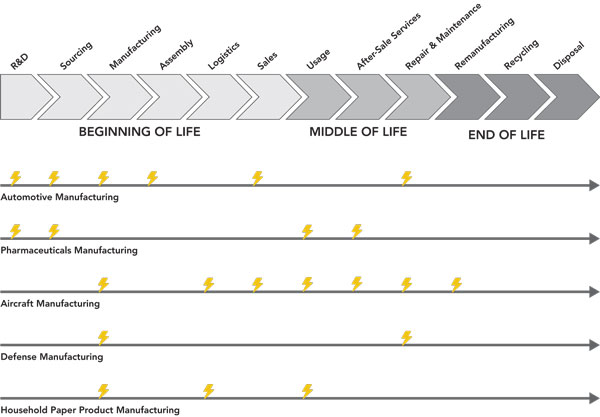
Meanwhile, major manufacturing companies, including Airbus, BMW, Boeing, GM and Volkswagen, shut down factories and lowered production levels. Many such shutdowns could have been averted if they had the ability to remotely continue production with a network of human operators. The United States reluctantly invoked the war-time Defense Production Act to compel GM, General Electric and other manufacturers to produce essential medical supplies and equipment. Manufacturing companies, research laboratories and universities are now sharing resources and retooling their systems to support the effort. Manufacturing and supply networks across most industries have been impacted by COVID-19 and/or the mitigation measures enacted by governments, companies or health systems (see Figure 1).
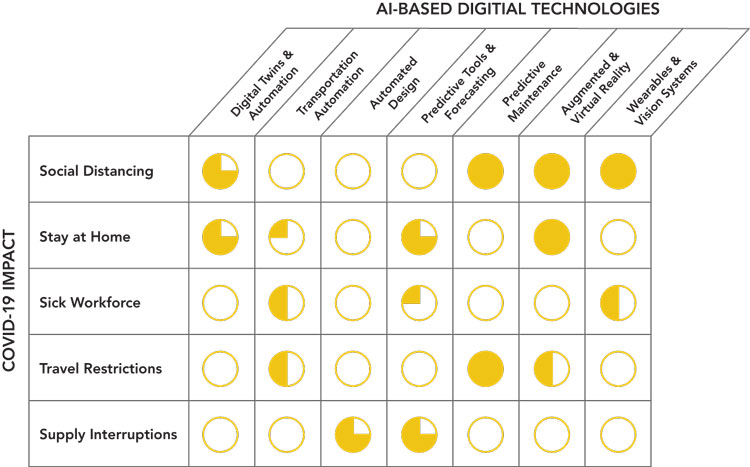
A common digital platform allows for the seamless sharing of resources. For example, GM and Tesla are ramping up their production of ventilators. Essential businesses are faced with challenges, including complying with the directive for workers to remain six feet apart. In most cases, such a directive is incompatible with a conventional manufacturing environment that has been optimized for space and flow, blissfully ignoring how it can in fact be the very opposite of optimal in a different scenario such as what we are experiencing today during the pandemic. Sick or quarantined workers, as well as supply interruptions of critical components and materials, pose even greater challenges. Unforeseen rapid changes in demand for home supplies (e.g., hand sanitizers, toilet paper) and more importantly healthcare supplies (e.g., masks, protective gowns) and complex medical equipment (e.g., ventilators) have affected all regions, resulting in surges of locally produced supplies. Yet, it would be absurd to run operations regularly as “designed for pandemics”; instead these challenges could be addressed with AI-enabled digital transformation (see Figure 2), as evidenced in the redesigned factories in post-pandemic China, with remotely supervised human-robot networks that meet the social-distancing guidelines [8].
Opportunities for AI to Mitigate Impact
The AI-enabled digital transformation provides an opportunity to address product lifecycle issues, including design, manufacturing, sustainability and resilience. The adoption of AI-enabled technologies results in increased connectivity, transparency and visibility across digital supply networks. This, in turn, increases the reactivity and resilience of complex global digital supply networks.
Smart factories, with their digital twins, process automation and robotics are by their nature designed to function with a skeleton crew. Even if the cost of operating smart factories in an unmanned mode for an extended period could increase, measures such as stay-at-home orders could be implemented with minimal impact on the factory output and efficiency. In addition, the manufacturing resiliency practices would allow for retooling the factory to produce repurposed, high-demand products such as ventilators in automotive factories [9].
Automated material and transportation systems – including driverless trucks, cars, automatic guided vehicles (AGVs) and robotics in factories, warehouses and on roadways – are another component mitigating the challenges posed by COVID-19. They make the factories and streets less crowded and thus better support measures such as social distancing while ensuring operations of the integrated digital supply networks.
AI is suited for automated design of new products and processes, e.g., design of new drugs and vaccines. In the manufacturing industry, design adaptations have become a necessity in the absence of key components, manufacturing resources and raw materials. For example, some components of medical systems, originally manufactured in elaborate injection molding processes and sourced from overseas suppliers, are currently in sort supply. To address the shortage, these critical components might need to be redesigned for local additive manufacturing.
AI-based predictive tools forecast demand, shortages and bottlenecks before they occur, and thus provide an opportunity to react to avoid major disruptions. Such tools, when deployed alongside pandemic dashboards and epidemiological models, can help firms with factories, distribution centers and consumer markets around the globe to predict pressure points and proactively shift their human resources, inventory levels, supplier bases and product mixes.
Predictive maintenance offers insights into the probability, timeframe and nature of issues affecting manufacturing. AI-supported remote condition monitoring solutions are emerging in the industry. The status of equipment is remotely evaluated, and actions such as scheduled replacement of parts and maintenance operations are generated. This also reduces the travel needs of maintenance experts to assess manufacturing assets – a mode of operations that prevails in practice. Such solutions are needed amidst travel bans, supply shortages and stay-at-home orders.
Virtual and augmented reality solutions enhance remote support, training and interactions immersed in a realistic environment. Critical issues in manufacturing call for human expertise for inspection of the status of assets and processes. Furthermore, training of operators requires direct interactions with equipment, which are often infeasible during pandemics. Virtual and augmented reality enables the trainee to obtain direct interactive experience remotely and allows the local expert to troubleshoot complex problems in collaboration with a remotely connected expert.
Wearable devices and AI-powered vision systems monitor worker safety, including the adherence to hygiene and social-distancing guidelines [10]. Wearables, including augmented reality solutions and smart watches, offer personalized tracking of health status of employees. The surveillance data collected in such a crowdsourcing fashion may provide early warnings for potential threats and spread of infections. The latter implies that personal data and information protocols are observed.
Figure 2 summarizes the extent to which AI-based digital technologies address the impact of COVID-19 on manufacturing and supply networks.
Challenges for Artificial Intelligence
The opportunities offered by AI are promising. However, several challenges need to be considered. First, many AI models require historical data. Given the unprecedented nature of the current crisis, such data might not be readily available, especially if the events are not directly disease-related, e.g., changes in demand for medical supplies. However, most of the AI-enabled technologies are not pandemic-data-dependent, e.g., vision systems for co-bots.
Second, the shortage of a skilled workforce needed to spearhead and implement AI-related projects in a manufacturing and supply network, as well as manufacturing experts familiar with the detailed process and operations to guide the model development, can pose a challenge. This challenge might be naturally mitigated with a retooled workforce and fast-growing unemployment.
Third, data quality is a challenge as some data sources might be corrupted and biased, thus making reliable predictions difficult. Besides random factors, the data quality could be low due to lack of testing, delays in reporting, different reporting standards and data-privacy regulations. A data-driven model based on low-quality data is neither accurate nor robust. Measures need to be taken to assess and control data quality.
Finally, many businesses are in the process of implementing lean process solutions. Operating with low or no safety stock, lack of cash reserves and knowledge gaps in manufacturing integration are common across industries, often at the cost of supply chain resiliency. Although lean production and AI-inspired digital transformation may complement each other, some of the traditional drivers of lean production may need fine tuning. Long-term losses should be carefully evaluated while planning short-term gains. The benefits of lean production systems should not limit the ability of a corporation to respond in crisis.
Most Impacted Industries
As noted, the COVID-19 pandemic has impacted myriad industries (see Figure 1). Among the hardest hit have been service industries, including tourism (e.g., airlines, cruises), entertainment (e.g., movie theaters, theme parks) and hospitality (e.g., restaurants, bars).
The impact on manufacturing varies for different industries. The pharmaceuticals manufacturing industry is tasked to identify, design, manufacture, test and distribute drugs and vaccines in response to the new virus. As a highly regulated industry that depends on global suppliers, it has been severely impacted. International, national and regional regulations on testing and compliance have been modified. The private sector has stepped in to accelerate progress, e.g., the Gates Foundation has provided support for seven manufacturing programs involved in new vaccines, knowing that at most one or two will be useful.
The labor-intensive agriculture and food processing industry faces a shortage of seasonal workers while at the same time experiencing a surge in demand due to people stocking-up food items amidst the stay-at-home orders. The shortage of workers for food picking is impacted by travel bans, quarantines, social-distancing guidelines and, increasingly, infections among workers.
The automotive industry has been hit particularly hard [11]. Entire plants are shutting down due to safety concerns, as well as diminishing demand. Some factories are retooling their operations and transitioning to manufacture medical components, parts and systems.
The medical equipment industry is experiencing an unforeseen surge in demand and is struggling to ramp-up production amidst disruptions of critical components from the domestic and international suppliers. The same is true for paper product manufacturers, especially toilet paper manufacturers, which experienced a transition from a steady demand for consumer and business products to predominantly consumer variants. Both differ in quality, packaging and raw materials.
Manufacturers are struggling to keep up with the demand for these essential products. The aircraft industry is suffering from a steep drop in demand. Aircraft manufacturers have ceased operations at several facilities. The defense manufacturing industry stands out to some degree as it is largely deemed essential and thus is required to keep operations running. Many defense contractors are small- and medium-size manufacturers, and the industry is not as dependent on the global supplies and thus less prone to sudden drops in demand. However, the challenges of social distancing and a sick workforce remain. For small companies without the digital infrastructure and resources in place, paired with increased cybersecurity requirements for defense contracts, remote working is often not a viable option.
Logistics providers are impacted by rapidly changing regulations, such as trade restrictions and demand shocks. Trucking operations are faced with unavailable services along the highways, such as showers and bathrooms for drivers. Aircraft crews are having issues with immigration. Workers in the logistics industry are exposed to the increased risk of contracting the virus while providing essential services to society. The digital service industry is experiencing an unprecedented and rapid demand growth for their services. Digital video-conferencing tools are rolled out broadly, used by universities to deliver lectures and by companies to virtually conduct business. Distance learning and collaboration platforms are scaling up to accommodate the increase in the volume of traffic and users. Software-as-a-service (SaaS) and Industrial Internet (II) platform providers offer easy sign-up, minimal barriers for new users and scalable infrastructures. The system integrators are installing gateways and hardware to facilitate remote access and data exchange at factories.
Conclusion and Outlook
It is too early to assess the full impact of the COVID-19 pandemic on manufacturing and supply networks, but it is safe to say they have been and will continue to be disrupted. Many companies are facing existential threats and scrambling to survive in the months to come. Scrapping nonessential projects and initiatives without short-term impact is often the first reaction for many. This might not be the best way of moving forward, as the AI-inspired digital transformation and the transition toward digital supply networks [1] can mitigate many of the current challenges. In the short term, basic AI technologies can keep the lights on in the factories despite potentially large numbers of sick or quarantined employees and required social distancing measures. Collaboration between companies in need and providers experiencing a rapid increase in demand can build relationships versed in trust, serving as a foundation for long-term collaborations beyond the unfolding crisis. However, small manufacturers often have fewer options given their limited resources. Here, policymakers and governmental stimulus packages are tasked to support the investment needed to keep companies in business and facilitate their transformation toward digitization.
References
- Sinha, A., Bernardes, E., Calderon, R. and Wuest, T., 2020, “Digital Supply Networks: Transform Your Supply Chain and Gain Competitive Advantage with Disruptive Technology and Reimagined Processes,” McGraw-Hill.
- Consultancy.org, 2020, “The impact of the Coronavirus on the global consulting industry,” https://www.consultancy.org/news/162/the-impact-of-the-coronavirus-on-the-global-consulting-industry.
- Peha, J., 2019, “Robots, telework, and the jobs of the future,” Science, Vol. 363, No. 6422, pp. 38.
- Morath, E. and Guilford, G., 2020, “Unemployment Claims Data Point to Record Wave of Job Loss,” Wall Street Journal, May 8, https://www.wsj.com/articles/unemployment-benefits-weekly-jobless-claims-coronavirus-05-07-2020-11588813872.
- Swasey, C., Winter, E. and Sheyman, I., 2020, “The staggering economic impact of the coronavirus pandemic,” Data for Progress, http://filesforprogress.org/memos/the-staggering-economic-impact-coronavirus.pdf.
- Gates, B., 2020, “Responding to Covid-19 – a once-in-a-century pandemic?” New England Journal of Medicine, Feb. 28.
- Bradley, J., 2020, “In Scramble for Coronavirus Supplies, Rich Countries Push Poor Aside,” The New York Times, April 9.
- “Still made in China. How to reopen factories after COVID-19,” Economist, April 8.
- Kusiak, A., 2019, “Fundamentals of smart manufacturing: A multi-thread perspective,” IFAC Annual Reviews in Control, Vol. 47, pp. 214-220.
- Naughton, K., 2020, “Ford Tests Buzzing Wristbands to Keep Workers at Safe Distances,” Bloomberg, https://www.bloomberg.com/news/articles/2020-04-15/ford-tests-buzzing-distancing-wristbands-to-keep-workers-apart.
- Dressler, N., 2020, “How Automotive Companies Can Secure Short-term Survival and Prepare for a Post-Coronavirus Future,” April 8, https://www.rolandberger.com/en/Point-of-View/How-automotive-companies-can-secure-short-term-survival-and-prepare-for-a.html.
Thorsten Wuest is an assistant professor of industrial and management systems engineering and J. Wayne and Kathy Richards Faculty Fellow at the Benjamin M. Statler College of Engineering and Mineral Resources, West Virginia University. Andrew Kusiak is a professor of industrial and systems engineering at the College of Engineering, University of Iowa. Tinglong Dai is the Bernard T. Ferrari Professor in the Carey Business School at Johns Hopkins University. He is the Vice President of Marketing, Communication and Outreach at INFORMS. At Johns Hopkins, he co-chairs the Workgroup on AI and Healthcare, which is part of the Hopkins Business of Health Initiative. Sridhar R. Tayur, Ford Distinguished Research Chair Professor of Operations Management, Tepper School of Business, Carnegie Mellon University, Pittsburgh, for “developing and commercializing innovative methods to optimize supply chain systems.”
([email protected])

([email protected])

([email protected])