


June 17, 2020 in COVID-19 Perspectives
Stories and Perspectives on the COVID-19 Pandemic
Armed with novel analytics, INFORMS members and colleagues battle the novel coronavirus.
SHARE: PRINT ARTICLE: https://doi.org/10.1287/orms.2020.03.17

The coronavirus pandemic is not only the biggest single event of the 21st century, it also carries with it the largest, immediate analytic challenge of the decade. INFORMS members and analysts at large have responded to the crisis in individual and collective ways. A smattering of their stories and perspectives, many told in their own words, are highlighted below. For more information about INFORMS and COVID-19 and to share your stories, visit informs.org/covid19.
We begin with Scott Nestler, chair of the 2020 INFORMS Conference on Analytics, which went virtual due to the pandemic, and was held May 18-22.
Scott Nestler

Associate professor and academic director, MSBA program, University of Notre Dame, and INFORMS Fellow
I learned during spring break in mid-March that I would not be returning to the classroom because of the COVID-19 pandemic. Notre Dame gave us a week “off” to prepare for resuming classes in an online modality. I have been teaching online since 2010 and routinely teach an online course in the summer, so the transition was not difficult for me. So, I spent the week helping colleagues who had not previously had any online teaching experience.
In an effort to do something more, I am currently co-writing (with another INFORMS member) a book chapter titled “Using Data, Computer Models and Simulations to Forecast Its Spread,” to appear in a book on COVID-19 set for publication in fall 2020. We are writing for the general business/management audience, and those in crisis management and public health leadership roles. Additionally, I participated in a “Chautauqua”-style discussion [1] put together by a former colleague (who is also an INFORMS member). The topic was to find ways to communicate with COVID-19 pandemic deniers and get them to take the recommended precautions seriously.
Finally, as general chair of the 2020 INFORMS Analytics Conference (which was scheduled for late April in Denver), I have been planning for and executing INFORMS’ first-ever virtual conference [2]. This event included a few late-breaking presentations such as, “Using Analytics to Address the Impacts of COVID-19 on the Workplace” and “Is Anyone Operating ‘Business as Usual?’ Insights on the COVID-19 Impact to the Analytics Community.”
Editor’s note: For more on Scott Nestler’s one-of-a-kind experience as conference chair, see “So You Want to Plan a Conference (or Two?).”
Sheldon Jacobson

Founder professor, University of Illinois at Urbana-Champaign
Sheldon Jacobson has tracked COVID-19 data daily for the State of Illinois, the United States and several countries around the world. His focus has been on excess death days attributed to COVID-19 as a measure for how the SARS-CoV-2 virus has penetrated different countries and states. He has worked with his wife, Janet Jokela, an infectious disease physician, to provide information and insights for the local community [3]. For example, they provided insights into how universities will need to deal with their opening in the fall [4]. He provided perspective on the diverse areas of Illinois and how each should be guided in their reopening [5].
In addition, Professor Jacobson has given several interviews on how COVID-19 has impacted airport security and possible changes in aviation security in the future that balance air system security, passenger screening efficiency and public health risk [6, 7].
Editor’s note: For Sheldon Jacobson’s take on COVID-19’s impact now and going forward, see “Last Word.”
Norm Reitter

Chief analytics officer, CANA Advisors, and past president of the Military Operations Research Society
Over the past weeks, an unprecedented number of organizations have made the switch to working from home, a major transition for many employees. Our inboxes and news feeds have been flooded with articles on how to master the world of remote work. As an organization that was built to operate remotely and has been operating in this context for more than 12 years, CANA Advisors is no stranger to the world of working virtually.
Since the novel COVID-19 pandemic began, we have held a series of webinars to highlight considerations for organizations that have not previously had to work virtually but now find themselves in this situation. CANA’s Webinar Series [8] includes features such as The CANA Virtual Way, which presents CANA team members talking about maintaining a remote culture, the tools and techniques for successful execution, and how CANA puts it all together in practice. The Working Virtually Panel Discussion showcases several of CANA’s clients and partners discussing new challenges and best practices they have established as they work through analytics projects via virtual collaboration and connections. Finally, our Parenting, Caregiving and Remote Work program includes panelists who share their stories, challenges and tips in their dual roles as caregivers and professionals working remotely [9].
Anna Nagurney

John F. Smith Memorial Professor, University of Massachusetts Amherst, and INFORMS Fellow
The voices of the operations research community are informing the public through numerous interviews in the print media, on radio shows, as well as on television. Never has our work been more sought after, appreciated and recognized. I conduct research on a variety of network systems, including perishable product supply chains with applications ranging from blood to food. These specific supply chains have been especially stressed during the COVID-19 pandemic, generating great interest as to possible resolutions.
On March 11, the World Health Organization declared the COVID-19 pandemic; on March 12, my article, “How coronavirus is upsetting the supply chain,” was published in The Conversation. This article, as of May 9, is the most read one authored by any UMass Amherst faculty member over the past year in this outlet and subsequently updated and published as “The COVID-19 pandemic and the stressed supply chain,” in Coronavirus Chronicles in Analytics magazine.
The national blood supply chain is stressed for numerous reasons now including fewer collection sites for donations due to closures of universities, and fear among some donors, as well as fear of coronavirus striking donors and those who labor in blood services. Food supply chains have also been negatively impacted by the pandemic, from meat and dairy to fresh produce supply chains. Many meat processing plants have had workers contract COVID-19, resulting in closures, subsequent sanitization of facilities and redesign for physical/social distancing. Some dairy farmers have resorted to throwing out milk, and potato farmers their potatoes, because the supply chains are broken. Even freight service providers and warehouse employees have taken ill further disrupting the supply chain networks.
The cost is great to farmers and society as prices rise and children go hungry with increasing food insecurity. Our book [10] includes the impacts of a variety of supply chain disruptions. Further discussion of the pandemic and meat supply chains, including shortages, can be found in the footnoted references [11] in “Tools from Operations Research,” will continue to be utilized and extended, along with rigorous mathematical models, to capture the new realities under the pandemic. Many in our community are putting forward intense efforts in these dimensions.
Sam Savage

Executive director, ProbabilityManagement.org
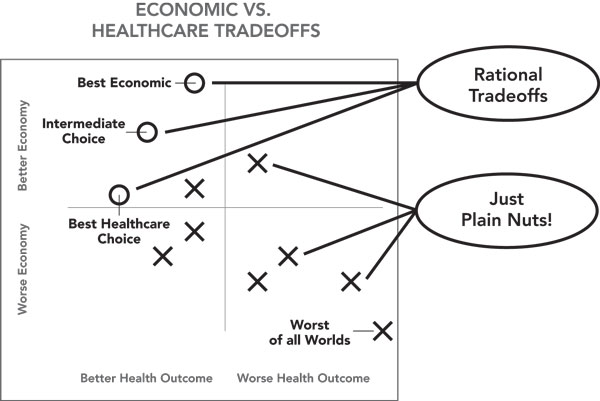
At ProbabilityManagement.org, we are working with Kaiser Permanente and others in the healthcare field on a collaborative approach to finding rational tradeoffs between public health and the economy (Os in Figure 1). Regardless of your politics, you would not want to unnecessarily damage both (Xs in Figure 1).
In theory, stochastic optimization may be used to find such efficient sets, but the problem is intractable using traditional models.
We are experimenting with decomposing such problems into manageable models created by separate teams on separate platforms, which would communicate through open stochastic libraries. This is a democratization of an approach used in financial engineering, to store simulated sample paths of interrelated asset values. The asset sample paths may then be combined, trial by trial, into sample paths of portfolios, which may be analyzed from a risk/return perspective. This is not unlike the approach that launched the discipline of probability management at Royal Dutch Shell as reported in OR/MS Today in 2006.
We can start moving to the northwest in Figure 1 by creating an open architecture in which libraries of contagion sample path inform models of healthcare and economic activities. We have already developed prototypes of this approach and are actively seeking collaborative partners with models that might fit into this structure.
Dimitris Bertsimas

Associate dean of business analytics, Boeing Professor of Operations Research and faculty director of the Master of Business Analytics program at MIT
COVID-19 creates unprecedented challenges. Hospitals are running out of beds and ventilators, and healthcare workers do not have enough masks to safely tend to patients. The virus’ uncommon ability to spread through everyday activities has led most countries to impose social distancing policies, with dire socioeconomic side effects. Policy makers and health providers around the globe are wrestling with difficult problems: How to treat COVID-19 patients with available resources? How to allocate resources to combat the disease? How to plan for the next stages of the pandemic?
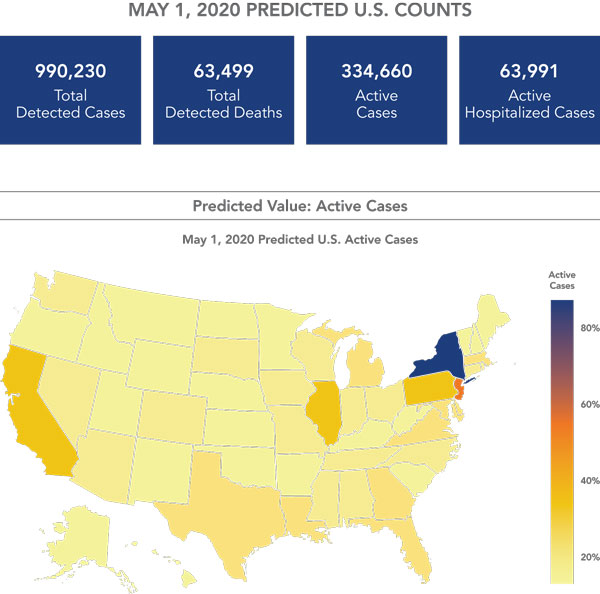
We tackle these urgent questions with an end-to-end analytics approach to chart, anticipate and ultimately beat back the spread of COVID-19. Using machine learning and artificial intelligence, we have developed decision tools to support clinical and public policy interventions. All these tools are available to the public [12] (see, for example, Figure 2). Some of these tools are already in use by our partner institutions, including the Centers for Disease Control and Prevention and the largest hospital system in Connecticut.
Following are some of our recent activities in the battle against COVID-19:
Clinical data repository. Early responses to COVID-19 have been hindered by the lack of data. To fill this gap, we have aggregated almost 150 observational studies released between December 2019 and March 2020. Our data set reports cohort-level information on demographics, symptoms, treatments, comorbidities, lab results and health outcomes. We published the data online to provide insights about the disease’s clinical profile and enable broader use by the research community.
Epidemiological modeling. We developed a new epidemiological model called DELPHI (differential equations lead to predictions of hospitalizations and infections). The model uses a data-driven approach to forecast near-term dynamics of the disease in each U.S. state and each country with sufficient data. We publish daily updates in the projection of infections, hospitalizations and deaths on our website. These projections have been found to be among the most accurate to date; they also suggest that the path to recovery may be slower than otherwise anticipated [13].
Survival calculator. Due to the rapid spread of the disease, large numbers of COVID-19 patients have exceeded the capacities of many hospitals. To manage scarce resources, physicians have to make difficult triage decisions, with life-and-death consequences. To support these decisions, we use clinical data from ASST Cremona in Italy to predict survival from patient demographics, vitals and comorbidities. Our model achieves strong predictive performance – with an out-of-sample area under the curve of 0.92. Our website includes a personalized risk calculator based on this model.
Resource allocation. Another way to manage scarce resources is to redistribute critical equipment across hospitals, states or even countries. In many cases, shortages occur not because supply is lacking, but because equipment is not in the right place at the right time. We have developed an optimization model to minimize ventilator shortages, leveraging the fact that COVID-19 does not peak everywhere at the same time. Our solution has been implemented in the largest hospital system in Connecticut. Our results also suggest that ventilator shortages can be avoided in the United States through interstate cooperation – and provide guidelines to support interstate transfers.
For further information, contact us at [email protected].
Van Gurley

President and CEO, Metron, Inc.
As part of the defense industrial base, Metron’s challenge has been to maintain as close to full operations as possible, while balancing all the COVID-related restrictions, impacts and concerns of our employees. Since most of our projects are classified, we also face the problem of generating enough unclassified work to allow a large fraction of our workforce to initially work from home and reduce the number of people in our classified spaces at any one time.
Like many companies, our initial focus was to rapidly find new ways to operate in a social-distancing world. This included initially shifting almost everyone to telework, setting up new policies and benefits to support those employees dealing with impacts from the virus, making sure financially that we could ride out a storm of unknown duration and uncertain intensity, and setting up protocols to safely allow limited mission essential work to continue in our classified labs and client on-site locations. We restructured many projects, pulling much of the unclassified tasks left on the development schedule. This allowed maximum telework while we set up ways to safely bring the workforce back into the classified labs.
One mitigation we found was to invent a series of “toy” mathematical problems that captured fundamental aspects of hard problems we had been wrestling with in classified projects while obscuring anything classified about the work. This allowed our research scientists to continue exploring solution approaches from home. In at least one case, refocusing on the “toy” problems, without all the extra complexity of the real-world use case, led to a key insight and new solution path for something that had challenged us for the last three years.
Over the last two months, we have become new believers in the capabilities of virtual collaboration platforms like Microsoft Teams and GoToMeeting. Although we used them in the past, we did not really focus on them since we were used to doing mostly everything in person. Now that we have to use them, we have been pleasantly surprised at all the ways they allow us to stay better connected, collaborate and innovate. The fact that we had to deliberately work to overcome the challenge of being remote actually led us to becoming better connected across the whole company. This may be one of the positive discoveries coming out of this period.
We believe that Metron’s future health will be strongly impacted by how our employees feel the company handled this crisis. Did they feel supported and informed? Were we transparent and proactive dealing with issues as they arose? Did we maintain the right balance of safety with project execution pressure and technical rigor? In the end, do they trust us? These are some of the fundamental issues guiding us as we slowly bring the workforce back into our offices as conditions allow. Although this has been a painful, and for some tragic, period, we believe Metron will emerge from this an even stronger company.
Final Note from the Author
Before closing, I would be remiss if I did not mention some of my own work in this area [14]. My current practice focuses around broad trends in defense, and in the words of navalist and professor Wayne Hughes, “When there is a war, study the war.”
In our minds, COVID-19 is definitely a war; the United States has already allocated in real terms nearly half of the money spent during World War II, and there is a strong possibility of another round of stimulus at press time. As defense spending accounts for approximately half of all discretionary spending in the United States (and similar profiles in other nations), the amount that is spent on defense will almost certainly decrease, and perhaps more importantly, what nations expect from their defense establishments will change. This is different than other wars because the adversary is not a human opponent but rather a force of nature. It is also different because it requires a shift in budgets at the beginning rather than the end of the contest. Nature is indifferent to bargaining strategies, and “shelter in place” or quarantine cannot be bargained with.
Finally, in my capacity as inaugural chair of the INFORMS Conference on Security [15] and as evidenced above, it is clear to me that the INFORMS community, both as individuals and as a collective, has tremendous potential to apply the “Science of Better” in this time and in the future.
References and Notes
- https://en.wikipedia.org/wiki/Chautauqua
- http://meetings2.informs.org/wordpress/analytics2020/
- Jacobson, S.H., 2020, “Letter: Defying COVID-19 safety practices is like driving drunk,” Chicago Sun Times, April 22.
- Jacobson, S.H., Jokela, J.A., 2020, “Op-Ed: Second wave of coronavirus infections could hit Big Ten campuses hard,” Wisconsin State Journal, April 19.
- Jacobson, S.H., 2020, “Op-Ed: We need custom COVID-19 plans for the four distinct regions of Illinois,” Chicago Tribune, May 5.
- Silk, R., 2020, “On the Record with Sheldon Jacobson,” Travel Weekly, April 20.
- Jacobson, S.H., 2020, “Op-Ed: Airport security in a post-COVID-19 world,” The Hill, April 24.
- https://www.canallc.com/blog/categories/webinar
- For more information about CANA Advisors, or to contact them to talk through your remote working challenges, visit www.canallc.com.
- Nagurney, A., 2013, “Networks Against Time: Supply Chain Analytics for Perishable Products,” Springer.
- Interview with NBC Boston as well as radio segment on “Farm Talk,” broadcast from Fargo, N.D., entitled: “Supply chain management under the microscope.”
- www.covidanalytics.io
- See, e.g., https://www.nytimes.com/interactive/2020/04/22/upshot/coronavirus-models.html
- https://csbaonline.org/research/publications/covid-19-analysis-and-policy-implications/
- http://meetings2.informs.org/wordpress/2020security/
Harrison Schramm, CAP, PStat, is a senior lecturer at Naval Postgraduate School, splitting his time between Defense Management and Operations Research where, in addition to teaching, he runs the Contested At-Sea Logistics Lab (CASLL). He served as the inaugural chair of the INFORMS Security Conference and is a past president of the INFORMS Analytics Society.
([email protected])