August 3, 2020 in Returning to Campus
Does a ‘return to campus’ translate to a return to the classroom?
Feasibility from a space perspective: Colleges need to consider whether their supply of classrooms can accommodate social distancing and student demand for in-person education.
SHARE: PRINT ARTICLE: https://doi.org/10.1287/orms.2020.04.14

Editor’s note: A short, opinion piece based on this full article has been published in the Atlanta Journal-Constitution [1].
Due to the COVID-19 pandemic, many college and university administrators are facing challenging decisions about when and how to reopen their campuses. Although the safety of students, faculty and staff is a major concern, other factors such as quality of education and revenue implications also weigh heavily in these decisions. The Chronicle of Higher Education has been following these decisions closely and as of June 10, only 8% of colleges and universities had announced they were planning for online courses [2]. The remainder are considering strategies and contingency plans that would bring their students back to campus in the fall.
One fundamental trade-off in these decisions is the balance between the quality of education and the health of students, staff and faculty. In the absence of risks to public health, the latest research on education supports classroom environments that facilitate discussions to enhance critical thinking and communication skills. However, the benefits of having students engaging with their instructor and peers in the classroom are in direct conflict with the latest research on the COVID-19 pandemic, which has shown that transmission of the coronavirus is highest when people are sitting indoors for a long period and talking [3]. Therefore, more discussions lead to more respiratory droplets in the air, which leads to higher risk of transmission among those in the classroom. Reducing in-person instruction time may lead to reduced risk of transmission in classrooms, but this may also decrease the quality of discussion and interaction among classmates.
Imagine a campus holding tens of thousands of students, faculty and staff in dormitories and Greek houses, dining halls, weekend activities and travel, and at-risk professors, as well as vulnerable populations with physical disabilities or mental health issues. University campuses are basically a microcosm of the broader society. The diverse needs among the students, faculty and staff add yet another layer of complexity when deciding on how colleges can best fulfill their mission amid a pandemic.
When university presidents are writing op-eds and sending messages to their stakeholders about these decisions, they are trying to achieve a balance between many factors, such as public health, quality of education and financial implications for their institutions. For example, the president of the University of Michigan talks about a public health-informed return to campus in which larger classes remain online and smaller groups meet in-person [4]. Purdue’s president talks about separating those older than 35 from those younger due to different levels of risk [5]. Texas Tech’s president discussed fall mini semesters. While it’s clear that they intuitively understand the trade-offs and risks at a high level, the implementation details are complex, and the outcomes heavily rely on the behavior of a diverse population.
Important Questions
While the announced campus plans may seem like viable ideas on the surface, several important questions remain:
- Are these strategies feasible? That is, do colleges and universities have the resources (instructors, classrooms, housing capacity, lecture recording technology) to actually implement these strategies?
- Do they achieve the desired balance of safety, quality of education and financial implications?
- What other mitigating factors need to be put in place to make these scenarios worth considering?
Our research group has been investigating these questions using a systems approach. Our ultimate goal is to understand and quantify public health risks, educational experience impact, resource needs and costs, and the revenue implications for higher education institutions as they evaluate scenarios and contingency plans for a return to campus during academic year 2020-2021. Using systems engineering approaches such as resource allocation models, network analysis and discrete systems design methods, we have generated some insights that reflect why these decisions are so challenging, and propose several suggestions to colleges and universities as they weigh the trade-offs.
This article focuses on one trade-off: What percentage of credit hours will actually be delivered in person in the fall if schools want social distancing policies in classrooms? We explored the feasibility from a space perspective: Is a hybrid online/on-campus course delivery strategy feasible with social distancing requirements? Colleges need to consider their supply of classrooms that can accommodate social distancing and the demand for classrooms under their proposed strategies about which classes should be delivered online or in hybrid modes.
Based on our analysis, social distancing in classrooms is going to drastically reduce the in-person instruction time that can be delivered in fall 2020. When considering social distancing in a classroom, it may seem reasonable to think about dividing the room into 6-by-6-foot squares to reflect the recommended 6 feet of social distance between students. Campus planners may be tempted to take this approach because it is easy to estimate a reduced capacity with social distancing by simply dividing a classroom’s assignable square footage by 36 square feet. Another strategy might be to divide the room’s original capacity by three assuming two seats are left empty between students in each row. However, these simple approaches can lead to a large over-estimation of the actual classroom capacity with social distancing.
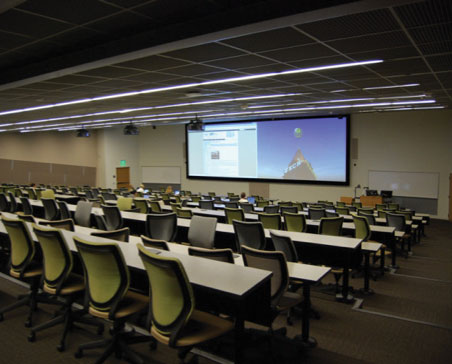
To demonstrate, consider the second largest lecture hall at Georgia Tech: Clough 152. Clough 152 normally holds 300 people and has an assignable 6,400 square feet (see Figure 1). Under the simple calculation above based on the room’s square footage, we would estimate the capacity of Clough 152 to be 164 students, while using the “every third seat” strategy would suggest a capacity of 100 students. However, the room’s actual capacity when enforcing 6 feet of social distance is much lower.
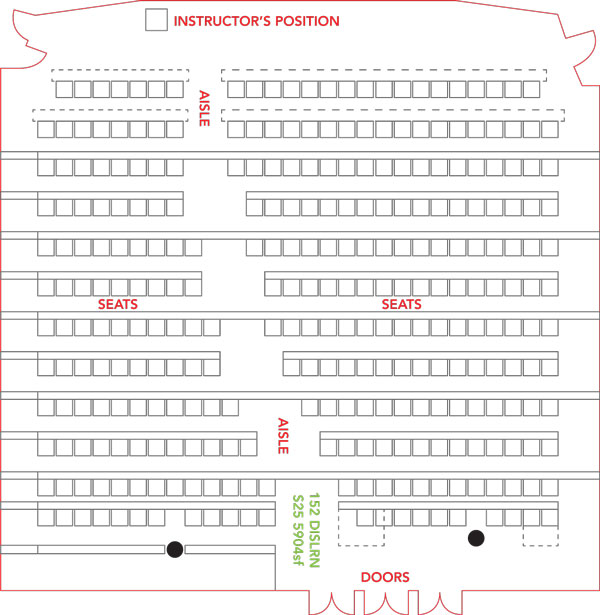
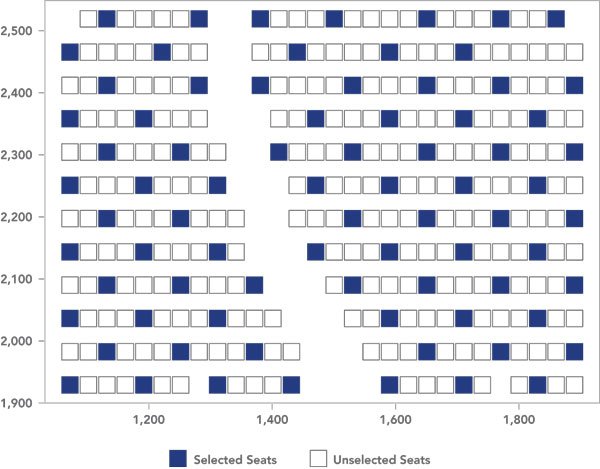
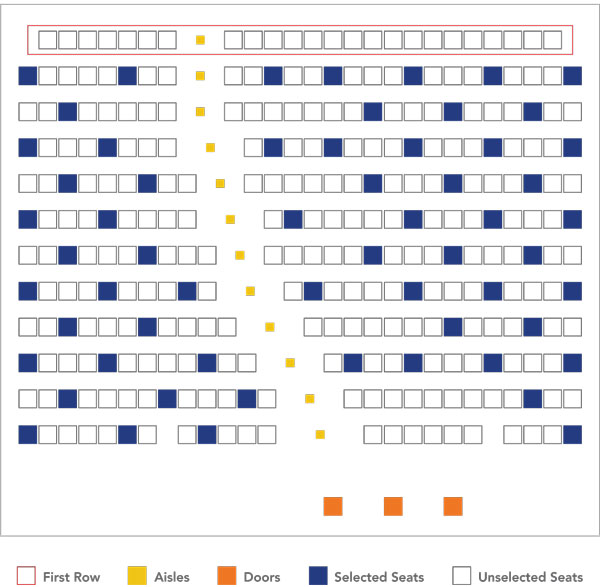
To estimate the actual capacity of this room, we formulated an optimization model that maximizes the number of students that can be seated with 6 feet of social distancing between them. Using this model, we found that Clough 152 can only hold 78 people (Figure 2). After adding restrictions related to the aisles, doors and location of the instructor, the capacity drops to 60 students (see Figure 3) – just 20% of the room’s original capacity.
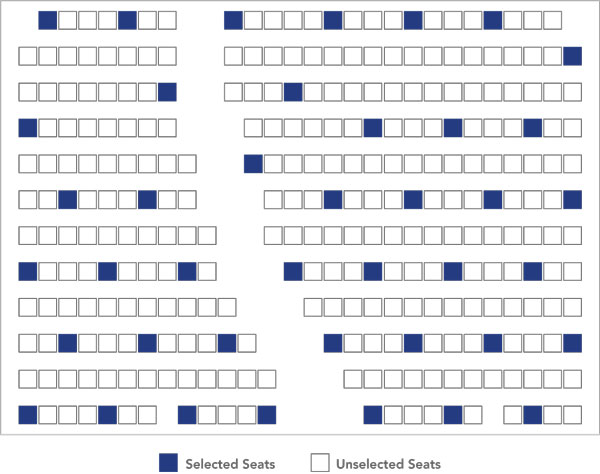
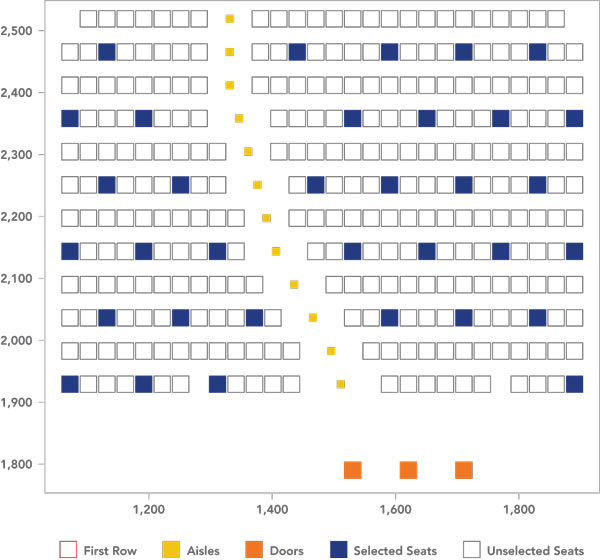
In general, our preliminary findings suggest that only about 12%-30% of the original room’s capacity can be used under 6 feet of social distancing. This estimate does not consider other restrictions such as leaving the front row empty. While the actual capacity will depend on the room’s layout and furniture restrictions, this simple rule may help colleges and universities estimate their classroom availability. If colleges would like to use the “rule of 36,” planners should look at the actual seating area of classrooms before dividing it into 36 square-foot blocks. For Clough 152, the area available to seat students makes up less than half of the classroom assignable square footage.
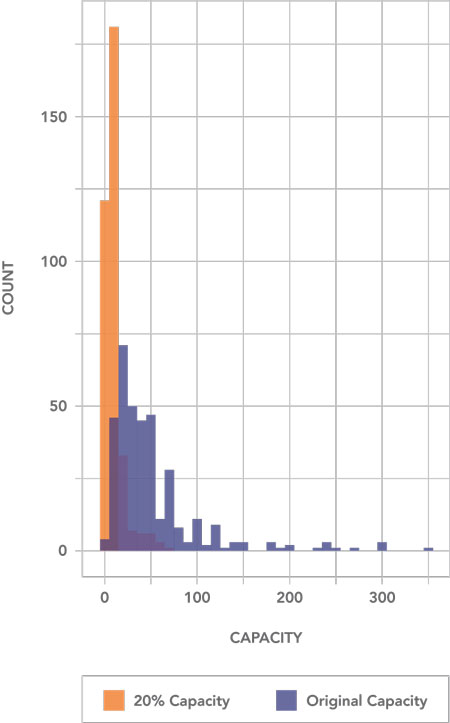
These classroom capacities are going to drastically reduce the number of students that can be receiving in-person instruction at any given time. Only around 30% of centrally scheduled classrooms and conference rooms can hold more than 10 people at 20% capacity. With reduced capacity, only 5% of these rooms can hold more than 30 students, and around 1.5% can hold more than 50 students. With these reductions, we foresee a large amount of in-person instruction time being shifted to remote delivery. We are working to analyze the percentage of credit hours that can be delivered in person assuming capacities that are adjusted for social distancing.
What About Wearing Masks?
Can wearing masks increase in-person instruction time? Given that some planners may use simple rules of thumb to estimate their classroom capacities, colleges should consider policies that hedge against these potentially inaccurate estimates. For example, colleges should strongly consider policies that require the use of face coverings and masks in instructional spaces to protect against the possibility of an in-person class turning into a COVID-19 super-spreader event.
Research has shown that mask-wearing reduces transmission by 85% [6]. Without masks, students should be placed farther apart. However, more distance between students leads to fewer classrooms available for in-person instruction. If we increase the social distancing to 10 feet between students, our example classroom Clough 152 will only fit 41 students (Figure 4). Given that Clough 152 is the second largest classroom on campus, that translates to vastly fewer in-person classes. Therefore, when determining return-to-campus policies and lower-risk classroom layouts, it is important to survey students about their level of comfort with social distancing guidelines in classrooms when masks are required versus when masks are merely recommended.
Nontraditional course delivery models and class locations may help allow for social distancing in classes. With large lecture halls being reduced to 12%-20% of their original capacity, campus planners need to be thinking about how to allocate classes to classrooms by decreasing the demand for large classrooms and increasing the supply of available spaces to hold classes. To decrease the demand for large classrooms, colleges should consider how to reduce the number of students that need to be in a classroom at a given time. Moving large classes online may resolve some issues but may not entirely solve the problem. At Georgia Tech, there are only 80 rooms that can hold classes larger than 30 students when adjusted for 6-feet social distancing requirements. Even if you move classes larger than 50 students online, there are not enough classrooms to accommodate these remaining classes in a way that allows for social distancing.
Perhaps the best strategy is to give students the choice to live remotely and take entirely online schedules. This strategy is appealing both from a risk perspective, as well as a space perspective. It allows for students who are hesitant about a return to campus to still receive their education, and allows for at-risk instructors to deliver their class sections remotely. While some schools appear to be offering this option for some students given their personal circumstances, offering this option more broadly could help make campuses safer for more students and instructors.
If schools choose to forgo that option, campus planners will need to consider how they are going to take other approaches to solve this problem. One potential solution is to have students alternate between attending class in person and attending class remotely. However, this solution requires that colleges increase their capability to record and post lectures for remote delivery. Adding these capabilities will also be necessary to accommodate students who are self-isolating or have been quarantined. Another option to reduce demand for classrooms is to deliver large lectures online and have small groups meet in person on a regular basis throughout the semester.
Other approaches to address the shortage of classrooms might focus on the “supply” side. Due to the severe limitations on classroom availability, some planners may want to pursue creative solutions to increase the supply of large classrooms. For instance, it may be possible to repurpose other spaces on campus, such as gymnasiums, performing arts theaters and concert halls, into classrooms or add capacity outside by setting up tents on outdoor quads to add classroom capacity.
Social Behavior
What about study groups, dorms and college parties? Classrooms are just one aspect of social interaction on campuses. Two things about classrooms to keep in mind: 1) colleges have control over practices and mitigating measures in classrooms, and 2) the policies implemented in classrooms will affect all students and instructors, regardless of whether they are concerned about their exposure. When students socialize outside of class, they are somewhat choosing to take on that risk. However, if in-person instruction is delivered in classrooms, some students may feel that they need to forgo their own preferred level of safety in order to fully obtain their educational experience. Therefore, we owe it to students and instructors to mitigate the risks in those environments.
That said, students’ social behavior should be considered when making decisions about how classes are delivered. While some online instruction has a benefit in terms of reduced virus transmission within classrooms, shifting too much instruction to online delivery could have inadvertent effects for this risk of overall transmission. If students are returning to campus with reduced in-person instruction time, they may substitute the time normally spent in class with risky social behavior. To mitigate this risk, colleges should have high-volume and frequent testing and contact tracing capabilities. They should also mandate return-to-campus safety trainings to thoroughly educate students about how COVID-19 spreads, how to reduce the risk of transmission at social gatherings, and their role in potentially spreading the disease to their classmates, instructors and workers on campus, even if they are not showing symptoms. Although it is unlikely that every student will alter their social behavior based on these educational trainings, some students may take a newfound view of reducing social behavior as an altruistic act.
Overall, the feasibility of campus reopening strategies is just one of several questions around return-to-campus decisions that a systems approach might address. The goal of our research group is to use analytical approaches to help colleges and universities make informed decisions about returning to campus, and to share code and tools to help them investigate these operational issues for their own campuses. The code used to generate the socially distanced seating layouts is available on our group’s GitHub page [7]. We have other on-going projects that are focused on other aspects of these decisions, such as the influence of student preferences and behavior, disease transmission simulations and other analytics approaches for questions related to campus recovery. Our group’s campus recovery project website is http://covid19campusrecovery.org.
Author’s note: With Natashia Boland, the authors are co-leading a research team of undergraduate and graduate students in the H. Milton Stewart School of Industrial and Systems Engineering. The code to generate the socially distanced classroom layouts was developed by Raneem Gashgari, Di Liu, Yuming Sun, Yogesh Avhad and Shimeng Zhang, and is publicly available on the team’s Github page. The authors thank Jimmie Hardin for his feedback and insight into the proposed classroom layouts. This work was supported by the Thos and Clair Muller Research Endowment Fund.
References
- https://www.ajc.com/blog/get-schooled/georgia-tech-researchers-colleges-too-optimistic-about-social-distancing/3RMVbYF5Hu9eLot26SyuLN/
- https://www.chronicle.com/article/Here-s-a-List-of-Colleges-/248626
- https://www.erinbromage.com/post/the-risks-know-them-avoid-them
- https://www.fox2detroit.com/news/university-of-michigan-president-talks-fall-semester-re-opening-the-big-house
- https://www.purdue.edu/president/messages/campus-community/2020/2004-fall-message.php
- https://www.livescience.com/face-masks-eye-protection-covid-19-prevention.html
- https://github.com/COVID19-Campus-Recovery/campus-recovery-modeling
Lauren Steimle is an assistant professor in the H. Milton Stewart School of Industrial and Systems Engineering at Georgia Institute of Technology. Dima Nazzal is a faculty member in the H. Milton Stewart School of Industrial and Systems Engineering at Georgia Tech, where she serves as director of Professional Practice and research director of the Center for Health and Humanitarian Systems. Her research focuses on modeling, design and control of discrete-event logistics systems, including health systems. Her recent work has focused on health equity, election voting systems, higher education response to COVID-19, and developing models for driving higher childhood vaccination rates in developing countries.