


August 5, 2020 in Issues in Education
Mathematical Programming Physical Model: A Multidimensional Learning Tool
SHARE: PRINT ARTICLE: https://doi.org/10.1287/orms.2020.04.15
“You use every possible way of doing it … so as to catch this guy or that guy on different hooks as you go along.” – Richard Feynman on teaching
I’ve personally experienced the power of a brain-based teaching approach with an active, student-centered and experiential emphasis at its core, an approach that focuses on intuition as opposed to memorization. This approach provides a periodic reminder that intelligence is malleable (growth mindset) and can be learned through deep practice, and that mistakes are the best learning opportunities [1] and can provide a motivational boost, especially for those students who believe they are not “smart.”
In my experience, students with a growth mindset display a desire to be challenged and are more open to active or cooperative class experiences. It’s clear to me that both the students and I need to be actively engaged in class. If I am the only one active, and they are passively trying to listen, then I’m the only one learning [2]. I’d like my students to be able to reflect on direct in-class experiences and for their reflections to yield new abstractions and new ways for them to frame future situations. This is how experiential or cooperative learning changes the brain – by changing the number and strength of past or new electrochemical pathways or neuronal networks through the transformation of classroom experiences, such as trial and error, exploration, discussion and guided struggle [3, 4, 5].
Brain-based Pedagogical Strategies
I recognize that students have different learning needs [6], and so it is of paramount importance to generate lessons that reach as many learners as possible by incorporating different brain-based pedagogical strategies. These techniques provide multiple and varied opportunities to connect with students and keep them mentally present in class. At the same time, students have different, albeit not necessarily exclusive, sensory learning preferences: Visual learners prefer images and pictures, auditory learners are “those who talk it out,” and kinesthetic learners are physical and palpable learners [7].
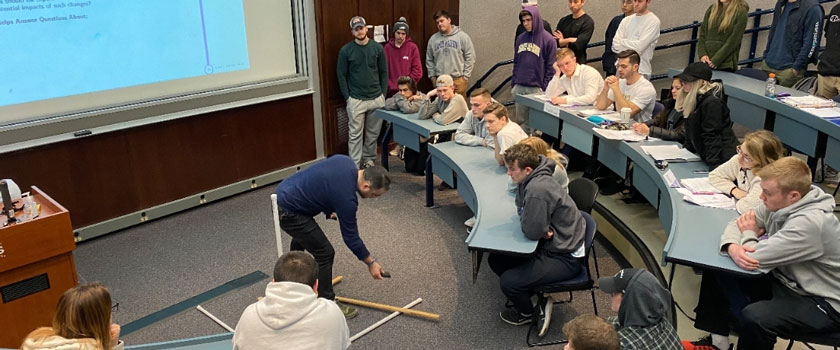
I have been developing a tool that targets all sensory learning preferences through an in-class activity that seeks to build and foster intuition on concepts in mathematical programming via visualization, movement and physical interaction.
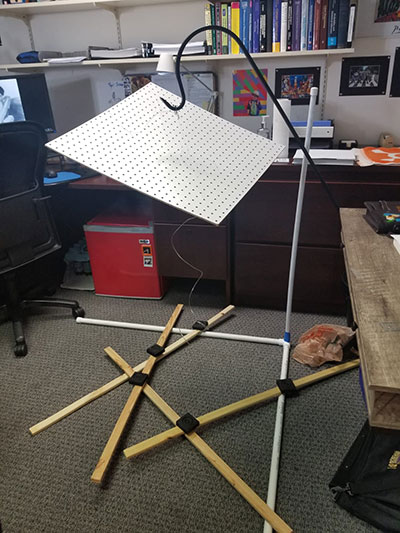
It’s fascinating to see what can be achieved with just a few wooden sticks, a table, a bowl, a bit of rope and some pieces of PVC pipe. I developed a hands-on representation of a 3D (two-variable) mathematical program. The model provides a first bridge between the algebra and geometry of mathematical programs, allowing students to see changes (sensitivity analysis) in real time. I have employed the model to introduce linear programming concepts using a flat table to represent the objective function and wooden sticks to represent the feasible region on the floor. The table is suspended in the air using a hook and some nylon rope.
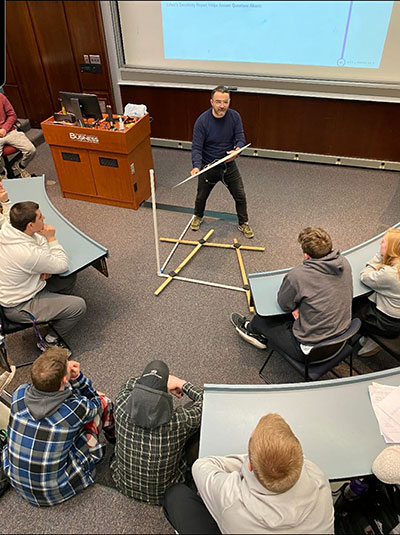
Students interact with each other by locating extreme points, identifying the optimal solution(s) and discussing the consequences of changes in the objective function coefficients (tilting the table), constraints’ coefficients and right-hand sides (movement of the wooden sticks on the floor), among other activities. With this model, I can help lead students to attain a level of insight into concepts that may otherwise be difficult for some students to grasp. For example, I can easily show that, depending on the form of the objective function, the optimal solution to a maximization linear program could perfectly well be (0,0), assuming it is feasible.
Versatility of the Model
The tremendous versatility of the model is another great feature: I’ve used it to introduce integer programs, using a table with equidistant holes on the floor representing the feasible solutions, and for introducing nonlinear programs (convex and nonconvex) by using 3D shapes for the objective function and rope for the feasible region. This provides an opportunity for an intuition-oriented discussion of solution algorithms.
The tool has proven useful within the brain-based cooperative approach, as it involves students in their learning process and invites them to test each other’s ideas. This also provides an opportunity for them to teach each other and improve their interpersonal skills [8].
I’ve received largely positive feedback regarding how clearly and intuitively the model presents and demonstrates the concepts being discussed. One unexpected benefit that remains a pleasant surprise, however, is the positive impact on students’ perceptions of me. Many have expressed their appreciation and gratitude for taking on the task of building a model like this. This makes them feel that I care about their individual learning processes, which creates a reinforcement loop: They interact with a positive attitude, which leads, in turn, to an improvement in the cooperative learning experience.
Figure 1 shows images of the model’s construction and use, accompanied by some of the reactions and feedback from students when asked about the model’s usefulness.
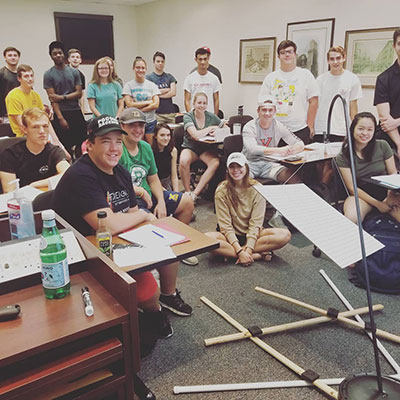
As James Cochran puts it, “Every student will remember something from your course, so why not making it something worth remembering?” [9]. I believe this is one of the experiences my students will remember and return to when looking for inspiration in the future.
Did you find the “LP Physical model” (the one with the table and the wooden sticks) useful? Why?
- Yes, it was a great visual representation of what we were learning that cleared things up well.
- Yes, no one had ever truly explained the “behind the scenes” of graphing/solving an LP. Gave me a much better understanding.
- Yes, because it provided a physical visualization & broke the frame of the class from totally computer-driven visualizations.
- Yes!! I always enjoyed the visualization aspect of learning – this includes the visualizations of the PowerPoints. In addition, I learned MUCH more from this course than the last class, as the emphasis was on LEARNING, and not just on grades.
- Yes – I am a visual person and helped me understand the logic behind the model.
- Yes, this was also useful in 291. Always good to see something physical instead of just trying to imagine it.
- Yes, it made it easier to understand and visualize what we’re actually solving, and how IPs and NLPs work.
- Yes, it is helpful to see the concepts visually in order to really understand them.
- It allowed us to visualize what was happening, which was helpful to me.
- Yes – when topics get complicated to visualize, it helps to have several different mediums in place to get the message across as to how we’re supposed to be imagining the problem.
- I thought it did show some more difficult-to-grasp concepts really well.
- YES ABSOLUTELY! That thing and your lectures gave me better understanding by visualizing. It is easier to learn and understand by looking at the sticks compared to the slides and imagining things.
- Yes. I think it provided a helpful visual aid to gain a better understanding of something that was difficult to otherwise grasp.
- I think it was useful because visualizing helps me to understand better.
- Yes, I thought it was unique.
- Yes, it was a good visual.
References
- Boaler, J., 2019, “Limitless Mind: Learn, Lead, and Live without Barriers,” HarperOne.
- Moffett, N., and Fleisher, S.C., 2013, “Matching the Neurobiology of Learning to Teaching Principles,” Journal on Excellence in College Teaching, Vol. 24, No. 3, pp. 121-151.
- Kolb, D.A., 1984, “Experiential Learning: Experience as a Source of Learning and Development,” Prentice Hall.
- Roberts, J.W., 2002, “Beyond Learning by Doing: The Brain-compatible Approach,” Journal of Experimental Education, Vol. 25, No. 2, pp. 281-285.
- Zull, J.E., 2002, “The Art of Changing the Brain: Enriching the Practice of Teaching by Exploring the Biology of Learning,” Stylus Publishing.
- Connell, J.D., 2009, “Global Aspects of Brain-based Learning,” Educational Horizons, Vol. 88, No. 1, pp. 28-39.
- Khan, S.A., Manzoor, H.A., and Yousuf, M.I., 2019, “A Study of Relationship Between Learning Preferences and Academic Achievement,” Bulletin of Education and Research, Vol. 41, No. 1, pp. 17-32.
- Liebman, J.S., 1998, “Teaching Operations Research: Lessons from Cognitive Psychology,” Interfaces, Vol. 28, No. 2, pp. 104-110.
- Cochran, J.J., 2012, “You Want Them to Remember? Then Make it Memorable! Means for Enhancing Operations Research Education,” European Journal of Operational Research, Vol. 219, No. 3, pp. 659-670.
Luis Novoa, Ph.D., is an assistant professor in the Department of Computer Information Systems and Business Analytics in the College of Business at James Madison University.
([email protected])