
July 28, 2020 in INFORMS Member News
COVID-19 Comprehensive Risk Index
SHARE: PRINT ARTICLE: https://doi.org/10.1287/orms.2020.04.28n

The COVID-19 pandemic prevention and control has entered a new “normal” stage, and the world needs to reopen. The European Union has begun to open its borders within member countries. For countries and regions where the epidemic has been contained, they are currently planning to gradually open their borders to restore the flow of people, business and goods.
For any country and region to reopen its borders, it is necessary to understand which countries and regions around the world are at high risk and which are at low risk. To achieve this targeted goal, precise prevention and control policies are needed.
The compilation of a COVID-19 comprehensive risk index is an important step to provide decision support for the reopening of countries and regions. This article details the method for compiling the global COVID-19 comprehensive risk index, mainly including population infection rates, test adequacy, short-term trends of the epidemic, case fatality rate and other important indicators.
The index was developed by Dr. Chen Jian from CreditWise Technology. The rest of the team included professor Wenhong Zhang from Huashan Hospital at Fudan University, who provided medical consultation; Caixin Data Technology Co. Ltd., which provided the underlying data support related to the epidemic; and Angu Medical Technology, which provided technical support for website development.
Currently, the index and all sub-indices have been published on the following website: http://covid19-risk-index.com/.
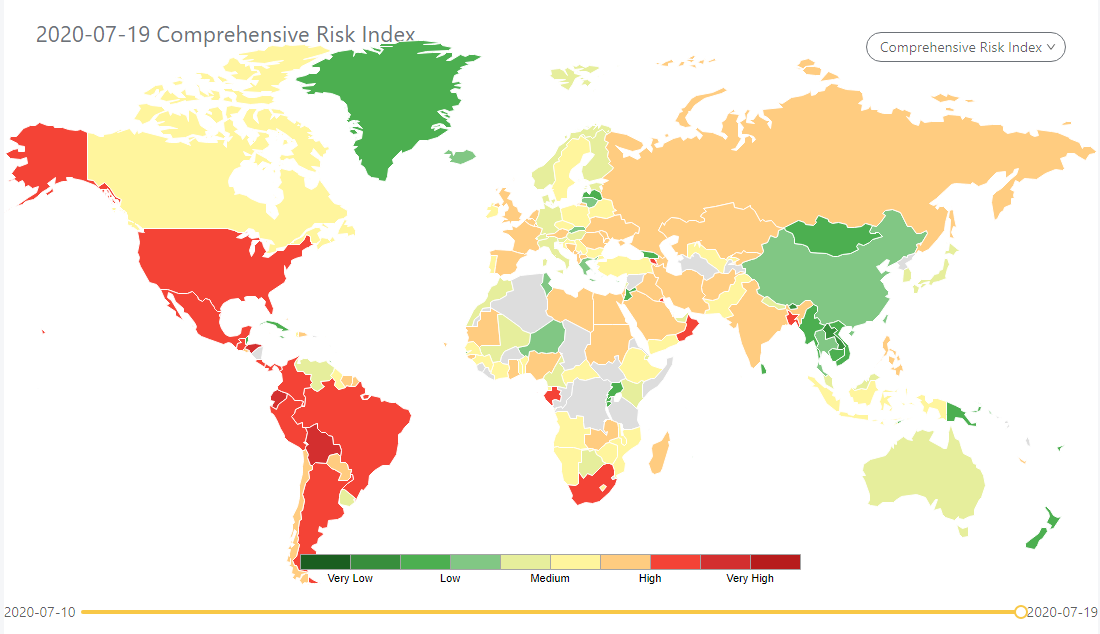
In the webinar “Prevention and Control Decisions Under Uncertain Epidemic Situation” on June 17, Wenhong Zhang and Chen Jian proposed for the first time that in the case of an uncertain epidemic, it was necessary to appraise the transmission risks for major regions, countries and cities around the world. Based on the risk ratings or risk indexes, the decisions to restart an economy and reopen borders can be made with scientific evidence.
After careful analysis, we believe the following risk indicators have more important warning significance and can be used to construct an infectious disease risk index:
- Total infection rate: cases per 100K population
- Total test rate: tests per 100K population
- Active infection rate: active cases per 100K population
- Total positive rate: total positive/test ratio
- New positive rate
- Close contact growth rate
- New confirmed case growth rate
- Case fatality rate
- New death case growth rate
- Nonpharmaceutical intervention: effectiveness parameter
Among them, the growth rate of new close contacts is not easy to obtain, because not all countries disclose the number of close contacts, and not every country can fully track close contacts. Therefore, our first version of the new crown epidemic risk index does not include this indicator for the time being, and other indicators are weighted and averaged according to the following weights:

where Wk is the weight of each risk indicator, and its weighted sum is 100%; Ik is the value of various risk indicators, which can be regularized and standardized according to the probability distribution to keep the total value of the index floating within 0-100.
|
Risk Indicator |
Sub-Index |
Weight |
|
Cases per 100K Population |
Total Infection Rate |
15% |
|
Tests per 100K Population |
Total Test Rate |
8% |
|
Total Positive% |
Total Positive Rate |
10% |
|
New Positive% |
New Positive Rate |
13% |
|
Case Fatality Rate% |
Case Fatality Rate |
5% |
|
New Confirmed Case Growth Rate |
Infection Growth Rate |
22% |
|
New Death Case Growth Rate |
Death Growth Rate |
7% |
|
Active Cases Per 100K Population |
Active Infection Rate |
20% |
|
NPI Effectiveness |
|
|
|
|
|
|
|
Sum of Weights |
|
100% |
Jian Chen is the founder and CEO of CreditWise Technologies, Co. Ltd. and has served as an adjunct professor at Johns Hopkins Carey Business School.