
September 11, 2020 in Contact Tracing
Quantifying COVID-19 Asymptomatic Transmission with Graph Analysis
Contact tracing: Mediating the complexities of biological and economic forces.
SHARE: PRINT ARTICLE: https://doi.org/10.1287/orms.2020.05.02

A sustainable approach to contact tracing is becoming a central factor in economic recovery from the coronavirus pandemic, yet contact tracing is failing in most parts of the United States. We have a limited range of social interventions for responding to COVID-19, the disease caused by the virus. Although our options are limited, we can identify a path that effectively mediates between the complexities of biological and economic forces.
Contact tracing can help solve the tension between biological containment and economic recovery. It requires a fusion of technical innovation and social innovation – it is a sociotechnical system. The potential value is enormous: Early detection and notification of exposure would provide an opportunity to slow the spread and decrease treatment costs while preserving economic activity. The patient population and healthcare payers/providers need a behavioral solution to accelerate adoption of an integrated and scalable approach to non-intrusive contact tracing.
Asymptomatic transmission is an especially nefarious attribute of COVID-19, yet there is still lively debate about its extent, even among the experts. An automatic approach to contact tracing offers a formidable advantage over a manual approach in terms of timeliness; it is particularly effective in the context of asymptomatic transmission because it provides an accurate history of social activity during the asymptomatic period. In any case, the extent of asymptomatic transmission is a critical element in determining the effectiveness of contact tracing.
Epidemic spread is a “graph-shaped” problem; contact tracing is a “graph-shaped” solution. We have data from South Korea CDC that enables us to quantify asymptomatic transmission with graph analysis. The extent of asymptomatic transmission can be known; it does not need to remain a mystery or be subject to controversy. Although the United States is unlikely to adopt an approach to contact tracing that is as aggressive as South Korea, we can learn from that experience as a laboratory for asymptomatic transmission and apply it to various U.S. approaches.
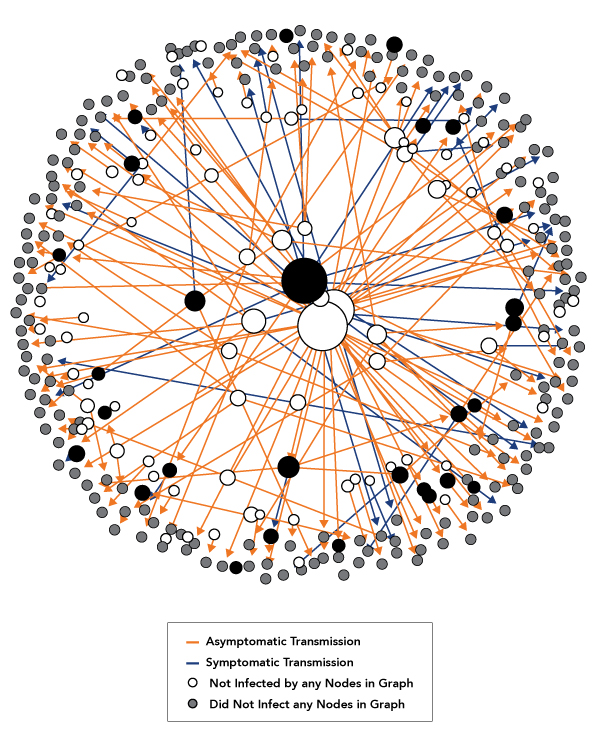
We used a Kaggle COVID-19 dataset [1] from South Korea CDC and a TigerGraph COVID-19 starter kit [2] to conduct our analysis. Our dataset included 234 confirmed infection pairs with confirmed test dates and estimated onset dates. We implemented the Kaggle dataset of patient information on the high-performance TigerGraph graph database suite to derive infection chains. We explored the relationship between serial interval (the interval between the onset dates of infection pairs) and incubation period to determine transmission type for each infection pair. We assumed an incubation period of five days based on the scientific literature [3]. If the serial interval for an infection pair was greater than or equal to the incubation period, we classified the infection pair as symptomatic. If the serial interval for an infection pair was less than the incubation period, we classified the infection pair as asymptomatic. We also conducted sensitivity analysis with a range of values for incubation period. The results are summarized in Table 1.
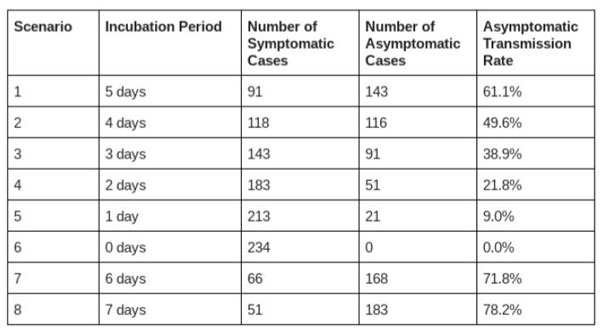
Sensitivity Analysis of Incubation Period
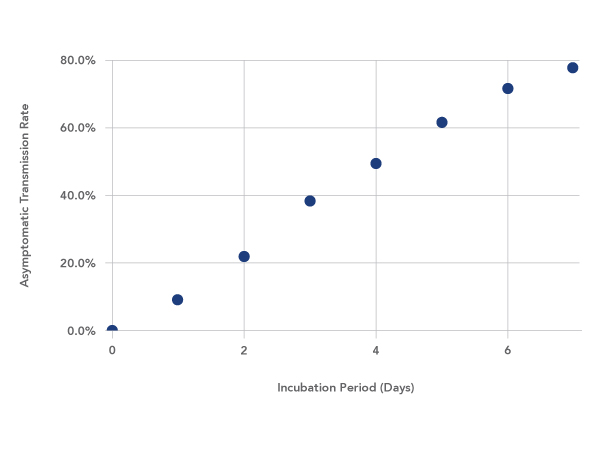
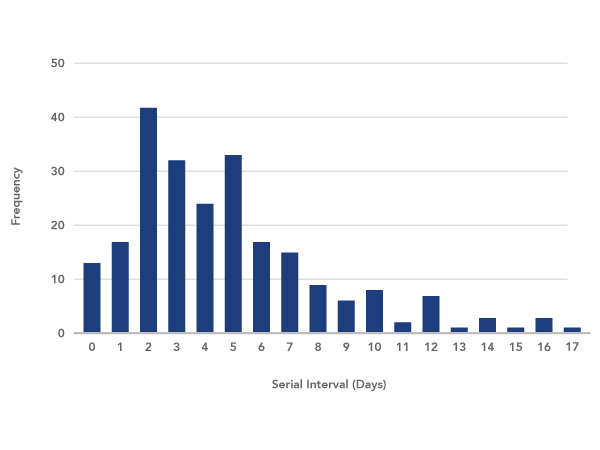
As expected, an increase in incubation period produces an increase in asymptomatic transmission rate. Conversely, a decrease in incubation period produces a decrease in asymptomatic transmission rate. The baseline incubation period of five days produces an asymptomatic transmission rate of 61.1%. Note that an incubation period of two days or less is highly unlikely; even at two days, we see an asymptomatic transmission rate of 21.8%. Asymptomatic transmission rate decreases to 0.0% only at an incubation period of 0 days. At the other end of the spectrum, an incubation period of seven days produces an asymptomatic transmission rate of 78.2%. The mean of serial interval over 234 observations was 4.67 days with a standard deviation of 3.54 days.
The asymptomatic transmission rates for various incubation periods are plotted in Figure 1, while the frequency distribution of serial interval is shown in Figure 2. Figure 3 illustrates the transmission graph of infection chains.
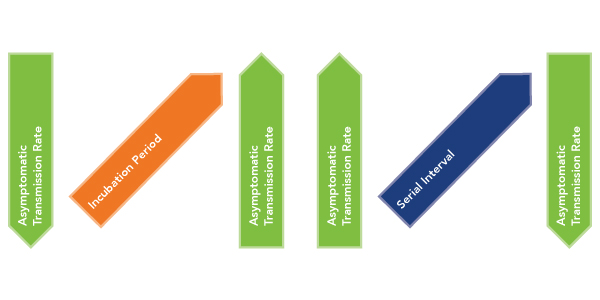
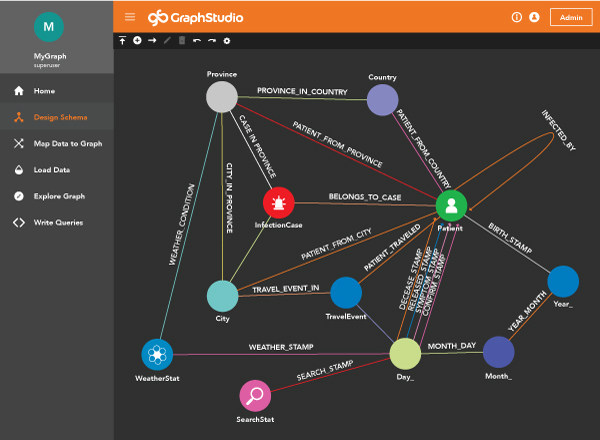
Note that serial interval and incubation period operate on asymptomatic transmission in opposite directions. For a given incubation period, an increase in serial interval produces a decrease in asymptomatic transmission rate, while a decrease in serial interval produces an increase in asymptomatic transmission rate. These structural relationships are illustrated in Figure 4. Figure 5 illustrates the graph schema we used to model the Kaggle dataset in TigerGraph.
Analysis Limitations
Our analysis has several limitations. Most importantly, we depend on the potential subjectivity of onset dates. These dates depend on human memory and interpretation. Over a large population of observations, they are likely to skew in a similar direction, and errors are likely to cancel each other in terms of serial interval. An overall skew in one direction or another would, however, produce an accumulated error in incubation period. An aggregate estimate of onset dates that is skewed early would produce an inaccurately smaller incubation period; an aggregate estimate of onset dates that is skewed late would produce an inaccurately larger incubation period. We anticipate that our use of sensitivity analysis to model various values of incubation period preserves the integrity of the analysis.
We also rely on the determination of infection chains and corresponding infection pairs. We are confident that the rigorous case investigation methods and technology that were employed by South Korea CDC and corresponding adoption of the dataset by Kaggle provide a credible foundation for our analysis.
Finally, we recognize the potential variability around incubation period and our assumption of five days. We expect that the scientific literature provides us with a reliable baseline and, again, we invoke the use of sensitivity analysis to model various values of incubation period.
We hope that our conclusions serve to clarify the various disputes around the extent of asymptomatic transmission. We hope that this clarification, in turn, motivates a corresponding response in approaches to COVID-19 social intervention in general and contact tracing in particular.
Acknowledgment
The authors are grateful to TigerGraph and Futurist Academy for their support of this investigation.
References
David Quimby is a principal at Innovation Radiation, where he practices systematic innovation, experimental design, and technology forecasting. He is a patented inventor in Web architecture and user experience. He assisted a multitude of U.S. and international clients with environmental scanning and technology forecasting at Stanford Research Institute. He assisted an array of manufacturing and service enterprise with technical and economic feasibility analysis at Deloitte Consulting. He assisted Best Buy and Bank of America with adoption of emerging technologies. He is a co-founder of Minnesota Change Management Network. He earned a bachelor’s degree in mathematical economics and developmental economics at UCLA and a master’s degree in organizational behavior and socio-technical systems at UC Berkeley. Akash Kaul is a student in computer science and pre-medicine at Washington University in St. Louis. He is also an intern at Futurist Academy, a community of communities focused on exploring, building and applying emerging technologies to reshape the future. An expert in graph analysis and a practitioner of the TigerGraph graph database suite, he has published on graph analysis in healthcare and COVID-19.