
November 11, 2020 in INFORMS Annual Meeting
AI is the Right Term for our INFORMS Profession
Plenary coverage from the Virtual 2020 INFORMS Annual Meeting
SHARE: PRINT ARTICLE: https://doi.org/10.1287/orms.2020.05.44n

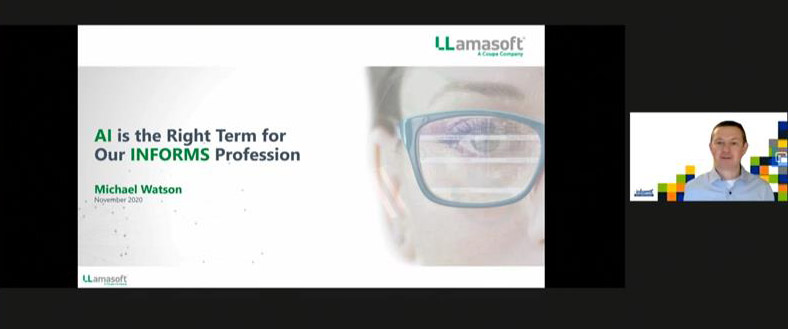
On Wednesday morning during the Virtual 2020 INFORMS Annual Meeting, Mike Watson of Opex Analytics, took a bold stance in front of virtual meeting attendees, many of whom are operations research and management science (OR/MS) professionals, to discuss embracing artificial intelligence (AI) as the right term to use for OR/MS and analytics.
In 1996, when Mike was a Ph.D. student in the Industrial Engineering department at Northwestern University, this same discussion was being had about O.R. versus management science. A decade or so later saw OR/MS competing with the up-and-coming “analytics” trend, which INFORMS rightfully embraced. Now, he says, why not use AI as the umbrella term for OR/MS?
 Considering the fact that AI has been around since the 1950s, Mike has complete confidence in AI and what the term implies. In recent years, research and development (R&D) labs were using algorithms, transcription, neural networks and image recognition, which gave new life to AI. Tech giants like Google and Facebook were among the first to use AI in a public and noticeable way (think image recognition, etc.). We’ve seen the advancement of self-driving cars and robots. In 2017, Jeff Bezos spoke about AI and said there were two types: the “shiny” AI such as self-driving cars and then the “under the hood” AI that helps operations. The latter is where OR/MS professionals thrive.
As the co-founder and partner of Opex Analytics (now a Llamasoft company), Mike decided in 2018 to pick up and embrace AI, much the same way INFORMS embraced analytics years ago. His first task was to define AI. He shared his two definitions:
- Artificial General Intelligence (AGI) – using algorithms that think the way people think and are able to solve new and different problems, the way a human would be able to (e.g., OpenAI)
- AI is the umbrella term for: deep learning, reinforcement learning, optimization, machine learning, simulation and statistics
However, Mike said that AI is more than just an umbrella term, but also a mindset. This mindset comprises algorithms + data + computation, but does not ignore research from AGI (e.g., Atari, Go, etc.). The framework of AI is how algorithms work together, at the macro- and micro-level. Mike used GrubHub as an example to show the levels of an AI framework. At the microscale, GrubHub might look at: how many orders are coming in? How many drivers are working right now? What time do most orders come in? What is the weather? GrubHub cannot make decisions at the microscale because they would have to answer all of these questions for every city in the U.S. at every time of the day. So, the macroscale gives us an optimization algorithm that can tell GrubHub what to do in different areas at different time periods using previously collected data. Thus, the AI mindset and framework together have three layers: data (the pipes), algorithms (the brains) and software (the application).
Then Mike got to the fun stuff. Why AI is a better term than analytics. Basically, a pro/con list for his reasoning.
- Pro for AI: It implies you need algorithms, which in Mike’s opinion “ups the game because it is more than just reports.”
- Con for Analytics: It is still dominated by descriptive, despite the great work done by INFORMS to include prescriptive and predictive analytics.
- Pro for AI: It is not new. It is already out there and in use, and has a common definition.
- Con for Analytics: The “new thing” that took off in the early 2000s still struggles to be defined today.
In conclusion, Mike offered his four sustaining thoughts for why AI should replace OR/MS/analytics for our society’s profession.
- We need to be clear that AI is two distinct things: Artificial General Intelligence and Narrow AI (ANI) or Practical AI.
- Narrow AI is about algorithms and mindset.
- AGI and ANI are close cousins – they are two sides but closely related because they share techniques such as deep learning and optimization. There is also some overlap in problems, such as the self-driving car, which is ambiguous in terms of which part of AI it fits. (Mike noted that some ANI solutions can look like AGI from the outside, such as black box problems.)
- Last, but most certainly not least, INFORMS should say we do AI. Mike said we (INFORMS) help with AGI, but there is no one else out there who has a better claim on Narrow AI. “We can claim that!” he said. He also noted that people with OR/MS backgrounds are leading ANI groups in organizations (although they are not called ANI groups) and that this is just a natural extension of O.R. techniques.
Mike’s final thought before opening the floor was that AI, even if qualified with “practical” or “narrow” is a better term than analytics. Period. Because AI always implies algorithms.
With that closing, the virtual chat box lit up with questions and comments for moderator Irv Lustig to throw at Mike, and the INFORMS audience tossed him some whoppers, with questions like “How long will AI survive?” “Would ‘DI’ for decision intelligence be the better broad description?” “Do you think AI is THE right term or one of the many right terms?” and “In your opinion, what is a good way for humans and AI work together?”
I won’t spoil his answers; if you missed this plenary, watch it for yourself here and continue the AI vs. analytics discussion on INFORMS Connect.
Annya is a master’s student in the College of Management, National Taiwan University in Taipei. She is looking to enter the workforce in supply chain logistics.