December 15, 2020 in Student Perspectives
Pandemic Disruptions: Virtual Learning the New Normal for Nontraditional Students
SHARE: PRINT ARTICLE: https://doi.org/10.1287/orms.2020.06.11

The global education system is facing a massive learning crisis due to the COVID-19 pandemic. School closures around the world may cause loss of learning for students in the short term and reduce the workforce, affecting economic growth in the long term. According to a UNESCO report [1], 87% of the world’s student population – more than 1.5 billion learners in 165 countries – have been affected by the temporary closure of schools. In the United States, the school closures are disproportionately affecting disadvantaged students. These students are more likely to be students of color, from low-income families, or in households with lower parental education levels who depend on schools for their basic needs like internet, housing and reliable food access [2].
Who are Nontraditional Students?
In the 2020 fall semester, most U.S. educational institutions are open for virtual or hybrid learning activities and worked over the summer to develop effective remote teaching strategies. Because school administrators had to quickly shift teaching strategies, little attention has been paid to nontraditional students. Who are nontraditional students and what unique challenges do they face in learning during COVID-19?
A traditional student attends a university full-time within a few years of graduating from high school. They may be financially dependent on generous relatives or dependent on student loans. On the other hand, a nontraditional student (i.e., adult learner) attends college in a format or time frame that differs from the typical route. Career changes, personal growth and workplace promotion constitute some of the reasons why nontraditional students choose to continue their education. The National Center for Education Statistics describes the additional responsibilities of nontraditional students as attending college part time, working full time, financially independent from financial aid, having dependents other than a spouse, a single parent, or did not receive a high school diploma at the typical age.
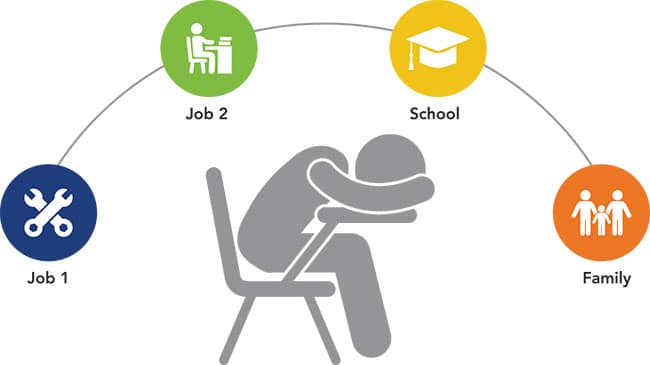
The educational and training needs of nontraditional students have been significantly impacted by the pandemic. Policy responses to COVID-19 forced telework on employees, home-based virtual learning on college and K-12 students, and increased the need for more adults to re-skill or pursue advanced education. For instance, home-based learning for K-12 students means nontraditional students now must dedicate time to their children, taking time away from their own schooling.
The challenges of the current pandemic-era telework, and simultaneous online education, are vast, especially for nontraditional students. For example, the increased virtual workplace may demand new or additional skillsets such as digital and socioemotional skills necessary for nontraditional students to compete and thrive in a society shaped by varying pandemic policies. Most students did not see the importance of these skills pre-pandemic as everything was done in a face-to-face setting.
Online course delivery is a viable alternative in the era of COVID-19. However, studies from Massive Open Online Courses (MOOCs) indicate that on average the completion rate of online courses is 10%, and online course delivery must be designed to increase student success [3-5]. For example, creating an adult e-learning from the beginning would reduce learning disparities and improve academic success between nontraditional and traditional students [6]. Adults’ needs for education and skills training has never been more critical, and because of changing telework availability (e.g., machinist skillset), they face the challenge of managing additional responsibilities due to the pandemic policies on top of attending school.
Nontraditional Student Experience & Survey
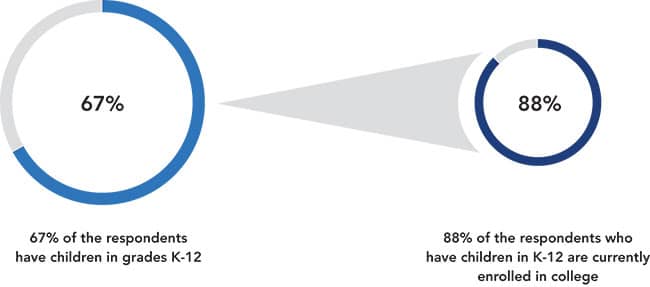
To get a better sense of the nontraditional student experience, we surveyed a sample of 12 nontraditional undergraduate and graduate students teleworking and enrolled for classes during the pandemic in several universities within the United States. The survey seeks to elicit information about their enrollment motivations, concerns, most difficult challenges and success strategies. The open-ended and semi-structured interviews investigated reasons for enrollment, employment and financial situations, additional family responsibilities, and attitudes toward online learning during the pandemic. Of our sample population, 67% reported having children in the K-12 grade level. Of this group with children, 88% reported teleworking and enrolled in online college classes (Figure 2). An analysis of their experiences would give insight into online learning challenges for nontraditional students in this pandemic era.
The survey highlights self-motivation as a hallmark and driver of the academic success of nontraditional students. Every registered student in the study indicated a determination to successfully complete the fall semester despite increased challenges due to the pandemic. Some of the students adopted strategies including a success mindset, flexible study schedules, time management and taking advantage of Coursera and Khan Academy resources to help teach their kids. One of the students said, “I always encourage myself to keep my eyes on the prize.” Specific challenges for these adult students include time constraints, increased work pressure, challenges with online course delivery and home-schooling their children.
All but one of the participants reported increased schedule conflicts due to increased family responsibilities of home-schooling their children while juggling telework. As expected, none of the parents in the study were planning on their children attending virtual school from home, and all reported technical and academic challenges with that transition and the greater responsibility of assisting their children with schoolwork. In the face of all these additional challenges, more than ever the nontraditional students are focused on “doing whatever it takes” to achieve academic success and earn their respective degrees. There is an increased motivation to improve their credentials, which drives their resolution to persist against challenges. Although some do not mind working from home, about 25% of the participants reported a reduction in income due to a pay cut or being furloughed. This outcome of COVID-19 forced one survey respondent to work more hours and hence dropped all classes for the 2020 fall semester.
Academically, the students experienced difficulties navigating online course delivery systems and poorly structured classes. More than 75% of the students’ online class experiences were poor due to faculty members struggling to effectively translate their in-person courses online, combined with reluctant online adult learners who prefer face-to-face class structure and some technical glitches. We found that the pandemic’s disruption has some effect on students’ academic performance (such as late submissions, inability to attend or stay focused in classes because of home-related distractions) and is related to their personal and professional responsibilities. Our survey showed the wide-reaching economic, academic, social and psychological impacts of the pandemic have been challenging for nontraditional students.
Recommendations for College and University Educators
The most critical takeaway from the survey is that the pandemic has created social and technical challenges for nontraditional students, such as inability to balance family responsibilities, little time to study and increased work pressure. For example, juggling working at home, being a teacher’s assistant, and technical support for the virtual school of their K-12 age children and dealing with their own academics. The combination of schedule conflicts, parental difficulties in adequately assisting their home-bound children in virtual school, students’ limited digital skills to easily navigate the learning systems, technological glitches, and the online deliverability of some courses is evidence of a disharmonious social and technical phenomenon.
The online learning platform, both for nontraditional students and their young children, is a technology that must be socially adapted to the students’ convenience in order to be effective in facilitating the desired learning. Adapted learning strategies called “andragogy” that work for nontraditional students encourage discussions between students, increase faculty-student interactions, depend less on third-party software and utilize discussion boards.
One of the students responded, “Discussion boards are underutilized because students are not encouraged to attempt questions asked by classmates. The professor will eventually answer the questions, but it is supposed to be a discussion – it is not.”
More than ever, online learning systems are sociotechnical systems that require adequate coupling of the social and technical components to deliver on the system’s goal. Strategies for the success of nontraditional students needs to be developed from a sociotechnical system perspective to adequately mitigate their challenges. For example:
- Prioritize strategies for enhancing and sustaining adults’ motivation. The family, professional and academic responsibilities of nontraditional students could keep increasing, but our survey shows their self-motivation to be successful can be insurmountable. Motivation and need for online students are necessary for their continued enrollment[5]. Nontraditional students mostly drive their own academic success [7]; therefore, interventions that target enhancing adult students’ motivation could improve outcomes. Adopting a philosophy that views students as customers and embraces the right customer service mindset and practices would motivate adult learners.
- Train faculty members on course design for online users with the attitude and mindset suitable for adult students. An essential part of sociotechnical systems philosophy is the participatory decision-making process. Therefore, it requires that the faculty members and staff are engaged from the beginning, trained and incentivized to transition to online teaching. From a sociotechnical system perspective, online course design for nontraditional students must consider their learning needs (e.g., learning style and preferences) and their personal needs while enrolled (e.g., financial and family responsibility). More adult students than ever want to earn college degrees. The pandemic has reduced or removed the advantage that face-to-face course delivery has at colleges and universities over traditional online ones.
- With over 40% of all adults pursuing some form of higher learning[8], the market is continuing to grow. For an institution to gain a larger share of the students, they need to compete and improve the quality of their online learning systems, customer orientation practices, inclusiveness in terms of breadth of the population targeted, and diversity of course schedules and options. We recommend designing courses that can accommodate the availability, learning style and skill needs of nontraditional students. Education for nontraditional students is not just a matter of economic advantage; it is a “fundamental human right,” enabling them to realize their dreams [9].
- Insist on orientation for online course delivery prospects or evidence that they are proficient in relevant information communication and technology skills. Identifying these skills ensures that class time is not wasted on technicalities and logistics, but the course content. The students also need to be included in the course decision-making (e.g., decisions about class scheduling).
- Design programs and courses to reflect a more realistic graduation rate of adult students. Before COVID-19, it was expected that nontraditional students, even those with K-12 grade children who are working at least part time, complete a four-year degree in four years just like traditional students. Even more so the case during COVID-19, it is an unachievable expectation for them to take the typical 12 credits per semester considering telework and other pandemic constraints. Whereas a few may be able to push through the new responsibilities, it should not be the expectation given the slower graduation rate of adult learners will be even worse with the pandemic constraints.
In order to maintain the academic success rate of nontraditional student and increase revenue for institutions, educators need to understand the pandemic’s multidimensional effects on the education of this demography. In the design of e-learning platforms or courses, feedback from nontraditional students should be integrated to facilitate a better success rate. We recommend a sociotechnical systems approach that would adequately consider students’ multifaceted needs and the university faculty to achieve academic success.
References
- UNESCO, 2020 “COVID-19 educational disruption and response,” Paris: UNESCO, https://en.unesco.org/covid19/educationresponse/globalcoalition.
- U.S. News, 2020, “$23M to get Detroit students tablets, internet amid pandemic,” https://www.usnews.com/news/us/articles/2020-04-23/23m-to-provide-laptops-for-detroit-students-amid-pandemic.
- Á. Fidalgo-Blanco, M. L. Sein-Echaluce and F. J. García-Peñalvo, 2016, “From massive access to cooperation: Lessons learned and proven results of a hybrid xMOOC/cMOOC pedagogical approach to MOOCs,” International Journal of Educational Technology in High, Vol. 13, Article no. 24.
- S. Murray, 2019, “MOOCs struggle to lift rock-bottom completion rates,” Financial Times.
- R. Rivard, 2013, “Measuring the MOOC dropout rate,” Inside Higher Education, Vol. 8.
- OECD, 2020, “OECD Policy Responses to Coronavirus (COVID-19): The potential of online learning for adults: Early lessons from the COVID-19 crisis,” https://www.oecd.org/coronavirus/en/policy-responses.
- I. Okechukwu, 2020, “Sociotechnical systems approach for designing effective pre-college STEM programs for adult students,” Wayne State University, Detroit.
- H. Gillin, 2020, “COVID-19 and the future of adult education,” https://today.tamu.edu/2020/09/24/covid-19-and-the-future-of-adult-education.
- M. Avoseh, 2018, “Commission for International Adult Education (CIAE) of the American Association for Adult and Continuing Education (AAACE),” Proceedings of the 2018 International Pre-Conference, Myrtle Beach, S.C.
Egbe-Etu Etu is a Ph.D. candidate at Wayne State University. He serves as an editorial staff writer for OR/MS Tomorrow, the student magazine of INFORMS. Ifeoma Okechukwu, Ph.D., is the engineering education manager at Focus HOPE: Center for Advanced Technologies in Michigan. Leslie Monplaisir, Ph.D., is professor and associate dean of the College of Engineering at Wayne State University. Celestine Aguwa, Ph.D., is an associate professor of industrial and systems engineering at Wayne State University.