


January 8, 2021 in Viewpoint
Vaccine Queue: Exchanging Places
SHARE: PRINT ARTICLE: https://doi.org/10.1287/orms.2021.01.01
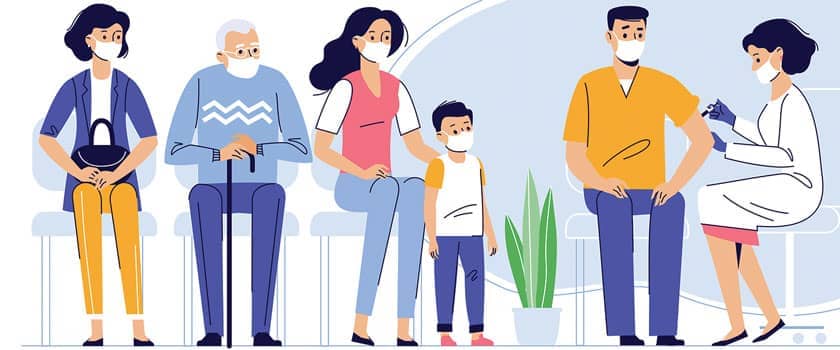
Most of us are now waiting in line, a queue, for the COVID-19 vaccine. This is a virtual queue, as we are not all lined up in one place. The Centers for Disease Control and Prevention (CDC) has given us guidelines on priority of service in the queue, with medical professionals and long-term care facility residents being first in line. After that comes Phase 1b, with people over the age of 75 and non-healthcare frontline essential workers – including first responders – receiving the vaccine. After that, in Phase 1c, we have ages 65-74, ages 16-64 with high-risk medical conditions, and essential workers not included in Phase 1b.
For each of the 50 states, the prioritization details of each line are being adjusted as we write this. For instance, Massachusetts Governor Charlie Baker recently announced some fine tuning, with the next phase in Massachusetts ordered in the following way for the period February to April 2021: (2.i) individuals with 2+ comorbidities and residents age 75 and older; (2.ii) early education, K-12, transit, grocery, utility, food and agriculture, sanitation, public works and public health workers; (2.iii) people age 65 and older; (2.iv) people with one comorbidity [1]. Other states are also fine tuning procedures.
Now imagine a priority-ordered vaccination queue as a physical line, and think back on the many lines you have been in – grocery store checkout, post office, bakery, deli, etc. Someone shows up after you and joins the line in back of you. But maybe the person is a parent accompanying two small children, or someone with physical disabilities or other special needs. I’d bet that everyone reading this has on occasion offered to exchange their place in line with someone.
When feasible, exchanging places is what we should allow, even encourage, for the vaccination queue. For instance, I am over 75 years of age, now scheduled in CDC Phase 1b (Charlie Baker 2.i), and – to my knowledge – without serious medical conditions. But I know and deeply care about several younger people who are currently after me in line and who need the vaccine before I do. Their need stems from serious underlying medical conditions such as cancer and their on-going COVID-19 risk exposure from frequent visits to medical facilities. These are special needs, analogous to our grocery store example, but of course far more serious. I’d willingly exchange places with one of them (actually, all of them, if I could).
In situations in which the health system allows, why don’t we incorporate “Exchanging Places” into our official vaccine allocation policy?
For two people having the same health insurance provider, no queued person with that provider other than our two “switchers” would be affected in any way – their line positions would be unchanged. This is analogous to a single grocery store queue. As we move to multiple providers and perhaps cross state lines (different grocery stores perhaps in different states), this switching suggestion may be bureaucratically infeasible. So, to make this work, we must keep it simple, and – at least in the short term – focus on only same-provider situations. The easiest example: husbands and wives or other family members in the same household. For individuals who are not in the same household but are on the same healthcare plan, a simple form should suffice, signed by the person offering their queue positon and warranting no value received for the exchange in queue positions.
Colleagues I have spoken with have shown interest in this idea. INFORMS President Steve Graves reports that if the “switching policy” was implemented he and his wife would switch places, and MIT Research Affiliate and former IBM executive Irving Wladawsky-Berger says the same. My hunch is that nationally, there are many thousands of family members who would switch. Finally, physician leaders at MIT have expressed interest in such queue position switching, calling it “highly altruistic,” but only if government rules and regulations would be modified to endorse such switching.
National and even state top-down guidelines are good in the large but cannot anticipate human complexities in the small. Looking out for one another, we see very clearly the needs of individuals up close and personal. We care, we’ll switch!
Reference
- Gardizy, Anissa, 2021, “Five things you need to know about the vaccine rollout in Mass.,” Boston Globe, Jan. 4.
Richard C. Larson is Mitsui Professor, post-tenure, in the Institute for Data, Systems and Society of the Massachusetts Institute of Technology. He is founding director of MIT LINC and principal investigator of MIT BLOSSOMS. Larson is a member of INFORMS and the U.S. National Academy of Engineering. He served as president of ORSA and INFORMS. His first book, “Urban Police Patrol Analysis” (MIT Press, 1972), was awarded the Lanchester Prize of ORSA. He has been honored with the INFORMS President’s Award and Kimball Medal. Larson served as co-director of the MIT Operations Research Center for more than 15 years. In 2017, he was given the first-ever Lifetime Achievement Daniel Berg Medal for “making significant contributions to technology innovation, service systems and strategic decision-making.”
([email protected])