


April 8, 2021 in Risk & Disaster Management
Use of e-mobile technology in building risk and disaster management systems
FRG and e-CRG members join hands to develop a disaster rapid response system using mathematical optimization model
SHARE: PRINT ARTICLE: https://doi.org/10.1287/orms.2021.02.15

 The Department of Disaster Management Affairs (DoDMA) in Malawi – under the Ministry of Natural Resources, Energy and Mining (MNREM) – is responsible for managing disaster operations including floods, droughts and pandemics, such as COVID-19. Every June, the government of Malawi, through MNREM, joins the rest of the world to celebrate World Environment Day. In 2015, Malawi celebrated World Environmental Day in a special way in conjunction with a climate change week symposium that took place at the Bingu International Conference Centre (BICC) in Lilongwe (the capital of Malawi) [1]. The symposium, “Toward Green Societies for Sustainable Development,” invited individuals, stakeholders, researchers and academics to showcase and present their innovations or scholarly work contributing to management of climate change and global warming effects in Malawi. A three-member team of young researchers from the University of Malawi, Chancellor College within the Fibonacci Research Group participated in the symposium and designed an operations research (O.R.)-based solution to challenges faced by DoDMA in managing disaster strike effects in Malawi.
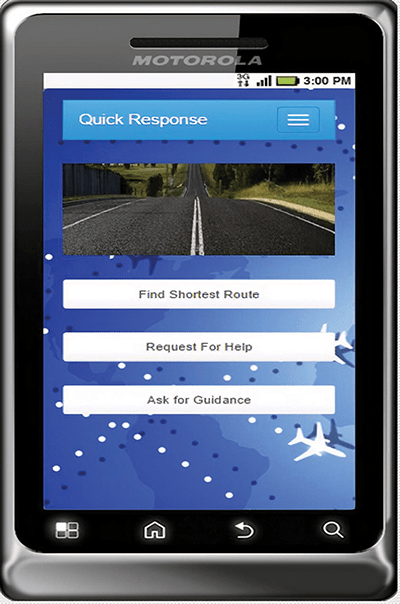
mobile phone.
The Fibonacci Research Group (FRG) team developed a mathematical optimization system to help DoDMA effectively manage the disaster effects on both lives and property. The e-mobile-based emergency response system (prototype) provides an opportunity for the rapid response team to reach out to the large masses of people through its capability to run on any Android-based mobile device (see Figure 1). Such a model supports the required community’s capacity over management of disaster strikes and their impacts in Malawi. The model is built on the principles of vehicle routing problems (VRPs), with history dating back to the 1950s [2, 3].
Prototype Strategy
The FRG team first reviewed existing literature that demonstrated the use of O.R. principles, in particular VRP techniques, to address emergency response issues [4-8]. A paper by Umitsu and Fushimi [9] was particularly helpful to our ideas. In an attempt to save lives of people during earthquakes for the region of Minami-Ku in Japan, Umitsu and Fushimi developed a Geographic Information System, ArcGIS 8.3, coupled with Dijkstra’s algorithm that was coded in Visual Basic for Applications (VBA) to generate shortest-travel paths for ambulances to carry injured people from disaster occurrence scenes to hospitals, avoiding blocked road segments that can change over time.
Although several papers demonstrated the use of such O.R. methods to serve either patients or victims during emergency incidences [9-12], the FRG team did not come across any paper that proposes building an emergency medical service (EMS) system that is accessible to all when responding to an emergency case, be it a disease or natural disaster. Several proposed EMS systems described in the literature were based on centralized systems where patients or victims had no room to individually initiate the rapid response process. Thus, we developed a prototype of an Android e-mobile app-based emergency system that allows individuals to take part in preparing for or responding to any disaster or disease outbreak. The idea of using mobile phones was motivated by Ni et al. [13].
State of Emergency Response System in Malawi
While embarking on this project, the FRG team observed that Malawi was reported as one of the countries in sub-Saharan Africa to have faced loss of lives due to impacts of natural disasters such as droughts, floods and earthquakes [14, 15]. For example, between the years 2014 and 2015, Malawi recorded high lives and property losses due to floods that occurred mainly in the districts and townships of low-lying lake shores and Lower Shire areas [16]. In addition, Malawi also reported figures of deaths due to rampant epidemic diseases such as cholera [17]. According to a National Disaster Risk Management Plan (NDRMP) report, natural disasters have had serious impacts on Malawi’s economic development as well [18]. For example, the Global Facility for Disaster Reduction and Recovery (GFDRR) country profile report revealed that an average annual loss of gross domestic product (GDP) of 1% and 0.7% was reported from impacts of drought and dry spells, and flooding and overflowing of lakes and rivers, respectively [19].
Despite such reported figures of lives and property loss due to natural disasters, it is of great concern that disaster recovery, from an operational point of view in particular, has remained an ignored area during planning processes in Malawi [18]. In addition, no systematic monitoring of recovery interventions exists. While we acknowledge the government’s move toward disaster prevention and resilience building programs through an established disaster risk management (DRM) agenda in an approved NDRMP, succeeding GFDRR program [18, 20], it still anticipated that disaster deaths and property loss figures may continue to rise if the country remains in a state of ineffective recovery systems, and preparedness for and response to natural disasters. Although the policy saw the birth and use of mobile clinic vehicles in some districts during the 2014/2015 floods [16], such vehicles may not effectively operate without proper guiding maps and routes from emergency operations centers to referral hospitals or health centers.
Moreover, 2015 reports from both GFDRR and DoDMA showed that despite emergency operations centers being instituted in all disaster-prone areas, most districts in Malawi are reported to have poor strategic preparedness and response moves. However, deaths and property losses may decrease if the country adopted O.R. methods in establishing effective emergency response systems. Here an effective system means use of both basic and advanced science and technological ideas to respond to emergency cases.
With such a background, members of FRG observed the undeniable need for a mobile ambulance service, especially when emergencies involve life or death situations. Therefore, the important factors to determine are the availability of ambulances and how fast they can travel to emergency sites to meet the level of victims’ needs. As such, improving the level of satisfaction in providing emergency services to disaster victims became the team’s goal as it embarked on this project. Just as in other developing countries, the problem of longer response times experienced in Malawi is impacted by unavailability of ambulances to attend to emergency cases, nonoptimal number of ambulances to provide maximum coverage to the designated population, or a nonstrategic location and poor deployment system of the ambulances [5, 21].
However, during emergencies such as floods or earthquakes, most of the electrical and telephone lines are damaged, thereby creating a communication barrier between emergency operations centers and victim sites. The increased use of mobile technology assets, such as Android-based phones and tablets, provides us with an opportunity to extend the methods of operations research reported in the literature by proposing means of access to even a large, rural mass for victim support. Thus, rather than developing a centralized system, the team proposed designing an Android-based e-mobile system that not only presents a possibility of contributing to quick response times of ambulances to disaster incident areas, but also provides an individualistic opportunity for strengthening preparedness capacity to such disasters.
The FRG Team’s Solution
After each disaster strike, the number of people seeking quick treatment from emergency operations departments (EODs) increases. However, the FRG team found that most EODs fail to properly manage these cases due to low resources, for instance, emergency vehicles (ambulances). It is therefore desirable to find means of managing a few available resources without compromising individual lives and property during a disaster. One possible approach is shortening vehicle travel times when responding to emergencies via routing of rapid response vehicles on short distances. This leads to minimized response times and operation costs. Seeking methods of improving response times at minimal cost translates to solving vehicle routing problems (VRPs), which in turn translates to finding a shortest path that connects the two arbitrary locations u and z from a list of several possible connected routes [22]. The assumption is that, discounting topographical or traffic interruption (congestion), such a path would be optimal.
Consequently, the team designed its own system prototype – modeled over graph theory-based road networks – as a VRP and applied a heuristic algorithm [5, 21, 23] to generate quasioptimal solutions to the problem faced by DoDMA. A key advantage to using such a heuristic algorithm is that they are efficient for large problems such as the one we decided to address. Heuristic algorithms fall into the categories of construction, savings-based and splitting methods [24]. In addition to the capability of producing solutions in a short period of time, heuristic algorithms are not too difficult to code and implement, making them convenient and easy to apply in the real-life implementation. The team generated its solutions using a modified dynamic Dijkstra’s algorithm coded with SQL database and PHP scripting language to handle the functionalities of the mobile application.
When traffic congestion, topographic effects and other factors such as random demands are considered, the problem translates into a dynamic vehicle routing problem (DVRP) [2, 11, 25, 26]. The system also considers dynamic call requests. Graph data of road segments from disaster-prone areas were obtained from the digitized road network distances and topological measured gradients prepared in ArcMap GIS 10.0. Data was fed into and updated from an SQL database to run the algorithm and execute shortest routes.
Considering that the proposed system aims at serving rescue team disaster operations centers and victims, the whole system was built along the lines of the proposed system framework presented in Figure 2.
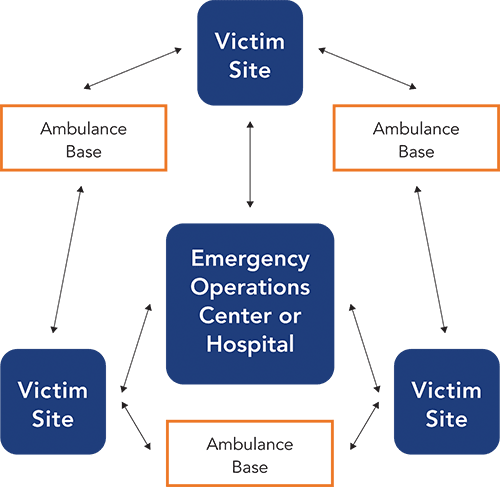
Navigating Through e-Health Services App Version 15.01
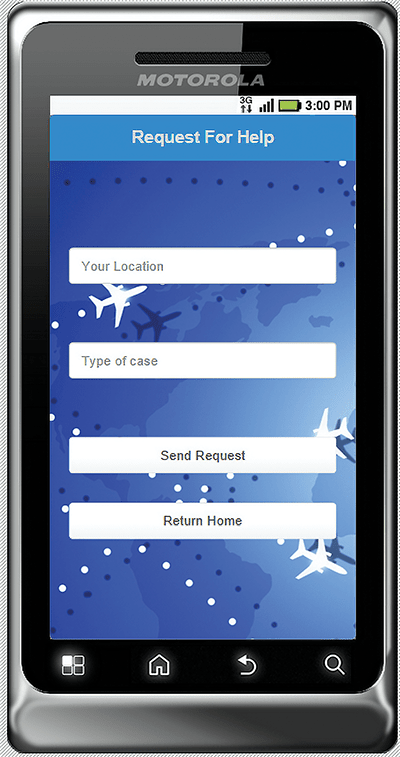
Figure 3: e-Health Services app Version 15.01 showing victim's
supporting feature.
The result of the team’s project was an EMS graphic display system capable of operating on all Android-based
apps and devices. Using simulation analysis proposed by Marinho et al. [10], the proposed method was tested on the graphical road network that contains road networks and locations of emergency ambulances and/or physicians within residential locations.
Furthermore, navigating through the developed e-Health Services App Version 15.01, the system contains two main features that can help both emergency operations centers and any victim prepare for or respond to an emergency outbreak through finding the shortest route, requesting a physician or ambulance during vehicle operations, or seeking guidance in general (Figure 1). In case of an emergency outbreak or a disaster strike, the first feature allows the victim to request help using their phone. The app allows the user to send a request by stating the location where an incident has happened, as well as note the state (e.g., injury) of the victim (Figure 3). If the request requires help of a physician, the system provides contact information for the closest physician.
Additionally, a quick response can also be sought from the closest ambulance (see Figure 4). A victim inputs the current location and intended destination, and the app returns results of the closest located ambulance and how long it would take to arrive. The second feature of the EMS app aims at assisting ambulance drivers and disaster rescue teams by estimating the shortest route for rapid response to victim locations.
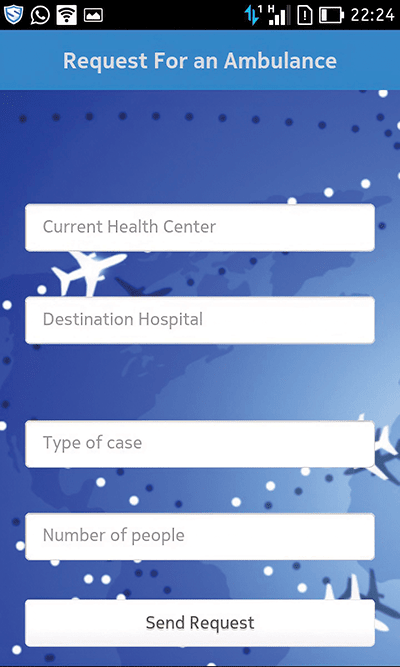
Figure 4: Requesting an ambulance.
Conclusions and Further Work
The FRG team used O.R. methods to develop a system prototype that when implemented at a large scale can help EMS and DoDMA respond to disaster impacts in Malawi. Our major contribution lies in the attempt to operate this emergency response system through mobile phones and any Android-based device, which the majority of people in Malawi can access. Despite high internet data tariffs presenting another setback, our proposed model provides an opportunity to communicate to the masses in case of preparedness for, and response to, natural disasters.
The system satisfies the basic requirements of an emergency system [6] and is replicable in other areas within sub-Saharan Africa. This article sets the groundwork for implementing these ideas at a large scale and for further research seeking optimal solutions to rapid response problems in Malawi.
Even though our proposed methods seek to provide practical examples and useful guidance for planning of disaster risk management programs for sustainable livelihoods, obstacles exist. We predict that the problem of lack of clean and updated routing data in Malawi presents a major setback. Additionally, road hindrances due to collapsing of buildings, and washing away of roads and bridges during disaster strikes would make some areas inaccessible. As such, government departments should consider providing fully accessible, clear and updated data of geographical locations [27-28]. In addition, road rehabilitation projects need to be extended to all disaster-prone rural areas with planted satellite towers that would be able to communicate real-time road status with GPS devices mounted in emergency vehicles.
References
- Likomwa, L., 2016, “Mutharika launches 2016 Climate Change Week, EBAFOSA,” NyasaTimes, June 7, https://www.nyasatimes.com/mutharika-launches-2016-climate-change-week-ebafosa/.
- Larsen, A., 2001, “The dynamic vehicle routing problem,” Doctoral dissertation, Department of Mathematical Modeling (IMM), Technical University of Denmark.
- Toth, P. & Vigo, D., 1996, “Fast local search algorithms for the handicapped person’s transportation problem,” I. Osman & J. Kelly, eds., Meta-heuristics: Theory and Applications, Canada: Kluwer Academic Publishers.
- Javidaneh, A., Ataei, M. & Ale Sheykh, A.A., 2010, “Ambulance routing with ant colony optimization,” Geospatial Information Systems Seminar, https://www.sid.ir/en/seminar/ViewPaper.aspx?id=1945.
- Nordin, N.A.M., 2010, “Real-time dispatching and routing of the EMS ambulances using the Dijkstra-based CTT Model: A case study of HTAR,” Master’s thesis, Universiti Teknologi Malaysia.
- Sung, I. & Lee, T., 2012, “Modeling requirements for an emergency medical service system design evaluator,” Proceedings of the 2012 Winter Simulation Conference, pp. 792-803.
- Ardekani, L.H., Haight, D., Ingolfsson, A., Salama, M. & Stanton, M., 2014, “Scheduling and routing ambulances that provide inter-facility patient transfers,” http://professor.business.ualberta.ca/armanningolfsson/Research/~/media/business/FacultyAndStaff/AOIS/ArmannIngolfsson/Documents/2014-08-28_IFT_paper.pdf.
- Kumar, R.V. & Benedict, P., 2011, “Development of route information system for ambulance services using GPS and GIS – A study on Thanjavur town,” International Journal of Geomatics and Geosciences, Vol. 2, No. 1, pp. 47-156.
- Umitsu, R. & Fushimi, F., 2006, “Shortest path problems for ambulances in case of severe earthquakes,” The Sixth International Symposium on Operations Research and Its Applications (ISORA’06), Xinjiang, China, http://www.aporc.org/LNOR/6/ISORA2006F23.pdf.
- Marinho, P., Silva, S. & Pinto, L.R., 2010, “Emergency medical systems analysis by simulation and optimization,” Proceedings of the 2010 Winter Simulation Conference, http://www.informs-sim.org/wsc10papers/222.pdf.
- Créput, J-C., Hajjam, A., Koukam, A. & Kuhn, O., 2011, “Dynamic vehicle routing problem for medical emergency management,” Mwasiagi, J.I., ed., Self Organizing Maps: Applications and Novel Algorithm Design, London: IntechOpen.
- Jlassi, J., Euchi, J. & Chabchoub, H., 2012, “Dial-a-ride and emergency transportation problems in ambulance services,” Computer Science and Engineering, Vol. 2, No. 3, pp. 17-23.
- Ni, Z., Wu, B., Samples, C. & Shaw, R.J., 2014, “Mobile technology for health care in rural China,” International Journal of Nursing Science, Vol. 1, No. 3, pp. 323-324.
- Chatora, G., 2007, “An analysis of the contingency planning systems for disaster management authorities in Southern Africa,” Master’s thesis, University of Free State, http://natagri.ufs.ac.za/dl/userfiles/Documents/00002/2249_eng.pdf.
- United Nations, 2015, “UN Country Team in Malawi: 100 Days of Response to Malawi Floods,” April 28, http://reliefweb.int/report/malawi/100-days-response-malawi-floods.
- DoDMA, 2015, “Malawi: Floods DoDMA-UNRCO Situation Report No. 11,” March 2, https://www.humanitarianresponse.info/en/operations/malawi/document/malawi-floods-dodma-unrco-situation-report-no-11-02-march-2015.
- OCHA, 2015, “Mozambique, Malawi, Zimbabwe & Tanzania: Cholera Situation,” April 28, http://reliefweb.int/sites/reliefweb.int/files/resources/ocha_rosa_cholera_map_29april2015.pdf.
- NDRMP, 2015, “National Disaster Risk Management Policy Report,” https://www.ifrc.org/docs/IDRL/43755_malawidrmpolicy2015.pdf.
- GFDRR, 2015, “Global Facility for Disaster Reduction and Recovery Report-Country Profile: Malawi,” www.gfdrr.org.
- The World Bank, 2009, “Disaster Risk Management Programs for Priority Countries: Global Facility for Disaster Reduction and Recovery,” http://www.unisdr.org/files/14757_6thCGCountryProgramSummaries1.pdf.
- Pathomsiri, S. & Sukaboon, P., 2013, “Determination of a fair price for blood transportation by applying the vehicle routing problem: A case for National Blood Center, Thailand,” World Academy of Science, Engineering and Technology, Vol. 7, No. 2, pp. 523-528.
- Parragh, S.N., Doerner, K.F. & Hartl, R.F., 2006, “A survey on pickup and delivery models, Part II: Transportation between pickup and delivery locations,” http://prolog.univie.ac.at/research/surveyPDP/PDPsurvey_Part2.pdf.
- Faulin, J., Sarobe, J. & Simal, P., 2005, “The DSS LOGDIS optimizes delivery routes for FRILAC’s frozen products,” Interfaces, Vol. 35, No. 3, pp. 202-214.
- Cordeau, J-F. & Laporte, G., 2003, “The Dial-a-Ride Problem (DARP): Variants, modeling issues and algorithms,” 4OR, Vol. 1, pp. 89-101, https://doi.org/10.1007/s10288-002-0009-8.
- Panahi, S. & Delavar, M.R., 2009, “Dynamic shortest path in ambulance routing based on GIS,” International Journal of Geoinformatics, Vol. 5, No. 1, pp. 13-19.
- Kergosien, Y., Lenté, C., Piton, D. & Billaut, J.C., 2010, “A tabu search heuristic for a dynamic transportation problem of patients between care units,” https://hal.archivesouvertes.fr/file/index/docid/488270/filename/Transp_Patients.pdf.
- Wang, R.Y. & Strong, D.M., 1996, “Beyond accuracy: What data quality means to data consumers,” Journal of Management Information Systems, Vol. 12, No. 4, pp. 5-33.
- Janssen, M., Charalabidis, Y. & Zuiderwijk, A., 2012, “Benefits, adoption barriers and myths of open data and open government,” Information Systems Management, Vol. 29, No. 4, pp. 258-268.
Elias Mwakilama is a lecturer at University of Malawi-Chancellor College, Mathematical Sciences Department. He is a PAU Scholar, pursuing a Ph.D. in computational mathematics at PAUSTI, Jomo Kenyatta University of Agriculture & Technology, Nairobi, Kenya. His research interests include mathematics and statistics. He is a co-founder of the Fibonacci Research Group (FRG). Frank Mtumbuka is a Rhodes Scholar and Oxford-Linacre African Graduate Scholar pursuing a D.Phil. in computer science at the University of Oxford. He is part of the Fibonacci Research Group (FRG). His primary research interests include deep learning, knowledge graphs, (open) information extraction and healthcare. Eric Samikwa is a Ph.D. student in machine learning at University of Bern, Switzerland and CEO and co-founder of NetSoft Malawi. He is part of the e-Communications Research Group (eCRG) of Chancellor College. His research interests include the Internet of Things (IoT), machine learning and edge computing.
([email protected])

([email protected])

([email protected])